 by Tom Gurney
Tom Gurney BSc (Hons) is an art history expert with over 20 years experience
Published on June 19, 2020 / Updated on October 14, 2026
Email: tomgurney1@gmail.com / Phone: +44 7429 011000
A face without a name
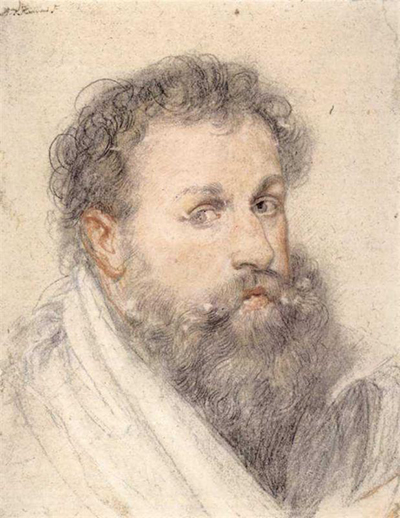
The man turns toward the viewer but does not quite confront us head-on. His hair is thick and irregular, his beard spreads across the lower half of the face, and his eyes catch us from a head held at an angle. Light strokes define the garments beneath. The image gives a convincing sense of a particular person without providing the clues that would tell us who he was. No title of office, coat of arms or securely recorded sitter name accompanies this sheet.
The ALBERTINA[1] in Vienna catalogues it as Peter Paul Rubens’s Portrait of a Bearded Man, a drawing measuring 31.8 × 24.7 centimetres, inventory 8265. The page address uses the broader wording “Portrait of a Man”; the museum’s more descriptive title identifies the object precisely. This object is a coloured-chalk study on paper; it is not the small 1597 oil-on-copper Portrait of a Man in the Metropolitan Museum of Art, which is a separate object.
The distinction is visible even before reading a catalogue. The ALBERTINA figure has a full beard and softly drawn clothing. The Met sitter holds a watch and measuring instruments and wears a crisp white ruff. Their physical supports, dimensions, apparent ages and collections differ. A generic title can hide such differences; an inventory number and medium make the subject of this page precise.
The viewer meets the Vienna sitter at unusually close range. The sheet reaches little below his shoulders, so there is no room for the architecture, tools or heraldry that might make a formal portrait easier to decode. The head is turned, yet the eyes look back across that turn. The beard is weighty while the outline of the clothing seems almost temporary. One should not infer from that contrast that the sitter was an ordinary model rather than a person of status: the drawing gives different kinds of attention to different parts of one figure, and the surviving record has lost the circumstances in which it was made.
At a Glance
- ArtistPeter Paul Rubens [1]
- SitterUnidentified [1]
- DateUndated; older c. 1604/05 proposal [1]
- MediumBlack, red, yellow and white chalk on paper [1]
- Dimensions31.8 × 24.7 cm [1]
- CollectionALBERTINA, Vienna, 8265 [1]
Contents
- What materials did Rubens use?
- Is the inscription Rubens’s signature?
- Why have scholars proposed different dates?
- What can a portrait drawing establish?
What materials did Rubens use?
The ALBERTINA’s technical field[1] lists black chalk, red chalk, smudged yellow chalk and white chalk heightening on brownish paper. Those details explain the portrait’s restrained colour. Warmth in the face does not require a fully painted surface. Rubens could build the hair and beard with dark chalk, bring flesh forward with red and yellow, and pick out light with white. The toned paper sits between those extremes, doing some of the visual work that blank white paper would not.
In the reproduction here, the strongest attention falls on the eyes, nose, cheeks and beard. The garment is indicated broadly rather than resolved thread by thread. This unequal finish makes a hierarchy: the face contains the encounter with the sitter; the clothing gives enough body to hold it. It may also reflect the practical purpose of a drawing, which can record a head without completing every peripheral feature. The public record does not say that this sheet prepared a particular finished portrait, so such a destination should not be invented.
The chalk marks have a softness different from oil paint. Lines around the hair and beard overlap; white heightening lifts parts of the face and collar from the brown paper. Smudged yellow chalk gives intermediate tone rather than a hard boundary. These choices allow the man’s features to emerge gradually. The image is not a monochrome outline waiting to be coloured in: the material already gives the face its volume and temperature.
There is a small but instructive difference between descriptions of those materials. The current ALBERTINA record names four kinds or uses of chalk and brownish paper. In the 1977 Corpus Rubenianum catalogue, Frances Huemer[2] describes black and red chalk with white heightening, and says that the face is partly worked in watercolour. She gives the sheet as 319 × 247 millimetres, effectively the same size as the museum’s 31.8 × 24.7 centimetres once older measurement and rounding are allowed for. The colour in a photographic reproduction cannot by itself decide whether a passage was laid down wet or rubbed in dry. Huemer’s observation is valuable as a documented scholarly reading; it should not quietly replace the museum’s current technical field or be treated as a new conservation finding.
This matters because a drawing can be more technically elaborate than its label suggests. The dense dark beard does not simply surround a blank face. Small changes of warmth and light help locate cheekbone, eyelid, nose and ear, while the very pale garment leaves a broad space between the sitter’s body and the paper’s edge. If Huemer’s identification of watercolour in the face is right, some of this effect crosses the usual boundary between chalk drawing and wash. If the colour is entirely chalk, the apparent fluidity still tells us something about Rubens’s handling of dry media. Either way, the sheet deserves to be read as a worked portrait, not as a mere outline for a future oil painting.
Care is needed in reading expression. The man’s turned head and eyes may suggest awareness of someone to one side, but no record preserves his thoughts or the circumstances of the sitting. “Thoughtful,” “suspicious” or “commanding” would be interpretations of a momentary look, not biographical facts. Rubens’s achievement is that the portrait invites such reactions while withholding the identity that could anchor them in a known life.
Is the inscription Rubens’s signature?
At the upper left, the sheet bears the words “P.P. Rubens f.” The ALBERTINA catalogues this inscription as by another hand. It is therefore evidence that a later person identified the drawing with Rubens; it is not an autograph signature that can independently certify his authorship. The museum itself attributes the drawing to Rubens, but that curatorial attribution and the later inscription are different pieces of evidence.
The collection also records a mark of Duke Albert of Saxe-Teschen at the lower left and lists him under provenance. Such a stamp helps trace the sheet’s later collection history. It does not tell us who ordered the portrait, where Rubens made it, or whether the duke knew the sitter’s name. A drawing can pass into a great graphic collection with its author recognised and its sitter forgotten.
The museum’s current object record provides no date in its structured fields. Its catalogue-raisonné list cites a 1928 Glück and Haberditzl entry that assigned the drawing approximately 1604/05. That older proposal is worth reporting as part of the scholarship, but it should not be silently promoted to the ALBERTINA’s current date. A caption reading simply “1604” would claim greater precision than the record supports.
Why have scholars proposed different dates?
Huemer’s catalogue entry, no. 51, makes the disagreement visible. It reports that Gustav Glück placed the drawing around 1604–05, comparing it with Rubens’s Mantuan altar. Justus Müller Hofstede preferred 1601–02. Huemer argued for 1603 by comparing the Vienna head with a head in drawings connected to the Duke of Lerma portrait. These dates cluster in Rubens’s Italian period, but a cluster of scholarly proposals is not a dated document. None supplies a year written by Rubens on the sheet.
The comparison with Lerma needs careful handling. The Prado’s equestrian portrait of the duke[3] is signed and dated 1603; its sitter, grand scale, armour and horse are firmly identified. Huemer did not argue that the bearded man in Vienna was the duke. She compared his glance with the head of a groom in the preparatory drawings and said the two might possibly show the same man. A likeness between drawn faces is the basis of her dating suggestion, not proof of the Vienna sitter’s name, job or a direct commission for the Prado painting.
The Louvre holds a drawing for the Lerma portrait[4], and the related drawing discussed by Huemer was then associated with Weimar. Those sheets give a comparative setting for a specialist’s argument. They do not make the ALBERTINA sheet a recognised part of the Lerma commission in the museum’s present record. The sequence also matters: if a date is inferred because two faces seem alike, using that inferred date to assert they depict the same person would circle back to the original unproven resemblance.
Müller Hofstede offered a different reading of the anonymous sitter: a dignitary in official robes who might be holding a beret. The museum’s current title remains the neutral Portrait of a Bearded Man. What appears as a broad pale garment in the reproduction can invite a reading of status, but without a name, insignia or identified office that suggestion remains an interpretation. The date debate therefore opens questions about Rubens’s early career and portrait conventions while leaving the individual at the centre of the sheet unidentified.
There is a further safeguard in Huemer’s printed sequence. Her preceding entry, no. 50, discusses a different bearded-man drawing and a proposed identification with Jan Woverius. That name does not belong to the ALBERTINA’s inventory 8265, entry no. 51. Similar titles and adjacent catalogue entries can easily produce a mistaken sitter attribution when the inventory number is dropped. The present page retains the Vienna number precisely so that the two works and their hypotheses stay separate.
What can a portrait drawing establish?
This sheet establishes an encounter in Rubens’s portrait practice at the scale of a head and shoulders. The sitter’s beard, hair, face and broad garment were important enough for sustained chalk work. The lack of a securely named person or documented commission limits what can be said about the social purpose of the likeness. It may have been a study made for a later work, a drawing kept for its own sake, or a portrait whose original context is lost. The available object record does not choose among those possibilities.
The distinction between a portrait and a head study is difficult here because both can begin with close observation of a living face. An individual expression and unevenly finished clothing might support either purpose. Nor does the fact that Huemer compared the face with a groom settle the issue: an artist might draw one person on several occasions, reuse a model for a narrative figure, or make a comparison that later viewers find persuasive without any original connection between the sheets. We can say that the Vienna drawing preserves a sustained examination of a face. We cannot reconstruct from that alone whether its first viewer expected a finished likeness, a reusable model or a private record.
That restraint is part of reading the drawing well. One can describe how dark and light chalk shape the face, why the brown ground matters and how the head turns, without attaching a plausible but unverified name. Rubens drew known courtiers, family members and models at different points in his career; resemblance to another bearded figure would need specific comparative evidence before it became a sitter identification.
The Metropolitan Museum’s 1597 Portrait of a Man, Possibly an Architect or Geographer[5] illustrates the danger of relying on a route title alone. Its wearer of a ruff has instruments that invite a qualified occupational reading. None of those objects appears in the ALBERTINA chalk portrait. The Met’s date, copper support and professional clues belong to its painting, while the Vienna drawing’s sitter remains unnamed. Both can be called “portrait of a man” in ordinary speech; catalogue identity prevents the articles from becoming mixed.
Rubens artworks directory
Frequently Asked Questions
The ALBERTINA does not name the sitter in its current record. The drawing should be presented as an unidentified man.
The museum’s structured entry gives no date. Older scholars have proposed 1601–02, 1603 and around 1604–05, using different comparisons. None is a settled current museum date.
Black, red, smudged yellow and white chalk on brownish paper. It measures 31.8 × 24.7 centimetres.
The words “P.P. Rubens f.” are on the sheet, but the museum identifies them as the work of another hand.
No. The Met owns a separate 1597 oil painting on copper. This page concerns the ALBERTINA’s chalk drawing, inventory 8265.
Discussion
Look closely at the chalk marks that bring the face forward from brown paper.
Share an observation about the drawing or a reliable source that adds to its history.
Reader Insights
How does Rubens give the face more attention than the clothing?
What can the later inscription establish, and what can it not?
Why does the lack of a current catalogue date matter?
Join the Conversation
Add your reading below, keeping observations specific and evidence clear.
References
- ALBERTINA, Rubens, Portrait of a Bearded Man , inventory 8265. View source
- Frances Huemer, Portraits Painted in Foreign Countries , Corpus Rubenianum Ludwig Burchard XIX.1 (1977), catalogue no. 51, pp. 183–84; digitised by the City of Antwerp. View source
- Museo del Prado, Rubens, Equestrian Portrait of the Duke of Lerma , 1603. View source
- Louvre, drawing for the Duke of Lerma portrait, INV 20185. View source
- Metropolitan Museum of Art, the separate Portrait of a Man, Possibly an Architect or Geographer , 1597. View source