by Tom Gurney
Tom Gurney BSc (Hons) is an art history expert with over 20 years experience
Published on June 19, 2020 / Updated on October 14, 2026
Email: tomgurney1@gmail.com / Phone: +44 7429 011000
An arrival rather than a struggle
An enormous eagle carries a young man through clouds. Its wings open across much of Peter Paul Rubens's Ganymede, while the youth turns upward toward two women who approach from the right. One offers him a cup. At the upper left, smaller figures sit together at a distant feast. The picture joins two moments of a myth: Ganymede's journey on the eagle and his reception among the gods. Although this page's established address says “abduction,” the painted action is calmer than a scene of capture. Ganymede appears to be arriving.
The painting reproduced here is the large, nearly square canvas catalogued by LIECHTENSTEIN. The Princely Collections[1] as Sir Peter Paul Rubens, Ganymede, 1611–12, oil on canvas, 207 × 207 centimetres, inventory 10. Its owner is the Princely Schwarzenberg Art Foundation, which lends it to the Liechtenstein collections. The present collection record places it in the Garden Palace in Vienna. Those details identify this particular work. Rubens made another, later Ganymede for a Spanish royal hunting lodge; the shared subject does not make the two paintings interchangeable.
At a Glance
- ArtistPeter Paul Rubens [1]
- Date1611–12 [1]
- MediumOil on canvas [1]
- Dimensions207 × 207 cm [1]
- CollectionSchwarzenberg Art Foundation; permanent loan to LIECHTENSTEIN [1]
Where this work sits in Rubens's career
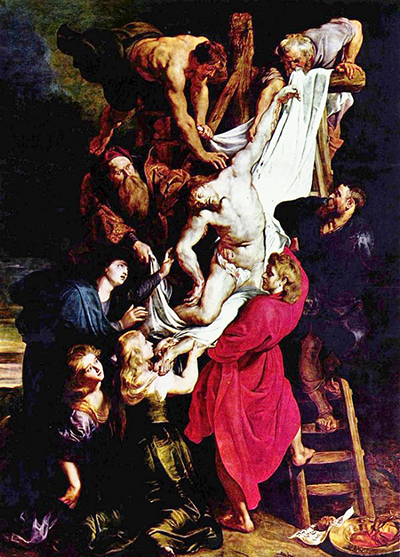
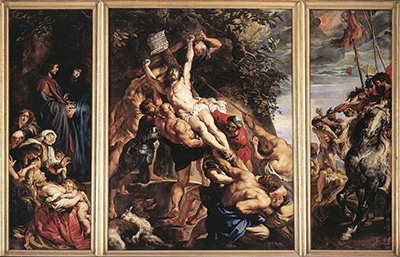
The Elevation of the Cross
1609–10Ganymede
1611–12The Descent from the Cross
1611–14The Garden of Love
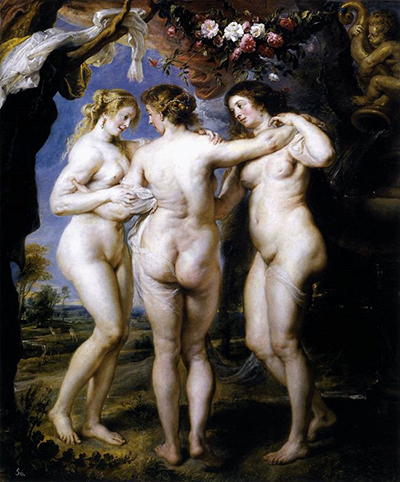
1630–35The Three Graces
1630–35Contents
- What happened to Ganymede?
- How Rubens holds the scene together
- A related version in Bordeaux
- A related Jupiter painting
- Do not confuse it with the Prado Ganymede
- Where has the Vienna painting been?
What happened to Ganymede?
In the ancient story, Ganymede is a beautiful Trojan youth brought to Olympus to serve wine or nectar to the gods. Homer's Iliad (20.231–35)[8] says the gods took him because of his beauty and made him Zeus's cupbearer. Ovid's Metamorphoses (10.155–61)[9] gives Jupiter—the Roman name for Zeus—a more active part: inflamed by love, he takes an eagle's form to carry the youth away. The two texts share the move to Olympus and the cupbearer's role but differ in how they tell the taking. Neither ancient passage describes every detail Rubens added to this painted reception.
The eagle identifies Jupiter's presence even though the god does not appear here as a human figure. The two women and the cup make the end of the journey visible. In its discussion of a related version in Bordeaux, the Musée des Beaux-Arts de Bordeaux[2] names Hebe and Iris as the welcoming figures and points to the distant banquet as a sign of Ganymede's coming work. That museum regards its own canvas as probably painted in Rubens's Antwerp workshop and as one version of the design preserved in Vienna. Its iconographic reading helps explain the scene, but its Bordeaux painting remains a separate object with its own maker assessment, dimensions and inventory number.
The painting can be read without assuming that abduction and welcome mean the same thing. In Ovid, Jupiter's desire and transformation begin the story. Rubens lets us see the result: Ganymede is lifted from the mortal world into a gathering above the clouds. The offering of a cup points forward to his new task. The viewer looks up with him, toward those who receive him, rather than down to a landscape from which he has just been seized. The violence implied by the inherited English title is therefore less visible than the youth's elevation.
Ovid also makes clear that Juno objects to Ganymede's new position at Jupiter's side. That tension does not appear as an argument between gods in the Vienna painting. Instead, the welcoming figures and the small distant banquet occupy the upper reaches of the composition. Rubens makes the destination of the flight available to the viewer at the same time as the journey. The ancient text helps identify why a cup matters, while the painting chooses its own way of joining departure and arrival.
How Rubens holds the scene together
The broad wings give the square painting its architecture. One reaches behind Ganymede and the other projects toward the welcoming women. The bird's dark feathers separate the youth's pale body from the clouded sky. Its head rises at his chest, while its talons and the cloud bank anchor the lower part of the composition. The eye can follow a path from the bird's wings through Ganymede's raised arm to the cup. The distant feast then completes the story without competing with the main figures for scale.
Ganymede is shown large enough to act, rather than as a tiny figure helplessly held in an animal's claws. His turning torso and extended hand connect him to the figures at the right; the eagle's body supplies the contrary weight. That balance gives Rubens a difficult visual problem: an airborne figure must feel suspended, but the many overlapping wings, arms and clouds must remain legible. He solves it by setting light flesh against dark plumage and by giving the central human figure a clear upward movement.
The eagle deserves attention as more than an emblem attached to Jupiter. In Anne T. Woollett's Getty study of Rubens and his collaborators[4], this Ganymede is an example of Rubens's own accomplished treatment of an eagle. Woollett describes its refined handling as suited to the elevated mythological subject. That is useful when reading the bird's detailed feathers and commanding wingspan. It also guards against automatically crediting every animal in a Rubens painting to the specialist Frans Snyders: a documented collaboration on another canvas does not assign the eagle here to him.
The Bordeaux museum's discussion of its related canvas[2] calls Ganymede's body a reworking of an antique sculptural model. That is the museum's interpretation of a classical-looking form, rather than proof that the Vienna picture copied one named statue. In the Schwarzenberg painting, the youth's body occupies a substantial part of the square surface; the wings and clouds support its upward turn. This explains why the scene can feel ceremonial even though an eagle is carrying a human being through the air. Ancient story and Rubens's choice of physical form work together, but they are different kinds of evidence.
A related version in Bordeaux
The Musée des Beaux-Arts de Bordeaux keeps a canvas of the same design, inventory Bx E 138, measuring 204 × 206 centimetres. That is close in format to the Vienna work but is not the same picture. Bordeaux's current public account says its version was very probably painted in Rubens's Antwerp workshop and had belonged to the collection of Maximilian I of Bavaria. Its own recorded acquisition by the city of Bordeaux was in 1829. These details belong to the French canvas, not to the Schwarzenberg painting's provenance.
The French Ministry of Culture's Joconde record[6] shows why a single shorthand attribution would be misleading. Its current maker field labels the Bordeaux painting after Rubens and after Frans Snyders. The historical note describes older assignments to Abraham van Diepenbeeck, sometimes with Snyders for the eagle, and records scholars who treated it as an unnamed replica or argued for more direct Rubens involvement. The record also says extensive overpainting and the canvas's condition have complicated judgments about its original surface. This is an attribution history for the Bordeaux version; none of it overturns the Liechtenstein collection's direct Rubens attribution of the Vienna canvas.
That history sharpens the question of the eagle. The Joconde account reports Michael Jaffé's rejection of a Snyders attribution for the Vienna bird, while Woollett independently uses that bird as an example of Rubens's own animal painting. Other specialists' proposed roles in the Bordeaux replica cannot simply be projected backward onto the prime Schwarzenberg work. A familiar design could circulate through workshop production and copies, accumulating different maker labels while the composition remained recognisable.
A related Jupiter painting
The Princeton University Art Museum[3] compares the Schwarzenberg Ganymede with Rubens and studio's Cupid Supplicating Jupiter. Both compositions give a large eagle a prominent place. Princeton argues that the two pictures were probably square and close in size originally, although the Cupid canvas has been cut down. It also reports that scholars usually place them close together in Rubens's career on stylistic grounds. The Liechtenstein collection's 1611–12 date is followed for Ganymede here; the proposed relationship does not establish that the two were commissioned as pendants or made for a named patron.
The comparison helps explain a choice in the Vienna design. The eagle's spread wings are almost heraldic in their breadth, but they carry a body through space rather than sitting as a static badge. In Cupid Supplicating Jupiter, the bird belongs beside the ruler of the gods; in Ganymede, it transports the person Jupiter desires. Princeton suggests that the birds' prominence might eventually help identify the pictures' patron. “Might” is important: shared size and iconography are clues to investigate, not a surviving contract.
Princeton draws a second interpretive connection between the two subjects. In Cupid Supplicating Jupiter, Cupid asks Jupiter to permit marriage to Psyche; in Ganymede, Jupiter's desire for the mortal youth drives the event. Princeton reads the pair as images in which even the king of the gods is touched by love's power. That is a proposed thematic relationship, not evidence that one picture was physically displayed beside the other. The comparison matters because it directs attention to Jupiter's role in the Vienna canvas, even though he appears there only in the eagle's form.
Do not confuse it with the Prado Ganymede
The Museo del Prado[5] holds a different Rubens painting, The Rape of Ganymede, dated 1636–38. Its tall format was designed for the Torre de la Parada, a Spanish royal hunting lodge, and the Prado describes the eagle carrying Ganymede off. The Vienna picture was made more than two decades earlier, is square, and shows a reception above the clouds. The Prado's commission, measurements and picture should not be transferred to the Schwarzenberg canvas merely because both subjects include an eagle and Ganymede.
The comparison also clarifies the route name. “The Abduction of Ganymede” is a familiar English name for the myth and the established address of this page. The Liechtenstein collection calls its object simply Ganymede. The page keeps the approved route but gives the holding institution's title and the actual painted episode in the heading and text. Readers looking for the later dramatic abduction can then tell which version they have found.
There is also a later Rubens oil sketch at the Princeton University Art Museum[7], dated about 1636. Princeton links that panel to the eventual Prado picture for Philip IV's Torre de la Parada. Its curator describes a white ground, brown preparatory layer and rapidly handled eagle, and notes that the panel is made from four planks; whether the side planks formed part of Rubens's first design remains uncertain. Those material facts describe Princeton's panel, not the earlier canvas shown on this page.
Princeton compares its sketch with the Prado canvas and finds changes to the boy's expression and body, the eagle's beak and the added quiver. The museum relates the quiver to the ancient account of Ganymede's hunting, and notes a thunderbolt in the later finished sky. This design sequence is a good example of why “a Rubens Ganymede” is not enough of an identification. The 1611–12 Schwarzenberg picture presents an Olympian reception; the Princeton study and Prado canvas belong to a much later royal project that makes the carrying away more dramatic.
Where has the Vienna painting been?
The Liechtenstein collection's provenance record[1] begins with a presumed, not documented, connection to Archdukes Albert and Isabella. It places the painting with Cardinal-Infante Ferdinand in 1641, records an offer by dealer Matthijs Musson to Amalia van Solms on 26 October 1645, and says Johann Adolf zu Schwarzenberg bought it before 1655. None of those entries names Rubens's original commissioner. A proposed archducal link is worth noting, but it cannot be made into a certain commission for the couple.
The same record documents a break in the painting's later history. It says the work was confiscated in 1941 during the Nazi expropriation of Adolph Prince zu Schwarzenberg for Hitler's planned gallery in Linz. An anonymous loan to the Kunsthaus Zürich followed in the 1950s, presumably after restitution to the Schwarzenberg family, in the collection's wording. The catalogue does not give a precise restitution date or a full legal account; the qualification should remain attached to that step. Since 2005 the painting has been on permanent loan to the Liechtenstein collections. The painting's owner and its place of display are therefore different facts.
The dated 1645 offer is particularly useful evidence, but it is not the same as a completed sale to Amalia van Solms. Likewise, the catalogue's “before 1655” gives an outer limit for Johann Adolf zu Schwarzenberg's purchase rather than a transaction day. Reading those entries precisely keeps a defensible chain of known points without pretending that every transfer is recorded. It also leaves the original patron open: a presumed archducal connection is not a commission document signed in the 1610s.
Rubens artworks directory
Frequently Asked Questions
The Princely Schwarzenberg Art Foundation owns it and lends it to the Liechtenstein Princely Collections. The collection record currently places it at the Garden Palace in Vienna.
The Liechtenstein collection dates it 1611–12. It is an oil painting on canvas measuring 207 × 207 centimetres.
No. The Prado painting is a later, vertically shaped work made for the Torre de la Parada in 1636–38. This page shows the earlier square Schwarzenberg canvas.
The eagle represents Jupiter's action in carrying Ganymede to Olympus. Ovid says Jupiter took an eagle's form for the journey; the painted bird is the means by which Rubens brings the myth into view.
The Bordeaux museum's discussion of a related version identifies the welcoming goddesses as Hebe and Iris. The cup anticipates Ganymede's role serving the gods.
Discussion
Look closely at Ganymede, the eagle, the offered cup and the distant feast.
Share an observation about the painting or a reliable source that adds to its history.
Reader Insights
How does Rubens turn a story of abduction into an image of arrival?
What do the bird's wings do for the square composition?
How is this scene different from Rubens's later Prado Ganymede?
Join the Conversation
Add your reading below, keeping observations specific and evidence clear.
References
- LIECHTENSTEIN. The Princely Collections, Ganymede , inv. 10: object, ownership, display and provenance. View source
- Musée des Beaux-Arts de Bordeaux, related workshop version and interpretation of Hebe, Iris and the banquet. View source
- Princeton University Art Museum, Cupid Supplicating Jupiter and the comparison with Schwarzenberg Ganymede. View source
- Anne T. Woollett, in Getty's Rubens and Brueghel: A Working Friendship , on Rubens's eagle in Ganymede. View source
- Museo Nacional del Prado, the separate later Rape of Ganymede. View source
- French Ministry of Culture, Joconde record for the separate Bordeaux replica, Bx E 138. View source
- Princeton University Art Museum, the separate circa-1636 oil sketch for the Prado commission. View source
- Homer, Iliad 20, on Ganymede as the gods' cupbearer, Perseus Digital Library. View source
- Ovid, Metamorphoses 10, on Jupiter and Ganymede, Perseus Digital Library. View source