by Tom Gurney
Tom Gurney BSc (Hons) is an art history expert with over 20 years experience
Published on June 19, 2020 / Updated on October 14, 2026
Email: tomgurney1@gmail.com / Phone: +44 7429 011000
A traveller recorded in chalk and ink
A slender man stands nearly the full height of a tall sheet. His cap rises above a long face and narrow beard; a broad robe gathers at the waist and falls in layered folds toward the lower edge. He looks to one side rather than meeting the viewer. At the upper right, faint writing shares the paper with the figure. Peter Paul Rubens drew Nicolas Trigault, a Jesuit missionary who had travelled from China to Europe, during his visit to the Low Countries in 1617. The drawing is a portrait of a known person and a close study of clothing that crossed several cultural boundaries.
The Metropolitan Museum of Art[1] catalogues it as Portrait of Nicolas Trigault in Chinese Costume, inventory 1999.222. It lists black, red and white chalk, blue pastel, and pen with brown and black ink on light brown laid paper, 44.6 × 24.8 centimetres. This is a worked drawing, not an oil portrait. The museum title names both the sitter and the distinctive clothing that Rubens studied.
Rubens gives the robes more than the shorthand needed to identify a wearer. Dark strokes build the weight of sleeve and skirt, pale touches bring out edges and creases, and the sash interrupts a long vertical fall. The relatively sparse background leaves little setting to compete with the man’s outline. That concentration lets a viewer compare the fine attention to Trigault’s face with the almost architectural volume of the garments. It also warns against imagining a specific room or ceremony behind him: the sheet does not document one.
The unusually narrow sheet makes the standing figure seem taller than the paper actually is. Rubens leaves breathing room around the cap and hem but gives most of the width to the billowing sleeves. This creates a difference between the vulnerable, turned face and the substantial costume. The posture is calm: hands disappear into the sleeves, while the eyes appear alert. A reader can describe that tension without claiming to know how Trigault felt about his European tour. The drawing preserves what Rubens could observe and chose to emphasise, not a transcript of the sitter's inner life.
At a Glance
- ArtistPeter Paul Rubens [1]
- SitterNicolas Trigault [1][2]
- Date1617; 17 January inscribed without year [1][2]
- MediumChalk, blue pastel and ink on paper [1]
- Dimensions44.6 × 24.8 cm [1]
- CollectionThe Metropolitan Museum of Art, 1999.222 [1]
Where this work sits in Rubens's career
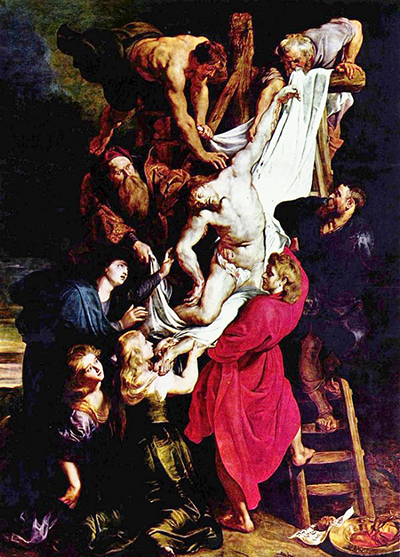
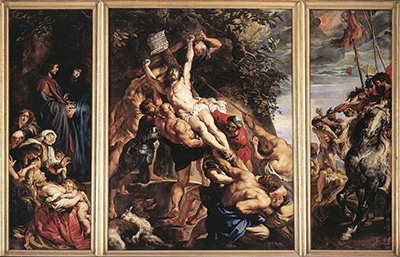
The Elevation of the Cross
1609–10The Descent from the Cross
1611–14Nicolas Trigault
1617The Garden of Love
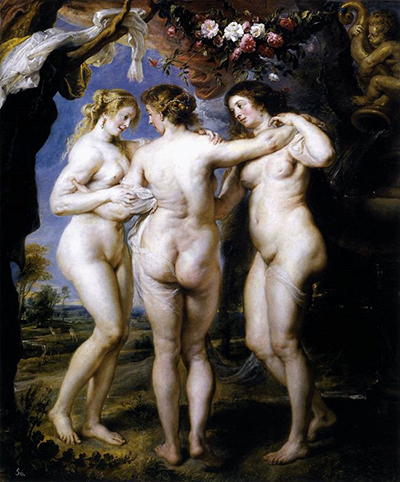
1630–35The Three Graces
1630–35Contents
- Why was Trigault in Europe?
- A Chinese robe and a Korean cap
- What do Rubens’s notes on the sheet say?
- How secure is the sitter’s identity?
- Costume study and individual portrait
Why was Trigault in Europe?
Trigault was a Flemish Jesuit from Douai who travelled to China as a missionary. Anne-Marie Logan and Liam Brockey’s study in the Metropolitan Museum Journal[2] explains that he left Europe for China in 1610, returned west in 1614, and travelled through European cities to raise funds and recruit people for the China mission. Letters place him in the southern Netherlands from late 1616 into early 1617. The drawing belongs to this visit, when his appearance, news and requests attracted attention from people already connected with the Jesuits.
Trigault had a role in carrying accounts of China to European readers. Brockey describes his 1615 Latin publication, based on Matteo Ricci’s papers, and the books and objects he brought on his journey to support the mission. These activities explain why a portrait of him could matter beyond a private likeness: he was a public advocate for an enterprise that needed money, colleagues and intellectual credibility. They do not show that Rubens’s particular sheet was printed as an advertisement or used at a recruiting event. The drawing’s original intended destination is not documented by the museum.
Rubens had reasons to know the Jesuit world independently of this meeting. Logan notes his work in 1616 on portraits of Ignatius of Loyola and Francis Xavier for the Jesuit college in Brussels, and negotiations around the same period for paintings in the Antwerp Jesuit church. Those commissions provide a credible setting for his interest in a visiting missionary. They cannot establish which Jesuit introduced Trigault, whether Rubens invited him to sit, or whether the drawing was ordered by the Society of Jesus. The known overlap is enough to place the encounter in a real network without inventing its conversation.
A Chinese robe and a Korean cap
The Met describes a Chinese scholar’s robe combined with a Korean cap. Calling the whole outfit simply “Chinese dress” would lose that distinction. The museum reads the combination as expressing a Jesuit attempt to adapt to Chinese cultural expectations while retaining a difference of its own. That is an interpretation of the clothing and its missionary context, not a claim that this mixed costume represented every scholar or every missionary in China.
Logan relates the robe to the dress promoted by the Italian Jesuit Matteo Ricci. In the late sixteenth century Ricci argued that the missionaries’ earlier, plainer clothing did not help them approach educated Chinese elites. Scholar-style garments could signal learning and social standing to the people whose support the mission sought. Trigault’s costume therefore has a purpose in the history of the mission, while Rubens attends to it as a painter would: the changing width of cloth, the turn of a sleeve, the line of a collar and the way a belt holds a heavy fabric in place.
The portrait invites a distinction between what the eye sees and what a catalogue can tell it. The cap’s upright shape, robe’s layered front and long hem are visible even in a small reproduction. Their cultural identifications come from the Met’s research, not from a viewer’s ability to read an entire dress tradition from that reproduction. The robe should not be treated as proof that Trigault had become a Chinese scholar. It records how a European missionary chose to present himself while pursuing work in China and Europe.
That distinction also helps with the word “costume” in the museum title. It names the clothing Rubens studied, but it need not imply a theatrical disguise. Logan's research connects the robe to a deliberate Jesuit practice of dressing for encounters with learned and powerful people. The headgear, however, is not part of one uniform Chinese ensemble. A modern viewer should avoid turning a single European missionary's assembled appearance into a representative portrait of China, Korea or the wider Jesuit mission. The portrait is most specific when it is read as Trigault's appearance at a particular moment in 1617.
What do Rubens’s notes on the sheet say?
The writing is unusually useful because it ties an artist’s observations to this physical drawing. Logan and Brockey transcribe a Latin note at the upper right in which Rubens distinguishes the dark colour used by Jesuit fathers from the blue facings shared with others and says yellow was reserved for the ruler. The precise terms reflect the information Rubens received and chose to record. They should not be promoted into a complete, authoritative account of seventeenth-century Chinese dress law. They do show that colour, not just silhouette, interested him even though much of the drawing now looks restrained in reproduction.
A second, faded inscription at the lower left includes a form of Trigault’s name, his membership in the Society of Jesus and the date 17 January. The year was not written there. Logan explains that the known itinerary makes 1617 the convincing year; the Met now dates the drawing accordingly. It is therefore accurate to call the object a 1617 work and to say the written day is 17 January, but inaccurate to claim that Rubens wrote “17 January 1617” in full on the sheet.
The day also narrows where the meeting might have happened without deciding it. Logan suggests Trigault may have been passing through Antwerp, or Rubens may have drawn him in Brussels, where a letter places the missionary at the start of that January. The sheet does not name a place. Choosing one city as fact would turn a reasonable reconstruction into a false certainty. What the inscription does give us is unusually close timing for a portrait drawing: a named figure, a day, and a year established from the surrounding documentary record.
The researchers also note a small profile study of the priest’s head at the upper left. This quick alternative to the full standing view reveals the page as a working surface. Rubens examined the man’s features and his dress in more than one way, using chalk for modelling and ink both to outline and to preserve words. The annotations make the portrait more specific than a generic study of an unfamiliar costume: they join a named person, an encounter date and details of a garment on one sheet.
How secure is the sitter’s identity?
For a time the subject and author were not read as clearly as they are now. Logan recounts that a nineteenth-century annotation attributed the drawing to Anthony van Dyck, and a mount described the figure with other, incorrect identities. The faded lower-left inscription was not fully deciphered until the drawing was prepared for sale in 1999. Its reading, especially the partial form of Trigault’s name, helped secure the identification alongside likeness and documentary chronology. These later labels belong to the drawing’s history; they do not supersede Rubens’s own notes or the Met’s present attribution.
A related painted portrait in Douai can help explain the identification, but it is a separate object. France’s national museum catalogue[3] records a large oil-on-canvas Portrait de Nicolas Trigault at the Musée de la Chartreuse, inventory 27, catalogued as an anonymous painting after Rubens. It describes the work as a copy after a lost painting known through the Met drawing. Logan’s 2003 article called the Douai picture a work of Rubens’s workshop and noted a tablet naming Trigault. The differences in attribution and relationship are the sources’ scholarly descriptions of the Douai canvas, not grounds to relabel the autograph Met sheet as an oil painting or a workshop copy.
The sheet’s material facts help keep those versions apart. The Met drawing is a relatively narrow 44.6-centimetre paper portrait built with chalk, pastel and ink. The Douai canvas is much larger and belongs to another collection. A viewer who searches for “Rubens Nicolas Trigault” may encounter both. Inventory numbers, dimensions and media prevent an attractive but false merger of their dates, inscriptions and ownership histories.
Costume study and individual portrait
Logan suggests that Rubens was particularly interested in the missionary studies as records of costume. The Met’s own summary also calls this drawing an affecting portrait. These readings can coexist. The slight body, triangular face, long beard and sideward attention give Trigault an individual presence; the studied robe and notes hold a set of observations that might be useful to an artist later. The available sources do not prove that Rubens used this exact sheet for a named finished painting.
Other missionary drawings make the boundary clearer. Logan discusses a similar Stockholm sheet without the Met drawing’s inscriptions and argues it is probably a copy after this one. She also identifies other Rubens studies of missionaries in Asian dress, including a separate figure in Korean costume whose cap appears in a Rubens altarpiece. That specific reuse does not automatically extend to the Trigault portrait. It demonstrates how such drawings could serve Rubens’s practice, while this particular sheet remains valuable as a recorded meeting with a named man.
The portrait’s strength lies in that combination of personal and material evidence. Trigault’s journey brought reports, objects and requests from a Jesuit mission to Rubens’s world. Rubens’s eye found structure and variation in a robe that contemporary viewers might have treated chiefly as a sign of distance. The handwritten notes preserve something of his curiosity, and the measured face keeps the costume from becoming the whole subject. The drawing can be read as an encounter across regions and institutions without claiming to reveal Trigault’s private thoughts or to represent Chinese culture as a whole.
Rubens artworks directory
Frequently Asked Questions
He was a Flemish Jesuit missionary to China who visited Europe to raise support and recruit for the mission. Rubens drew him during that visit in 1617.
No. The Met object is a drawing in chalk, pastel and ink on paper. A separate, much larger painted portrait is held in Douai.
The Met identifies a Chinese scholar’s robe and a Korean cap. The mixed dress should be described with those distinctions.
His lower-left note records 17 January but omits the year. Scholars date the encounter to 1617 from Trigault’s documented travels.
It is in The Metropolitan Museum of Art, New York, inventory 1999.222.
Discussion
Look closely at Rubens's treatment of Trigault's face and layered robe.
Share an observation about the drawing or a reliable source that adds to its history.
Reader Insights
How does the costume help explain Trigault's missionary role?
What do the artist's handwritten notes establish about the sitting?
Why must the related Douai painting remain a separate object?
Join the Conversation
Add your reading below, keeping observations specific and evidence clear.
References
- The Metropolitan Museum of Art, Portrait of Nicolas Trigault in Chinese Costume , 1999.222. View source
- Anne-Marie Logan and Liam M. Brockey, “Nicolas Trigault, SJ: A Portrait by Peter Paul Rubens,” Metropolitan Museum Journal 38 (2003), pp. 157–67. View source
- French Ministry of Culture, Joconde record for the separate Douai Portrait de Nicolas Trigault , inventory 27. View source