by Tom Gurney
Tom Gurney BSc (Hons) is an art history expert with over 20 years experience
Published on June 19, 2020 / Updated on October 14, 2026
Email: tomgurney1@gmail.com / Phone: +44 7429 011000
A face prepared for a formal portrait
Don Diego faces us almost directly, with curly hair, a shaped moustache and a short pointed beard. His face is much more completely described than the high ruff and clothing beneath it. Rubens has set the head within broad, pale chalk lines, then worked over the eyes, cheeks, nose, lips and hair. The image feels both deliberate and provisional: it secures a sitter’s likeness before the full costume and setting of a painted portrait are added.
The ALBERTINA[1] in Vienna catalogues the sheet as Rubens’s drawing of Don Diego Messía (Mexía) Felipe de Guzmán, first Marquis of Leganés. It dates the drawing September–December 1627 and records black and red chalk with traces of white chalk, 38.5 × 27.6 centimetres, inventory 8258. The page address contains “don-diego-messina,” a misspelling inherited from the old site. The museum’s sitter identification governs the title and account here.
This is a portrait drawing, not an oil painting. The ALBERTINA identifies it as a study for a separate three-quarter-length painted portrait of the marquis now in a private collection. It should also not be confused with a later painted portrait of Leganés by Anthony van Dyck. Three objects can represent the same man while differing in maker, date, support, collection and purpose.
At a Glance
- ArtistPeter Paul Rubens [1]
- SitterDon Diego Messía (Mexía), Marquis of Leganés [1]
- DateSeptember–December 1627 [1]
- MediumBlack and red chalk; traces of white chalk [1]
- Dimensions38.5 × 27.6 cm [1]
- CollectionALBERTINA, Vienna, 8258 [1]
Where this work sits in Rubens's career
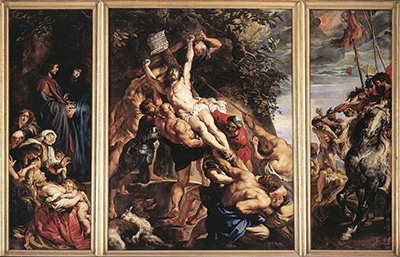
The Elevation of the Cross
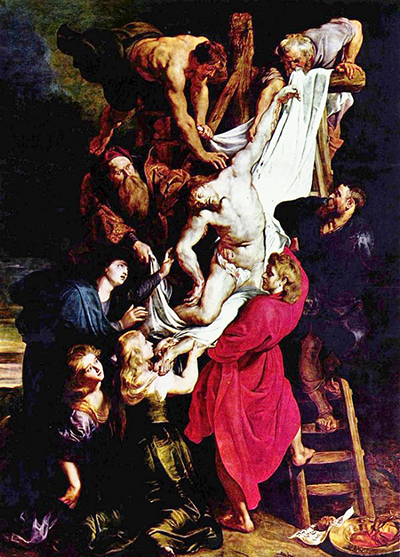
1609–10The Descent from the Cross
1611–14The Garden of Love
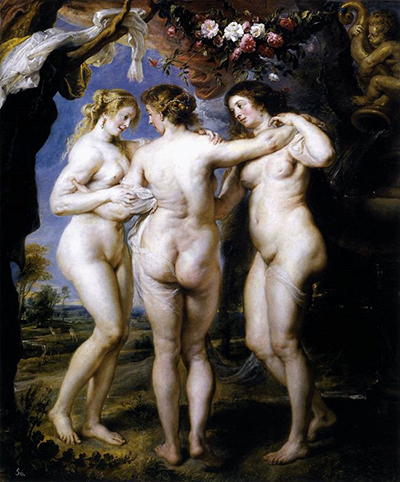
1630–35The Three Graces
1630–35Contents
- Who was Leganés?
- Why date the drawing to late 1627?
- How does Rubens make a working likeness?
- Names and later marks on the sheet
- Other portraits of the same sitter
- The date range is an argument, not an inscription
- The collector and the collection numbers
Who was Leganés?
The ALBERTINA’s catalogue describes Leganés as a Spanish military and political figure sent by Philip IV to the court of Archduchess Isabella in Brussels. He became a member of the Spanish war council in 1622, a field marshal in 1625, and received the marquisate in 1627. His appointment put him in the circles where Rubens worked as both painter and intermediary. The portrait thus belongs to a documented network of court service and diplomacy, not merely to Rubens’s interest in an anonymous striking face.
Leganés was also an important collector. The ALBERTINA cites Rubens’s correspondence with Pierre Dupuy in January 1628 as evidence that the artist admired the marquis’s judgement about painting. Its essay reports a 1655 inventory of Leganés’s collection with more than a thousand pictures, including at least thirty works by Rubens. These figures belong to a later collection inventory, not to the drawing’s inventory number or to the number of works Rubens made for him at a single sitting. They help explain why a portrait of Leganés by a leading painter had personal and courtly significance.
The ALBERTINA also reports that Leganés commissioned a Rubens Immaculate Conception that later entered the Spanish royal collection. That example places the portrait relationship within a broader pattern of patronage, but it is no proof that this particular chalk sheet was ordered under a surviving written contract. The museum proposes a commission for the portrait in connection with his new title and presents that motive as likely rather than documented.
Why date the drawing to late 1627?
The ALBERTINA places Leganés in Brussels between 9 September 1627 and 3 January 1628 and argues that he and Rubens most probably met there. Rubens had diplomatic business at the Brussels court during those months. The museum’s structured date, September–December 1627, reflects that historical setting and the presumed sequence of drawing before the painted portrait. It is a curatorial conclusion based on correspondence and comparison, not a day and month written by Rubens on the sheet.
The political setting was unsettled. According to the ALBERTINA essay, Leganés carried news of a Spanish-French agreement against England at a time when Rubens hoped to advance peace between England and Spain. Rubens travelled to Brussels to negotiate at court. It is therefore plausible that a painter-diplomat and a Spanish envoy met repeatedly. Still, the drawing itself does not record the place or hour of a sitting. A page can describe the reasoned Brussels context without claiming to know when Rubens took up his chalk.
The museum further suggests that Leganés may have commissioned a formal portrait to mark his elevation to marquis. That is a plausible motive for a representative painted likeness, especially with a new title and court position, but remains a proposal. The drawing’s date and purpose should not be made more exact simply because the historical event is known.
How does Rubens make a working likeness?
The head fills the sheet. Rubens first laid out its outline and the ruff, then used the chalk to model the individual face. In the reproduction here, the curls and moustache have many broken, overlapping strokes while the collar remains a broad arc. That imbalance is purposeful: the sitter’s features are the information most necessary for a later portrait. A formal garment can be worked out elsewhere; a fleeting configuration of eyes, nose and mouth is more efficiently caught from life.
The ALBERTINA’s essay says Rubens worked over a fine network of lines and that the painted version follows the drawing closely in the head’s position, gaze, ruff and curls. This is stronger evidence of a preparatory relationship than a mere resemblance between two portraits. Yet the oil painting is a separate object. Its full figure, armour or dress, background, measurements and later ownership must come from its own record, not be read back into this modest chalk sheet.
The sitter’s expression invites interpretation but resists certainty. The ALBERTINA describes a serious, somewhat tired face and sees the slight view from below as a way to convey status. These are useful curatorial observations about how portraiture works, not psychological facts about Leganés. We can see the face, ruff and subtly raised viewpoint. We cannot recover exactly how he felt during the sitting. Rubens could make a likeness suitable for a court figure while keeping the particularities of a curl, eyelid and moustache.
This combination of specificity and incomplete finish is what makes the sheet worth looking at separately from the finished oil. A viewer can trace how the artist prioritised a recognisable head. The surrounding blank or lightly drawn paper leaves room to see decisions in progress. The drawing is not a lesser image only because it preceded a painting; it is the surviving record of Rubens’s encounter with a consequential sitter.
Names and later marks on the sheet
The sitter’s name appears in several historical spellings: Messía, Mexía, and, in some records, Felípez for the compound family name. The ALBERTINA’s current title uses Messía (Mexía) Felipe de Guzmán, Marquis of Leganés. The page address’s “Messina” is not one of those forms. The museum’s title supplies the sitter’s name.
The ALBERTINA records an inscription at the lower edge rendered “Marquis de la genesse” and notes it was made by another hand. Its catalogue text also says a red-chalk designation helps identify the sitter. Such old annotations can carry useful information even when they are not Rubens’s own writing. Their evidential role should be kept separate from the artist’s chalk modelling. The sheet also carries a collection mark of Duke Albert of Saxe-Teschen.
The museum’s provenance states that the drawing was in the Imperial Court Library in Vienna and was acquired by Duke Albert in an exchange in 1796. That is a concrete later transfer, not an uninterrupted chain back to the marquis or Rubens. Nothing in the public record requires that Leganés personally owned this preparatory sheet after the painted portrait was made.
Other portraits of the same sitter
The ALBERTINA associates its drawing with Rubens’s distinct, privately held three-quarter-length oil portrait. The link is a key part of the sheet’s purpose, but the oil painting’s current access and full collection record are different questions. A photograph or print after the painted portrait could look related without being the exact object shown here.
A later example makes the need for separation clearer. The National Museum of Western Art in Tokyo[2] holds Anthony van Dyck’s Diego Felipe de Guzmán, Marquis of Leganés, dated about 1634, oil on canvas, collection number P.1987-0002. It portrays the same historical man after Rubens’s 1627 drawing, but Van Dyck is the painter. Its large format, dark clothes and later collection history cannot be assigned to the ALBERTINA sheet. The direct Tokyo record confirms that Leganés remained a sought-after portrait subject; it does not show that Rubens’s chalk drawing prepared Van Dyck’s canvas.
The date range is an argument, not an inscription
The ALBERTINA's object essay gives the reasoning behind its September–December 1627 date. It notes that Michael Jaffé proposed September–October 1627 for the associated oil portrait and extends the possible period for the drawing through December because Leganés remained in Brussels during negotiations. That reconstruction joins a historically documented visit to a likely sequence of drawing before painting. It is stronger than guessing from the style of a ruff, but it still does not give us a dated sitting note on the sheet.
The same catalogue also records a difference among scholars: Hans Vlieghe placed the painted portrait in the early 1630s, when Leganés lived in Brussels. It adds a caution that the painting was not listed among the Rubens works in Leganés's own inventory. A later date for the canvas would change how closely the drawing and finished portrait were made, though their visual relationship remains clear in the museum's comparison. The manuscript should therefore retain the Vienna sheet's catalogue date while not turning the proposed commission for a new marquisate into a proven contract.
This matters because Leganés's advancement is tempting as a neat explanation. He received the title of Marquis of Leganés in 1627 and was a court officer whom Rubens had reason to know. A representative portrait around the new title makes sense. The ALBERTINA phrases this as an inference, not a discovered payment record. Rubens's involvement in negotiations and his admiration for the sitter's knowledge of painting make their contact plausible; they do not let us reconstruct what Leganés wore or said in a particular sitting. The drawing preserves a face. The history around it remains partly reconstructed.
The collector and the collection numbers
The ALBERTINA's essay gives the 1655 estate inventory more precisely than the shorthand “over a thousand paintings.” It records 1,333 paintings, with at least thirty by Rubens. Those are reported holdings at the sitter's death, almost three decades after the Vienna sheet's probable date. The figures show the scope of Leganés's collecting, but not that every Rubens work was painted to his order or that the drawing stayed in his possession. The portrait relationship should be distinguished from the later inventory's breadth.
The record mentions another commission, an Immaculate Conception by Rubens that Leganés apparently passed to Philip IV. Its cited notes place the painting in the king's collection by a 1636 royal inventory. That separate object illustrates how a courtier could acquire a work and move it into royal possession. It does not tell us that the chalk portrait took the same path. The Vienna sheet's documented later movement is quite different: it appears in the Imperial Court Library and was transferred to Duke Albert of Saxe-Teschen in 1796.
This is why the numbers on a Rubens page need labels. 8258 identifies the ALBERTINA sheet; P.1987-0002 identifies Van Dyck's Tokyo canvas; 1,333 and thirty describe the scale of Leganés's estate collection as reported by the ALBERTINA. Treating them as interchangeable would attach the wrong maker, owner or medium to the wrong work. The corrected sitter name in the visible heading serves the same purpose: it allows a reader to find this particular drawing despite the site's inherited “Messina” URL.
Rubens artworks directory
Frequently Asked Questions
Don Diego Messía (Mexía) Felipe de Guzmán, first Marquis of Leganés, a Spanish military officer, court figure and collector.
It preserves an inherited site address. The ALBERTINA’s catalogue identifies the sitter as Messía (Mexía), the spelling used in the title here.
The ALBERTINA dates the sheet September–December 1627, during a likely Brussels encounter. The exact sitting day is unknown.
Black and red chalk with traces of white chalk on a sheet measuring 38.5 × 27.6 centimetres.
No. It is a separate preparatory drawing for a Rubens oil portrait. Van Dyck’s painting in Tokyo is another, later work by a different artist.
The museum records an 1796 exchange from Vienna’s Imperial Court Library to Duke Albert of Saxe-Teschen. Earlier ownership remains untraced in its public record.
Discussion
Look closely at the contrast between the worked face and lightly indicated ruff.
Share an observation about the drawing or a reliable source that adds to its history.
Reader Insights
Which features would help transfer the sitter's likeness to a formal portrait?
How certain is the proposed Brussels meeting between Rubens and Leganés?
What do the later inscriptions contribute to identifying the sitter?
Join the Conversation
Add your reading below, keeping observations specific and evidence clear.
References
- ALBERTINA, Rubens, Don Diego Messía (Mexía) Felipe de Guzmán, Marquis of Leganés , inventory 8258. View source
- National Museum of Western Art, Tokyo, Van Dyck’s separate Diego Felipe de Guzmán, Marquis of Leganés , P.1987-0002. View source