by Tom Gurney
Tom Gurney BSc (Hons) is an art history expert with over 20 years experience
Published on June 19, 2020 / Updated on October 14, 2026
Email: tomgurney1@gmail.com / Phone: +44 7429 011000
A queen on a white horse
Marie de Médicis rides a white horse beneath a stormy sky. Her hand holds a baton of command, and winged figures above her celebrate an achievement. At left, a woman gestures beside a lion. Far behind the large foreground figures, troops and buildings mark the surrender of a fortified town. Rubens makes a military event into an image of royal authority, with the queen occupying the most visible place even though the battle itself is distant.
The Louvre[1] titles the canvas La Prise de Juliers, le 1er septembre 1610, The Capture of Jülich, 1 September 1610. It is oil on canvas, 394 × 295 centimetres, inventory INV 1781 / MR 972. It belongs to the twenty-four-part Marie de Médicis cycle, painted by Rubens in 1622–25 for the queen's Luxembourg Palace in Paris. 1610 is the date of the episode depicted; it is not the date at which this monumental painting was made.
The inherited route Triumph of Juliers reflects an older English way of naming the subject, but the Louvre's current title is more specific. It names the capture of Jülich, a town in today's Germany, and supplies the event's day. “Juliers” is a French form of the place-name. The page can preserve the familiar route while showing readers which historical event the collection now identifies.
At a Glance
- ArtistPeter Paul Rubens [1]
- EventCapture of Jülich, 1 September 1610 [1]
- Painted1622–25 for the Marie de Médicis cycle [1]
- MediumOil on canvas [1]
- Dimensions394 × 295 cm [1]
- CollectionMusée du Louvre, Paris, INV 1781 / MR 972 [1]
Where this work sits in Rubens's career
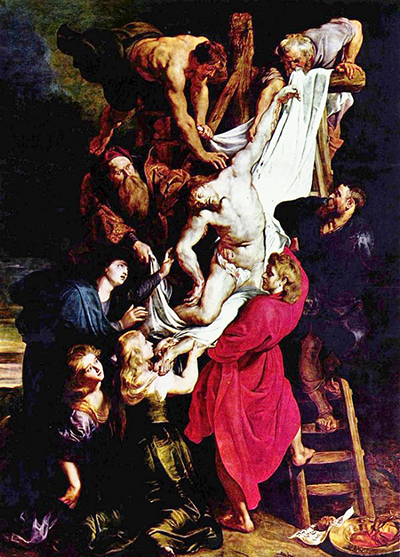
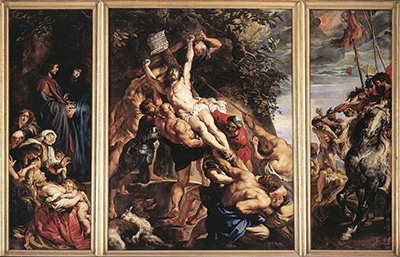
The Elevation of the Cross
1609–10The Descent from the Cross
1611–14The Capture of Jülich
1622–25The Garden of Love
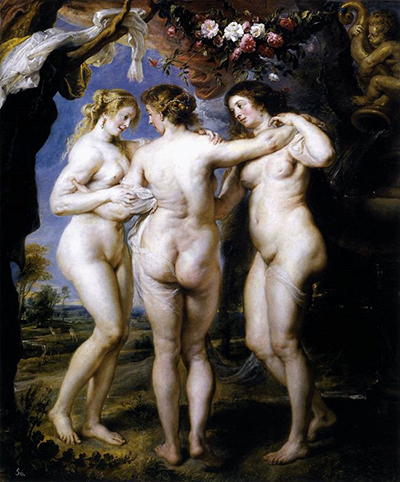
1630–35The Three Graces
1630–35Contents
- What happened at Jülich?
- How is Marie represented?
- Who are the figures above her?
- Who stands with the lion?
- Where is the battle?
- Why did the painting have another title?
- What was the Marie de Médicis cycle?
- How should the canvas be read now?
What happened at Jülich?
The Louvre explains that French troops helped return the fortified place of Jülich to German Protestants. In the cycle, this outcome becomes a regency success. The queen is presented as a successor to Henri IV in the ability to command and secure a political result. Rubens depicts her as if she were personally at the centre of a triumphant military procession.
That visual claim is not the same as a literal report of where Marie stood when the fortress surrendered. The canvas is an allegorical history painting made more than a decade after the event and commissioned by the queen whose life it celebrates. It gives her the emblems of command and surrounds her with personifications that no chronicler would have seen above a battlefield. The distant troops are enough to connect the image to a real conflict; the foreground turns that conflict into royal praise.
Jülich is also part of the cycle's broader account of the period after Henri IV's death. Rubens had to represent Marie's authority during a contested political era. A military success could be useful in that story because it allowed the queen to appear strong, decisive and publicly effective. The Louvre's object essay says that she is shown as Henri's true successor. The painting makes that proposition visible through armour, baton, horse and attendant Victory.
The event's political detail should not be simplified into “Marie conquered Germany.” The Louvre describes a specific fortified place returned through French troop action to German Protestants. The canvas celebrates the result in grand language, but the subject remains the capture or surrender of Jülich, not an unlimited campaign. Accurate geography and a restrained statement of the outcome help readers see how far the painted rhetoric extends beyond the historical fact.
How is Marie represented?
Marie sits on a white horse, armoured and helmeted. The horse's body carries her forward into the centre of the canvas, and its pale colour makes the pair stand out against the darker clouds and earth. Her baton is a clear sign of command. She is not dressed as a private court sitter; she appears as a ruler able to direct war and receive public acclaim.
The white horse matters compositionally as well as symbolically. It fills much of the lower middle, separating the large allegorical figure at left from the distant battle scene at right. Its raised foreleg and turning head give the painting motion, while Marie remains comparatively upright. The contrast makes her seem stable amid an event of action and acclaim.
Her garments mix practical and ceremonial elements. Armour suggests military leadership, but fabric and courtly presentation keep her recognisable as a queen in a heroic tableau. The Louvre calls her “superbly helmeted.” This is an elevated image of regency, not a neutral likeness of what she wore on one day in September 1610.
The horse and rider also occupy a scale much larger than the troops below. Rubens is telling viewers where to place attention. The surrender in the background supplies the historical basis; Marie's body and mount carry the meaning the commission wanted that event to have. The painting would have been viewed in a gallery full of related chapters of her life, so this emphasis formed part of a continuing argument about her worth and authority.
Who are the figures above her?
The Louvre identifies the winged figure who places a crown over Marie as Victory. Another is Fame, celebrating the deed with a trumpet. Their gestures form a second level of action above the queen. The baton says she commands; the crown and trumpet say that command deserves triumph and public recognition.
Victory's movement is energetic. The figure hovers close enough for the crown to meet Marie's head, connecting the heavenly register to the horse and rider below. Fame sounds a trumpet towards the edge of the composition, sending the news outward. The two personifications do not merely decorate the sky. They change how the earthly action is judged.
The clouds are dark and turbulent behind them, while lighter openings frame bodies, wings and drapery. The contrast gives the upper figures force. Fame and Victory appear to emerge into the scene at the right moment, as if the event itself called them down. In reality, they are painted inventions drawn from a language of classical and court allegory.
The personifications are identified in the Louvre's catalogue, not by inscriptions on the reproduced painting. Readers can use those names to follow the image while understanding them as the museum's iconographic reading. Rubens's allegory works by making abstract ideas act like figures in a shared space with the queen.
Who stands with the lion?
The Louvre names the figure at left Generosity. A lion stands beside her. Its animal strength complements the royal horse, but its meaning is different. The museum relates the lion to traditions that could praise both clemency and courage, citing ancient and early modern writers. In this image, the creature contributes to the moral portrait of the victorious queen.
Generosity's gesture opens the painting to the left. Her body and drapery counterbalance the horse on the right, while the lion at her side gives the lower register weight. Rubens uses her to make victory seem more than raw force. The queen's success is framed as a form of rulership with a positive moral quality.
There is room for caution in reading the animal. The lion is visibly present, and the Louvre supplies the name Generosity and its interpretive references. The painting does not print a complete set of definitions beside each figure. A page should report the museum's identification without asserting that every viewer in the Luxembourg Palace would have read the lion in exactly one way.
The figure also keeps the scene from becoming a straightforward equestrian portrait. A rider alone on a white horse could suggest a military commander. With Generosity at left and Victory and Fame above, the image becomes a compact argument about Marie's powers and virtues. The historical event remains visible, but it is filtered through allegory at every level.
Where is the battle?
The Louvre locates the surrender of Jülich in the background. In the retained image, small troops and the fortified place are visible far behind Marie's horse. Their scale is dramatically different from the queen and personifications. They provide evidence of the event while remaining subordinate to the heroic foreground.
This background is important for attribution as well as interpretation. The Louvre's object essay says there may have been an exceptional intervention by another hand in the surrender scene, perhaps a battle specialist such as Pieter Snayers. It puts the suggestion as a question, not as a confirmed identification. The page therefore credits the painting to Rubens as the museum does, while noting that one specific passage has been discussed as possible specialist assistance.
It would be misleading to turn that possibility into “Snayers painted the battle” without further proof. It would also be misleading to use the Louvre's broad statement elsewhere that the cycle is wholly autograph to erase the qualifying sentence in this object's own entry. The current evidence supports a careful formulation: Rubens is the credited artist; the distant battle may include exceptional help from another, unidentified or only tentatively named hand.
The small scale of the surrender within the image helps explain why a specialist might be proposed. Tiny ranks, fortifications and military detail require a different kind of description from the large mythic bodies in the foreground. That is a visual observation, not proof of who held the brush. The museum's caution remains the boundary for the public account.
Why did the painting have another title?
The Louvre records an old title relating the canvas to Marie de Médicis's journey to Pont-de-Cé in 1620. It says the proper Jülich title was restored in twentieth-century scholarship, supported by a memorandum from around 1622. The mistaken title matters because it would move the event to a different decade and a different political episode.
The current image's distant fortress and military celebration fit the Jülich interpretation supplied by the museum. The old Pont-de-Cé label should be mentioned as a historical cataloguing problem, not reused as the public title. The Louvre points readers to another inventory number for the Pont-de-Cé subject, confirming that the two episodes should not be collapsed.
This is a good example of why the approved route alone cannot determine object identity. “Triumph of Juliers” is close enough to the present identification to preserve for web continuity, but the page heading must make the Louvre's current title clear. A reader who comes from an old link can then see exactly which painting is being discussed.
The date difference is equally important. The 1610 in the title names the capture; the Louvre says Rubens painted the cycle in 1622–25. A date field that showed only 1610 would misdescribe the age of the physical canvas. The lead and caption give both dates in their proper roles.
What was the Marie de Médicis cycle?
The Louvre describes a group of twenty-four monumental canvases made for the western gallery of Marie's Luxembourg Palace in Paris. The paintings presented her life in a heroic mode, mixing documented events with gods and personifications. Rubens executed the cycle in 1622–25, years after the represented Jülich episode. The queen herself commissioned the series.
The original gallery was part of a palace built between 1615 and 1622. Canvases filled spaces between windows, so viewers encountered them as a continuous sequence while moving through an architectural setting. The Jülich painting's 394 × 295 centimetres match the large scale of that programme. It was not designed as a small independent battle picture to be examined at a desk.
The Louvre's historical account traces the cycle through the Luxembourg and royal collections, with movement to the Louvre around the end of the eighteenth century and permanent transfer in the early nineteenth. Its modern display gathers the cycle in the Richelieu wing, though the current gallery guide[2] reports a temporary closure while restoration is undertaken. That display status can change; the collection identity and original palace purpose are more durable facts for a lasting article.
The cycle context changes the meaning of Jülich. Seen alone, the painting may look like an unusually mythic battle victory. Seen among Marie's episodes, it is one chapter in an argument that she could inherit, preserve and exercise royal power. The queen's commission gives the image a clear point of view, and the allegories amplify that view.
How should the canvas be read now?
Begin with Marie on the white horse. Notice the baton, armour and helmet. Then look up to Victory with the crown and Fame with the trumpet. Move left to Generosity and her lion. Only then search the far distance for the small surrender scene. This viewing path follows the hierarchy Rubens gives the painting: heroic queen first, historical proof second.
The work does not become less historical because it is allegorical. The event at Jülich and its date are named in the Louvre record. But it is a painted interpretation commissioned by a participant in the political story, not a panoramic report from the battlefield. Its questions are: how should a queen be seen, what kind of victory deserves praise, and how can military action be transformed into a public image of regency?
The answer lies in a composition where a white horse carries a commanding queen, gods or personifications crown and announce her, and a small siege confirms the occasion. The painting is Rubens's Louvre canvas INV 1781 / MR 972, not the Pont-de-Cé episode and not a work painted in 1610. Those distinctions allow the viewer to appreciate its political force without confusing event, title and object.
Rubens artworks directory
Frequently Asked Questions
The Capture of Jülich, 1 September 1610. The inherited route phrase Triumph of Juliers refers to the same canvas.
The event was in 1610. Rubens painted the Marie de Médicis cycle in 1622–25.
The Louvre identifies Victory crowning Marie, Fame with a trumpet and Generosity with a lion at left.
The Louvre raises a possibility of exceptional help by a battle specialist, perhaps Snayers, in the background surrender. It does not confirm his participation.
It belongs to the Musée du Louvre, Paris, inventory INV 1781 / MR 972. It is oil on canvas, 394 × 295 centimetres.
Discussion
Look from Marie on the white horse to the distant surrender.
Share a close observation or a reliable source about Louvre INV 1781.
Reader Insights
How do Victory, Fame and Generosity recast the military event?
Why does the small background battle matter to the picture's meaning?
How should the Louvre's possible second-hand note be described?
Join the Conversation
Add your reading below, keeping event and painting dates separate.
References
- Musée du Louvre, La Prise de Juliers, le 1er septembre 1610 , INV 1781 / MR 972. View source
- Musée du Louvre, “To the glory of a queen of France — The Galerie Médicis”. View source