 by Tom Gurney
Tom Gurney BSc (Hons) is an art history expert with over 20 years experience
Published on June 19, 2020 / Updated on October 14, 2026
Email: tomgurney1@gmail.com / Phone: +44 7429 011000
Evening work beneath a double rainbow
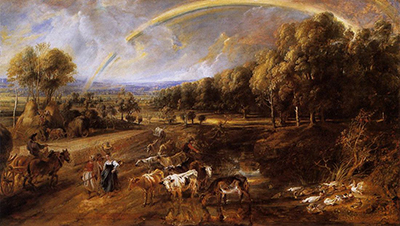
The sky is still bright, but long shadows spread across the fields. Cattle move along a track; people gather or carry the results of a day's work; a hay wagon approaches. Above them a double-arched rainbow sweeps across the wide view. Peter Paul Rubens makes the fleeting effect of weather the largest form in the painting, yet its force depends on the particular life happening below it.
The Wallace Collection's detailed record[1] identifies The Rainbow Landscape as Rubens, about 1636, oil on oak panel, inventory P63. It gives 137 × 233.5 centimetres as the image size. A separate Wallace feature page[2] prints 135.6 × 235 centimetres. The two published measurements should not be silently combined; the figure used here is explicitly the detailed catalogue's image-size entry.
The picture looks over the countryside of Flemish Brabant around Rubens's manor of Het Steen, between Brussels and Antwerp. The Wallace describes it as an idealised working landscape, not a survey made to record every field boundary. It shows recognizable rural activity while arranging it into an immense, calm panorama. The museum's word “idealised” leaves room for both observed details and artistic selection.
At a Glance
- ArtistPeter Paul Rubens [1]
- DateAbout 1636 [1]
- MediumOil on oak panel [1]
- Image size137 × 233.5 cm (detailed Wallace catalogue) [1]
- CollectionThe Wallace Collection, London, P63 [1]
- CompanionAutumn Landscape with Het Steen, National Gallery NG66 [1][4]
Where this work sits in Rubens's career
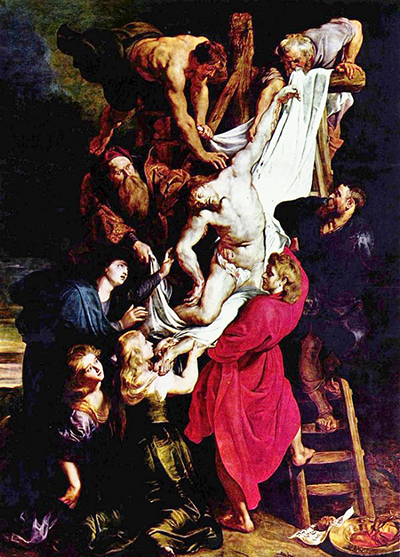
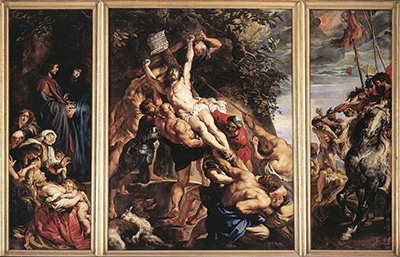
The Elevation of the Cross
1609–10The Descent from the Cross
1611–14The Garden of Love
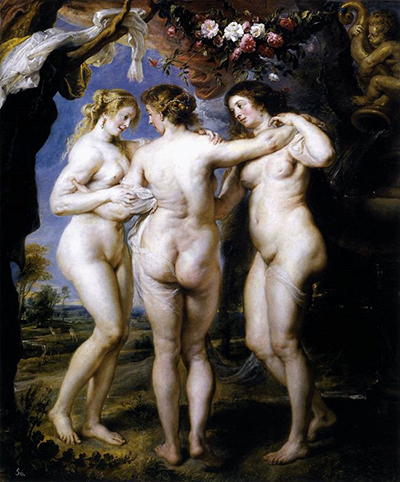
1630–35The Three Graces
1630–35The Rainbow Landscape
c. 1636Contents
- How the eye travels through the scene
- A rainbow that orders the sky
- Het Steen and late landscape painting
- Paired with a morning at Het Steen
- A joined history, then separate owners
- Looking again at the working landscape
How the eye travels through the scene
The near ground is busy with animals, people, water and vegetation. A road carries movement diagonally across the foreground, then the view opens through fields and trees to a low horizon. The large tree mass at the right weights one side of the painting, while the arc of the rainbow reaches across the sky to unite the whole width. Human figures appear small against that structure but remain essential to its sense of a lived place.
The Wallace object description[1] identifies haymaking, dairy cattle being herded, ducks at the stream, and milkmaids and a farmhand greeting the driver of a hay wagon. These incidents make the place active. They also help the viewer read its depth: a figure close to the road is more distinct, while work farther away becomes a small mark in the fields.
The painting does not give one action the priority of a history scene. The wagon, cattle and haymaking belong to related cycles of farming, but no single figure carries a plot with a beginning and end. Instead, the viewer moves among different tasks under the same change of light. The rainbow turns that routine moment into something visually extraordinary without removing the labour that grounds it.
The long shadows lead the Wallace to read the hour as approaching evening. This timing matters in a painting paired with an early-morning view. It is also apparent in the local image: the glow on the fields is lower and warmer than a midday light, and the dark tree group extends the sensation of a day nearing its close. The painting suggests the return from work rather than the beginning of it.
A rainbow that orders the sky
Rubens paints a double arc, not a single strip of colour. The brighter bow is easy to see, while the second gives the sky another delicate curve. The two arcs create a broad frame over the land. Because rainbows are temporary, the image holds a moment that could not remain fixed for long. The Wallace calls that atmospheric effect a technical challenge for painters. Rubens uses it as both observed weather and a powerful way to organize the composition.
The rainbow visually bridges areas that differ in light and texture. It rises above working people and animals, reaches over trees, and directs the eye from the dark near ground toward the open distance. We can enjoy it as a natural event before assigning it a symbolic meaning. Its placement is so prominent, however, that the Wallace offers an additional reading: a sign of reconciliation and peace that would have been poignant for Rubens, who had pursued diplomatic efforts to bring peace to the Netherlands.
The Wallace's wider essay on the great landscapes[3] also connects the rainbow with the biblical covenant after the Flood, a tradition in which it can signify hope. These are curatorial interpretations, not a surviving statement from Rubens explaining every element of P63. The painting supports the readings through its peaceful rural scene and enormous bow. It does not require one exclusive symbolic answer from every viewer.
That restraint matters. A rainbow can be an optical phenomenon, a compositional device and a historical religious sign at once. Rubens's achievement is to paint it convincingly over specific land and weather while allowing it to carry associations beyond the immediate view. The museum's interpretation helps us consider those associations; the figures and fields keep the image from becoming a diagram of an idea.
Het Steen and late landscape painting
Rubens bought Het Steen in 1635. The Wallace says he spent summers there in semi-retirement from 1636 until his death in 1640, looking at the countryside at different hours. It cites his nephew Philip Rubens on the artist's attention to land extending toward the horizon. The picture's high viewpoint and enormous sky fit that account, though the family report is not a dated note of how this particular panel was painted.
The Wallace's survey of his great landscapes[3] says Rubens developed the panoramic format with special energy late in life. It points to the oak-panel surface as suited to textured brushwork and saturated colour. Several of these panels were built from smaller boards and sometimes enlarged during work. This physical process is relevant to P63: the museum describes it and the morning companion as complex in construction and evolution.
The museum also argues that Rubens made landscapes for his own pleasure rather than as commissions. In the case of this pair, their presence in his own collection at death and their unusual, developing supports give that view substance. Yet no cited contract or letter says exactly when he began P63, where it was hung, or what private thought prompted it. The most careful description is that the painting was about 1636, associated with Het Steen and probably made for his own enjoyment.
Other landscapes show how varied that interest could be. The Wallace compares this peaceful view with the Stormy Landscape with Philemon and Baucis in Vienna, whose violent weather produces a very different emotional effect, and with a panoramic Landscape in Flanders at Birmingham's Barber Institute. Those are distinct works, not studies for P63. They show that Rubens's late landscape practice could move from productive calm to mythological danger while continuing to investigate sky, land and light.
Paired with a morning at Het Steen
The companion to P63 is An Autumn Landscape with a View of Het Steen in the Early Morning, now NG66 at the National Gallery, London. The Wallace catalogue[1] says the two developed together as companion pieces and were probably painted and displayed at Het Steen. The National Gallery records both in Rubens's possession at his death. Their paired status is stronger evidence than a guess based only on their similar size or subject.
The two views have different emphases. NG66 includes the manor itself and a morning sequence of a hunter, milkmaids, a market cart and people near the house. P63 gives the larger role to fields, haymaking, cattle and the extraordinary evening sky. Together they present activity at different hours without requiring that they depict the same literal day. The morning picture's light appears from the right; the rainbow picture's light comes from the left.
The National Gallery proposes that the works might once have faced each other across a room, with a window between them and real sunlight aligning with the painted light. It is a compelling way to imagine the pair, but the Gallery phrases the wall positions as probable[4]. No surviving installation plan in the cited material fixes the arrangement. The established relationship is the pairing; the exact display remains a reconstruction.
Both pictures ask the viewer to see farming as part of a broad landscape. The Wallace calls the scenes idealised and reads a productive, peaceful country in them. That selection is part of their meaning: Rubens includes work but not the full range of hardship that agricultural labour might involve. We can recognize the painting's mood and its historically limited viewpoint at the same time.
A joined history, then separate owners
The Wallace provenance says the two paintings were briefly separated after Rubens's death, then reunited by the late seventeenth century in an important Madrid collection. They moved to Genoa in the early eighteenth century and reached London in 1803, when dealers offered them to the nation without success. This sequence links the two works for generations, although it does not supply a complete, equally detailed record of every owner in each period.
Their enduring separation began in the London market. The morning painting was acquired for Sir George Beaumont and eventually passed to the National Gallery. The Rainbow Landscape followed a different route. The Wallace account[1] says Arthur Champernowne sold it to George Watson Taylor. The museum identifies Watson Taylor as a plantation owner. That context belongs in an honest account of the painting's collecting history. The source does not establish a direct funding route for this particular purchase, so no such claim is made here.
At Watson Taylor's sale in 1823, Horatio Walpole, 3rd Earl of Orford, acquired the picture and displayed it at Wolterton Hall in Norfolk. In 1856, an agent for Sir Charles Eastlake tried to buy it for the National Gallery to reunite the pair. The 4th Marquess of Hertford outbid him, paying £4,550, according to the Wallace catalogue. The painting entered the Wallace line of collecting rather than the National Gallery's. Its present inventory number is P63.
The pair came together temporarily for the Wallace Collection's 2021 exhibition, Rubens: Reuniting the Great Landscapes. The museum describes it as their first reunion in more than two centuries. An exhibition reunion does not change their separate permanent collection identities: P63 remains at the Wallace Collection, and NG66 remains at the National Gallery.
Looking again at the working landscape
Start with the people and cattle in the near ground, then follow the track past the stream into hayfields and distant meadows. Return to the great tree mass and finally trace both rainbow arcs across the sky. The route through the image makes the title's natural phenomenon feel connected to a particular place and a particular hour. It also reveals why the painting needs its enormous horizontal format: work, weather and distance all unfold across it.
Rubens combines an immediate physical effect with an idealised view of land he knew. The Wallace's interpretation of hope and reconciliation opens one route into the image; the observed details of milkmaids, animals, ducks and haymaking offer another. The picture remains persuasive because those routes meet in paint. The rainbow is immense, but it does not erase the people underneath it.
Rubens artworks directory
Frequently Asked Questions
It is P63 in the Wallace Collection, London. Current gallery display information can be checked on the museum's live record.
The Wallace dates it about 1636, soon after Rubens bought Het Steen in 1635. The date is approximate rather than a year inscribed on the panel.
It is oil on oak panel. The detailed Wallace catalogue lists 137 × 233.5 cm as the image size; a separate museum feature prints 135.6 × 235 cm. The measurements are reported with their source and convention rather than fused into one number.
The Wallace interprets the double arc as a sign of reconciliation and connects it with Rubens's diplomatic efforts and the biblical covenant. That is a museum reading, not a surviving statement by Rubens prescribing one meaning.
An Autumn Landscape with a View of Het Steen in the Early Morning, NG66, is at the National Gallery. The works developed together, but their proposed original wall positions are not documented with certainty.
After arriving in London in 1803, the morning painting entered the Beaumont collection. P63 went through Watson Taylor and Orford before the 4th Marquess of Hertford bought it in 1856, defeating an attempt to reunite the pair for the National Gallery.
Discussion
Follow the farm track from the foreground toward the distant meadows.
Share an observation about the painting or a reliable source that adds to its history.
Reader Insights
How do the people and cattle change the scale of the rainbow?
What suggests evening in the painted light and shadows?
Which differences from the National Gallery's morning view stand out?
Join the Conversation
Add your reading below, keeping observations specific and evidence clear.
References
- The Wallace Collection, detailed catalogue for The Rainbow Landscape , P63. View source
- The Wallace Collection, shorter object feature and variant dimensions. View source
- The Wallace Collection, Rubens's Great Landscapes. View source
- The National Gallery, companion An Autumn Landscape with a View of Het Steen in the Early Morning , NG66. View source
- The Wallace Collection, 2021 reunion exhibition. View source