by Tom Gurney
Tom Gurney BSc (Hons) is an art history expert with over 20 years experience
Published on June 19, 2020 / Updated on October 14, 2026
Email: tomgurney1@gmail.com / Phone: +44 7429 011000
A face caught in chalk
A young boy looks towards the left, his mouth relaxed and his eyes attentive. The contours of his head and collar are lightly drawn; short curved strokes build up his hair. Some lines stop before they describe a complete hairstyle, leaving the paper to do part of the work. Darker chalk concentrates at the eye, beneath the ear and at the neck. The drawing is close enough to make the child's individual features vivid, yet open enough to show Rubens thinking through them.
The ALBERTINA in Vienna[1] identifies the boy as Nikolaus, Rubens's younger son by his first wife, Isabella Brant. It catalogues the drawing as Peter Paul Rubens, about 1626–27, black chalk heightened with white chalk on brownish paper, 22.8 × 18.1 centimetres, inventory 17648. The small legacy image matches the pose, flying hair and lower-right inscription in the collection's reproduction. It is a drawing on paper, not the much larger painted portrait of two brothers to which it relates.
Nikolaus was baptised on 23 March 1618, according to the ALBERTINA's catalogue essay. The likely mid-1620s date makes him a boy of about eight or nine rather than an infant. Rubens's drawing fixes a particular view of his face without trying to describe his entire body or surrounding room. A short sitting was enough to gather the position and expression that the painter could use again. The paper preserves the speed of that encounter more directly than a finished group portrait does.
At a Glance
- ArtistPeter Paul Rubens [1]
- SitterNikolaus Rubens [1]
- DateAbout 1626–27 [1]
- MediumBlack chalk heightened with white chalk on brownish paper [1]
- Dimensions22.8 × 18.1 cm [1]
- CollectionALBERTINA, Vienna, 17648 [1]
- Related paintingPortrait of Albert and Nicholas Rubens, GE 114 [1][2]
Where this work sits in Rubens's career
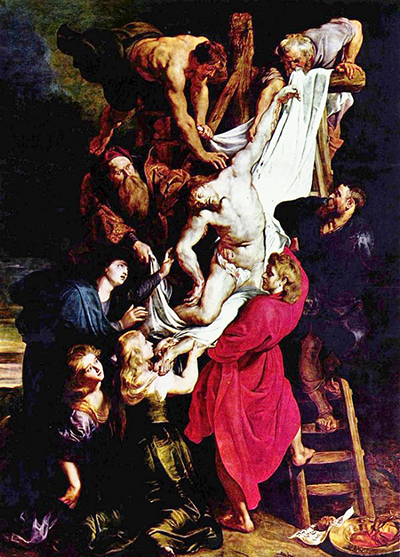
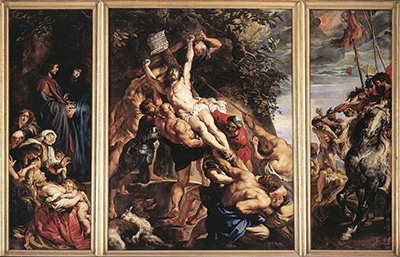
The Elevation of the Cross
1609–10The Descent from the Cross
1611–14Nikolaus Rubens
c. 1626–27The Garden of Love
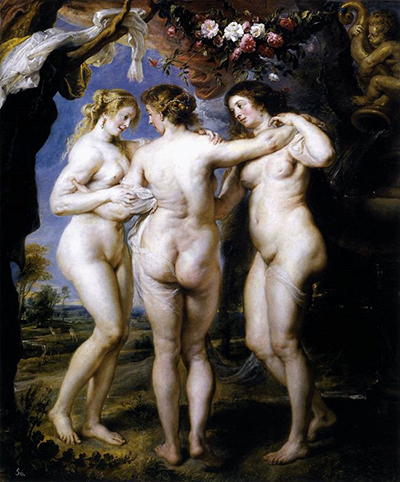
1630–35The Three Graces
1630–35Contents
- What makes the drawing feel immediate?
- How did the sketch relate to the brothers' painting?
- Why is the date approximate?
- Is the name at lower right Rubens's signature?
- Which other Nikolaus drawings are different?
- What survives of this family encounter?
What makes the drawing feel immediate?
Rubens uses different densities of chalk to make a head turn in space. Light outlines hold the outer shape; closely set strokes give weight to the hair and shadow. The nose and mouth are placed with relatively few marks, while the eyes receive more concentrated attention. The face is neither a fully shaded academic head nor a quick symbol for “child.” It has a specific direction of gaze and an uneven rhythm of curls.
The museum's catalogue text[1] calls this a fleeting chalk study made in a short sitting. It says Rubens recorded Nikolaus in much the same position that he later occupies in the brothers' painting, though the drawing is less focused. The painted hair is somewhat more dishevelled. These comparisons give a practical reason for the sheet: it could preserve a live observation while leaving decisions about clothing, setting and the relationship to Albert for the painting.
The paper's warm tone and the white heightening matter. Black chalk can outline and shade, while small light touches can lift parts of a face or hair out from that ground. The ALBERTINA supplies the material identification; a small digital reproduction alone is not a secure way to judge the paper's exact colour or to assign every pale point to white chalk rather than unworked support. What is clear is that Rubens did not need oil paint, a large format or a finished background to make the child seem present.
The unfinished-looking hair is particularly revealing. It gathers momentum in arcs over the forehead and around the ear, then lets individual lines remain visible. A finished painting can smooth or absorb such marks into colour and modelling. Here the lines retain their own energy. The eye moves between a more settled face and a more exploratory outer contour, as if the artist first secured the likeness and then tested how the curls would frame it.
How did the sketch relate to the brothers' painting?
The Liechtenstein Princely Collections[2] hold Rubens's separate Portrait of Albert and Nicholas Rubens, 1626–27, oil on panel, inventory GE 114. It shows the younger boy beside his older brother Albert. The ALBERTINA identifies its chalk study as preparation for Nikolaus's figure in that painting. The same child and family context connect them, but the Vienna sheet and the Liechtenstein panel are two distinct physical objects, in different collections and media.
In the painting, Nikolaus is occupied with a tethered goldfinch on a perch with small bells, according to the ALBERTINA. The Liechtenstein catalogue describes him paying little attention to the viewer as he plays with the bird. None of that apparatus is shown in the Vienna head study. The absence is significant: Rubens first needed a convincing child in a particular pose, not a complete miniature plan for every accessory. The bird and the relationship to Albert were part of the larger painted design.
The two brothers are deliberately unlike each other in that finished portrait. The Liechtenstein account describes Albert as composed and scholarly, holding a book, while Nikolaus is absorbed in play. It suggests a possible learned contrast between composure and childlike ease, drawn from ancient writing, but presents that as an interpretation. The Vienna drawing contributes the younger boy's likeness to this contrast; it does not by itself encode the book, bird or classical literary allusion.
The relationship is useful in both directions. Seeing the painting can explain why Rubens might make a quick head study; seeing the study can reveal how much work a single lively face contributed to the finished image. Yet a viewer should not use a later painted expression as proof that every inflection was already in the chalk. The ALBERTINA notes changes, including more tousled hair. Preparation and final painting are related stages, not duplicates.
Why is the date approximate?
The ALBERTINA dates the drawing about 1626–27. Its essay relates that estimate to the double portrait and to a family inventory made after Isabella Brant's death in June 1626. The painting of the brothers is not listed in that inventory; the museum takes this absence as a reason to think it was painted soon afterwards. Because the Vienna drawing helped prepare the panel, it is placed in roughly the same period.
This is a reasoned chronology, not a dated note on the paper saying exactly when Nikolaus sat. An absent item in an inventory can be informative, but it cannot by itself establish a month of execution. The Liechtenstein collection also dates its painting 1626–27, supporting the broad placement. A caption that says “about 1626–27” preserves the institution's degree of certainty.
The family moment matters without needing an invented emotional scene. Isabella's death precedes the probable completion of the brothers' painting; Rubens kept that painting and, according to the ALBERTINA, later left it to Albert. The drawing of Nikolaus can be understood within a household and a father's practice of drawing people close to him. Its speed need not be turned into a claim that it was made on the day of mourning, and the source does not say that it was.
Is the name at lower right Rubens's signature?
A name appears on the drawing: “P. P. Rubbens” in the lower right. The ALBERTINA record[1] explicitly marks it “von fremder Hand”—by another hand. The museum's scholarly note says similar names appear on other Vienna Rubens drawings and discusses why they may have been added later. The visible inscription therefore cannot be used as an autograph signature or as a date for the sitting.
This does not mean the museum doubts Rubens drew the portrait. Its artist field still credits Peter Paul Rubens. Authorship of the chalk study and authorship of a later written name are separate questions. Many works on paper acquired inscriptions, mounts, collector marks and inventory numbers long after an artist made them. The ability to see the name in a reproduction is useful only if its status is explained.
The ALBERTINA also records a collection mark of Duke Albert of Saxe-Teschen at the lower left and lists him in the provenance. That tells us something about the drawing's later passage into a major collection. It does not establish where Rubens sat with his son or whether a collector watched him draw. The sheet carries both an artistic image from the 1620s and later signs of ownership and naming.
A careful caption must therefore handle three layers: the sitter Nikolaus, the draughtsman Rubens and the non-autograph inscription. Confusing them would give a later mark more authority than the holding collection assigns it. The lesson is especially practical here because the legacy image includes the name clearly enough for readers to notice it.
Which other Nikolaus drawings are different?
The ALBERTINA catalogues a separate Nikolaus with a Red Felt Cap, inventory 8266, dated 1625–27. Its own record[3] says the red chalk describes the cap and the boy's complexion, and that no later painted version is known. This is not the black-and-white-chalk head reproduced here. Similar age and sitter do not make the sheets interchangeable.
Another Vienna drawing, Nikolaus with a Coral Necklace[4], inventory 17650, is dated about 1619 and shows him as a much younger child. The museum connects that sheet to a later religious painting in Kassel, where the child's likeness was adapted for the infant Jesus. Such reuse is not described for the 1626–27 head on this page. The three object numbers—17648, 8266 and 17650—keep the different ages, techniques and artistic uses in view.
The early coral-necklace sheet also helps prevent a generic story about Rubens always drawing his son the same way. A toddler's rounder features and a later boy's more alert turn call for different graphic decisions. The ALBERTINA records different media and dimensions for the sheets. Nikolaus was a recurring subject, but each drawing is a separate response to a particular likeness at a particular stage of childhood.
What survives of this family encounter?
The Vienna sheet survives as a direct study of one boy's head. The Liechtenstein panel preserves a more formal image of the brothers with objects and contrasting roles. A study of Albert for the same painting is lost, the ALBERTINA says, though a copy was once recorded. That uneven survival gives the Nikolaus sheet special value: it is not just a small version of the panel, but one of the few accessible steps in making it.
Their later collection histories also diverge. The Liechtenstein catalogue[2] gives the painted panel a height of 157 centimetres and a width of 93 centimetres: it is a substantial household portrait, far larger than the ALBERTINA's sheet of 22.8 × 18.1 centimetres. The princely collection says the painting was presumably acquired in 1712, while a surviving seal supplies its first firm documentary trace there in 1733. Those two statements have different levels of certainty. The sheet's recorded later ownership instead includes Duke Albert of Saxe-Teschen and the inscription by another hand. These histories help explain why the family study and the finished portrait are now described by separate catalogues. They also show why the appearance of the same child cannot by itself establish that two reproductions show the same work.
The drawing also remains a piece of paper with a history after Rubens. Its later inscription and collector's mark remind us that family images became collected art objects. When a viewer separates those later marks from the chalk likeness, the face can be read more clearly. Rubens's quick lines catch a child turning his attention elsewhere; the finished painting places him beside his serious brother and a goldfinch. Both views belong to the same artistic process, while neither should be mistaken for the other.
Rubens artworks directory
Frequently Asked Questions
Nikolaus Rubens, Peter Paul Rubens's younger son with Isabella Brant. The ALBERTINA identifies the sitter in drawing 17648.
The ALBERTINA dates it about 1626–27. The date is inferred from its relationship to the brothers' painting; the sheet is not precisely dated by an autograph inscription.
The lower-right “P. P. Rubbens” was added by another hand, according to the ALBERTINA. The museum nevertheless catalogues the drawing itself under Rubens.
No. The bird appears in the separate Liechtenstein double portrait of Albert and Nikolaus. This Vienna drawing concentrates on Nikolaus's head.
No. The red-cap drawing is ALBERTINA 8266. This black-chalk study is 17648; an earlier coral-necklace drawing is 17650.
In the ALBERTINA, Vienna, inventory 17648. Its collection record should be consulted for current access.
Discussion
Look at the changing pressure and density of the chalk marks.
Share a close observation or a reliable source about the ALBERTINA sheet.
Reader Insights
How does the study differ from the painting of both brothers?
What can the later inscription tell us, and what can it not establish?
How do the separate drawings of Nikolaus record different ages?
Join the Conversation
Add your reading below, keeping observation and attribution distinct.
References
- ALBERTINA, Peter Paul Rubens, Nikolaus Rubens , inventory 17648. View source
- Liechtenstein Princely Collections, Rubens, Portrait of Albert and Nicholas Rubens , GE 114. View source
- ALBERTINA, Rubens, Nikolaus with a Red Felt Cap , inventory 8266. View source
- ALBERTINA, Rubens, Nikolaus with a Coral Necklace , inventory 17650. View source