by Tom Gurney
Tom Gurney BSc (Hons) is an art history expert with over 20 years experience
Published on June 19, 2020 / Updated on October 14, 2026
Email: tomgurney1@gmail.com / Phone: +44 7429 011000
A boy seen from the side
A young boy faces left against a nearly bare sheet. His hair rises and curls in many thin strokes; his cheek, eye and small parted mouth receive softer attention. The neck and shoulders are sketched more lightly. It is easy to look at this drawing as an intimate study made by a father of his son. It is also important to notice that the paper has passed through more than one kind of mark making, and that the ALBERTINA's catalogue[1] does not certify all of those marks as Rubens's.
The museum titles the work Albert Rubens in Profile to the Left, inventory 8268. It describes a drawing in black chalk, red chalk, brown pen and brown and grey wash, measuring 22.8 × 20 centimetres. Its artist field says attributed to Peter Paul Rubens and its date is about 1619, with a question mark. The museum's own long catalogue text then explains why the cautious wording matters. The distinction is more than a technicality: a later hand may have gone over an earlier chalk study, and even that initial layer is difficult to assign beyond doubt.
This page therefore presents the sheet as a portrait associated with Rubens, not as an unquestioned autograph drawing from first stroke to last. The identification of the sitter as Albert is broadly accepted in the museum's account, yet authorship of the sheet is a separate question. A name written on the paper does not settle it: the catalogue explicitly records the upper-right “P P Rubens” inscription as by another hand.
At a Glance
- Current attributionAttributed to Peter Paul Rubens [1]
- DateAbout 1619? [1]
- MaterialsBlack and red chalk; later pen and wash [1]
- Size22.8 × 20 cm [1]
- CollectionALBERTINA, Vienna, 8268 [1]
- AuthorshipChalk uncertain; pen and wash judged non-autograph [1]
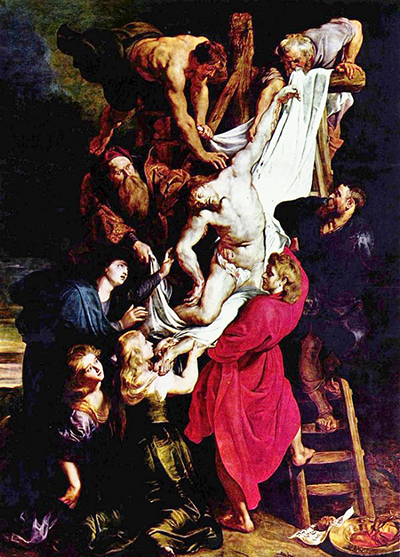
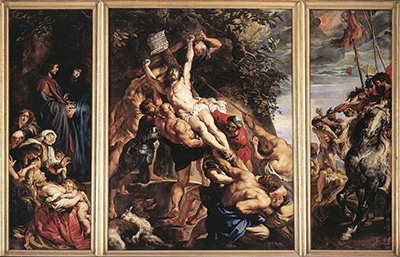
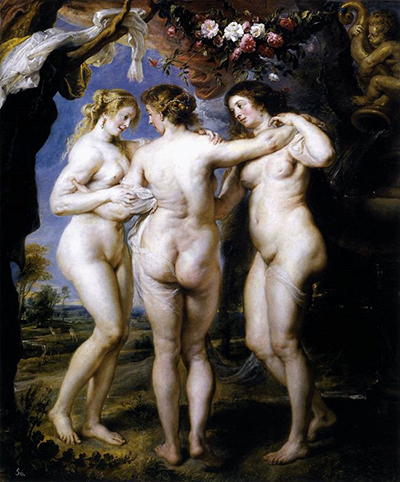
Where this work sits in Rubens's career
The Elevation of the Cross
1609–10The Descent from the Cross
1611–14The Garden of Love
1630–35The Three Graces
1630–35Contents
- Who was Albert?
- Look at the layers, not just the likeness
- Why is the attribution qualified?
- The Budapest and St Petersburg drawings
- A face used in religious painting?
- What the sheet can and cannot tell us
Who was Albert?
The Albertina identifies the child as probably Albert Rubens, Peter Paul Rubens's firstborn son. Its entry says Albert was baptised on 5 June 1614 and named after Archduke Albert, governor of the Southern Netherlands. If the boy appears four or five years old here, a date around 1619 follows. That is why the catalogue's date and question mark belong together: the estimate partly relies on the age read from his appearance, not on a dated inscription written by the artist.
Calling the child Albert does not turn this into an official family portrait. The closely cropped profile, unfinished shoulders and concentration on the head make it look like a study of a face. Yet a study can still have considerable tenderness. The small features have been observed closely, while the hair is worked into a more elaborate pattern. This balance between a particular child and a carefully built image is one reason the drawing invites personal readings.
The Albertina's text reports that Albert shared his father's interest in antiquities and cites Rubens's later affectionate correspondence. Such later biographical details can help us remember that the sitter had a life beyond this childhood likeness. They cannot prove who drew the specific surviving sheet. A loving father may have drawn his son repeatedly, as the museum suggests; this Vienna paper may nevertheless be a later version or copy within that group.
Look at the layers, not just the likeness
The portrait works first as a profile. The eye, nose, lips and rounded chin make a clear contour on the left. The boy looks away from us rather than outward. A few dark accents at the eye and mouth hold the expression together. Pink-red chalk warms the cheek. Around the forehead and ear, lighter marks establish volume; the curls at the back become denser and more emphatic.
The shoulders do not receive the same finish. Lines descend from the neck and fade into an open lower area. That incomplete edge directs attention back to the head. It also helps explain why one should avoid treating the sheet as if every visible mark were executed at one moment for one purpose. Drawing can be revised, strengthened and re-presented. The Albertina identifies chalk, pen and wash as separate materials that have interacted on this paper.
A reproduction allows us to see the broad difference between the pale foundation and darker outlining, but it cannot by itself establish which hand made each layer. The museum says the pen drawing and wash were added later and does not regard those additions as Rubens's own. On both the Vienna sheet and a related Budapest version, it says that overworking partly obscures the original black-chalk design. The extra marks make the study more picture-like, but they also make the underlying attribution harder to test visually.
The museum's assessment of line quality is specific. It describes the chalk hatching of the Vienna face as less delicate than the Budapest drawing, and the pen strokes around the lower face as coarser and heavier. Those are curatorial judgments made after comparing actual objects. We can understand their consequence without pretending a small online image settles the matter: the Vienna sheet's present appearance is not simply a transparent record of Rubens's first touch.
Why is the attribution qualified?
The Albertina's display field gives the traditional association in a controlled form: “attributed to” Rubens. Its catalogue essay is more explicit about the open alternatives. The underlying chalk could be connected with Rubens, but later ink and wash hide enough of it that the museum cannot confidently confirm his hand there. It also allows that the Vienna sheet may be a contemporary copy after the Budapest version, or that both Vienna and Budapest could depend on a lost Rubens original.
These possibilities should not be compressed into a single statement that the drawing is “fake.” A contemporary copy after a lost design would still be evidence of how a Rubens portrait circulated and was valued. A partly autograph chalk study with later reworking would have a different history again. The museum has not selected a definitive answer. The careful public description is therefore the one its current record uses: a drawing attributed to Rubens, with later additions it judges non-autograph and an unresolved chalk foundation.
The visible inscription “P P Rubens” might seem to simplify matters, but the Albertina states it was written by another hand. It is not a signature securely placed by Rubens himself. On works with debated authorship, this difference is crucial. An inscription can record an owner's belief or a later attribution; it need not prove the drawing's original maker. The catalogue also records a collecting mark of Duke Albert of Saxe-Teschen. That mark belongs to the sheet's later collecting history, not to the identity of the child named Albert.
Attribution is often presented as a yes-or-no label. This case is better understood as a sequence of questions: who first drew the face in chalk; who reinforced it with pen and wash; whether the Vienna and Budapest sheets repeat each other or an absent model; and what evidence could discriminate among those possibilities. The public record lets us ask those questions clearly. It does not let us answer all of them conclusively.
The Budapest and St Petersburg drawings
The Vienna profile is not the only portrait study associated with Albert. The Albertina discusses a close drawing in the Museum of Fine Arts, Budapest. Both sheets were shown together in Munich in 2003 to make direct comparison possible. The catalogue considers the Budapest version more finely handled, but says both were reworked in pen and wash. It therefore cannot simply inspect the visible surface and certify the original chalk beneath.
The museum also mentions two drawings of the young Albert in the Hermitage, St Petersburg, one seen from the front and another turned slightly left. These are related portraits, not alternate names for the Vienna object. The catalogue notes a further profile view, mirror-reversed relative to the Albertina sheet, recorded in a former Paris collection. A family of drawings thus surrounds this face. Their likenesses support a history of repeated study or copying, while their differences require each physical sheet to be identified separately.
For this page, the key object is Albertina inventory 8268. A comparison with Budapest helps explain the qualified attribution; it should not cause captions or dimensions from one sheet to migrate to the other. The Vienna drawing measures 22.8 × 20 cm. The Albertina gives the Budapest sheet different dimensions and inventory information in its notes. A shared child and similar profile do not make two pieces of paper one artwork.
The museum's text suggests Rubens probably drew Albert more than once. That is plausible given the repeated versions, but the exact direction of copying remains unsettled. Its possibility that both drawings depend on a lost original is an important reminder: an absent model can help explain similarities, yet its appearance cannot be described as though it survived. The differences we can see and the limits the catalogue states are the evidence available to a reader now.
A later Albertina drawing of Nikolaus Rubens[2], inventory 17648, offers a useful control for this family of images. The museum catalogues it as a separate black-chalk study with white heightening, about 1626/27, and links it to the brothers' later double portrait. That sheet, too, bears a name added by another hand, but the museum gives it an unqualified Rubens artist field. The contrast shows why an added inscription alone neither proves nor disproves authorship: the physical drawing and comparative evidence carry the argument.
A face used in religious painting?
The Albertina connects a portrait study of Albert with the young John the Baptist at the lower right of a Madonna and Child painting in Kassel. It says a study of Nikolaus, Rubens's other son, supplied the head of the Christ Child in the same work. This is a catalogue relationship between family drawings and a religious composition. It shows how a child's features could become part of a sacred scene rather than remaining confined to a domestic portrait.
Because the Vienna sheet's authorship is contested, the connection needs careful wording. The catalogue's claim about a study of Albert does not prove that every mark now visible on this exact Vienna sheet was drawn by Rubens for the Kassel painting. The surviving profile may preserve or repeat a design he used. The studio path from a particular sheet of paper to a finished canvas cannot be reconstructed just by matching the subject's name.
Even with that limit, the comparison changes how we look at the drawing. The compact outline makes the boy's head portable as a visual idea. A painter could turn a recognizable face into the head of a biblical child, adapting age and expression for the scene. Rubens's art often joined observed bodies to invented history, but the precise status of this surviving paper must remain independent of that broader practice.
The profile also differs from a formal painted likeness. There is no rich costume, elaborate setting or inscription to announce the child's rank. The focus is the structure of a young face. If the drawing or its model helped a later painting, that concentration would have made it useful. It is possible to appreciate its directness without deciding a disputed hand by sentiment.
What the sheet can and cannot tell us
The strongest object facts are straightforward: the Albertina holds inventory 8268, a 22.8 × 20 cm drawing in chalk, pen and wash; it names the sitter Albert Rubens in Profile to the Left and gives an attributed-to-Rubens authorship with an about-1619? date. The catalogue identifies the upper-right Rubens inscription as later or by another hand and views the ink and wash overwork as not by Rubens. Those facts should govern any short label for the page.
The child identification is well supported in the museum's view but still rests partly on comparison and apparent age. The exact original chalk hand is unresolved. The relationship between the Vienna and Budapest sheets is unresolved. The old inscription is not an autograph signature. None of these cautions makes the image less worth studying; together they make the sheet unusually revealing about how art historians reason from layered objects rather than names alone.
Look once more at the hair, the blush of the cheek and the thin outline of the shoulders. The sheet offers a remarkably vivid young profile. Then look at it as a historical object whose surface has changed. What seems like one immediate act of observation may contain an initial drawing, later enhancement, a name added by another person and a long afterlife in collections. Holding those stories together is more accurate than forcing an answer the present evidence does not give.
Rubens artworks directory
Frequently Asked Questions
The Albertina catalogues the sheet as attributed to Rubens, not securely by him throughout. It considers the later pen and wash reworking non-autograph and cannot firmly assign the underlying chalk.
The museum generally identifies him as Albert Rubens, Rubens's firstborn son, baptised on 5 June 1614. The apparent age of four or five contributes to its approximate 1619? date.
No. The Albertina records that inscription as by another hand. It cannot authenticate the drawing.
The catalogue lists black chalk, red chalk, brown pen and brown and grey wash. Their layered use is central to the attribution problem.
No. The Budapest sheet is a separate, closely related drawing. The Albertina compares them and leaves open whether one follows the other or both derive from a lost Rubens original.
The Albertina relates a study of Albert to the young John the Baptist in a Kassel Madonna and Child. Given the Vienna sheet's contested authorship, that comparison should not be treated as proof that this whole surviving drawing was an autograph working study for the canvas.
Discussion
Look closely at the face, curls and lightly sketched shoulders.
Share an observation about the sheet or a reliable source that adds to its history.
Reader Insights
Which parts seem made in chalk, and which seem later strengthened?
How does the Budapest comparison affect the attribution question?
What can an inscription by another hand tell us about a drawing's history?
Join the Conversation
Add your reading below, keeping observations specific and evidence clear.
References
- ALBERTINA, Albert Rubens im Profil nach links , inventory 8268, object record and catalogue essay. View source
- ALBERTINA, Nikolaus Rubens , inventory 17648, related family drawing. View source