by Tom Gurney
Tom Gurney BSc (Hons) is an art history expert with over 20 years experience
Published on June 19, 2020 / Updated on October 14, 2026
Email: tomgurney1@gmail.com / Phone: +44 7429 011000
A brother pictured alone
Philippe Rubens turns towards us in a dark coat and a broad pale ruff. His face emerges from a dark background, framed by short curls, a moustache and a full beard. There is no book, emblem or architectural setting to explain his position. Rubens relies on the sitter’s expression and the clear contrast of head, collar and clothing. The portrait is personal in subject, but it is also a carefully made picture of a man whose identity extended beyond being an artist’s brother.
The Detroit Institute of Arts[1] catalogues this painting as Philippe Rubens, the Artist’s Brother, dated 1610 or 1611. It is oil on oak panel, 68.6 × 53.7 centimetres unframed, accession 26.385. The alternative date belongs to the museum’s present record. The reproduction here shows this single bust portrait; Rubens also included Philippe in group compositions, and a later print shows him in yet another format.
The modest scale matters. The painting is large enough for a close view of a head and shoulders, but far smaller than Rubens’s imposing court portraits. That concentration draws attention to the face: the eyes look toward the viewer, the beard softens the outline of the jaw, and the white ruff holds the head against the black coat. A black-and-white reproduction can still show those relationships, though the colour and surface of the original panel should be understood from the museum’s own record, not inferred from this monochrome image.
At a Glance
- ArtistPeter Paul Rubens [1]
- SitterPhilippe Rubens [1]
- Date1610 or 1611 [1]
- MediumOil on oak panel [1]
- Dimensions68.6 × 53.7 cm [1]
- CollectionDetroit Institute of Arts, 26.385 [1]
Where this work sits in Rubens's career
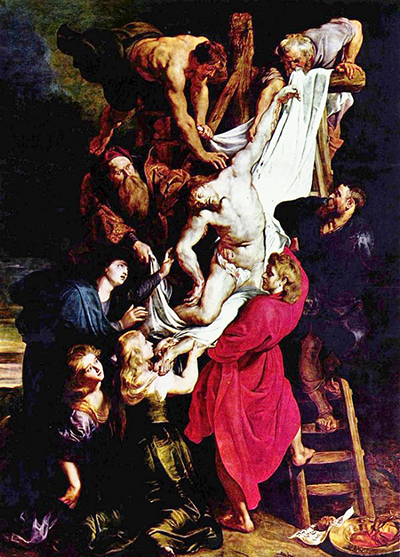
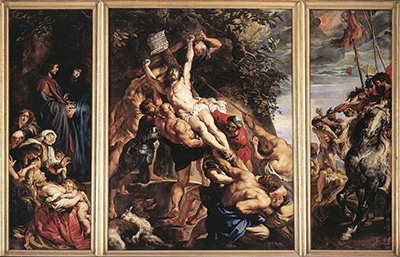
The Elevation of the Cross
1609–10Philippe Rubens, the Artist's Brother
1610 or 1611The Descent from the Cross
1611–14The Garden of Love
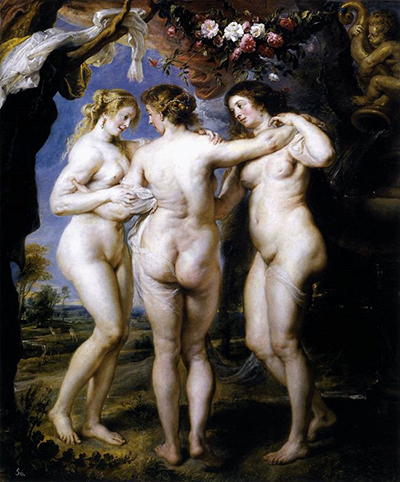
1630–35The Three Graces
1630–35Contents
- Philippe’s life beyond the portrait
- What do we see in the Detroit panel?
- Portrait, memorial and print
- What happened to the Detroit painting?
- Reading the epitaph as a family document
- What the 1615 engraving added
Philippe’s life beyond the portrait
Philippe was Peter Paul Rubens’s brother, but his own work belonged to the learned and civic world of the Low Countries. A surviving epitaph, transcribed in the Herzog August Bibliothek’s Rubens Online project[2], calls him a pupil of the humanist Justus Lipsius and records service connected with Richardot in Brussels and Cardinal Ascanio Colonna in Rome. It also names his role as a secretary to the Antwerp civic government. Those statements come from a memorial inscription, which praises the deceased; they provide contemporary evidence for how his family wanted his learning and offices remembered.
The epitaph records Philippe’s death on 28 August 1611. It names his wife, Maria de Moy, and their children, Clara and Philippe. The edition notes that Peter Paul became guardian of his brother’s young children. This family circumstance gives the Detroit painting an immediate human setting. It does not, by itself, prove whether Rubens painted the panel before Philippe’s death, just after it, or specifically for a grave monument. The museum’s date range straddles that loss and does not state a commission document in the online record.
Philippe’s humanist associations also help explain why Rubens represented him in other ways. The Italian national catalogue of The Four Philosophers[3] identifies Peter Paul, Philippe, Lipsius and Jan Woverius in the group painting now in the Uffizi. It dates that separate panel around 1611–12, after Philippe’s death and long after Lipsius’s. The group work builds a scene of friendship, learning and remembrance. Detroit’s portrait does something simpler: it presents Philippe alone, without a teacher, fellow scholar or philosophical bust. The two pictures can inform one another, but their supports, dimensions, settings and purposes differ.
What do we see in the Detroit panel?
The face is lit more strongly than the coat and background. The collar forms a broad white arc at the base of the head, almost a frame inside the picture. The shoulders turn slightly while the eyes meet us. Rubens did not need an elaborate gesture to make the sitter present; small differences of tone around the nose, eyelids and mouth give the face individual structure. The beard catches lighter strokes against the darker garment.
We can describe the visible pose without giving it an exact psychological label. A viewer may find the gaze solemn, reflective or direct. The museum does not document Philippe’s mood during a sitting. If Rubens painted the work before his brother died, such a reading would differ from a portrait made specifically after death. The current “1610 or 1611” date leaves that question open. The strongest account begins with what the object shows and with the named sitter, then keeps the larger memorial possibility qualified.
The support is oak, not canvas. This is part of the painting’s identity and affects how it would be handled and conserved, but the public Detroit record does not offer a technical report on the panel’s ground, pigments or alterations. No published technical findings here establish a particular underdrawing or restoration history. The black-and-white image helps identify the portrait but cannot support precise colour claims.
Portrait, memorial and print
The Detroit provenance begins with a probable association with the Church of St Michael’s Abbey in Antwerp. The word “probable” is important. Older writing, including nineteenth-century catalogue tradition, linked a portrait of Philippe with a memorial setting at the abbey. Detroit’s present record does not present that as an unqualified, fully documented origin for the surviving panel. The epitaph establishes a memorial for Philippe at St Michael’s; it does not identify every image once placed nearby or prove this exact panel’s original display position.
A related printed portrait is firmly a different object. The Rijksmuseum[4] holds a 1615 engraving by Cornelis Galle I after a design by Peter Paul Rubens, catalogue RP-P-OB-5961. It presents Philippe as a bust on a round pedestal within a niche, adorned with cherubs, fruit and torches. The museum identifies the print as an illustration for a 1615 volume of Philippe’s homilies. Its paper support, date, format and allegorical setting distinguish it from Detroit’s painted head-and-shoulders portrait.
The print shows how Philippe’s image circulated after his death in a scholarly publication. It does not establish that Galle engraved directly from the Detroit panel. The Rijksmuseum records an engraving after Rubens’s design, and other scholarship has discussed a drawing or oil sketch in that printmaking process. Without a direct object-to-object technical or documentary link, the safe relationship is that both works portray the same man through Rubens’s involvement. One is a painted likeness held in Detroit; the other is a memorial book illustration printed four years after the epitaph’s date.
The Uffizi group painting offers a third form of remembrance. There Philippe appears in a humanist circle, while the 1615 engraving elevates his bust in a symbolic niche and the Detroit panel stays close to an individual face. These are different visual answers to the question of how someone may be remembered. Rubens could picture a loved brother as a person, as a member of a learned community, and as an image fit to accompany published writings. The existence of all three does not fix the exact original intention of the Detroit panel.
What happened to the Detroit painting?
The DIA provenance[1] records a sequence of owners and sales after its qualified abbey association. It appears in a Peeters d’Aertselaer sale in 1817, an Antwerp sale in 1822, later private collections, and a Mecklenburg sale in Paris in 1854. Twentieth-century stages include the Castiglioni collection and its 1925 Amsterdam sale. William E. Scripps then gave the painting to Detroit in 1926, in memory of his son James E. Scripps II. These are documented collection milestones, not a perfectly continuous narrative from 1611 onward.
The many names in a provenance list can obscure the chief reader question: is this the same object as the portrait Rubens painted for a particular memorial? Detroit’s cautious first entry means the early link remains probable, and the intervening historical records need careful object identification. The painting’s present title and accession make its current identity clear. Its earlier placement should be explained with the museum’s own qualification rather than upgraded to certainty because a later print and epitaph also exist.
The Detroit museum lists extensive scholarship on the painting, including a 2019 article on the brothers’ early careers. That bibliography points to further scholarship. The account here rests on the direct museum record, transcribed epitaph, Uffizi catalogue and Rijksmuseum print for its principal claims. They let the article go beyond a generic biography while keeping each object and evidence type separate.
Reading the epitaph as a family document
The Latin epitaph offers more than a death date. It identifies Philippe as the son of Jan Rubens, praises his relationship with Justus Lipsius, lists work for Richardot, Cardinal Colonna and Antwerp's civic government, and names his wife and children. Those details explain the family and learned networks in which the Detroit sitter lived. The inscription also says that Maria de Moy placed the monument for her husband and his mother Maria Pypelinckx. The text is therefore a constructed act of family remembrance, not a neutral modern curriculum vitae.
The edition's note says Peter Paul became guardian of Philippe's young children. That fact gives the loss a direct consequence within the painter's household. Yet neither guardianship nor the epitaph's location at St Michael's proves the Detroit painting was hung at the tomb. The DIA lists the abbey as a probable first provenance; the memorial text establishes that there was an epitaph in the church. These two pieces of evidence intersect but do not identify the panel's original placement with certainty. A reader can see why a memorial association is plausible while still respecting the museum's qualification.
The inscription's rhetoric also differs from the painting's restraint. It praises Philippe's learning and offices through words, while the panel supplies no book, manuscript or civic badge. That contrast is evidence about two ways of representing him, not evidence that Rubens wanted the painted likeness to refute the epitaph. The text is public memorial language; the portrait brings a single face near to the viewer. We do not know whether Philippe sat for Rubens in 1610, early in 1611, or whether work continued after his death. Detroit's alternative date keeps all of those exact sequences unresolved.
What the 1615 engraving added
The Rijksmuseum identifies Galle's portrait as a book illustration for Homiliae Græcè & Latinè, edited by P. Rubens and printed in Antwerp in 1615. The sheet is an engraving on paper, 208 × 132 millimetres, catalogue RP-P-OB-5961. That format matters: it could circulate with a printed volume, reaching readers far beyond a family tomb or collection. Its round bust, niche, cherubs, fruit and torches give Philippe a formal memorial setting quite unlike Detroit's dark, plain background.
The museum credits Cornelis Galle I as printmaker after a design by Peter Paul Rubens and explicitly rejects an attribution to Cornelis Galle II. These are separate contributions. The plate's etched or engraved lines were made for a book illustration, while Rubens is credited with the design. A buyer of the 1615 volume might meet Philippe as a scholar whose writings survived him. That reading is supported by the print's published function and iconography; it does not establish a direct line of copying from the Detroit oil panel.
The print's exact measurements should not be imported into the oil painting's record. Its accession number and paper support keep it distinct, just as the Uffizi Four Philosophers keeps Philippe within a group rather than alone. Together the three images show how a likeness could be adapted for private viewing, collective humanist memory and publication. They do not prove that all three were conceived as one coordinated project. The surviving records connect them through sitter and Rubens's involvement, while leaving their commissioning relationships open.
Rubens artworks directory
Frequently Asked Questions
Philippe Rubens, the painter’s brother, a humanist and Antwerp civic secretary. His 1611 epitaph records his learned circle, family and offices.
The Detroit Institute of Arts dates it 1610 or 1611. The museum’s public record does not choose one year or establish a particular sitting day.
Detroit lists a probable connection with St Michael’s Abbey, where Philippe’s memorial was located. That is a qualified provenance claim, not a documented commission for this exact surviving panel.
No. The Detroit work is a single oil portrait on oak. The Four Philosophers is a separate group painting in Florence, and Galle’s 1615 engraving is a book illustration on paper.
It is in the Detroit Institute of Arts, accession 26.385, given by William E. Scripps in 1926.
Discussion
Look closely at the face and ruff in this monochrome reproduction.
Share an observation about the portrait or a reliable source that adds to its history.
Reader Insights
What can the 1611 epitaph tell us about Philippe?
Why does the possible abbey origin remain qualified?
How does the 1615 engraving change the form of Philippe's image?
Join the Conversation
Add your reading below, keeping observations specific and evidence clear.
References
- Detroit Institute of Arts, Rubens, Philippe Rubens, the Artist’s Brother , 26.385. View source
- Herzog August Bibliothek, Rubens Online , transcription of Philippe Rubens’s 28 August 1611 epitaph. View source
- Italian national catalogue, Rubens, The Four Philosophers , Uffizi, record 0900129505. View source
- Rijksmuseum, Cornelis Galle I after Rubens, bust portrait of Philippe Rubens, 1615, RP-P-OB-5961. View source