by Tom Gurney
Tom Gurney BSc (Hons) is an art history expert with over 20 years experience
Published on June 19, 2020 / Updated on October 14, 2026
Email: tomgurney1@gmail.com / Phone: +44 7429 011000
A battle that begins above the battlefield
An angel breaks out of the bright opening in a dark sky. Below, soldiers and horses crowd so tightly that the first impression is of a single mass of falling, turning and fleeing bodies. A pale horse rears near the centre; another horse and its rider strain through the crush. To the right, figures are already trying to escape. Rubens makes the attack arrive from a place the soldiers cannot fight. The painting's subject is a defeat caused by divine intervention, and its design gives that intervention the highest point and strongest light.
This is Peter Paul Rubens's The Defeat of Sennacherib, in the Bayerische Staatsgemäldesammlungen[1] at the Alte Pinakothek, Munich. The museum dates the work about 1617 and records it as oil on oak panel, 97.7 × 122.7 centimetres, inventory 326. Those details identify this particular painting. Other drawings and prints treat the same subject, but their materials, designs and histories belong to separate objects.
The reproduction on this page shows the main structure clearly, even at small size: a wedge of celestial brightness above an almost unbroken zone of human disorder. Red drapery catches the eye across the upper and central area, while the white and grey horses pull the viewer into the encounter below. The horses are not incidental scenery. They make the sudden reversal of power visible. A mounted army that might have seemed invincible now struggles to control its own animals.
At a Glance
- ArtistPeter Paul Rubens [1]
- DateAbout 1617 [1]
- MediumOil on oak panel [1]
- Dimensions97.7 × 122.7 cm [1]
- CollectionAlte Pinakothek, Munich, inventory 326 [1]
Where this work sits in Rubens's career
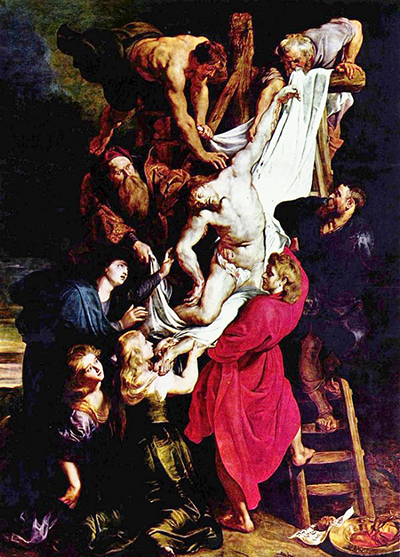
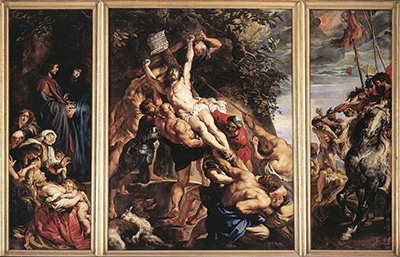
The Elevation of the Cross
1609–10The Descent from the Cross
1611–14The Defeat of Sennacherib
c. 1617The Garden of Love
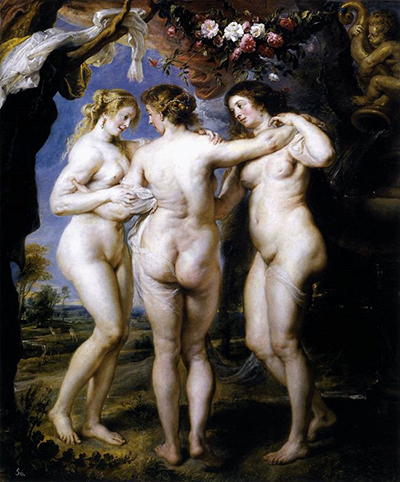
1630–35The Three Graces
1630–35Contents
- What happened to Sennacherib in the biblical account?
- How does Rubens organise the confusion?
- The composition before and after the Munich panel
- Where did the panel go after Rubens?
- What the drawings reveal—and what they do not
- A later print chose only part of the action
What happened to Sennacherib in the biblical account?
Sennacherib was the Assyrian king whose army threatened Jerusalem. The Pinakothek's account[1] sets the siege in 701 BCE and explains the painting through the Old Testament narrative. In 2 Kings 19:35–37[2], an angel strikes the Assyrian camp. The biblical text gives the number killed as 185,000; the survivors find the dead in the morning, and Sennacherib returns to Nineveh. The text then tells of his death there at the hands of his sons.
The biblical number is a claim within that narrative, not a count established by looking at the painting. Equally, Rubens does not illustrate the morning discovery as a quiet aftermath. He imagines the unseen night action as an immediate, spectacular collision. The angel is present, horses rear, soldiers fall, and the king's army is in the instant of losing control. This difference between text and picture matters: a painter can make a narrated miracle legible by showing the moment of impact that the words leave largely undescribed.
The religious meaning also depends on scale. The figures in the camp had brought an army to a city; the angel arrives alone. Rubens sets the supernatural figure and the opening in the clouds above the dense military apparatus. The result is not a balanced contest between two forces. The army's density becomes a liability as men, animals and equipment collide. The museum's reading identifies already fallen soldiers, fugitives at the right and an alarmed king within this compressed scene. That reading offers a useful route through a composition that can otherwise appear to be pure confusion.
How does Rubens organise the confusion?
At the top, the opening of light gives the eye a clear starting point. It is surrounded by dark cloud, making the bright passage more forceful. Diagonal movement then drives downward from the angel into the army. Below, the horses' heads and raised legs interrupt any simple horizontal march. Rubens gives the viewer the physical sensation of a formation collapsing rather than a map of a battlefield.
The pale horse near the centre is a decisive visual device. Its lifted body exposes its underside and makes its panic legible from a distance. Darker horses and armour overlap it, while the bright body stands out against the surrounding crowd. The Pinakothek specifically connects Rubens's rearing white horse to a model by Leonardo da Vinci. That is a statement about artistic borrowing, not an identification of every figure in Rubens's panel with an individual Leonardo drawing. The museum does not name a particular Leonardo sheet in its concise record, so a more exact source assignment would need separate evidence.
The light is also selective. It finds the angel, the horses and parts of the struggling army while leaving other sections in shadow. This uneven illumination lets Rubens present several events at once: supernatural arrival, terror in the middle and flight at the edges. The Pinakothek describes the scene as compressed and its light as differentiated. In a panel a little over a metre wide, compression is essential. Rubens cannot make the story unfold across a long continuous landscape; he pushes its causes and consequences close together.
The small image supports this broad reading but not every small identification. Its limited size makes some peripheral faces and equipment difficult to inspect. The safest visual claims are the luminous angel, turbulent clouds, rearing horses, fallen bodies and flight toward the right. For specific placement of the king and particular groups, the museum's interpretation is the stronger source.
The composition before and after the Munich panel
Rubens did not arrive at this subject in isolation. The ALBERTINA[3] in Vienna catalogues a separate pen-and-brown-ink drawing of The Defeat of Sennacherib, inventory 8204, measuring 21.8 × 31.4 centimetres. Its account places the sheet around 1615/16 or shortly afterward and discusses a chain of designs associated with Christoph Schwarz, a copy by Hans von Aachen, and the court collection of Archduke Albert in Brussels. The drawing's attribution to Rubens has been debated; the ALBERTINA reports the scholarly case for accepting it as his. It is therefore useful evidence of design and artistic exchange, but its authorship should not be presented as a universally settled fact.
The ALBERTINA distinguishes its earlier drawing from the later Munich painting. It notes that the panel, made about 1617, pushes the action toward the rearing horse and the dramatic opening of light. The museum also records another washed-pen drawing, inventory 15104, which it suggests Rubens may have worked out before the painted version. That sheet is a separate step; the catalogue's cautious wording does not make every drawing a certain preparatory design. The ALBERTINA essay relates the subject's visual tradition to Raphael's Expulsion of Heliodorus and Leonardo's battle imagery. These comparisons help explain why a biblical military defeat might invite complex horses and tumbling bodies. They do not turn Rubens's scene into a literal copy of Raphael or Leonardo, nor do they mean either ALBERTINA sheet is the Munich oil panel on paper.
Another life of the subject followed in print. The National Gallery of Art[4] in Washington catalogues an etching of The Defeat of Sennacherib by Pieter Claesz Soutman after Rubens, dated broadly 1618–45. The ALBERTINA describes Soutman's large print as drawing on the mounted central action. Reproductive prints could carry a Rubens design to viewers who would never see the painting. The NGA's print date is a range for the print, not a revised date for the Munich panel; Soutman is the printmaker, not the attributed painter of the Pinakothek object.
These related works illustrate a practical problem for anyone searching the title. A drawing, an oil panel and an etching can share a biblical subject and borrow compositional ideas without being interchangeable. The Munich painting has a known material, size and collection number. Those object facts should govern the page's image and caption.
Where did the panel go after Rubens?
The Pinakothek record[1] says the painting entered the Bavarian collection in 1806 from the Düsseldorf Gallery. This gives a secure documented transfer. The brief public record does not supply a named original patron or a continuous ownership chain back to Rubens's workshop. Those gaps should be left as gaps instead of filled with assumptions based on the painting's biblical subject or later location.
The support is worth repeating because it is easy to confuse the work with Rubens's much larger canvases. This is an oak panel, less than one and a quarter metres across. Its tightly packed figures and forceful lighting create the impression of a much wider conflict. The painting's physical compactness is part of the achievement: Rubens turns a short biblical report into an intense scene that appears to burst beyond its edges.
What the drawings reveal—and what they do not
The ALBERTINA's full discussion is unusually useful because it does not present the early sheet as an uncomplicated first draft for the Munich panel. Its 8204 drawing is catalogued as Rubens copying after Christoph Schwarz, with a date around or shortly after 1615–16. The museum says Rubens knew Schwarz's composition through a copy by Hans von Aachen, rather than by seeing the lost original directly. That makes the sheet evidence of artistic transmission across courts as well as of Rubens's response to a biblical subject. It also means that a similarity between the Vienna drawing and Munich panel cannot be described as if Rubens had simply sketched the painting from life and then enlarged it.
The ALBERTINA reconstructs a sequence in which the older composition reached Archduke Albert's collection in Brussels around 1615–16. Rubens could then study a version of it and reconsider its action. Its own object essay describes the later painted panel as concentrating the main scene around Sennacherib's suddenly rearing horse and opening a brilliant break in storm clouds. Those differences matter more than a vague claim that Rubens “borrowed” a battle scene. The story's centre of gravity moves toward one alarmed rider and the supernatural light that defeats his army. The Munich painting is a fresh, compressed treatment within a known visual tradition.
Authorship of the early drawing has itself been argued. The ALBERTINA says both Sennacherib sheets were considered Rubens originals in the collection of Pierre-Jean Mariette, but modern scholars have not agreed throughout. One objection is that Rubens's copies after older masters generally isolate and vary details instead of reproducing complete scenes. The museum reports Lohse Belkin's later case for accepting the early sheet as autograph, based partly on its technical refinement. That history explains why the current catalogue can credit Rubens while an article should still tell readers the attribution was debated. Neither an old collector's confidence nor a current label erases the argument behind the label.
The second Vienna drawing, 15104, is associated more directly with the composition developed for Munich, but the museum says Rubens may have worked it out before painting. It is not an exact timestamp for the panel's creation. A proposed progression from copied source to revised drawing to oil painting is a scholarly reconstruction using surviving objects, not a complete studio notebook. The paintings and drawings can show changes of emphasis without proving the number of drafts now lost. Keeping that limit visible helps readers understand the real evidential strength of a rare surviving design sequence.
A later print chose only part of the action
The ALBERTINA says Pieter Claesz Soutman's monumental print concentrated on the riders around Sennacherib rather than preserving all of the Munich panel's balance of heaven and earth. It even judges that choice unfavourably for the composition. This is a curatorial assessment of the print's design, not a statement that Soutman misunderstood the biblical text. A print after Rubens could select and reorganise a part of a painting for its own scale and audience. Its maker was responsible for that reproductive translation.
The sequence of Schwarz design, Van Aachen copy, Rubens drawings, Munich panel and Soutman print is therefore more than a list of same-title objects. At each stage, an artist or workshop handled an inherited composition differently. The subject remained Sennacherib's defeat, but the emphasis on a rearing horse, massed riders and the source of divine light could shift. A local page about the Munich panel should use that chain to explain Rubens's invention while still naming the oak painting as the object actually reproduced here. It should not silently attach Vienna's 21.8 × 31.4-centimetre drawing measurements or the print's wide date range to the Alte Pinakothek panel.
Rubens artworks directory
Frequently Asked Questions
It is in the Alte Pinakothek, Munich, as Bayerische Staatsgemäldesammlungen inventory 326.
The holding collection dates the panel about 1617.
It is oil on oak panel, measuring 97.7 × 122.7 centimetres.
The biblical story and the museum's identification make the figure the angel who strikes the Assyrian army.
No. It is a separate, smaller ink drawing related to the subject; its attribution has a documented scholarly debate. The Munich object is the finished oil panel on this page.
Discussion
Look closely at the angel, the rearing horse and the fleeing soldiers.
Share an observation about the painting or a reliable source that adds to its history.
Reader Insights
How does the high light shape the movement below?
What differs between the biblical narrative and Rubens's visible moment?
How do the ALBERTINA drawings relate to the Munich panel?
Join the Conversation
Add your reading below, keeping observations specific and evidence clear.
References
- Bayerische Staatsgemäldesammlungen, The Defeat of Sennacherib , inventory 326. View source
- 2 Kings 19:35–37, New Revised Standard Version Updated Edition. View source
- ALBERTINA, related Defeat of Sennacherib drawing, inventory 8204. View source
- National Gallery of Art, Pieter Claesz Soutman's etching after Rubens. View source