by Tom Gurney
Tom Gurney BSc (Hons) is an art history expert with over 20 years experience
Published on June 19, 2020 / Updated on October 14, 2026
Email: tomgurney1@gmail.com / Phone: +44 7429 011000
A hunt that fills the canvas
A white horse thrusts into the centre as riders, men on foot, dogs and wild animals converge. Spears rise above the crush. A brown horse presses from the left, while a grey horse and its mounted rider anchor the right. At ground level, bodies tangle so closely that it takes time to distinguish hound from wolf and living movement from fallen prey. Rubens and his workshop make the viewer feel the scale and confusion of a hunt before the scene can be read calmly.
The Metropolitan Museum of Art catalogues the painting[1] as Wolf and Fox Hunt by Peter Paul Rubens and Workshop, about 1616, oil on canvas, measuring 245.4 × 376.2 centimetres. Its accession number is 10.73. The workshop credit is an essential part of the object's identity: Rubens planned and participated in the picture, but the museum does not attribute every brushstroke of this vast surface to him alone.
The painting is large even now. According to the Met, it was originally larger and was trimmed to fit a collector's home. What survives is therefore a historically altered version of the composition. The lost edges cannot simply be reconstructed from the current canvas. Any reading of its balance must remember that the frame we see is not exactly the frame first painted.
At a Glance
- ArtistPeter Paul Rubens and Workshop [1]
- DateAbout 1616 [1]
- MediumOil on canvas [1]
- Surviving size245.4 × 376.2 cm [1]
- CollectionThe Metropolitan Museum of Art, 10.73 [1]
- Canvas historyOriginally larger; later trimmed [1]
Where this work sits in Rubens's career
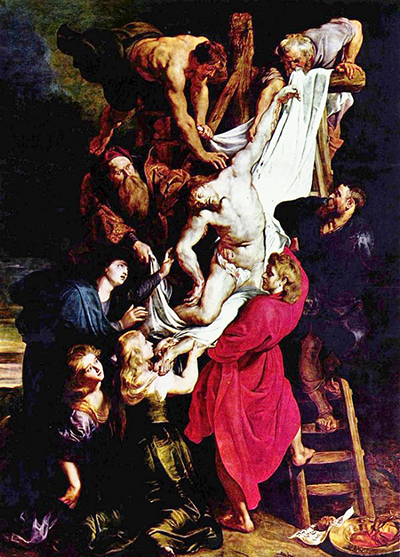
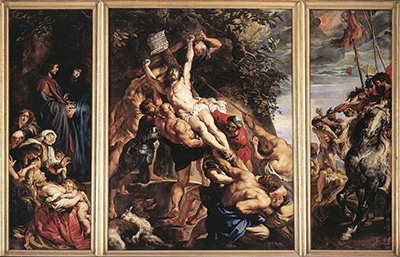
The Elevation of the Cross
1609–10The Descent from the Cross
1611–14Wolf and Fox Hunt
c. 1616The Garden of Love
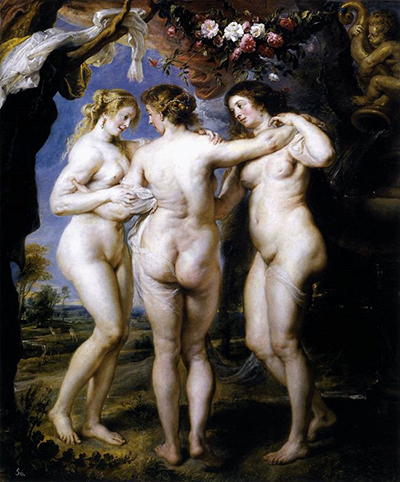
1630–35The Three Graces
1630–35Contents
- Where to look first
- Which passages are by Rubens?
- A new kind of monumental hunt
- Hunting as a sign of rank
- The scene's movement and its limits
- Compared with Rubens's other hunts
Where to look first
The light horse near the centre offers an entry point into the busy design. Its pale body stands out from brown animals and darker clothing. The Met's audio discussion features equine photographer Bethany Pastorial, who says the bright grey horse at right immediately drew her eye. That is a viewer's observation rather than an attribution claim, but it helps explain how colour and movement direct attention in such a crowded picture.
From the horses the eye drops into the struggle beneath them. Dogs seize or surround the quarry; a wolf's body meets the attack. At the left, a man on foot lunges inward, extending the human line of force from the edge of the picture. The weapons and horses turn the encounter into a collision of diagonals rather than a procession. The animals are not arranged as tidy specimens. Their overlapping bodies require the viewer to reconstruct who is pursuing whom.
The wide format lets multiple incidents happen at once. Mounted hunters have the elevated view and commanding gestures; people and dogs on the ground confront the animals at close range. The scene is organized enough to remain legible, yet it refuses the calm order of a ceremonial portrait. That tension between control and danger is part of its appeal. The hunters' status is visible in horses, equipment and command, while the physical fight at their feet shows what that privilege entails.
The painting does not ask us to admire a harmless outing. The quarry is being attacked, and the dogs and wolves appear caught in a violent struggle. Modern viewers may react differently to this spectacle than the elite buyers Rubens hoped to reach. Describing the scene accurately gives room for that response without pretending that the picture was made as an argument for modern conservation or animal welfare.
Which passages are by Rubens?
The Met says Rubens painted the picture with assistants, and it reports that he declared the wolves to be his own work. The statement is unusually specific within a large collaborative canvas. It gives a reason to pay close attention to the wolves' bodies, heads and movement. It does not license a neat division in which every other animal, hunter, tree or patch of sky can be assigned to a named assistant.
Rubens ran a workshop capable of producing large, complex pictures. In this case the current institutional credit is deliberately shared: Rubens and Workshop. Such a label describes authorship more carefully than either calling the canvas wholly autograph or reducing Rubens to a designer who never touched it. The Met's note on the wolves connects his own hand to a crucial part of the image, while leaving the rest of the labour unallocated in its public summary.
The scale of the work makes collaboration understandable. At nearly 3.8 metres wide, the painting has many figures, animals and interactions to coordinate. Planning that action and bringing it to completion are different tasks. Assistants could help execute portions within Rubens's studio practice, but the cited museum entry does not name them or map their contributions figure by figure. A responsible account stops at the level of detail the evidence supports.
That boundary matters because claims about workshop hands can sound more certain than they are. A horse that looks less forceful than a wolf is not, by itself, proof of another named painter. Brushwork may vary for reasons of subject, position, later trimming, condition or artistic choice. The Met's attribution and Rubens's statement provide a sound basis; unsupported lists of assistants would not improve the viewer's understanding.
A new kind of monumental hunt
The Met describes this as the first of Rubens's very large canvas hunting scenes[1] and says he created a market for such pictures. Its claim is about a particular monumental painted format in his practice, not a claim that no artist had pictured a hunt before him. The museum compares these canvases with tapestries, which could furnish a large room with scenes of pursuit but cost far more to produce.
In the Met's audio transcript, Associate Curator Adam Eaker explains that a tapestry on this scale might take a year to make. A painting produced by Rubens's workshop offered a less costly way to possess a monumental hunting image. This economic point helps explain why the canvas was so wide and why workshop participation was not incidental. Rubens could offer scale, prestige and dramatic invention in a medium more flexible than woven fabric.
The painting still needed a room large enough for it. The Met's note that it was later trimmed to fit a collector's home exposes the practical side of the market. A picture conceived on a grand scale could become difficult to install when ownership or setting changed. Cutting it down solved a display problem but changed the object. The surviving dimensions are measurements of the altered canvas, not proof of its exact original size.
The Met's discussion calls Rubens commercially alert. That is more concrete than a vague claim that he was simply “ahead of his time.” He identified a visual subject associated with elite display, adapted it to an enormous painted canvas and used his workshop to help produce it. The resulting work could compete in effect with a tapestry while retaining the speed and surface of oil painting.
Hunting as a sign of rank
The hunt was not an equal-access pastime in Rubens's world. In the Met audio commentary[1], Eaker calls it an aristocratic prerogative and a marker of status. Those entitled to hunt could commemorate that right in the pictures around them. The image's mounted riders, weapons and coordinated hounds make sense in that social context. It is a display of power over land and animals as much as a record of speed and danger.
This does not mean we can identify a specific patron from the current public object summary or say precisely where the original canvas hung. The museum's explanation identifies the market and status function of the type. The painting itself shows women and men participating in a staged pursuit, but it does not come with a label naming every sitter. Reading status in the equipment and action is supported; assigning personal identities without documentation would be a different claim.
Art historian Alice Ayres, in a peer-reviewed study of early Stuart hunting images[2], points out a composed female huntress at the edge of Rubens's battle. Her observation matters because it complicates an easy description of the scene as an exclusively male enterprise. The woman is not the central combatant, yet she appears equipped and present within the aristocratic hunting party. Ayres discusses her in comparison with other images of elite women and the hunt; the comparison does not prove the figure's individual name.
Ayres also says Sir Dudley Carleton attempted but failed to buy a Wolf and Fox Hunt in 1616–17. The correspondence around Rubens's hunt paintings is complicated, and related compositions circulated. The article's wording should not be flattened into a secure provenance statement that Carleton owned the present Met canvas. The useful point is that a buyer of diplomatic and courtly standing was interested in this kind of painting very soon after its production.
The scene's movement and its limits
Rubens's composition places the most difficult encounter low in the picture, where hooves, paws, bodies and weapons overlap. The upper half gives those actions air: riders' faces and raised arms stand against a lighter sky. That distribution lets a viewer recognize individual gestures while still feeling that the fight is one continuous event. The movement seems to cross the canvas in several directions rather than flow toward a single point.
The painting is often discussed as a triumph of action. That description is fair, but the action is not purely formal. A hunt was a claim to social privilege, and the animals' suffering supplies the scene's dramatic force. Rubens's wolves are both quarry and active bodies resisting attack. The dogs are not passive accessories; their movement drives the collision. Looking closely prevents the animals from becoming mere texture beneath heroic riders.
The title names both wolves and foxes. A small retained image makes some lower figures hard to distinguish; the Met's full object record[1] is the reliable anchor for identification. The painting's visual density is itself worth noting. A viewer's first impression may be “horses and dogs”; the title asks us to find the wild quarry among them.
The current cropped form may intensify the sense of crowding. Since the Met states that the painting was trimmed, we know its boundaries have changed. We do not know from the short public summary exactly how every original edge looked or how much space disappeared at each side. It would be misleading to draw a precise lost border from an intuition that the scene feels tight. The documented alteration is enough to frame a careful visual reading.
Compared with Rubens's other hunts
Rubens returned to hunting scenes with many different animals and settings. A viewer might compare this New York canvas with the Munich Lion Hunt or the Hippopotamus and Crocodile Hunt, but those are separate pictures with their own dates, locations and object histories. Here the quarry is wolf and fox, and the Met's distinctive evidence concerns an early monumental canvas, workshop execution and subsequent trimming. Details belonging to another hunt should not be imported into this one.
The comparison does help explain Rubens's range. Hunting pictures allowed him to test bodies under pressure: horses turning, men leaning, dogs springing, predators fighting back. The New York scene demonstrates how an enormous canvas could organize many such movements for a wealthy viewer. The workshop helped make that ambitious scale possible, while Rubens's declared work on the wolves kept his own painting central to the scene's most charged encounter.
The Met acquired the painting through the John Stewart Kennedy Fund in 1910, according to its object record. Today it is 10.73 at The Metropolitan Museum of Art, New York. Current gallery locations can change, so the accession and institution are the stable identifiers. The museum marks its object image Public Domain and offers Open Access media; the existing local image on this page is retained as the approved site asset.
Rubens artworks directory
Frequently Asked Questions
The Met credits Peter Paul Rubens and Workshop. It says Rubens worked with assistants and stated that the wolves were his own work. The public summary does not name an assistant for every other passage.
The museum dates it about 1616. The surviving oil-on-canvas painting measures 245.4 × 376.2 centimetres. It was once larger and was trimmed to fit a collector's home.
The Met explains that a monumental painted hunt could provide a tapestry-like display at lower cost. Its curator describes hunting images as markers of aristocratic status.
Alice Ayres reports that Carleton attempted but failed to buy a Wolf and Fox Hunt in 1616–17. That account should not be turned into proof that he owned the surviving Met canvas.
It is 10.73 in The Metropolitan Museum of Art, New York. The museum's live record gives current display information.
Discussion
Trace the struggle beneath the three horses before looking at the riders.
Share an observation about the painting or a reliable source that adds to its history.
Reader Insights
Which figure or animal draws your eye into the crowded scene?
How does the great scale change your response to the hunt?
What can the museum's workshop credit tell us, and what remains unknown?
Join the Conversation
Add your reading below, keeping observations specific and evidence clear.
References
- The Metropolitan Museum of Art, Wolf and Fox Hunt , 10.73, object record and audio transcript. View source
- Alice Ayres, peer-reviewed discussion of the hunt, female huntress and Carleton's attempted purchase, Journal of Historians of Netherlandish Art 12:2 (2020). View source