by Tom Gurney
Tom Gurney BSc (Hons) is an art history expert with over 20 years experience
Published on June 19, 2020 / Updated on October 14, 2026
Email: tomgurney1@gmail.com / Phone: +44 7429 011000
A rider worked out on paper
A horse steps forward from a few rapid lines and shaded areas. Its pale head is close to the centre of the sheet, one foreleg raised, while an armoured rider rises behind it. A tree trunk frames the left edge and branches hang at upper right. The drawing is small and monochrome, yet it already establishes the frontal encounter that gives Rubens's finished equestrian portrait of the Duke of Lerma so much force.
The Musée du Louvre catalogues this sheet[1] as Portrait du duc de Lerma by Peter Paul Rubens, inventory INV 20185 recto, in its Department of Prints and Drawings. It measures 29 × 21.5 centimetres and combines pen and brown ink, brown wash and black chalk. The Louvre does not give a date for its creation in the current object record. The title of this page describes its relationship to a famous equestrian canvas, but the museum's own title is simply a portrait of the duke.
That distinction matters. The drawing shows an idea for a mounted figure and closely relates to the signed 1603 oil painting now in the Prado. Calling it a study is useful, but it should not suggest that every line can be placed into a fully documented sequence of preliminary stages. The Louvre identifies the sheet, its materials and collection history; the finished Prado work supplies the secure dated context.
At a Glance
- ArtistPeter Paul Rubens [1]
- DateUndated; related Prado painting signed 1603 [1][5]
- MediumPen and brown ink, brown wash, black chalk [1]
- Size29 × 21.5 cm [1]
- CollectionMusée du Louvre, INV 20185 recto [1]
- Historic labelOnce catalogued as Archduke Albert on horseback [1]
Where this work sits in Rubens's career
Study for an Equestrian Portrait of the Duke of Lerma
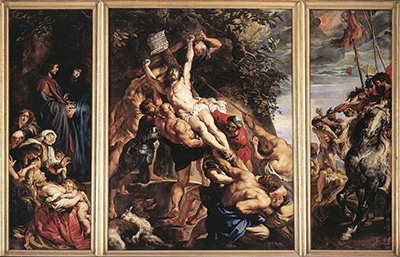
c. 1603 (inferred)The Elevation of the Cross
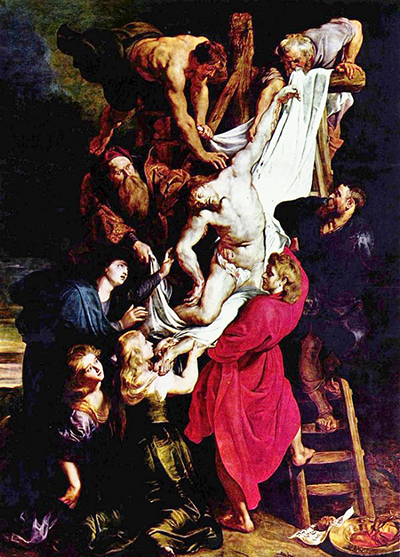
1609–10The Descent from the Cross
1611–14The Garden of Love
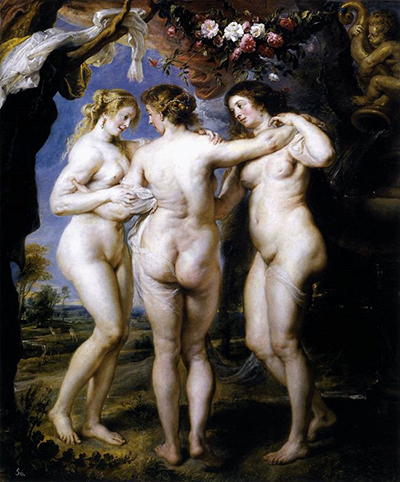
1630–35The Three Graces
1630–35Contents
- The horse's forward movement
- Ink, wash and chalk
- Relationship to the Prado portrait
- What can we say about the date?
- A portrait without a fixed historic name
- From the king's cabinet to the Louvre
- Looking again at horse and rider
The horse's forward movement
The horse occupies most of the sheet. Its head faces outward, its chest is broad, and a lifted foreleg gives the impression of motion toward us. The animal's pale mass separates from the darker rider and the tree behind. Rubens can make the horse feel substantial with only a limited range of tones. There is no need for oil colour to make the form advance.
Look at the foreleg first, then the bridle and head, and finally the rider. That route through the image repeats the physical hierarchy of an equestrian portrait: the powerful mount brings the sitter into view. The horse's neck and mane guide the eye upward, while the rider's body gives the movement a human owner. The sheet explores how horse and person can read as one commanding unit.
The tree is equally useful. It anchors the left side, countering the horse's motion and giving the rising rider a dark setting. Loose branches at the top keep the figure from floating in blank paper. Rubens gives just enough landscape to set the portrait in a place, but most of the sheet's energy remains in the horse and armoured figure.
The drawing's small size changes the viewer's relationship to this subject. At 29 × 21.5 cm, it can be examined close to the hand that made it. The Prado canvas is 290.5 × 207.5 cm, almost exactly ten times as high and nearly ten times as wide. The shared frontal idea is therefore tested across very different scales. The sheet invites close inspection of marks; the painting presents a mounted sitter at monumental size.
Ink, wash and chalk
The Louvre lists three kinds of mark-making: brown ink applied with a pen, brown wash, and black chalk. Those are not decorative labels. A pen can state a contour or harness line sharply; wash can give a broader area of shadow; chalk can set out or reinforce form in a softer way. The visible drawing depends on the movement between outlined parts and tonal masses.
It is tempting to treat each kind of mark as a dated step in a fixed workflow: chalk first, pen second, wash last. The Louvre entry does not specify such a sequence. A material list tells us what is present, not exactly when each pass was made. The sheet may still reveal searching or revision, but a claim about the order of execution would require closer technical evidence.
The medium also distinguishes this object from the finished portrait. The Prado catalogues the painting[5] as oil on canvas, signed and dated 1603. Its armour, white horse, command staff, tree and distant cavalry are carried through paint and colour. The Louvre sheet is a much smaller graphic object. Treating one as a reduced reproduction of the other would miss the drawing's own handling.
Even a monochrome reproduction shows how marks gather around the horse's face, the armour and the rider's head. Other areas are left relatively light. The contrast concentrates attention where the mounted figure needs definition. Rubens can leave air around the body and still make the horse step forward. That economy is part of the sheet's appeal as a drawing.
Relationship to the Prado portrait
The connection to the finished Equestrian Portrait of the Duke of Lerma[5] is visible in the armoured rider, frontal horse, lifted foreleg and framing tree. The Prado picture adds the full painted setting and the details of Lerma's public identity. Its white horse advances beneath dark foliage, while a cavalry action appears in the background. The sitter holds a staff of command and wears the scallop badge of the Order of Santiago.
Those additions matter because the canvas is more than a refined version of the sheet's contours. The oil portrait turns the riding idea into an image of a political favourite as a military leader. Colour, scale and distant action contribute to that public statement. The drawing is closer to the problem of how to position horse and rider so that they confront a viewer.
The Louvre's exhibition history strengthens the association. Its record for a 2001–02 Prado exhibition devoted to Rubens drawings for the Lerma equestrian portrait[2] includes INV 20185 recto as the Louvre sheet shown there. The exhibition entry uses a catalogue title equivalent to “equestrian portrait of an armoured gentleman.” This is evidence that the drawing has been presented in direct relation to the Prado painting, while also showing how descriptive titles can vary.
An earlier 1992–93 Louvre exhibition record[3] lists the sheet under a German title identifying it as a rider study for the Duke of Lerma portrait. That exhibition history does not date each line on the paper, but it helps document the scholarly and curatorial link between the small drawing and the finished canvas.
The site has a separate page for the Prado painting. Following that link lets a reader compare the shared front-facing horse and tree while keeping the Louvre and Prado inventories, media and scales separate. It also prevents the exact 1603 date inscribed on the canvas from being silently transferred to the undated sheet.
What can we say about the date?
The Prado painting is signed 1603 and was made in Valladolid during Rubens's first Spanish visit. That securely places the finished equestrian portrait in a particular year and setting. The Louvre object record gives no year for INV 20185 recto. Because the drawing is associated with the portrait, around 1603 is a reasonable contextual estimate, but it is not a date supplied by the Louvre or written on the sheet.
The Prado's entry on Lerma's collection[6] says Rubens travelled to Spain in 1603 from the Mantuan court with paintings to present to Philip III and Lerma. This context explains why Rubens encountered the duke and why an ambitious portrait could be made. It does not prove where Rubens first put pen to this particular sheet or how long before the oil portrait he used it.
The safest wording is therefore deliberately precise: an undated Louvre drawing connected with a 1603 Prado portrait. This does not weaken the connection. It tells a reader which fact is recorded for which object and which relationship is inferred from close visual and exhibition evidence.
There may have been more than one study for such a large painting. The Louvre's 2001–02 exhibition title itself uses the plural “drawings.” The record confirms that this particular sheet was included; it does not make INV 20185 recto the sole surviving preparatory work. A complete reconstruction of the portrait's development would need a broader drawing catalogue and comparisons beyond this object's entry.
A portrait without a fixed historic name
The Louvre's current title and person index identify the rider as the Duke of Lerma. Yet its transcribed Musée Napoléon inventory called the subject Archduke Albert on horseback. This is not evidence of two riders on the page. It is an older identification of the same sheet that differs from the museum's present one.
Historic labels in the Louvre's exhibition records show further changes in wording. A 1959 drawings exhibition[4] called it an armoured rider on horseback. The 2001–02 Prado exhibition used another descriptive “armoured gentleman” title, while its theme linked the sheet to Lerma's portrait. In 1992–93 it was explicitly described as a study for the duke's equestrian image. Each label emphasizes a different level of certainty or purpose.
The current Louvre identification should govern the page's object name. The older Archduke Albert label is valuable because it reveals how collection knowledge changes. A drawing with a mounted, armoured man can be plausible for more than one court figure when detached from its painterly context. Comparing it with the Prado canvas, and following its exhibition history, helps explain why the present identification matters.
This history also cautions against reading every detail as a literal portrait of Lerma. The sheet works through the entire mounted arrangement: horse, rider, tree and movement. The visible face is part of that arrangement, but the current title alone does not tell us whether Lerma sat before Rubens for this drawing or whether a model helped develop the pose. That question remains beyond the object record.
From the king's cabinet to the Louvre
The Louvre traces the sheet to the Cabinet du Roi, the French king's drawing collection. It then preserves the old Musée Napoléon inventory description, with former numbers NIII 9253 and MA 8725 in the current record. These entries give a later collection history independent of the Prado canvas's own route through Lerma's collection, Spanish royal holdings and later owners.
The Napoleonic inventory recorded the sheet at about 30 × 21.5 cm, while the Louvre's current measurement is 29 × 21.5 cm. That small difference should not be turned into a claim that the paper was cut without physical evidence. Historic measurements and current measurements can differ through method, mounting or transcription. For a present caption, the Louvre's current dimensions are the appropriate ones.
The Louvre says the drawing is available by appointment in the prints and drawings reference room. That status fits an object on paper whose close study may require controlled access. It also reminds us that a digital image and a gallery painting are encountered differently. The sheet is a small graphic work; the oil canvas was made for far larger public display.
These collection facts do not establish the drawing's first owner after Rubens or a complete path into the French royal cabinet. They give secure points in a longer history. The best interpretation uses them to identify the physical sheet and leaves undocumented transfers open.
Looking again at horse and rider
Return to the raised foreleg and follow it upward. The horse's head faces out, its mane gathers in pale strokes, and the armoured rider is held against a dark tree. This is the core formal problem Rubens explores. The sheet need not resolve every element of the later court portrait to show how a mounted figure can seem to step into a viewer's space.
The finished canvas makes that idea imposing through oil colour, a nearly three-metre height, a badge, staff and military background. Here, the same thrust is concentrated in a hand-sized drawing. A close look can move from the broad wash to the sharper pen lines and see an artist testing the balance between motion and authority.
The exact Louvre identity—Portrait du duc de Lerma, INV 20185 recto, pen, brown ink, wash and black chalk—keeps the page attached to the sheet itself. Its undated record and changing historic titles are part of the evidence, not inconveniences to erase. Read beside Prado P003137, the drawing offers a vivid view of Rubens working toward a powerful equestrian image while retaining its own material and collection history.
Rubens artworks directory
Frequently Asked Questions
No. This is a 29 × 21.5 cm Louvre drawing, INV 20185 recto. The Prado holds the distinct, signed 1603 oil-on-canvas portrait P003137.
The Louvre lists pen and brown ink, brown wash, and black chalk.
The Louvre entry is undated. Its relationship to the Prado canvas supports an estimate around 1603, but that remains contextual, not an inscribed year.
The Musée Napoléon inventory used that older identification. The Louvre's current title and person index identify the Duke of Lerma. It is one sheet with a changing catalogue history.
Yes. Louvre exhibition records place INV 20185 recto in a 2001–02 Prado exhibition devoted to Rubens drawings for the Duke of Lerma's equestrian portrait.
The Louvre says it is available by appointment in the prints and drawings reference room.
Discussion
Follow the horse's raised foreleg through its head to the rider.
Share an observation about the drawing or a reliable source that adds to its history.
Reader Insights
How do the ink, wash and chalk marks build the horse's form?
Which details connect this sheet with the finished Prado portrait?
How should the old Archduke Albert label affect our reading of the record?
Join the Conversation
Add your reading below, keeping observations specific and evidence clear.
References
- Musée du Louvre, Portrait du duc de Lerma , INV 20185 recto. View source
- Musée du Louvre, 2001–02 Prado exhibition of Rubens drawings for the Lerma portrait. View source
- Musée du Louvre, 1992–93 exhibition record for INV 20185 recto. View source
- Musée du Louvre, 1959 Rubens drawings exhibition record. View source
- Museo Nacional del Prado, Rubens, Equestrian Portrait of the Duke of Lerma , P003137. View source
- Museo Nacional del Prado, Duke of Lerma collection encyclopedia entry. View source