 by Tom Gurney
Tom Gurney BSc (Hons) is an art history expert with over 20 years experience
Published on June 19, 2020 / Updated on October 14, 2026
Email: tomgurney1@gmail.com / Phone: +44 7429 011000
A portrait of a countess and her world
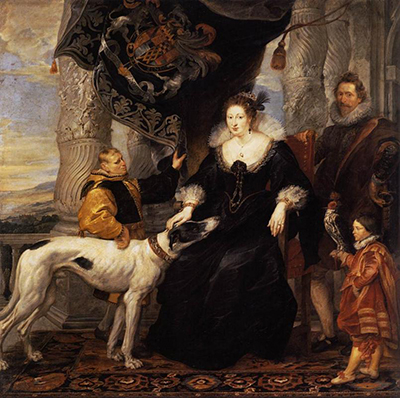
Aletheia Talbot sits at the centre of a wide terrace, wearing a black dress with a pale lace collar and cuffs. Her hand reaches towards a large white dog. Around her stand smaller attendants and a male figure; a bird of prey, columns, a hanging textile and a distant view extend the scene far beyond a single sitter. Rubens has made a portrait in which one woman’s place in a household and at court is conveyed through other people, possessions and space. The old title, Portrait of Lady Arundel with her Train, describes that company, but the Alte Pinakothek[1] identifies the principal sitter more precisely as Aletheia Talbot, Countess of Arundel.
The Munich collection dates the painting 1620 and records canvas as its support. It measures 262.5 × 266 centimetres, nearly square and more than two and a half metres in each direction, inventory 352. A web reproduction cannot convey how much physical space such a portrait commands. The countess is not merely enlarged within the frame: the format lets Rubens present a setting, attendants, animals and an open landscape around her. Her seated figure remains the stable centre as the viewer’s eye moves across the busy edges.
The museum says Rubens painted the picture during her brief stay in Antwerp in 1620. That gives the work a specific occasion without requiring a day-by-day account of the sittings. The portrait’s title often directs attention to the “train” or retinue. The arrangement does something subtler than listing servants: their positions, gaze and gestures make the countess’s centrality visible. Her dark dress contrasts with a light dog in front, the brighter clothing at the sides, and the sky glimpsed beyond the terrace.
At a Glance
- ArtistPeter Paul Rubens [1]
- SitterAletheia Talbot, Countess of Arundel [1]
- Date1620 [1]
- SupportCanvas [1]
- Dimensions262.5 × 266 cm [1]
- CollectionAlte Pinakothek, Munich, 352 [1]
Where this work sits in Rubens's career
The Elevation of the Cross
1609–10The Descent from the Cross
1611–14The Garden of Love
1630–35The Three Graces
1630–35Contents
- Who was Aletheia Talbot?
- The dog, falcon and attendants
- A composition built around the countess
- An Antwerp encounter and a travelling sitter
- How did the portrait reach Munich?
Who was Aletheia Talbot?
Talbot was married to Thomas Howard, Earl of Arundel, whom the Pinakothek describes as an influential English diplomat and art collector. That relationship helps explain why a major Flemish painter received the portrait commission, but it is not the whole of her identity. Paul Crenshaw’s peer-reviewed study of the Arundel collection[3] stresses that the couple’s collecting capacity depended in part on her inherited estates and income. It also describes her later role in hosting artists and scholars around the collection. The painting presents her as the focus of a grand household at a moment when she was undertaking international travel, not as a decorative addition to a portrait of her husband.
Rubens places her before tall columns on an outdoor terrace. The Pinakothek says she appears like a princess, attended by her household. That comparison describes the picture’s scale and formality; it is not a claim that she held a royal title. The architectural setting, decorated hanging cloth, patterned ground and opening to the landscape make an imposing stage. Talbot’s white collar and cuffs give her face and hands particular clarity within the black dress. The surrounding details amplify her standing without competing for the central position.
The journal study[3] compares the portrait’s presentation to the prominence granted to European monarchs. Its point is grounded in composition: the woman occupies the middle of an immense canvas and is framed by columns, textile, attendants and objects of privilege. This is a useful way to read the painting, but it does not mean every surrounding figure or object carries a single fixed allegorical meaning. Rubens’s immediate achievement is to make social rank visible through a convincing scene.
The dog, falcon and attendants
The large white dog crosses the front of the painting. It draws the viewer’s eye towards Talbot’s hand and creates an active contact between the seated countess and the nearer foreground. The Pinakothek reads both dog and falcon as references to aristocratic hunting privilege. A hound and trained bird could be valued possessions as well as signs of leisure and status. Their presence makes the portrait more specific than a generic display of expensive fabric. The interpretation belongs to the holding museum; the painting itself does not label the animals or record the circumstances of a particular hunt.
The Nationalmuseum in Stockholm[2] preserves a separate Rubens drawing of Robin, described as the dwarf in the Earl of Arundel’s household. Its museum text identifies the Robin shown in the finished Munich portrait as carrying the falcon on an outstretched arm. The related drawing, dated 1620, uses red and black chalk, pen and brown ink and traces of white chalk; the sheet measures 40.8 × 25.8 centimetres, inventory NMH 1913/1863. Rubens noted costume colours and fabrics there, including satin and velvet. These concrete notes show that he planned how a secondary figure would appear in the larger picture rather than adding the retinue as an undifferentiated backdrop.
The Robin sheet matters because the Pinakothek says Rubens sketched faces and postures during Talbot’s Antwerp stay and wrote down colours for the clothing. The finished canvas can look effortless despite its size. The surviving drawing lets us see some of the practical work behind it: a quick face, carefully considered costume and colour reminders for later painting. It is still a different object from the canvas and should not be captioned as the full preparatory design. The museum record does not claim that every study made for the portrait survives.
The Stockholm sheet's later collection history also differs from the Munich canvas's. Nationalmuseum says the drawing reached its collection through a transfer from the Royal Museum in 1866, whereas the painted portrait came to Munich from Düsseldorf in 1806. Those dates explain why the two pieces of evidence now sit in different countries. They do not tell us when Rubens separated the study from the painting or whether Talbot ever saw the drawing. A visitor can nevertheless compare their documented roles: the quick, colour-annotated study concentrates on Robin and his costume, while the canvas turns him into one part of a larger statement about the countess's household.
The drawing also gives the portrait's falcon a human connection. In the large painting, the bird can first register as an emblem of elite hunting. The Stockholm record tells us that it perches on Robin's outstretched arm. That placement makes the emblem part of an attendant's particular task, not a free-floating symbol above the countess. Rubens coordinated a person's pose, clothing and animal within the larger image. This is a more specific account of how the retinue supports the main sitter than merely calling every surrounding figure a sign of wealth.
There are other figures in the Munich scene whose identities should not be deduced from this small reproduction alone. A standing man has been given different names and roles in art-historical accounts; an early twentieth-century biography of the Arundels[4] even argued that he was added later. The Pinakothek’s current short record does not settle those claims. The visible male figure remains unnamed here because the competing identifications are unresolved. The countess, dog, falcon and retinue are secure enough to explain the portrait’s structure without turning each face into an unverified biography.
A composition built around the countess
The terrace has two different directions. At the right, the columns and hanging textile close the space into a formal setting. At the left, the landscape opens outward under a pale sky. Talbot sits between them. This balance allows the portrait to show both command of a constructed social scene and a sense of travel or access to a wider world. The latter is a visual reading rather than a claim that the painted view depicts a specific place visited by the countess.
The dark textile above and behind her carries a large design, while the patterned ground beneath the group repeats ornament at a smaller scale. Against those surfaces, the countess’s mostly black dress could have disappeared. Rubens instead uses a pale collar, cuffs, face and hand to articulate her presence. The hound’s bright body creates another patch of light at her side. These relationships help the viewer find the principal sitter even though the painting contains several other living figures.
The attendants bring scale as well as narrative interest. Their bodies are much smaller than the countess’s seated figure in the composition. That relative size can reflect placement and pictorial hierarchy; it should not be read as a measurement of their actual heights except where a reliable source names Robin. Rubens gives the company actions to perform, so the household seems occupied rather than frozen into a row of identically posed sitters. The scene remains a carefully staged image of status, not an unmediated snapshot of everyday life.
The format distinguishes this work from a smaller paired portrait or a head study. A viewer might expect a portrait to isolate a face. Rubens makes the countess’s likeness inseparable from the environment that frames it. The museum’s description calls this kind of commission relatively unusual within Rubens’s practice, and the surviving figure drawing helps explain why it demanded considerable preparation. Each element had to be coordinated around the countess without losing the recognisable individuals who accompanied her.
An Antwerp encounter and a travelling sitter
The museum places Talbot in Antwerp for a short visit in 1620. The Nationalmuseum says she stopped there while travelling towards Padua. Those sources give the portrait a setting of movement between courts and cities. It is tempting to treat the landscape behind the terrace as an itinerary or to name one building as her residence. No direct record reviewed here makes that identification. The safer account is that she sat in Antwerp and Rubens devised a grand setting suited to her rank.
Crenshaw’s study of the later Arundel collection emphasizes that Talbot continued to act in cultural networks after this portrait was painted. She and her husband assembled art and antiquities, and she later occupied a central place in the collection’s Dutch setting. Those later activities do not prove why every feature in the 1620 painting was chosen, but they correct a narrow impression of the subject as someone known only through her marriage. The woman presented so forcefully here was a participant in the collecting world that connected aristocrats, artists and scholars.
How did the portrait reach Munich?
The Pinakothek records the painting’s arrival in its present collection in 1806 from the Düsseldorf Gallery. This is a clear later transfer; it does not supply an unbroken chain from Rubens’s Antwerp studio through every earlier owner. The painting now belongs to the Bayerische Staatsgemäldesammlungen and is catalogued as inventory 352. Its current museum title names Talbot directly, helping a modern visitor keep the principal subject in view despite the old web route’s emphasis on her train.
The museum also records an eighteenth-century German frame attributed to Joseph Effner. That frame is part of the work’s later display history, not evidence of how Rubens first intended it to be mounted. Separating the painted canvas from the later frame is especially important for a picture of this scale: its effect in a gallery includes choices made long after the sitting. The reproduction here retains the painting’s broad arrangement, while the holding collection supplies the object details.
Rubens artworks directory
Frequently Asked Questions
The Alte Pinakothek identifies her as Aletheia Talbot, Countess of Arundel. She was married to Thomas Howard, Earl of Arundel, and was herself part of the couple’s collecting and travelling world.
The museum dates the canvas 1620 and says Rubens made the studies during Talbot’s brief visit to Antwerp. A particular sitting day is not recorded in the sources reviewed.
The Pinakothek interprets them as signs of aristocratic hunting privilege. They also help structure the group: the dog draws us towards the countess, while the falcon is associated with Robin in a separate preparatory drawing.
No. The Munich portrait is a very large painting on canvas. Stockholm’s Nationalmuseum holds a separate Rubens study of Robin with costume colour notes.
It is held by the Alte Pinakothek, Munich, inventory 352. The museum records its 1806 transfer from the Düsseldorf Gallery.
Discussion
Look closely at how the countess anchors the large group.
Share an observation about the painting or a reliable source that adds to its history.
Reader Insights
How do the dog and falcon shape its account of status?
What does the separate Stockholm study reveal?
Which attendants remain unidentified?
Join the Conversation
Add your reading below, keeping observations specific and evidence clear.
References
- Bayerische Staatsgemäldesammlungen, Aletheia Talbot, Countess of Arundel , inventory 352. View source
- Nationalmuseum, Stockholm, account of Rubens’s Robin, the Dwarf of the Earl of Arundel , NMH 1913/1863. View source
- Paul Crenshaw, “Rembrandt and Hals Visit the Arundel Collection,” Journal of Historians of Netherlandish Art 9, no. 1 (2017). View source
- The early twentieth-century Arundel biography, digitised by the Warburg Institute, for the historical claim about the standing man. View source