Peter Paul Rubens.jpg)
 by Tom Gurney
Tom Gurney BSc (Hons) is an art history expert with over 20 years experience
Published on June 19, 2020 / Updated on October 14, 2026
Email: tomgurney1@gmail.com / Phone: +44 7429 011000
A portrait of a person and his instruments
The man looks toward us from a dark background. A white ruff circles his neck, making his face stand out above a patterned black doublet. One hand presents a small gold watch; the other holds measuring instruments. His carefully trimmed beard, composed pose and direct gaze give him an individual presence, yet neither the tools nor the painting’s surviving inscriptions tell us his name. Rubens made the sitter recognisable to those who knew him without leaving later viewers a secure identification.
The Metropolitan Museum of Art[1] calls the work Portrait of a Man, Possibly an Architect or Geographer. It is oil on copper, dated 1597, and measures only 21.6 × 14.6 centimetres. Its accession number is 1982.60.24. The museum describes it as thought to be Rubens’s earliest dated work and one of the few paintings known from before he left Antwerp for Italy in 1600. The qualification matters: the catalogue does not claim that no lost or undated earlier Rubens painting ever existed.
The “-painting” in this page address distinguishes the Met portrait from the anonymous bearded sitter in an ALBERTINA chalk drawing[4] at /portrait-of-a-man/. The Met sitter has a ruff, instruments and a painted 1597 date. The similar titles therefore refer to different objects.
At a Glance
- ArtistPeter Paul Rubens [1]
- Date1597 [1]
- MediumOil on copper [1]
- Dimensions21.6 × 14.6 cm [1]
- CollectionThe Metropolitan Museum of Art, 1982.60.24 [1]
Where this work sits in Rubens's career
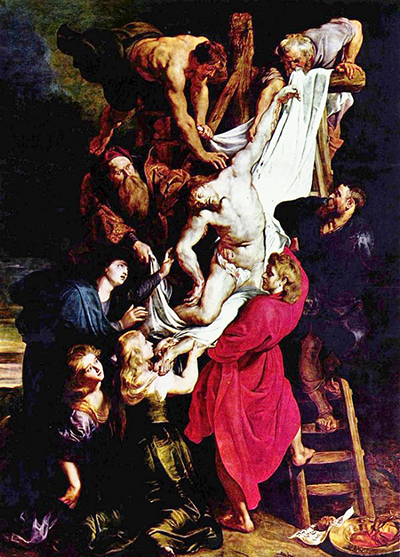
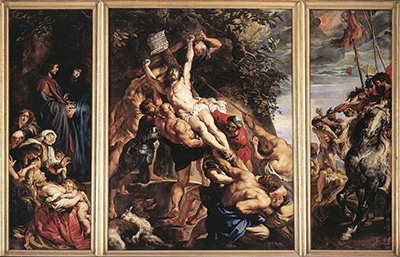
The Elevation of the Cross
1609–10The Descent from the Cross
1611–14The Garden of Love
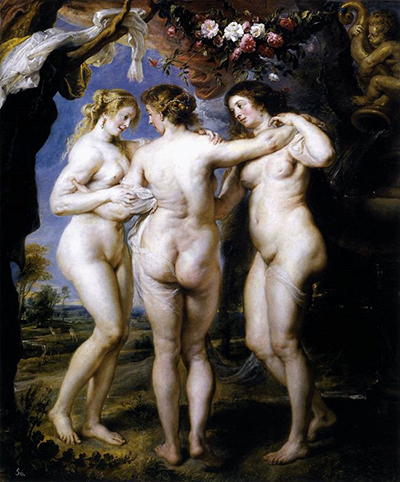
1630–35The Three Graces
1630–35Contents
- What do the date and age tell us?
- Architect, geographer or something else?
- Why paint on copper?
- Where did the painting go?
What do the date and age tell us?
A Met publication on notable acquisitions[2] records inscriptions at the top of the little copper painting: the year 1597 at the upper left and “AETAT. XXVI.” at the upper right, giving the sitter’s age as twenty-six. It also records an engraving of Rubens’s name on the back of the copperplate. The stated age makes the man approximately Rubens’s senior by several years, since the artist was born in 1577. It does not identify the sitter or his occupation.
The date gives the work unusual value for understanding Rubens before Italy. He was about twenty when he painted it. Much of his later fame rests on enormous altarpieces, mythological scenes, court commissions and forceful movement across large canvases. Here the young artist works within a small metal surface, concentrating on likeness, clothes and objects held close to the body. The portrait does not need to foreshadow every feature of the mature Rubens to be important. It shows what he could already do within the conventions of a late-sixteenth-century Netherlandish likeness.
The two inscriptions on the front answer different questions. The date anchors the making of the picture; the age belongs to the sitter. The engraved name on the reverse names the painter, but does not name the man depicted. A reader could easily mistake “twenty-six” for Rubens's own age and build a false self-portrait story from it. The artist was born in 1577 and was approximately twenty in 1597. Reading the evidence in its place—year, sitter's age and artist's name—keeps those three identities and dates separate.
The Met’s older publication relates the style to Rubens’s teacher Otto van Veen and to an established Netherlandish portrait tradition. The sitter’s controlled pose and dark clothing give the image formality. Within that formality, light on the face, small movements around the mouth and the carefully placed hands make him feel present. These observations can be made from the reproduction without assigning a particular emotion to the sitter. A direct gaze is visible; confidence, melancholy or professional pride would be interpretations rather than documented facts.
The museum's acquisition essay[2] also compares the composition with portraits by Anthonis Mor and his followers. That places Rubens's small work within a tradition of figures presented calmly and clearly for inspection. The essay then notices stronger modelling and an effect of spatial presence that it sees as anticipating his Italian development. This is an art-historical comparison, not evidence that Rubens had already adopted the methods of his later Italian years. The 1597 date makes the painting a point from which to examine change, rather than a miniature version of his mature style.
Architect, geographer or something else?
The current Met object essay[1] identifies a watch, a square and a pair of dividers. The square and dividers were tools used in drawing, measurement and design. They may point to architecture or geography, which is why those words appear in the museum’s title. They do not amount to a name, guild record or written employment history. “Possibly” is part of the title’s evidential meaning.
The hands turn the objects into an active part of the likeness. Instead of laying them on a table in the background, Rubens brings them close to the man’s chest and into the viewer’s field. The pale ruff and hands punctuate the dark clothing. A viewer can first register the face, then follow the hands to the instruments and return to the face with a question about the sitter’s work. The little painting thus offers more than a costume portrait, even while its clues remain incomplete.
The watch has a different role. The Met says the encased timepiece is a conventional reminder of mortality. The older Met publication calls this a vanitas reference: the passage of time makes worldly achievements temporary. That interpretation does not rule out the possibility that the sitter owned a fine watch or enjoyed displaying one. It explains why such an object could carry meaning in portraiture beyond mere possession. A square and dividers may suggest measured work; a watch makes the measurement of a human life part of the picture’s thought.
It is tempting to infer a precise profession from the group of things in the hands. Several activities in the period used instruments for angles and distances. The museum’s own restraint is therefore a useful model. The painting depicts a young man, aged twenty-six by inscription, with objects associated with measurement. It supports a qualified occupational possibility, not a conclusive biography.
The Met's earlier acquisition essay shows how far the guesses once spread: writers called the man a geographer, architect, astronomer, goldsmith or watchmaker according to how they read his tools. The museum's current title keeps only two qualified possibilities. That change is informative. A square and dividers could be useful to several skilled people; the tools do not function like a written nameplate. The more carefully one names what is visible, the less reason there is to invent an occupation that the archival record cannot confirm.
The watch itself was once caught up in that professional guessing. The acquisition essay describes an oval gold case with chased and enamel decoration. The curatorial argument is that the enclosed object is a timepiece, not an unidentified technical instrument tailored to the sitter's trade. The essay treats it as a vanitas sign. A finely made watch could display wealth and craft while also calling attention to time's passage. The two meanings need not cancel each other, but the museum's moral reading is an interpretation of portrait convention rather than proof of the sitter's own intention.
Rubens gives those objects a place in the visual order of the portrait. The watch's small brightness near one hand, the pale ruff around the neck and the lighter face interrupt the broad dark areas of costume and background. The square and dividers require closer inspection. This difference lets the picture work at two distances: a person first emerges, then the things he holds begin to prompt questions. The object page and the older essay support the names of the instruments; how the eye moves among them is an observation of the composition.
Why paint on copper?
Copper is a rigid, smooth support. The tiny dimensions of this portrait allowed Rubens to paint detailed features and reflective surfaces in a compact area. The reproduction shows a sharp contrast between the white ruff and dark doublet, with small highlights on the watch and fingers. The copper support is part of the object’s identity, but the web record does not provide a technical study of its layers or any claim about exactly how Rubens prepared the plate. The page should not invent pigments, grounds or tool marks absent from a conservation report.
Its scale is easy to miss on a screen. At 21.6 centimetres high, the entire image is roughly the height of a small book. The man’s face occupies only a portion of that. Reproduced large online, the portrait may appear like a full-size canvas; physically, it is a carefully made small object. That difference between screen and object matters to any account of how the viewer encounters the watch, ruff and eyes.
The acquisition essay nevertheless calls the picture monumental in effect despite its few inches of height. Its argument rests on the sitter's strong modelling and apparent volume, not on physical size. The distinction helps explain the painting's interest: Rubens presents a person with enough presence to hold the viewer's attention while still inviting close, almost private examination of details. The copper support and small format make that encounter different from standing before a later Rubens altarpiece.
The portrait also belongs to the history of Rubens’s early training. The Met situates it in Antwerp before his 1600 departure for Italy. Other early paintings are fewer and not all securely dated. Later Italian experience would broaden Rubens’s models and scale, but this copper plate demonstrates an existing ability to make a figure convincing within a disciplined portrait format. It is useful evidence for his development precisely because it is early and dated.
Where did the painting go?
The Met identifies the work as part of the Jack and Belle Linsky Collection, acquired in 1982. A separate Met provenance statement from 2000[3] cites a 1924 publication placing the portrait in the collection of Henry Blank of Newark, New Jersey, and says published records kept it there until 1949. The museum issued that statement in response to a public question about the picture’s wartime history. Its cited Blank ownership establishes a twentieth-century segment; it does not fill the entire route from Rubens’s Antwerp to the United States.
The statement also acknowledges that the work had passed through dealer Karl Haberstock, who later dealt in looted art, while saying the transaction involving this portrait occurred before the Nazi era. The museum cited Blank's documented ownership from at least 1924 through 1949 in answering the specific wartime allegation. The statement is an institutional response to that allegation, not a complete catalogue of every transfer since 1597. For this page, the verifiable point is the published Blank segment and the Met's account of the earlier dealer transaction, with the older history left open.
It is worth keeping provenance and sitter identity apart. Knowing a twentieth-century owner does not tell us who sat for Rubens in 1597. Conversely, recognising a watch and drafting tools does not establish who owned the painting three centuries later. These are different research questions answered by different evidence: inscriptions and visible objects for the portrait's first presentation, and documents and catalogues for its later movement. Neither set of clues currently supplies the sitter's name.
The portrait is now at the Metropolitan Museum of Art, New York, accession 1982.60.24. The museum labels its image Public Domain and states that its open-access images may be reused commercially and noncommercially.
Rubens artworks directory
Frequently Asked Questions
His name is unknown. An inscription gives his age as twenty-six in 1597; the measuring instruments may suggest a profession, but the Met does not identify him.
No. The museum’s title says “Possibly an Architect or Geographer.” The square and dividers support a possibility, not a documented occupation.
The Met reads the encased watch as a conventional allusion to mortality and passing time.
The Met calls it thought to be his earliest dated work. Its 1597 date places it before Rubens left Antwerp for Italy and makes it a rare fixed point for his early painting.
No. The ALBERTINA work is a separate chalk drawing of an unidentified bearded man. This page concerns the Met’s small oil-on-copper painting.
Discussion
Look closely at the sitter's watch, square and dividers.
Share an observation about the painting or a reliable source that adds to its history.
Reader Insights
How do the small painting's scale and copper support affect its detail?
What do the tools suggest about the sitter without proving his occupation?
How does the watch connect the portrait to the passage of time?
Join the Conversation
Add your reading below, keeping observations specific and evidence clear.
References
- Metropolitan Museum of Art, Portrait of a Man, Possibly an Architect or Geographer , accession 1982.60.24. View source
- The Metropolitan Museum of Art, Notable Acquisitions 1983–1984 , p. 53, on the inscriptions and early style. View source
- Metropolitan Museum of Art, statement on the portrait’s provenance, 13 March 2000. View source
- ALBERTINA, the distinct chalk Portrait of a Bearded Man , inventory 8265. View source