by Tom Gurney
Tom Gurney BSc (Hons) is an art history expert with over 20 years experience
Published on June 19, 2020 / Updated on October 14, 2026
Email: tomgurney1@gmail.com / Phone: +44 7429 011000
The duke before the grand portrait
George Villiers looks directly towards the viewer. Rubens has modelled his eyes, long nose, moustache and narrow beard with considerable care, while his collar and clothing remain a much lighter network of lines. Curls rise above the forehead and spread beyond the right side of the head. The page address retains an old misspelling, “George Vilie.” The ALBERTINA’s record[1] identifies him as George Villiers, Duke of Buckingham. The museum’s spelling, George Villiers, identifies the sitter.
This is a drawing, not one of Rubens’s finished portraits in oil. The ALBERTINA dates it March–June 1625 and records black and red chalk, traces of white chalk and brown pen on a sheet measuring 38.5 × 26.7 centimetres, inventory 8256. Those facts identify this particular object. Villiers was pictured in other drawings, paintings and prints; their dates, dimensions and ownership cannot be transferred to the Vienna sheet simply because they show the same man.
The drawing has the immediacy of a likeness being secured for later use. The face is built from fine observations, including the different shadows around each eye and the turning line of the upper lip. The collar provides enough setting to place the head in formal dress, but its broad outline leaves us able to follow Rubens’s decisions. A court portrait would eventually need fabric, insignia and a more complete presentation of status. Here the chief task appears to be to hold the sitter’s recognisable features.
At a Glance
- ArtistPeter Paul Rubens [1]
- SitterGeorge Villiers, Duke of Buckingham [1]
- DateMarch–June 1625 [1]
- MediumBlack and red chalk, traces of white, brown pen [1]
- Dimensions38.5 × 26.7 cm [1]
- CollectionALBERTINA, Vienna, 8256 [1]
Where this work sits in Rubens's career
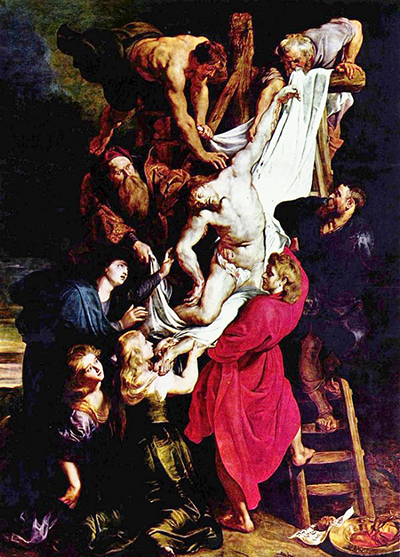
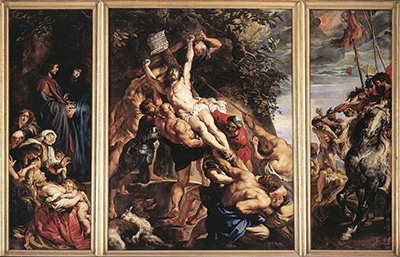
The Elevation of the Cross
1609–10The Descent from the Cross
1611–14The Garden of Love
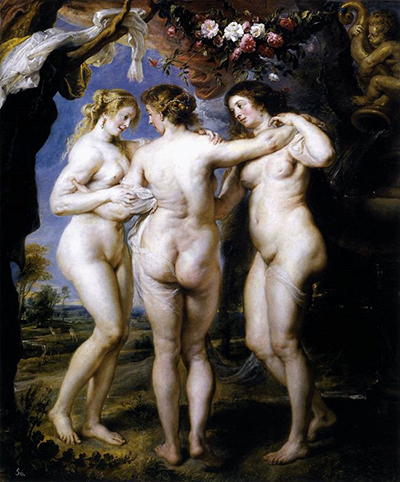
1630–35The Three Graces
1630–35Contents
- Why did Rubens draw Buckingham in 1625?
- How is the head made?
- The later portrait family
- An inscription made by someone else
Why did Rubens draw Buckingham in 1625?
The Kimbell Art Museum[2] places a meeting between Rubens and Buckingham in Paris in 1625. Rubens was there in connection with the installation of his great cycle on Marie de’ Medici’s life. Buckingham came for the marriage by proxy of the English king Charles I and Marie’s daughter Henrietta Maria. This gives a well-supported setting for contact between the painter and the duke during the ALBERTINA’s date range. The sheet itself carries no place or exact sitting day, so “drawn in Paris” is a strong historical inference rather than an inscription by Rubens.
Buckingham was a powerful court figure and an ambitious patron. The Kimbell says he commissioned a large equestrian portrait from Rubens, and its own oil sketch records that project. The National Gallery in London[7] also holds an oil sketch for an allegorical ceiling celebrating the duke. These works show the range of images Buckingham sought: a recognisable face, a rider with military command, and a figure exalted through myth. They are related by patron and artistic ambition, but they are distinct objects and commissions.
The Kimbell’s anniversary account places the equestrian commission with their 1625 Paris encounter. The National Gallery instead describes a 1627 commission for the York House ceiling and equestrian portrait. The accounts differ on when that larger project was commissioned. The ALBERTINA’s 1625 date for this head drawing does not, by itself, settle the timing of the later contract or finished work.
The Kimbell’s anniversary account[3] specifically describes the ALBERTINA head drawing as made from life and useful for the equestrian image. An RKD Studies catalogue for Dulwich Picture Gallery[5] follows the Vienna head into another line of portraiture: a bust-length likeness associated with a surviving oil painting in Glasgow. Both accounts help explain why Rubens would want a careful record of Buckingham’s face. Neither requires us to claim that the sheet had one exclusive purpose or that every later picture copied it directly. An artist could return to a useful likeness while developing several kinds of portrait.
How is the head made?
In the reproduction here, the forehead and cheeks stay relatively open, allowing the paper to form lighter passages. Chalk darkens the nostrils, eyelids, beard and the outer curls. A few pale marks help pick out highlights. The hair is described with mobile, looping strokes, quite unlike the calm regularity of the face’s central features. This contrast is a visual choice: the sitter’s identity depends on the stable arrangement of eyes, nose and mouth, while the surrounding hair can suggest life and movement.
The ALBERTINA’s materials field includes brown pen as well as three colours of chalk. This small reproduction does not allow every line to be assigned confidently to pen or a particular chalk colour. The drawing’s material mixture matters nonetheless. It gave Rubens ways to separate the face’s shadows, warmer passages and small lights before deciding how those features would appear in paint. The museum’s materials list gives the reliable description of the media.
The left side of the collar is sketched with only enough shape to locate the shoulder. Elsewhere the neck and clothing dissolve into pale strokes. That uneven finish is not evidence that Rubens abandoned the portrait in disappointment. It is consistent with the sheet’s value as a working record of a head. The Glasgow Museums catalogue[4] describes a separate painted bust with a black slashed jerkin, lace collar and Garter ribbon; those features belong to the completed oil, not to a finished costume painted on this drawing.
The sitter’s expression is difficult to fix in words. He meets our gaze while his mouth remains quiet. It can be tempting to read confidence, calculation or charm into that look because Buckingham’s public career was highly charged. Those are responses to a portrait, not documented emotions from the sitting. The drawing’s strongest evidence is what it shows: a precisely observed head within an incomplete framework for dress.
The later portrait family
The Glasgow Museums record[4] catalogues Rubens’s George Villiers, First Duke of Buckingham as an oil on panel, about 1625, 60.9 × 47.3 centimetres unframed, inventory PC.49. Its material and scale distinguish it from the ALBERTINA drawing. The RKD Studies catalogue explicitly relates the Vienna head to that bust portrait and records the painting’s identification in Glasgow after restoration in 2017. A viewer of the two objects can consider how a head taken on paper became the focus of a dark-costumed presentation in paint.
An older Italian national catalogue record[6] describes a further Buckingham portrait in Palazzo Pitti, Florence, inventory 324. Its scholarly note says the Pitti panel follows the ALBERTINA drawing but questions whether the painting is itself an original by Rubens. The record was updated before the Glasgow identification. It remains useful evidence for the history of Buckingham portrait versions, but it cannot settle the status of every related painting today. The Pitti object, the Glasgow panel and the Vienna drawing should each be labelled with their own collection and support.
The equestrian image is another branch. The Kimbell’s oil sketch[2], accession AP 1976.08, shows Buckingham mounted above Neptune and a sea nymph while Fame sounds a trumpet. The Kimbell says the large equestrian portrait for which it was made was destroyed by fire in 1949. That lost monumental picture is not the Glasgow bust portrait and not this chalk head. The ALBERTINA sheet may have helped Rubens carry the sitter’s likeness into more than one project; it does not reproduce the horse, allegorical figures or finished costume of the equestrian composition.
The National Gallery’s Apotheosis of the Duke of Buckingham[7] goes further into courtly allegory. Minerva and Mercury conduct Buckingham towards a Temple of Virtue in an oil sketch for a planned ceiling. It shows how a portrait patron could want a public image of power rather than only a likeness. The Vienna drawing provides a useful counterpoint: no gods, horse or military baton are needed to identify the person. The head alone makes the duke available for the larger inventions.
An inscription made by someone else
Words run across the top of the drawing. The ALBERTINA transcribes an inscription identifying the Duke of Buckingham and including Rubens’s name, but explicitly marks it as “by another hand.” It is not an autograph signature by Rubens. A later writer could correctly record a sitter and artist without having been present when the sheet was made. The inscription is part of the object’s history; its handwriting and the drawing’s chalk work are different forms of evidence.
The museum also records the collection mark of Duke Albert of Saxe-Teschen at the lower right and lists the sheet in the earlier Court Library. That gives two later stages in its collecting history, not a continuous path back to Buckingham. We cannot infer from the stamp that the duke owned this specific working sheet after the sitting. Nor does the ALBERTINA’s record provide a purchase or gift document for its move between all prior owners.
The related portrait drawing of Katherine Manners, Buckingham’s wife, is listed by the RKD as ALBERTINA 8257. It is one number away but is a separate sheet with a separate sitter. The RKD discusses whether the two drawings and subsequent paintings were meant as pairs and treats the identification of the woman with care. This matters here because it would be easy to describe the male drawing as half of a proven married-couple commission. The existence of a related female study makes that idea plausible; the exact intended pairing remains a scholarly question.
The RKD's fuller discussion[5] gives a reason for the caution. It notes that Katherine Manners is not known to have travelled outside England. If Rubens made the female study from life, a proposed Paris sitting in 1625 would therefore be difficult; his later stay in London offers another possible setting. The catalogue also compares portraits in which the supposed Katherine looks different and keeps the identification of Dulwich's related woman qualified. None of that doubt changes the ALBERTINA's identification of the male head as Buckingham. It changes only how confidently we can say that the neighbouring female sheet was drawn at the same sitting or designed as an intended pendant.
The connection between artist and duke also went beyond portraits. The RKD account records Rubens selling Buckingham his collection of antiquities in 1627. That later transaction documents a continuing relationship, but it is separate from the 1625 sheet and does not tell us its price, delivery or first owner. It helps explain why Rubens and Buckingham appear in several kinds of surviving records, from drawings and oil sketches to collecting history. At the same time, it warns against treating every contact between them as evidence for a specific artwork's commission. The drawing's own date and materials must still come from the ALBERTINA entry.
Another portrait of Buckingham appears in the ALBERTINA's related-object list, but it belongs to a different maker. The museum catalogues a 1626 engraving by Willem Jacobsz. Delff[8], after a design by Michiel van Miereveld. The sheet is held in an old print album. Its presence next to the Rubens drawing in a modern online list reflects a shared sitter, not a claim that Delff engraved Rubens's chalk head. This distinction matters on image-search pages, where a name and an approximate date can make unrelated likenesses look like direct copies of one another. The maker and object number are the safer guide. The listed model also rules out treating this particular print as the documented afterlife of the Vienna drawing.
Rubens artworks directory
Frequently Asked Questions
The old URL misspells George Villiers, first Duke of Buckingham. The ALBERTINA identifies the sitter by his correct name and holds this drawing as inventory 8256.
The ALBERTINA dates the sheet March–June 1625. Rubens and Buckingham met in Paris that year, but the drawing itself does not state an exact day or place.
No. It is a drawing in black and red chalk, traces of white chalk and brown pen. The Glasgow bust portrait and Kimbell equestrian sketch are separate works in oil.
The Kimbell relates the head drawing to Rubens’s equestrian project, and RKD Studies relates it to a bust portrait. It may have served more than one later use. The surviving records do not require one exclusive purpose.
The ALBERTINA catalogues the identifying inscription as by another hand. It is a later mark, rather than the artist’s own signature.
Discussion
Look closely at the finished face and lightly indicated clothing.
Share an observation about the drawing or a reliable source that adds to its history.
Reader Insights
Which marks make the duke recognisable?
How might a head study serve several portraits?
What does the later inscription establish?
Join the Conversation
Add your reading below, keeping observations specific and evidence clear.
References
- ALBERTINA, Rubens, Georges Villiers, Herzog von Buckingham , inventory 8256. View source
- Kimbell Art Museum, Rubens, Equestrian Portrait of the Duke of Buckingham , AP 1976.08. View source
- Kimbell Art Museum, 50th anniversary account of the equestrian portrait and related head drawing. View source
- Glasgow Museums, Rubens, George Villiers, First Duke of Buckingham , PC.49. View source
- RKD Studies, Dulwich Picture Gallery catalogue of Buckingham and Katherine Manners related portraits. View source
- Italian national catalogue, Buckingham portrait at Palazzo Pitti, Palatina 324. View source
- National Gallery, London, Rubens, The Apotheosis of the Duke of Buckingham. View source
- ALBERTINA, Willem Jacobsz. Delff after Michiel van Miereveld, separate Buckingham engraving, 1626. View source