by Tom Gurney
Tom Gurney BSc (Hons) is an art history expert with over 20 years experience
Published on June 19, 2020 / Updated on October 14, 2026
Email: tomgurney1@gmail.com / Phone: +44 7429 011000
A quiet head for a public altarpiece
A young woman lowers her eyes. Her face turns slightly, with a soft mouth and rounded cheeks, while braided hair gathers around the back of her head. The lines at the neck and shoulder remain spare. There is no painted robe, surrounding saint or architectural setting. The small sheet concentrates on how a particular head might look before Rubens placed such a figure into a large religious picture.
The ALBERTINA in Vienna[1] catalogues the work as Head of a Woman with Downcast Eyes (Study for the Madonna of the Ildefonso Altarpiece), by Peter Paul Rubens, about 1630–31. It is black and red chalk heightened with white chalk, 19.2 × 16.5 centimetres, inventory 8272. The inherited route name Head of Woman II is too generic to explain the image. The museum's title identifies both the pose and the drawing's relation to a later painted Madonna.
The reproduced image matches the museum's sheet, including the braid, the downward glance and a written name at the lower right. That name has its own history, discussed below. The sitter herself is not named by the ALBERTINA. The sheet is best understood as a study of a young woman's appearance for a sacred figure, rather than as a formal portrait of an identified individual.
At a Glance
- ArtistPeter Paul Rubens [1]
- PurposeStudy for the Ildefonso Altarpiece Madonna [1][2]
- DateAbout 1630–31 [1]
- MediumBlack and red chalk heightened with white chalk [1]
- Dimensions19.2 × 16.5 cm [1]
- CollectionALBERTINA, Vienna, 8272 [1]
- InscriptionP P Rubbens, by another hand [1]
Where this work sits in Rubens's career
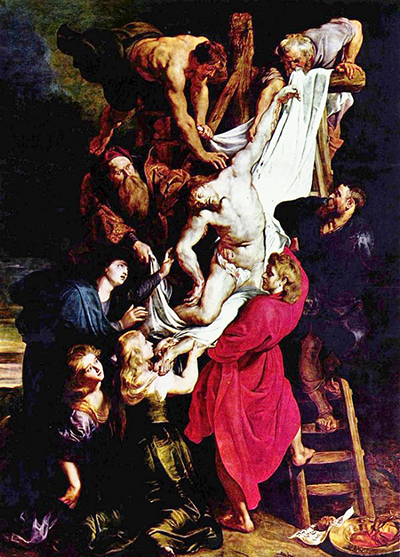
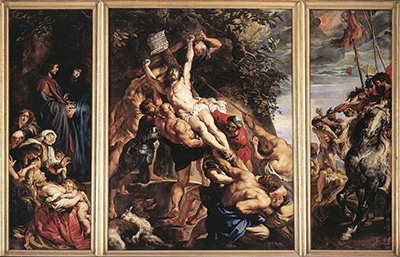
The Elevation of the Cross
1609–10The Descent from the Cross
1611–14Head of a Woman with Downcast Eyes
c. 1630–31The Garden of Love
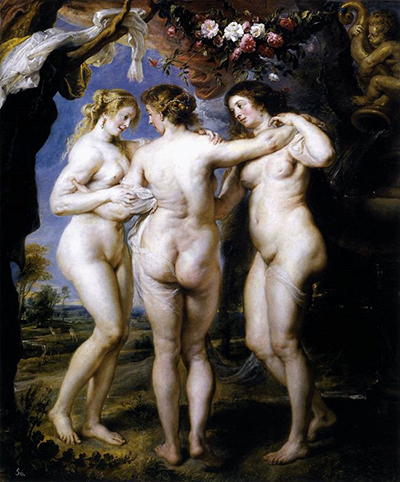
1630–35The Three Graces
1630–35Contents
- How does chalk make the face present?
- Who was the model?
- What was the Ildefonso Altarpiece?
- What changes between drawing and painting?
- Are there other studies for the same altar?
- Is “P P Rubbens” Rubens's signature?
- What should a reader notice first?
How does chalk make the face present?
The museum explains that Rubens used black chalk to establish the shape of the head and hair, then red chalk to give the cheeks, skin and eyes life. White chalk adds selected light. In the reproduction, the most insistent dark marks follow the hair and the lines around the face; softer red passages warm the cheeks and eyelids. The contrast keeps the face solid without making every edge equally firm.
The eyes are the study's centre of attention. Because they are lowered, the figure does not meet the viewer in the manner of a commissioned portrait. The downward gaze can become modest or contemplative when placed in a religious painting. On the sheet, however, it is also a carefully observed physical action: eyelids cover part of the eye, the head inclines, and the nose and mouth change their relation to the viewer. Rubens needed those relationships to remain convincing at a much larger painted scale.
The braid gives a second kind of structure. Curved black lines turn across the crown and collect behind the ear. Some are quick and separate; others merge into shadow. Red chalk does not simply colour in a finished black outline. It shifts the temperature of the face and helps it seem alive against the pale paper. The ALBERTINA's material description governs these statements; a small web image alone is not enough to identify every white mark or reconstruct the exact order of strokes.
The sheet's size matters. At under twenty centimetres high, it could be held and studied close to the eye. The finished altarpiece addressed worshippers from a different distance. A head that is sensitive on paper must be translated into a figure readable amid white garments, other women and a miraculous event. The study lets us see the detail that a large composition may absorb.
Who was the model?
The ALBERTINA suggests that young, round-cheeked women from Rubens's Flemish surroundings may have posed for the head studies connected with the altarpiece. It does not identify this woman by name, family or social position. The wording is deliberately conditional. A face that looks individualized can originate in direct observation without leaving a documentary identity for modern viewers.
That distinction protects the drawing from a common error. The person who may have sat for the chalk study is not automatically the historical Virgin Mary, and the figure created in the altarpiece is not a portrait of the model in a modern sense. Rubens could use a recognisable, living face as material for a sacred scene. The museum's essay explicitly values this immediacy: it says Rubens sought plausible young women to make Saint Ildefonso's vision vivid for churchgoers.
The downward look, rounded cheeks and lightly tied hair give the figure a particular presence. They do not tell us her name or whether she posed only once. Nor can a viewer infer that she belonged to Rubens's family because he drew relatives elsewhere. This page follows the holding collection's description and keeps the model anonymous.
The question is worth asking because “study for the Madonna” describes an artistic role, not a sitter's identity. A drawing can be both close to life and transformed for a commission. The chalk records a face as Rubens studied it; the altar would assign that face a role in a story centuries older than the woman herself.
What was the Ildefonso Altarpiece?
The Kunsthistorisches Museum in Vienna[2] holds Rubens's Triptych of St Ildefonso, dated about 1630–32. Its central scene shows the Madonna appearing to the saint in supernatural splendour and giving him a ceremonial vestment. The side wings depict Archduke Albert and Infanta Isabella Clara Eugenia with their patron saints. This is a multi-part painted object made for public devotion, not the paper head study reproduced here.
The ALBERTINA's account[1] says Infanta Isabella commissioned Rubens in April 1630 to make the altarpiece for the Brussels church Sint-Jacob-op-Koudenberg. It considers an unveiling on 23 January 1632, Ildefonso's feast day, probable. The commission date concerns the large altar; the probable unveiling is not a date written on this drawing. The ALBERTINA dates the sheet about 1630–31, a more appropriate caption for the study.
In the legend described by the museum, Ildefonso, bishop of Toledo, is praying when Mary descends with female saints and takes his throne. She rewards him with a splendid vestment for his writing in defence of the Virgin's purity. The head study does not show Ildefonso, the throne or the garment. It prepares one of the female faces through which Rubens could make the visitation emotionally immediate.
The museum says this study helped shape the Madonna in the central panel. It also describes how the young women's faces become part of a painted group whose white robes add splendour and ceremony. A reader looking only at the chalk sheet should not imagine that those robes are faintly present on the paper. They belong to the finished painting's colour and narrative setting. The two objects answer different questions: the sheet asks how a head turns and looks; the triptych asks how a sacred encounter unfolds before viewers.
What changes between drawing and painting?
The drawing isolates an expression. With no elaborate background, it is easy to follow the low gaze, the small shifts in cheek and eyelid, and the hair's curve around the head. In the altarpiece, such observation works within a larger arrangement of figures, garments and light. The viewer reads the face as part of a revelation to Ildefonso rather than as the entire subject.
Scale changes the artistic task. A quiet head on a 19.2-centimetre sheet may be viewed from a hand's breadth away; a church altarpiece must be understood at a distance. Rubens could preserve the pose while strengthening contrasts or simplifying transitions in paint. The ALBERTINA establishes the relation between study and central panel, but it does not provide a stroke-by-stroke transfer diagram. We should not claim that every chalk mark was copied literally.
The emotional tone also shifts with context. Downcast eyes can suggest inward attention in the study. In a religious group they can guide the viewer towards another figure or action. The face remains human, but its painted role is theological and ceremonial. This is why the museum's full title matters more than a generic “Head of Woman”: it gives the reader a path from close observation to public purpose.
The transition does not make the drawing a lesser object. Its individual identity, material and later collection history are distinct from the Vienna painting. Even if the painted Madonna became the most visible result of the commission, the chalk study preserves Rubens's decision to begin with a believable young face rather than a purely abstract ideal.
Are there other studies for the same altar?
The ALBERTINA holds another Rubens drawing, Woman's Head in Profile to the Right[3], inventory 8270, also catalogued as a head study for the Ildefonso Altar, about 1630–31. It is black and red chalk, 24.7 × 15.8 centimetres. Its title and profile view distinguish it from the downcast, more frontally presented head on this page. Both relate to the painted project, but they are separate sheets with different dimensions and inventory numbers.
The comparison shows that the altarpiece did not depend on a single generic female type. Rubens could investigate different turns and expressions for women who would appear in the sacred group. The profile study may help a reader understand why this sheet focuses on a downcast gaze: each drawing solved a particular visual problem. It would be misleading, however, to assign both sheets to the same named model or to swap their captions because they share a commission.
The ALBERTINA also lists an oil sketch for the central panel in the Hermitage, St Petersburg. That is another stage of planning, made in paint rather than chalk, and the museum does not present it as the image on this page. Recognising several kinds of preparation helps explain how a large triptych might emerge from individual heads, compositional sketches and final panels. It does not establish a simple straight line in which one head drawing must precede every other surviving study.
Is “P P Rubbens” Rubens's signature?
No. The ALBERTINA records the lower-right inscription “P P Rubbens” as “von fremder Hand”—by another hand. The name is visible in the inherited reproduction, so it deserves an explanation near the work rather than silence. It should not be used to claim that Rubens signed or dated the sheet himself.
The museum nonetheless attributes the drawing to Peter Paul Rubens. Those two statements are compatible. Authorship of the chalk image is an art-historical judgement; authorship of the later written name is a separate question. Collectors and keepers often added names or marks to works on paper after their creation. A visible inscription can help track how an object was labelled without proving who drew it.
The record also notes the collector's mark of Duke Albert of Saxe-Teschen at the upper right and lists him in the provenance. That mark belongs to the sheet's collecting history. It does not identify the model, locate Rubens's sitting or date the initial chalk work. The drawing carries an image made for a seventeenth-century commission and later signs of how it was kept and classified.
These layers matter for a practical reason. A visitor may spot the written name before noticing the thin red chalk in the cheeks. A precise caption can redirect attention: Rubens is the museum's credited draughtsman; the woman is an unnamed model for the Madonna; the inscription is another hand's. Keeping those roles apart makes both the image and its history clearer.
What should a reader notice first?
Begin with the eyes and the turning cheek. The lines around them are measured enough to give the face a direction, yet light enough to leave the paper active. Then follow the braid and the loose edge of the shoulder. Black, red and white chalk work together to make an observed person available for a painted sacred figure. The result is intimate without requiring the viewer to know the model's name.
The sheet's later role adds another layer of interest. It connects a small act of looking to the vast Ildefonso project commissioned for Brussels and now in Vienna. It can be understood as a preparation for the Madonna without being mistaken for the painted triptych. Its quiet gaze, material subtlety and separately recorded ownership are enough to sustain attention on this small work in its own right.
Rubens artworks directory
Frequently Asked Questions
The ALBERTINA does not identify the model by name. It calls the sheet a study for the Madonna of the Ildefonso Altarpiece.
The museum dates the drawing about 1630–31. The altarpiece's probable 1632 unveiling is a separate event.
No. It is a black, red and white chalk drawing on paper, 19.2 × 16.5 centimetres, ALBERTINA 8272.
No. The ALBERTINA says “P P Rubbens” was added by another hand, although it credits the drawing itself to Rubens.
The painted Triptych of St Ildefonso is in the Kunsthistorisches Museum, Vienna. It is distinct from the ALBERTINA drawing.
No. The related ALBERTINA profile drawing is inventory 8270; this downcast head is 8272.
Discussion
Look at how the chalk shapes the lowered gaze.
Share a close observation or a reliable source about ALBERTINA 8272.
Reader Insights
How does a study of an unnamed model become a Madonna?
What changes when the head enters the large triptych?
Why should the later inscription be read separately from the drawing?
Join the Conversation
Add your reading below, keeping the Vienna drawing and painting distinct.
References
- ALBERTINA, Rubens, Head of a Woman with Downcast Eyes , 8272. View source
- Kunsthistorisches Museum, The Triptych of St Ildefonso in Flemish Baroque highlights. View source
- ALBERTINA, Rubens, Woman's Head in Profile to the Right , 8270. View source