by Tom Gurney
Tom Gurney BSc (Hons) is an art history expert with over 20 years experience
Published on June 19, 2020 / Updated on October 14, 2026
Email: tomgurney1@gmail.com / Phone: +44 7429 011000
A child in three colours of chalk
The boy turns his head down and to one side. His lips part slightly and his eyes look away rather than meeting ours. Loose curls interrupt the outline of his hair; the shoulders below are hardly developed. Rubens concentrated his work on the face, where delicate changes of line and tone give the child a distinct presence. This is a portrait study, not a complete painted likeness in costume.
The ALBERTINA in Vienna[1] catalogues the sheet as Portrait of George Gerbier, Son of Balthasar Gerbier, by Peter Paul Rubens, dated 1629/30. It is a drawing, 28.8 × 21.9 centimetres, inventory 8267, made in black and red chalk with white chalk heightening. The museum’s interpretive text adds an important caution to its formal title: the sitter is believed to be George, not identified by a contemporary document attached to the sheet. “Probably George Gerbier” is the appropriate way to name him in the article.
The page address says only “portrait of a boy.” That description remains useful to someone searching the page, while the museum record gives a more specific probable identity. The reproduction shows the drawing’s near-frontal child with flowing hair and a downward gaze. Its pale paper, red touches and dark chalk strokes make the medium legible. It should not be confused with an oil painting of a boy or with the figure that Rubens later placed in a much larger allegorical canvas.
At a Glance
- ArtistPeter Paul Rubens [1]
- SitterProbably George Gerbier [1]
- Date1629–30 [1]
- MediumBlack, red and white chalk; later pen additions [1]
- Dimensions28.8 × 21.9 cm [1]
- CollectionALBERTINA, Vienna, 8267 [1]
Where this work sits in Rubens's career
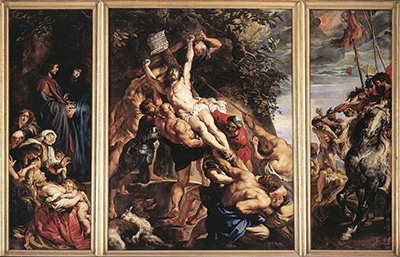
The Elevation of the Cross
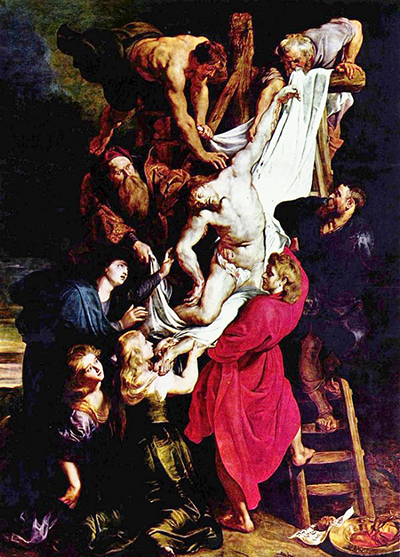
1609–10The Descent from the Cross
1611–14Portrait of a Boy
1629–30The Garden of Love
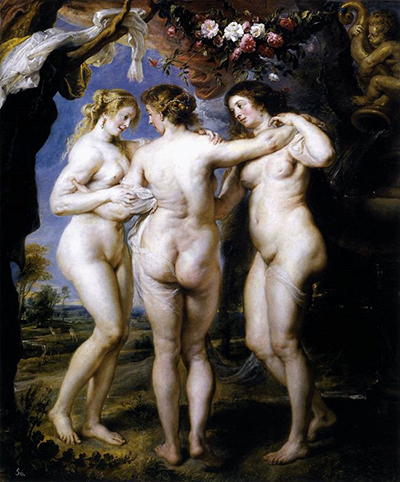
1630–35The Three Graces
1630–35Contents
- What can the drawing itself tell us?
- Why was Rubens drawing children in London?
- A family portrait as a possible first purpose
- A portrait within a wider artistic and political story
What can the drawing itself tell us?
Rubens did not define the child through clothing, possessions or a family setting. Hair, cheeks, eyes, nose and mouth carry nearly all the information. The black chalk builds the larger structure; red chalk gives warmth around the face; white accents lift areas from the paper. The lightly indicated shoulders leave the head as the sheet’s primary work. The effect is immediate, but that immediacy comes from decisions about what to finish and what to leave open.
There is a material limit to reading the surface as wholly Rubens’s hand. The ALBERTINA’s technique field[1] says that brown pen additions at the mouth, nose and eyes were made later by someone else. Its inscription field likewise records “P P Rubbens.” at the lower right as the work of another hand. The name on the paper is thus not an autograph signature, and the most forceful visible marks in particular facial features cannot all be assigned to Rubens. The collection still catalogues the underlying chalk drawing as his.
This matters more than a technical footnote. A small portrait is often read through the eyes and mouth, precisely the places where the record says a later person intervened. The image shows a persuasive child’s face, but a modern reader should not build a theory of Rubens’s intention from every dark accent in those features. The chalk modelling, loose hair and selected highlights supply a firmer basis for discussing his portrait practice.
The sheet also carries a collection mark of Duke Albert of Saxe-Teschen, whose holdings form a major part of the ALBERTINA’s historic graphic collection. The mark explains a later stage of the drawing’s life. It does not identify the boy, prove when Rubens gave the sheet away or establish a continuous ownership chain from 1630 to Vienna. The public record’s listed provenance begins with Duke Albert.
Why was Rubens drawing children in London?
Rubens spent 1629–30 in London while negotiating between the English and Spanish courts. The ALBERTINA explains that he came as a representative of Philip IV of Spain and Archduchess Isabella and stayed at York House on the Strand, where Balthasar Gerbier and his family were also living. Gerbier, a Flemish artist and court intermediary, had known Rubens for several years. The two men’s professional relationship and shared lodging offered an immediate setting in which Rubens could study the Gerbier children from life. This context makes the identification of the boy plausible, though it does not document the exact sitting.
Rubens’s visit was political, but it was also a working artist’s visit. He had access to important English collections and made pictures while diplomatic talks continued. The National Gallery in London[2] describes the large allegory Minerva protects Pax from Mars, often called Peace and War, as a gift Rubens gave to Charles I in 1630. England and Spain had been at war; the picture urged peace through mythological personifications and images of prosperity. A peace treaty followed in November that year. These events give the portrait sheet a specific historical setting, but they do not make the child himself an envoy or turn the drawing into a diplomatic document.
The ALBERTINA says the child on this sheet served as the model for Hymenaios, or Hymen, the marriage figure carrying a torch in the allegory. The National Gallery’s account[2] likewise identifies George Gerbier as the model for Hymen. In the painting he crowns a girl with a floral wreath, identified there as his sister Elizabeth; another sister, Susan, looks out at the viewer. Their family likenesses become part of an allegorical argument: children represent both particular people Rubens knew and the future that a peaceful society could protect.
The transformation from sheet to canvas is striking. The chalk drawing shows one child’s head, with little beyond the shoulders. The painting gives that boy a body, a gesture, a torch and a role within a crowded composition almost three metres wide. The drawing’s purpose cannot be reduced to a mechanically transferred face. It was a record Rubens could adapt while arranging a complex painting. The National Gallery dates the allegory 1629–30, the same general period as the sheet, which makes the relationship chronologically coherent.
The National Gallery's detailed interpretation[2] helps locate the boy within that larger argument. Pax, who also takes on qualities of the fertility goddess Ceres, shares food and abundance with the children. Minerva holds back Mars and the forces of conflict above them. The torch-bearing George, read as Hymen, crowns Elizabeth nearby; Susan faces outward. The children therefore give Rubens's abstract plea for peace a set of individual young faces. That double identity is why it matters to begin with the drawing: without the separate chalk study and collection records, the painted boy could be described only as a mythological figure. The family likeness makes the future at stake in the allegory feel immediate.
The gallery also documents the painting's first political setting more precisely than the drawing's. It says the canvas was presented to Charles I and recorded in the Bear Gallery at Whitehall by about 1639. The ALBERTINA's essay reports that Rubens was knighted by Charles there in March 1630, with the allegory already placed in that royal setting. These records concern a gift and its display, not a transaction for the small head study. The drawing can be connected to the allegory's making while still lacking a known first owner or a documented gift inscription of its own.
A family portrait as a possible first purpose
The ALBERTINA’s essay suggests that the studies of the Gerbier children may originally have been made for a family portrait, then used in Peace and War. This is a scholarly reconstruction, not a surviving instruction from Gerbier to Rubens. A separate painting gives the idea weight: the National Gallery of Art in Washington[3] holds Deborah Kip, Wife of Sir Balthasar Gerbier, and Her Children, accession 1971.18.1. The museum identifies Rubens’s work in 1629/30 and says the canvas was probably reworked by Jacob Jordaens in the mid-1640s.
Washington’s account places Deborah Kip with four children in an elaborate terrace setting. It identifies the son George and daughters Elizabeth and Susan among them. Rubens apparently began the family group on a narrower central piece of canvas, then added strips on all sides for a nearly square composition. He took the still-unfinished portrait back to Antwerp when he left England. The NGA suggests Jordaens probably completed it after Rubens’s death. That painting’s stages matter: the present large canvas is not simply a finished portrait made during one sitting in London, nor is it the chalk sheet discussed on this page.
The family picture may have been conceived as thanks for the Gerbiers’ hospitality or as a work Rubens intended to keep; the NGA presents such motives as possibilities. The ALBERTINA also describes a possible gift to the family, but none of these hypotheses is a documented commission. What is secure across the records is that Rubens had close access to the Gerbier household, drew a child probably identified as George, and used family likenesses in both portrait and allegorical work. The direction of every preparatory step remains a matter of interpretation.
One archival absence reinforces that caution. The ALBERTINA notes that the Gerbier family painting is not listed in Rubens's 1640 estate inventory. That fact is consistent with the picture having left his possession earlier, but it cannot tell us exactly when, how or to whom it was given. The same essay says Gerbier moved with his family back to Flanders in 1631 and remained in contact with Rubens. Their continued connection makes a gift imaginable, yet the inventory gap is not itself a receipt. It is possible to reconstruct an artistic relationship from several surviving objects without pretending that their every transfer is documented.
The museum also identifies two more preparatory resources without treating them as pieces of the Vienna sheet: a Weimar drawing associated with Susan, and a Rotterdam sheet with loose studies for Hymen and other children. In its note on the Weimar work, the ALBERTINA reports a scholarly view that the face and hair may have been reworked by a later hand. That is a parallel warning to the documented later pen additions on Vienna 8267. When comparing likenesses across the family, a reader should ask which parts of each present image belong to Rubens's first drawing and which may reflect a later intervention.
There are other related drawings of Gerbier children in European collections. The ALBERTINA points, for example, to a study associated with Susan in Weimar and another child study connected with Elizabeth. Those are useful for understanding a group of drawings made around Rubens’s London visit, but they are not parts of this physical sheet. Their later interventions, inscriptions, measurements and collection histories cannot be assigned to inventory 8267.
A portrait within a wider artistic and political story
The drawing is a rare point where a private household and a public painting meet. The child’s expression is not overtly heroic. His face is observed in a moment of quiet attention, before his likeness becomes the god Hymen in an argument for peace. Rubens’s ability to shift between these registers explains why the head can feel intimate while its working history connects it to a royal gift.
This double life also warns against reading the drawn boy entirely through the finished painting. The sheet does not itself display a torch, crown, fruit, Pax, Minerva or Mars. Those belong to the National Gallery canvas. Conversely, the painted Hymen is embedded among real children and invented allegorical figures; its individual features are only one part of the political message. A reader can look from one object to the other and follow Rubens’s use of a model without collapsing drawing and painting into the same work.
The ALBERTINA sheet remains a small physical object: chalk on paper, not a reduced oil portrait. Its provisional lines record the artist’s attention to a living face. The later pen marks and non-autograph inscription show how other hands affected what is now visible. The probable name George Gerbier gives it a place in Rubens’s London life, while the careful qualification leaves open the possibility that future documentary or technical study could refine the identification.
Rubens artworks directory
Frequently Asked Questions
The ALBERTINA titles the drawing as George Gerbier, Balthasar Gerbier’s son, but its essay says the identification is believed rather than proven. “Probably George Gerbier” reflects the evidence.
The museum dates the sheet 1629/30, the period of Rubens’s London diplomatic visit and his stay where the Gerbier family was lodging. The exact sitting date is not recorded.
It is black and red chalk, heightened with white, on paper. The ALBERTINA identifies later brown-pen additions by another hand around the facial features.
No. The ALBERTINA catalogues the inscription as by another hand.
No. This is an ALBERTINA drawing, inventory 8267, measuring 28.8 × 21.9 centimetres. Peace and War is a separate large oil canvas in London, whose Hymen figure was modelled on the child.
Discussion
Look closely at Rubens's chalk work and the later touches around the face.
Share an observation about the drawing or a reliable source that adds to its history.
Reader Insights
Which features make the boy feel individual despite the qualified identity?
How might Rubens have used the drawing in his London paintings?
Why should the later pen additions affect a close reading of the eyes and mouth?
Join the Conversation
Add your reading below, keeping observations specific and evidence clear.
References
- ALBERTINA, Portrait of George Gerbier, Son of Balthasar Gerbier , inventory 8267. View source
- National Gallery, London, Rubens, Minerva protects Pax from Mars ( Peace and War ), NG46. View source
- National Gallery of Art, Washington, Deborah Kip, Wife of Sir Balthasar Gerbier, and Her Children , accession 1971.18.1. View source