by Tom Gurney
Tom Gurney BSc (Hons) is an art history expert with over 20 years experience
Published on June 19, 2020 / Updated on October 14, 2026
Email: tomgurney1@gmail.com / Phone: +44 7429 011000
Two children reach toward one another
Two infants occupy the front of this painting. Jesus stands on the left and reaches across a pale cloth toward the seated young John the Baptist on the right. Mary watches from the middle, while two older figures lean in behind. The scene is close and domestic, but one detail identifies the boy facing Jesus: he sits against an animal skin, a sign of the wilderness clothing he will wear as John the Baptist.
The Wallace Collection[1] catalogues this exact work as The Holy Family with Saint Elizabeth and Saint John the Baptist by Peter Paul Rubens, dated 1614–15. It is oil on oak panel, inventory P81. The painted image measures 136 × 100 centimetres. Its recorded overall object size is larger, 165 × 130 × 11 centimetres, because the panel was later made up or mounted. Those two sets of numbers should not be substituted for one another.
Rubens painted the work for Archduke Albert, governor of the Spanish Netherlands. The Wallace says it hung in Albert's private oratory at the Ducal Palace in Brussels, and that Rubens received 300 guilders for it in 1615. The documented setting helps explain the painting's intimate scale and its closely grouped devotional figures. It was made for a particular patron's religious space, not as a generic scene destined for a public altarpiece.
At a Glance
- ArtistPeter Paul Rubens [1]
- Date1614–15 [1]
- MediumOil on oak panel [1]
- Painted image136 × 100 cm [1]
- Original settingArchduke Albert's private oratory, Brussels [1][2]
- CollectionWallace Collection, P81 [1]
Where this work sits in Rubens's career
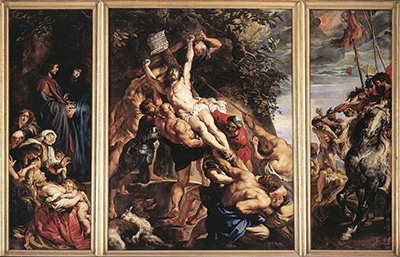
The Elevation of the Cross
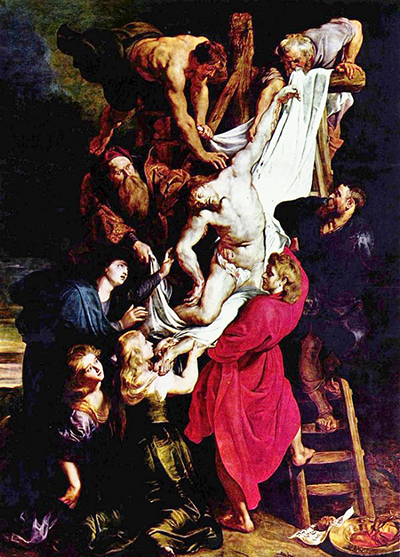
1609–10The Descent from the Cross
1611–14The Garden of Love
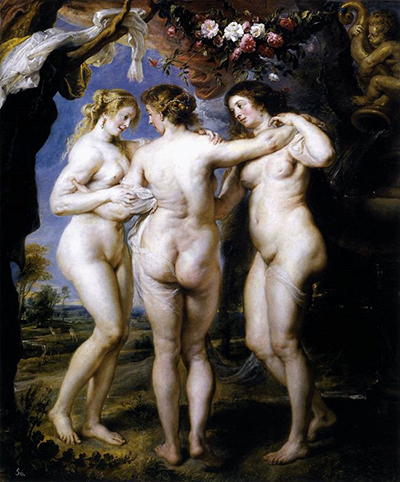
1630–35The Three Graces
1630–35Contents
- Finding the five figures
- A meeting not told as a simple Gospel episode
- Jesus and John in the foreground
- Mary, Elizabeth and Joseph
- Painted for Archduke Albert's oratory
- Oak panel, image size and later mounting
- Later owners and changing value
- Reading the whole group
Finding the five figures
The two children are easiest to see because their pale bodies catch the strongest light. Jesus stands at the left, slightly forward, with his feet set on the drapery. John sits opposite him at the right, reaching up. Between and behind them Mary leans forward, her face framed by a darker head covering. The older woman beside John is Elizabeth, his mother. Joseph appears behind at the far left.
The title identifies the family relationships, while the visual arrangement gives them immediacy. Joseph is not in the front row of action; Elizabeth bends toward her son; Mary stays between the children. The composition makes the two infants the centre without cutting them off from the adults around them.
The Wallace specifically identifies the little John by the animal skin. This is a stronger cue than simply calling the boy at the right “another child”. It connects an infant in a home-like gathering with the adult Baptist's later life in the desert. The skin works as an attribute, allowing a viewer to recognise a future saint before that future has happened within the picture's imagined time.
In the inherited reproduction, both children reach toward the space between them. Their bodies form a crossing movement over the white cloth. That movement leads the viewer's eye through the painting more surely than any painted doorway or distant landscape would. Rubens fills the panel with people and cloth, leaving very little background to distract from the meeting.
A meeting not told as a simple Gospel episode
The Wallace says the subject comes from the Meditations on the Life of Christ, a devotional text used by seventeenth-century Catholic artists. This matters because the scene of the two infants together should not automatically be presented as a directly witnessed episode from one Gospel verse. Rubens drew on a broader religious imagination that expanded the story of Christ's infancy for contemplation.
The collection record does not cite a precise chapter or passage of the Meditations. This page therefore names the source as the Wallace does, without manufacturing an exact quotation or claiming that every gesture follows a fixed text. The painting is a painted devotional scene, not an illustrated page number. The human relationships are central to its effect.
The combination of Elizabeth and young John also changes what “Holy Family” means in the title. The core group of Jesus, Mary and Joseph is present, but relatives join them. John will later baptise Jesus as an adult. Here, their connection is imagined in infancy, with an animal skin already signalling John's future role. The result offers a viewer a way to contemplate sacred history through a family visit.
Nothing in the Wallace record requires us to say that Rubens meant the two infants to enact a specific later sacrament here. We can see them reach toward one another and know John's future identity from his attribute. That is enough to give the gesture significance without inventing a complicated coded programme for the cloth or every hand.
Jesus and John in the foreground
Jesus stands firmly for an infant, his bright body turned toward John. John sits with one leg extended and raises his hands near the cloth. The two children do not mirror each other. One is upright and moving outward; the other is seated and responding. Rubens uses this difference to make the meeting active rather than a formal pairing of small figures.
The pale cloth between them is a visual bridge. It catches light, links their hands and gives the adults something to hold or arrange. The exact meaning of every fold is not given by the collection record. Its clear compositional task is to connect the two bright bodies in the foreground.
The skin beside John is more than a patch of brown texture. The Wallace calls it the identifying sign of the Baptist, anticipating the animal skin he would later wear while preaching in the desert. It allows a viewer to read the infant as John without a written label inside the scene. This is especially important because many Rubens Holy Family paintings include different combinations of relatives and saints.
The children fill a substantial portion of the panel. The adults bend around them, making an arch of faces and shoulders. The encounter feels close enough for private contemplation: a viewer in the oratory could study the small exchanges of hands, eyes and posture rather than standing far below a monumental altar image.
Mary, Elizabeth and Joseph
Mary sits behind the gap between the boys. Her red clothing, dark veil and illuminated face give her a strong central presence, even though Jesus and John take the foreground. She is looking toward the children rather than outward at the viewer. That inward attention helps hold the scene together.
Elizabeth leans over John from the right. Her aged face and head covering distinguish her from Mary. The contrast between older and younger mothers repeats the contrast between the two children. Rubens does not line up figures by age in neat pairs, but he lets the viewer feel a network of familial relationships.
Joseph is higher and farther back at the left. Much of his figure is in shadow, but his face remains visible. His position completes the family group without competing with the foreground encounter. The eye finds him after tracing the children and the two women, so the painting unfolds gradually despite its compact form.
No source cited here assigns a psychological state to each adult. The close faces and inward looks can be described without claiming that Joseph is anxious, Mary is prophetic or Elizabeth knows a particular future event. The devotional setting makes such readings tempting, but the painting's confirmed facts are the identified people, their gestures and the Wallace's account of the iconographic attribute.
Painted for Archduke Albert's oratory
The Wallace identifies Archduke Albert as the patron and the Ducal Palace in Brussels as the painting's first setting. An oratory is a place set aside for prayer. That context makes the work's intimate format and family subject meaningful: it could be approached at close range by a patron rather than viewed from the length of a church nave.
The collection records a payment of 300 guilders in 1615. The date supports the painting's documented 1614–15 period, but payment should not be described as the moment every brushstroke was finished. The transaction shows the value of the commission and the patron's relationship with Rubens. It does not provide a complete diary of design, delivery and installation.
A Wallace Collection essay on court art[2] also mentions P81 and its placement in Albert's private oratory. It situates Rubens in the service of Albert and Isabella Clara Eugenia, governors of the Spanish Netherlands. The object record is the more precise source for this painting's size, date and payment; the broader essay helps show why a religious panel belonged in a courtly environment.
The private destination should not be confused with the painting's current position in a public collection. The Wallace now lists it in the Great Gallery. Gallery placement can change, while the documented original oratory remains part of the object's history. A visitor planning to see it should consult the collection's current display information.
Oak panel, image size and later mounting
The Wallace identifies the support as oak, not canvas. The painted image is 136 × 100 cm, a substantial panel but still suited to a private room. The collection also lists an object measurement of 165 × 130 × 11 cm, explicitly described as made up to that size. The difference likely reflects later physical additions or mounting, but the public record quoted here does not describe every component in detail.
For a reader, the practical distinction is simple. If the question is how large Rubens's painted scene is, use the image size. If the question is how large the currently mounted object is, the larger measurement may be relevant, but it needs its “made up to” qualification. This page captions the painted image rather than silently presenting the later assembly as Rubens's original dimensions.
The retained reproduction is 400 pixels wide. It conveys the five-figure design and John's animal skin, but it cannot settle the state of the oak boards, the paint surface or the later mounting. Those require the collection's technical records and direct examination. The article's medium and measurements therefore come from the Wallace's catalogue rather than an attempted measurement of the JPEG.
The panel's physical character also distinguishes it from the Prado's Holy Family with Saint Anne, a different Rubens composition on canvas made much later. Similar family titles do not imply the same support, size, patron or date. P81 is the Wallace's early Albert oratory panel with Elizabeth and the young John.
Later owners and changing value
The Wallace records the painting in the collection of Emperor Joseph II during the eighteenth century. It later entered the collection of the 4th Marquess of Hertford, who bought it in 1846 for 2,660 guineas. The museum reads that high price as evidence of the regard in which Rubens's religious and historical paintings were held in the nineteenth century.
These ownership points do not fill every intervening year. They do show a work moving from a private princely oratory into imperial and then British aristocratic collecting before its present public home. The painting's purpose and audience changed. A devotional commission became an admired Old Master object, yet the people and gestures Rubens painted remain the same.
The price is a historical figure, not a current market valuation. Its importance is comparative and contextual: a nineteenth-century buyer made a substantial investment in this Rubens panel. The collection's own interpretation connects the sum to the esteem for Rubens at that time. An article need not convert it into present currency to explain the documented acquisition.
The current Wallace record identifies the work as P81 and gives its location as the Great Gallery. The number provides a stable way to distinguish the exact panel from other Holy Family paintings. The public display may be the easiest way to encounter it today, but the original Archducal oratory is the key to understanding why Rubens painted the intimate meeting in the first place.
Reading the whole group
Begin with the two children. Jesus stands on the left and reaches toward John, who sits against the animal skin on the right. Then move upward: Mary watches between them, Elizabeth bends near John, and Joseph looks from the rear left. The adults' faces make a close canopy over the exchange below.
Notice how the light concentrates on flesh and white fabric. Darker drapery and background let the children come forward. The figures overlap so tightly that the family seems gathered into a single room without the painter having to describe much of that room. The design is dense, but the children remain clear.
This is Rubens's 1614–15 Holy Family with Saint Elizabeth and Saint John the Baptist, oil on oak, Wallace Collection P81. It was painted for Archduke Albert's private oratory in Brussels, and Rubens was paid in 1615. The painted image measures 136 × 100 cm; a larger recorded object size refers to later made-up dimensions. John's animal skin gives the viewer the clue to the little boy's identity, while the meeting of the two infants gives the painting its energy.
Rubens artworks directory
Frequently Asked Questions
It belongs to the Wallace Collection in London, inventory P81. The online record currently lists the Great Gallery; check current display before visiting.
The Wallace dates the panel 1614–15. It records a 300-guilder payment in 1615 from Archduke Albert's commission.
The Wallace identifies John by the animal skin beside him, anticipating the clothing he later wore while preaching in the desert. He is the seated child at the right.
Archduke Albert, governor of the Spanish Netherlands, commissioned it for his private oratory in the Ducal Palace, Brussels, according to the Wallace Collection.
The Wallace traces the subject to the Meditations on the Life of Christ, a devotional source. Its object record does not specify an exact passage, so the painting should not be presented as a literal illustration of one named Gospel verse.
The painted image is 136 × 100 cm. The Wallace also records the later made-up object at 165 × 130 × 11 cm; that larger measurement is not the original painted image size.
The 4th Marquess of Hertford bought it in 1846 for 2,660 guineas, according to the Wallace. Earlier, it belonged to Emperor Joseph II.
Discussion
Follow the two children's hands and the cloth between them.
Share an observation about the panel or a reliable source that adds to its history.
Reader Insights
How does the animal skin identify the young John?
What do the adults' positions add to the children's encounter?
How might a private oratory setting have shaped the painting's scale?
Join the Conversation
Add your reading below, keeping observations specific and evidence clear.
References
- The Wallace Collection, Rubens, The Holy Family with Saint Elizabeth and Saint John the Baptist , P81. View source
- The Wallace Collection, court-art essay mentioning the Archduke Albert oratory picture. View source