by Tom Gurney
Tom Gurney BSc (Hons) is an art history expert with over 20 years experience
Published on June 19, 2020 / Updated on October 14, 2026
Email: tomgurney1@gmail.com / Phone: +44 7429 011000
Four figures, one small space
The infant Jesus stands on Mary's lap and reaches toward her. She supports him while Saint Anne leans close from behind. Joseph watches at the right, resting his chin on his hand. There is little empty space between the four bodies. Rubens has made a religious subject feel like a family encounter, with each figure connected by touch, gaze or proximity.
The Museo Nacional del Prado[1] identifies this painting as The Holy Family with Saint Anne by Peter Paul Rubens, dating it about 1630. It is oil on canvas, 116 × 91 centimetres, inventory P001639. The exact object matters because Rubens painted other Holy Family subjects, and a similarly named work in another collection may have a different grouping and attribution.
At a glance, Mary and the child dominate the image. Yet the picture is built from four relationships: mother and son in the centre, Anne embracing them from behind, and Joseph attending from the shadowed right. The Prado reads the group's nearness as a way to draw viewers into a circle of familial feeling. That interpretation fits what the reproduction shows, though no source supplies a private statement from Rubens spelling out the emotion he intended each person to feel.
At a Glance
- ArtistPeter Paul Rubens [1]
- DateAbout 1630 [1]
- MediumOil on canvas [1]
- Size116 × 91 cm [1]
- Later settingSpanish royal collection; El Escorial [1][2]
- CollectionMuseo Nacional del Prado, P001639 [1]
Where this work sits in Rubens's career
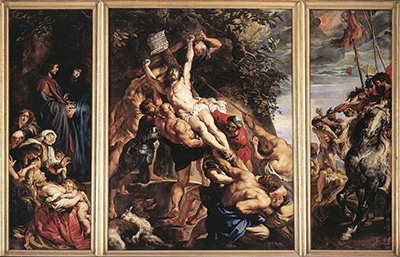
The Elevation of the Cross
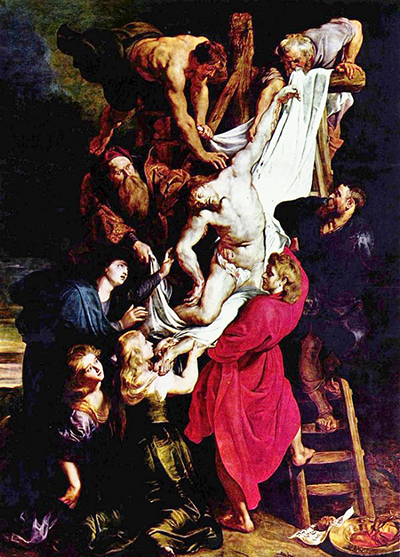
1609–10The Descent from the Cross
1611–14The Garden of Love
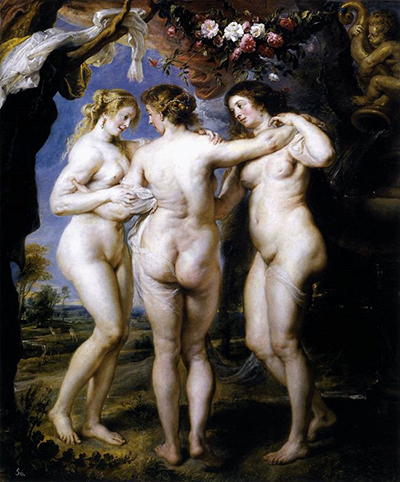
1630–35The Three Graces
1630–35Contents
- The child standing on Mary's lap
- Mary at the centre
- Saint Anne's embrace
- Joseph at the right
- A close composition at a human scale
- Rubens's later manner and Titian
- From the Spanish royal collection to the Prado
- Which Holy Family is this?
The child standing on Mary's lap
Jesus is not asleep in a cradle or held horizontally across Mary's arms. He stands upright, his feet resting on her lap and hand. His body is bright against the deeper reds and blues around it. This placement makes him easy to find and gives the painting its first movement: he leans toward Mary rather than posing independently of her.
The Prado observes that the child touches Mary's breast with one hand and rests the other near her neck. Mary, in turn, holds his torso and supports his left foot. These are specific gestures, not generic signs of affection pasted onto the scene. The contact has a practical aspect: an infant standing precariously needs support. It also gives the divine child a visible human dependence.
The child's upward glance differs from Mary's. The museum notes that he looks toward the heights, while her gaze drifts into the middle distance. They are connected more by touch than by eye contact. That mismatch prevents the group from becoming a posed exchange of smiles. Each person remains absorbed in a slightly different thought, while the joined hands and bodies maintain the bond.
His pale skin catches light, and his extended arm crosses the red of Mary's dress. The viewer can follow that arm inward to the place where she holds him, then down to his feet and the cloth across her lap. Rubens makes the painting's devotional centre legible through the movement of a real, weight-bearing child.
Mary at the centre
Mary wears a vivid red dress and a deep blue mantle. The Prado describes the colours as scarlet and cobalt blue. In the inherited image, the red appears through the centre of the composition while the blue opens out at the lower right. These large areas of colour establish Mary's position before the viewer has worked out every face.
She does not hold the child stiffly. One hand steadies his body and the other supports a foot. Her head inclines toward him, yet her gaze does not lock with his. The tension between physical closeness and inward thought gives her a presence beyond a purely decorative role. She is both the person bearing the child's weight and the main emotional anchor of the picture.
The Prado calls the bond between mother and child unusually intimate. That is a museum interpretation based on the visible gestures. The painting itself gives a clear basis for it: Mary's arms, the child's hands and the tight space between their faces. We do not need to invent a specific conversation or hidden incident to see how the relationship works.
The blue mantle has substantial weight. It rolls across her arm and lap rather than hanging in neat, flat folds. The red and blue make a stable structure behind the more active flesh tones. This contrast of firm colour masses and soft bodies is one reason the small painting feels full without becoming confusing.
Saint Anne's embrace
Saint Anne, Mary's mother, appears just behind the central pair. Her older face and grey hair are visible above the child. Her arms reach around Mary and Jesus, making her part of their physical group rather than a distant background witness. The Prado specifically describes her as embracing them and looking at her grandson.
Anne's placement extends the family across generations. Jesus is supported by Mary; Mary and Jesus are enclosed by Anne. This layered arrangement helps explain why the painting feels so compact. There are not four unrelated portraits pushed into a frame. Rubens uses overlapping arms and shoulders to make one connected structure.
Her gaze comes down toward the child, while his goes upward. As with Mary, the difference in direction makes their closeness more interesting than a simple set of mutual looks. Anne's expression appears warm but quiet in the small reproduction. It is safer to describe her position and attention than to assign her a precise thought that no source records.
Anne's presence also distinguishes this work from the most familiar three-person Holy Family of Jesus, Mary and Joseph. The title names her because she changes the subject. She is not an incidental older woman whose identity can be dropped from a caption. The Prado's object record provides the identification and anchors the route to this exact four-person painting.
Joseph at the right
Joseph occupies the darker right edge. His beard and leaning pose become clearer after the bright child and Mary's clothes have caught the eye. The Prado describes him as an older man watching the child with his chin resting on his hand. He is close enough to be part of the group, yet his posture makes him an observer rather than the central person holding Jesus.
The contrast is productive. Three figures are joined by touch; Joseph's connection is made through attention. His gaze brings the viewer back to the child from the outer edge. The right side does not become empty shadow because his head, hand and shoulder give it a human focus.
The museum's essay describes Joseph's expression as fascinated. The visible pose supports a sense of absorbed looking. Rubens lets that quiet attention balance the more active contact around Jesus. The painting's intimacy depends on both kinds of relationship: hands holding and eyes contemplating.
His figure also completes the main Holy Family while Anne enlarges it. With all four present, the picture can show a small community around the child without opening into a broad crowd of saints. The composition remains domestic in scale, even though the figures carry a devotional meaning for viewers.
A close composition at a human scale
The canvas is just over a metre tall, far smaller than Rubens's monumental altarpieces. The four bodies fill it almost edge to edge. The Prado notes their nearness to the picture plane and suggests that it draws the viewer into the family circle. In the reproduction, there is no long architectural vista to cross before reaching the figures. Faces, fabric and hands are brought forward.
The closeness does not mean every part is equally bright. Rubens gives the child's skin and Mary's face the strongest light, while Joseph and the rear setting are darker. Anne is visible above and behind. This hierarchy makes the group readable: the viewer finds Jesus and Mary first, then discovers the two older figures who complete the family.
The arrangement has an almost architectural solidity. Mary's seated body forms the base, Jesus stands against it, and Anne and Joseph rise behind. The Prado describes this construction as a synthesis of classical harmony and Christian family values. That is a curatorial reading of the composition; it should not be expanded into a claim that Rubens copied a particular classical statue or planned every relationship from a written programme.
The painting also uses natural contact. The child needs support, Anne's arms curve around her family, and Joseph leans in. Rubens makes the sacred people feel physically present. The Prado relates that naturalism to the devotional art of the Catholic Counter-Reformation, which sought to move viewers emotionally. The object itself shows how a small scene could do that through the ordinary language of touch.
Rubens's later manner and Titian
The Prado places the painting among Rubens's later Holy Family works, made around 1630. It sees a relationship between its soft modelling and expressive paint and Rubens's study of Titian. Rubens encountered Venetian paintings in the English and Spanish courts and made copies of Titian's work, according to the museum.
This connection is about artistic manner rather than a claim that one exact Titian painting supplied the design. The Prado points to loose, fluid brushwork and subtle colour. In the small inherited JPEG, it is easier to see the broad effects—the red dress, blue mantle and softly lit flesh—than the detail of individual strokes. The museum's record is the stronger source for the stylistic comparison.
The figures feel solid but not hard-edged. Mary's face, Anne's age and the infant's body have different surfaces, while the fabrics add heavier colour and movement. The warm flesh and dark background make the bright parts feel especially near. These are visual features a reader can look for even when the tiny reproduction cannot reveal the full paint surface.
Rubens's painting of families in this period was not limited to this one canvas. The Prado says the work belongs to a group of Holy Family images from the late 1620s and early 1630s. That broader pattern helps date and contextualize the picture, but each version still needs its own object record. The Prado's P001639 is the four-person group shown here, not every Holy Family Rubens or his workshop produced.
From the Spanish royal collection to the Prado
The painting became part of Philip IV's royal collection. The Prado says it appears in an inventory made after the king's death in 1665. That establishes a documented later ownership point; it does not prove that Rubens painted the canvas for a particular room in Spain or personally delivered it to the king.
Diego Velázquez later selected it for the Prior's Chapter Room at El Escorial, where it was displayed with works by Raphael, Titian and others. The Prado also notes Rubens's Immaculate Conception among the pictures there. Velázquez's choice is evidence of the painting's importance in the royal collection. It is a later display decision, not a claim of collaboration between Velázquez and Rubens on this Holy Family.
A late seventeenth-century description by Francisco de los Santos, quoted and discussed in the Prado's essay, responds to the painting's joy and tenderness. The source is useful because it shows that the family's closeness struck a historical viewer as well as a modern curator. The article need not reproduce a long passage to convey the point. What matters is that the work's emotional effect has a record in its reception history.
The canvas eventually entered the Museo del Prado, where it is catalogued as P001639. Its royal and El Escorial history gives the painting a life beyond the moment of its making. The same close group could serve devotion, royal display and museum study in different settings. These changes of place do not erase the object facts: Rubens, about 1630, oil on canvas, 116 × 91 centimetres.
Which Holy Family is this?
The title Holy Family with Saint Anne is shared or echoed by other works. This page identifies the Prado painting P001639. Its key visible pattern is the nude standing child on Mary's lap, Anne embracing from behind and an elderly Joseph watching at the right. The museum's dimensions and inventory keep it tied to one collection object.
That distinction prevents an easy mistake. A painting with Mary, Anne, Joseph and Jesus may look broadly similar in words yet differ greatly in composition, scale or attribution. The illustration here matches the Prado's arrangement. The collection identifier lets a reader verify the link rather than trusting a generic title alone.
The picture rewards a second look. Start with Jesus's body and the hands that steady it. Follow Anne's embrace behind Mary, then find Joseph leaning from the right. Finally step back to see how the scarlet and cobalt shapes keep four figures inside one compact design. The central subject is a family connection made visible by the placement of bodies.
Rubens's Holy Family with Saint Anne is an intimate canvas from about 1630, now in the Museo Nacional del Prado. Its royal provenance and Velázquez's later selection for El Escorial show how highly it was regarded. Yet the painting's force begins with a simple visual fact: the child, his mother, his grandmother and Joseph are drawn so close that their separate gestures become one shared image of care.
Rubens artworks directory
Frequently Asked Questions
It belongs to the Museo Nacional del Prado, Madrid, inventory P001639. Current gallery placement should be checked with the museum.
The Prado dates it about 1630. It is oil on canvas, 116 × 91 centimetres.
They are the infant Jesus, Mary, Saint Anne—Mary's mother—and Joseph. Anne embraces from behind, while Joseph watches at the right.
That is Rubens's way of bringing his body and gestures into direct contact with Mary. She supports his torso and foot; the Prado stresses their connection through touch.
The Prado documents its later place in the Spanish royal collection and says Velázquez selected it for El Escorial's Prior's Chapter Room. The cited record does not establish that Rubens originally painted it for that room.
This is the Prado's P001639, with a standing child on Mary's lap, Anne embracing the pair and Joseph at the right. Check collection and inventory when comparing similarly titled Rubens works.
Discussion
Follow the child's hands and feet, then trace the adults' gestures around him.
Share an observation about the canvas or a reliable source that adds to its history.
Reader Insights
How do touch and gaze connect the four people differently?
What do the red dress and blue mantle contribute to the composition?
Why does the later royal collection history matter to this intimate picture?
Join the Conversation
Add your reading below, keeping observations specific and evidence clear.
References
- Museo Nacional del Prado, Rubens, The Holy Family with Saint Anne , P001639. View source
- Museo Nacional del Prado, Spanish object essay and provenance for La Sagrada Familia con santa Ana. View source
- Museo Nacional del Prado, 2010 Rubens exhibition checklist. View source