 by Tom Gurney
Tom Gurney BSc (Hons) is an art history expert with over 20 years experience
Published on June 19, 2020 / Updated on October 14, 2026
Email: tomgurney1@gmail.com / Phone: +44 7429 011000
A stopped sacrifice, copied from another artist
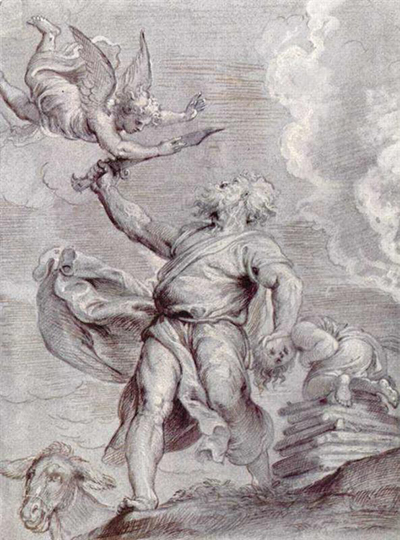
An angel flies in from the upper left. Abraham stands on a rocky rise with one arm stretched towards the angel and the other hand at the boy's head. Isaac crouches on a pile of wood at right. The moment is almost at its climax: the father is about to sacrifice his son, but the divine messenger interrupts him. A small animal's head appears below the figures at left.
The ALBERTINA in Vienna[1] catalogues this work as The Sacrifice of Abraham, a drawing by Peter Paul Rubens copied after Titian. It is inventory 8203, measures 33.3 × 24.9 centimetres, and uses black chalk, brown brushwork and opaque white on grey-green paper. The phrase “after Titian” is crucial. Rubens drew the scene, but he was studying a design made by an earlier painter rather than inventing this composition as an independent oil painting.
The inherited page title and picture could easily be confused with Rubens's own painted Sacrifice of Isaac compositions. Here the object is a small sheet of paper in the ALBERTINA. Its subject is the same biblical episode, yet its artistic relation to Titian makes it a different kind of work. The sheet shows how copying could be an active way of looking: Rubens had to translate a painted arrangement of bodies, movement and light into chalk, brush and white pigment.
At a Glance
- Drawing byPeter Paul Rubens [1]
- AfterTitian [1]
- SubjectAngel stopping Abraham's sacrifice of Isaac [1]
- DateNot established; older catalogue suggests 1600–08 [1]
- MediumBlack chalk, brown brushwork and opaque white on grey-green paper [1]
- Dimensions33.3 × 24.9 cm [1]
- CollectionALBERTINA, Vienna, 8203 [1]
Contents
- What happens in the story?
- How does the composition direct the eye?
- What did Rubens copy from Titian?
- Why copy a painting rather than invent a scene?
- What do the drawing materials contribute?
- When did Rubens make it?
- What does the collector's mark tell us?
- How should this drawing be read?
What happens in the story?
Genesis 22 recounts God's command that Abraham offer his son Isaac as a sacrifice. Abraham prepares the wood and reaches the point of raising his hand, but an angel calls to stop him. A ram is then provided for the offering instead. The drawing concentrates the story into the instant of interruption. The angel's arrival, Abraham's response and Isaac's vulnerable position are all visible at once.
Abraham dominates the centre. His body twists between the angel above and the son below and to the right. The figure is not calmly posed for a portrait; its gesture carries the moral and physical strain of the event. One arm reaches up into the angel's path. The other bends down towards Isaac. That opposing movement turns a narrow vertical sheet into a scene of competing forces.
Isaac lies or kneels on stacked wood. His body is markedly smaller than Abraham's, and the parallel pieces of the pyre make his position plain. The viewer can see that the boy is not simply resting on a ledge. The wood gives the contemplated act a terrible practical setting. The angel's movement has meaning because Abraham has already brought his son to the point of sacrifice.
The animal at lower left is less clear in the retained monochrome reproduction. It should be read cautiously. In Genesis, a ram becomes the substitute victim. A British Museum record of a 1682 etching after Titian's painting[2] describes a donkey's head at lower left. The difference between that description and the biblical ram warns against using a small cropped form as proof of a particular species. The key to the scene is the angel's intervention; the lower-left animal is a secondary detail whose identification should not carry the argument.
How does the composition direct the eye?
The angel and Abraham's raised arm form a diagonal across the top half of the sheet. The angel's drapery curls as the figure enters, and a pointing hand addresses the central man. Abraham looks upward. His white hair and beard sit near the meeting point of these gestures, making his head the hinge between the divine command and his own action.
From Abraham, the eye drops to the hand at Isaac's head and then to the woodpile. The figure of Isaac lies near the right edge, partly sheltered by the curve of Abraham's body. The dark accents on the wood and ground hold the composition down. A clouded opening at upper right prevents the angel and Abraham from filling every part of the sky, while giving their movement space to unfold.
The figures are large relative to the sheet. There is little narrative distance between them and the viewer. This closeness reflects the urgency of the subject: the instant before a death would occur cannot be treated as a remote landscape anecdote. Yet the drawing also remains a study of another artist's solution. It records relationships among bodies, hands and diagonals, with less attention to the large painted work's original scale and colour.
The upper left is busy with the angel's wings and garments. The lower right is dense with Isaac, the pyre and the sloping ground. Abraham bridges the two. The design uses the full height of the sheet, so the angel's descent and the father's poised action feel connected. A reader who looks only at the central torso misses the way the composition is stretched between heaven and the prepared wood.
What did Rubens copy from Titian?
The ALBERTINA explicitly calls Rubens's sheet a copy after Titian. A British Museum catalogue entry[2] for Valentin Lefebre's later etching describes Titian's Sacrifice of Isaac: Abraham on a rock at centre, Isaac kneeling on a pyre at right and an angel arriving at upper left. This shared arrangement supports the identification of the composition Rubens studied. Lefebre's 1682 print is another work after Titian, not a source Rubens could have copied if the older 1600–08 dating of his drawing is accepted.
Titian's painting was made for the ceiling of the church of Santo Spirito in Venice and was transferred to the sacristy of Santa Maria della Salute in 1657, according to the British Museum. The scholarly Teutsche Academie edition[3] catalogues the painting as 1542–43, oil on canvas, now in the Salute, and places it with Titian's related biblical canvases David and Goliath and Cain and Abel. The British Museum and the edition thus give context for Titian's large original. The ALBERTINA sheet is a later, much smaller translation of its design into drawing media.
The ALBERTINA record does not say whether Rubens made his copy while directly looking at Titian's ceiling canvas, from another drawing, or from an available reproduction. The historical connection between the compositions is secure enough to explain “after Titian,” but the exact circumstances of the copying are not documented by this short object record. It is tempting to place Rubens in a particular Venetian room with chalk in hand; the evidence here does not allow that scene to be stated as fact.
Copying is not a claim that the two artists' works are physically or materially the same. Titian's canvas was painted to be seen high above a church interior. Rubens's paper sheet could be held and examined close to the eye. The action moves from colour and oil paint into lines, washes and touches of opaque white. Studying the difference is part of understanding what Rubens learned and what his drawing preserves.
Why copy a painting rather than invent a scene?
For a painter, copying another master's composition can be a form of analysis. The problem is not simply how to imitate a surface. It is how a design makes the viewer read movement and meaning quickly: why Abraham occupies the middle, how the angel's arrival interrupts his action, and where the vulnerable Isaac must be placed so that the gesture has force.
In the ALBERTINA sheet, Rubens had to choose what mattered within a much smaller format. He could not reproduce the physical scale of a Venetian ceiling painting. He could carry across the important spatial and gestural relationships. The angel still rushes from the left, the father still turns up, and the child still waits on the wood at right. Those relationships are the composition's working structure.
The object record's wording does not tell us what Rubens later did with this particular study. It is safest to describe the act of copying rather than to claim that the sheet directly prepared a named Rubens painting. An artist may copy to remember, practise, compare or adapt. Those are plausible purposes, not recorded facts for inventory 8203. The visible result is a study in which Rubens explored a powerful predecessor's solution to a difficult dramatic moment.
The distinction matters because Rubens also painted the Abraham and Isaac story himself. If this page merges those separate objects, the reader loses the interesting point: a drawing can reveal a painter studying someone else's design while still making decisions about line, tone and emphasis in his own medium. Calling it merely a Rubens Sacrifice of Abraham without “after Titian” conceals that relationship.
What do the drawing materials contribute?
The ALBERTINA lists black chalk, brown brushwork and opaque white on grey-green paper. The coloured paper provides a middle value. Chalk and brown strokes can deepen shadows; white can pick out the most exposed parts of the bodies and drapery. The inherited website image appears nearly monochrome, so the paper's grey-green colour should be taken from the museum's catalogue, not inferred from that reproduction.
Look at the angel's garments, where darker contours and light passages pull the moving body away from the background. Abraham's beard and robe likewise gain form through contrasts of dark and bright. The bend in the father's torso is legible because the lit folds and shaded creases do different work. A few light touches on Isaac help his body remain visible against the darker pyre and ground.
Chalk is suited to varied pressure and broken edges. The brown brush passages can spread tone more broadly, gathering forms into shadow. Opaque white is a different kind of intervention: it makes selected places appear illuminated rather than leaving all the lights to the untouched paper. That mixture is part of the translation from a painted composition into a drawing. It is not evidence that the sheet was an oil sketch.
Some exact marks are hard to classify in a small digital reproduction. The museum's medium list gives the reliable inventory of materials, while close looking can show how lines, broad tone and light work together. It would be unwise to describe every bright fleck as definitively made with white paint or to reconstruct the exact order in which Rubens applied the media without examination of the original.
At 33.3 × 24.9 centimetres, the sheet is much smaller than Titian's canvas. The size invites close examination of Rubens's handling rather than an expectation of theatrical wall scale. Its paper surface, coloured ground and collector's mark also remain properties of this individual object, independent of the painting it studies.
When did Rubens make it?
The current ALBERTINA record has no date field for the drawing. It cites a 1928 catalogue by Glück and Haberditzl that placed the sheet in 1600–08. That range is a historical scholarly suggestion, not an inscription on the paper and not an exact date adopted in the current structured entry.
The proposed span overlaps Rubens's years in Italy, which makes an encounter with Venetian art plausible. But the record alone does not prove where the sheet was drawn, when within those years it was made, or whether Rubens stood before the original canvas. For the public caption, “undated; older cataloguing suggests 1600–08” preserves the distinction. The page should not convert that older range into a confident single year such as 1620.
Titian's painting has its own chronology. The Teutsche Academie edition dates the large work to 1542–43. Its move to the Salute in 1657 happened after Rubens's death and after the older proposed date for his drawing. These dates describe the model and its later location, not the moment Rubens made his copy. Keeping them on separate timelines prevents a simple but misleading caption error.
What does the collector's mark tell us?
The ALBERTINA records a mark at the lower left belonging to Duke Albert of Saxony-Teschen and lists the duke in the provenance. The mark is a sign of later ownership. It does not make Duke Albert a patron of Rubens or explain the drawing's first purpose. No earlier owner is named in the short museum entry.
This provenance matters because it identifies the physical sheet within the ALBERTINA's historical holdings. The drawing is not merely an image that could be exchanged with any other depiction of the biblical story. It has a recorded size, materials, inventory number and collector's mark. Those features help distinguish it from a later print after Titian or from an oil painting of the same subject by Rubens.
The legacy reproduction does not convey every material fact. It crops the sheet for web display and reduces the grey-green paper to a pale monochrome field. The collection record supplies information that the image cannot: the paper colour, the materials and the formal status as a copy after Titian. Both visual inspection and catalogue evidence are needed to describe the work accurately.
How should this drawing be read?
Start with the angel's outstretched arm and follow it to Abraham's raised face. Then follow Abraham's other arm down to Isaac on the woodpile. The three figures form a chain of urgent responses. The drama of the story lies in a command being stopped at the last possible moment; the drawing's diagonals make that interruption visible.
Next look at the medium. Dark lines, brown brush tones and white highlights on coloured paper are Rubens's means of restating a monumental Venetian composition at hand-held scale. The title names the biblical subject, while “after Titian” names the artistic relationship. Neither cancels the other. Rubens is the ALBERTINA's credited maker of the drawing; Titian is the painter whose earlier design it studies.
The sheet remains undated in the museum's current fields. The old 1600–08 range is worth reporting with attribution, and the Duke Albert mark is worth reporting as later ownership. Those modest limits make the object more interesting, not less: we can see precisely what survives and what must remain an open question.
Rubens artworks directory
Frequently Asked Questions
No. It is a drawing on grey-green paper, 33.3 × 24.9 centimetres, ALBERTINA inventory 8203. The museum credits it to Rubens as a copy after Titian.
He is on the wood prepared for sacrifice. The angel arrives to stop Abraham before the act is completed, the crucial moment from Genesis 22.
The ALBERTINA identifies the sheet as after Titian. A British Museum record of a later etching describes the corresponding Sacrifice of Isaac painting made for Santo Spirito, Venice, later moved to Santa Maria della Salute. The exact circumstances in which Rubens encountered the design are not recorded on the ALBERTINA page.
The museum's current entry is undated. A cited 1928 catalogue suggested 1600–08; that remains a qualified older dating.
The ALBERTINA lists Duke Albert of Saxony-Teschen and records his mark at the lower left.
Discussion
Follow the angel's arm to Abraham, then down to Isaac.
Share a close observation or a reliable source about ALBERTINA 8203.
Reader Insights
How does Rubens translate Titian's painted design into drawing media?
Which details make the intervention feel immediate?
How should the older 1600–08 dating be captioned?
Join the Conversation
Add your reading below, keeping Rubens's drawing and Titian's painting distinct.
References
- ALBERTINA, Das Opfer Abrahams , inventory 8203. View source
- British Museum, Valentin Lefebre, The Sacrifice of Isaac , etching after Titian, 1682. View source
- Teutsche Academie scholarly edition, Titian, The Sacrifice of Isaac. View source