 by Tom Gurney
Tom Gurney BSc (Hons) is an art history expert with over 20 years experience
Published on June 19, 2020 / Updated on October 14, 2026
Email: tomgurney1@gmail.com / Phone: +44 7429 011000
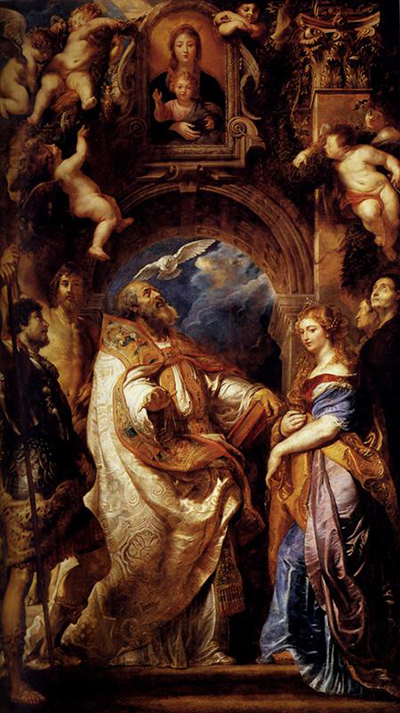
Gregory looks towards the Madonna
Pope Gregory stands in magnificent vestments beneath an image of the Virgin and Child. He lifts his face towards it as a white dove approaches; saints gathered on either side seem to witness the same sacred presence. Children and decorative garlands animate the upper architecture. Rubens made this vast canvas for the high altar of Santa Maria in Vallicella, also called the Chiesa Nuova, in Rome. It is now at the Musée de Grenoble.
The museum titles it Saint Gregory the Pope, surrounded by male and female saints, venerating the miraculous image of the Virgin and Child of Santa Maria in Vallicella. It dates the painting 1606–07 and gives oil on canvas, 477 × 288 centimetres. The Louvre's state collection record[2] identifies the Grenoble depository number MG 97. This is the first large Vallicella altarpiece, not the different solution that Rubens later made for the Roman church.
The inherited page title lists Gregory with Domitilla, “Maurus” and Papianus. That shortened wording is incomplete and one saint's name differs from the current museum description. The Grenoble object essay[1] identifies Maurice, with Domitilla, Nereus, Achilleus and Papianus also present. The stable route can remain, while the article follows the collection's fuller identification.
At a Glance
- ArtistPeter Paul Rubens [1]
- SubjectSaint Gregory and saints venerating the Madonna of Vallicella [1]
- Date1606–07 [1]
- MediumOil on canvas [1]
- Dimensions477 × 288 cm [1]
- LocationMusée de Grenoble, MG 97, on long-term state deposit [1]
Where this work sits in Rubens's career
Saint Gregory with Saints
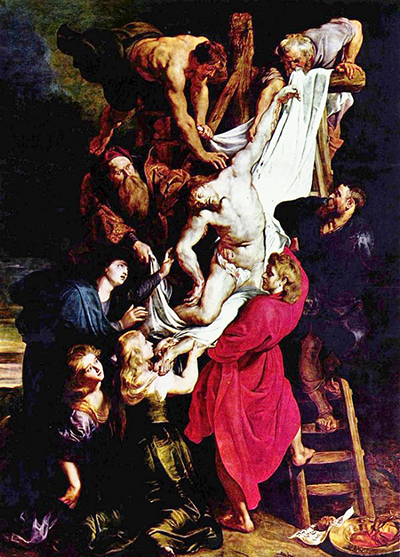
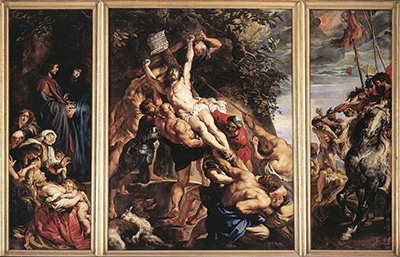
1606–07The Elevation of the Cross
1609–10The Descent from the Cross
1611–14The Garden of Love
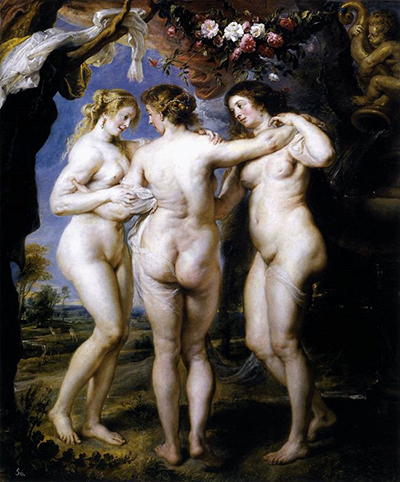
1630–35The Three Graces
1630–35Contents
- Why did Rubens paint it for the Chiesa Nuova?
- Who are the saints?
- How is the composition built?
- What did Rubens learn in Italy?
- Why is the original altarpiece now in Grenoble?
- Is it the same as the Vallicella painting in Rome?
- How should the altarpiece be read today?
Why did Rubens paint it for the Chiesa Nuova?
In 1606, Rubens received a commission for the high altar of Santa Maria in Vallicella. The church was the home of the Oratorians in Rome and held a revered image of the Madonna of Vallicella. The Grenoble museum explains that the canvas was designed around the presence of that image. Rubens was not painting a generic meeting of saints; he was working for a particular devotional site and its miraculous Madonna.
The Louvre's history is more precise about the timetable. It records the Oratorian commission in January 1606, work begun in the autumn and completed by June 1607. That sequence helps date the painting during Rubens's Italian years. It was an ambitious commission for an artist still in his late twenties, at a high altar in one of Rome's active churches.
The sacred image appears near the top of the painting, presented within a stone frame amid putti and garlands. This is a picture within a picture: the Madonna and Child are shown as the church's revered object, while the saints below turn towards it. A viewer at the altar would thus see a painted assembly directing attention to an image already important to the site. The architecture inside the canvas helps bridge the painted devotion and the real building around it.
The commission also called for saints connected with the church. Grenoble says the church preserved their relics, and that their role as intermediaries between the faithful and the miraculous image mattered in the spirit of the Counter-Reformation. The saints were therefore not chosen simply to fill an impressive composition. They were patrons and witnesses whose presence made sense at this altar.
Who are the saints?
Gregory the Great is the commanding figure below the Madonna. The Grenoble museum identifies him by the dove of the Holy Spirit, which approaches his head, and by his upward gaze. Gregory was pope from 590 to 604. The museum also explains that his inclusion honoured Pope Gregory XIII, who assigned the newly arranged church to the Oratorians. The ancient saint's presence therefore had a local institutional meaning in sixteenth-century Rome.
At the right stands Saint Domitilla, presented with costly dress and a composed expression. She is accompanied in the museum's account by Nereus and Achilleus, described as her two servants. On the other side, Saint Maurice wears armour, while Saint Papianus is also named among the assembly. The saints' places in the canvas and their links to the church make them more specific than a generic circle of holy people.
The inherited longer title on another site route gives only Domitilla, “Maurus” and Papianus. It should not be treated as a complete key to the picture. Grenoble's current essay supplies the fuller group and uses Maurice for the armoured saint. A reader trying to identify figures from the image should begin with the museum's account, not with the abbreviated historical website label.
The saints are arranged as participants in an act of veneration. Gregory looks up; others turn their faces or bodies towards the Madonna and the pope. Rubens gives their gestures enough variety that the scene does not become a row of independent portraits. The group directs attention to the image above and offers the viewer a model of looking, reverence and appeal.
How is the composition built?
Rubens places the principal figures in the foreground, slightly raised and large enough to command the vertical canvas. A triumphal-arch setting rises behind them. The Grenoble museum points out how their postures follow the architecture: the swirling curve of Gregory's cope echoes the vault, while Domitilla's upright form answers a pilaster. This connection between body and building gives the many figures an underlying order.
The arch also makes a space for the sky and dove above Gregory. It frames his lifted face and separates the central devotional act from the surrounding figures. Above it, the Madonna appears in another framed zone. The viewer's eye can move upward through nested stages: saints, arch and dove, then Virgin and Child. The painting's height makes that climb physically meaningful when seen at its full scale.
The upper putti and garlands contribute movement without taking over the main story. Children lean and gesture around the Madonna's frame. Their small bodies echo the larger human forms below, but at a different scale. The result is a busy composition held together by a clear centre of attention.
Colour and fabric help distinguish roles. Gregory's richly worked vestments spread broadly across the middle; Domitilla's dress falls in tall folds at the right; Maurice's armour provides harder, darker surfaces. The museum's essay stresses Rubens's care with textiles, changing colour and light. Such details were not optional luxuries in an altarpiece meant to meet worshippers in a large church. They gave the saints bodily presence and made the image compelling from a distance.
What did Rubens learn in Italy?
Grenoble calls this a major work from Rubens's Italian period. It notes the influence of Venetian masters, especially Titian and Veronese, while praising Rubens's own use of curves, counter-curves, lighting and exchanged glances. This is a museum interpretation of the painting's style, not a claim that any one passage copies a particular Venetian canvas.
Venetian painting offered Rubens models for monumental figures, glowing fabrics and complex sacred gatherings. In the Vallicella canvas, he joined that richness to a Roman altar commission with its particular saints and miraculous image. The painting's setting and subject were local; its painterly language drew on works Rubens had studied during his years in Italy.
The date 1606–07 places it before Rubens's return to Antwerp at the end of 1608. It therefore shows him taking on a very large public church project before the Antwerp career for which he is often best known. The scale alone—nearly 4.8 metres high—would have required planning for a viewer looking upwards from the nave or high-altar area.
It is tempting to describe any early work as merely preparation for a mature style. That would understate this canvas. The Grenoble museum presents it as a major achievement in its own right, carefully executed and original in its arrangement. The fact that it was later removed from the Roman altar says nothing simple about its quality. Its long later history needs to be considered separately from what it achieved as painting.
Why is the original altarpiece now in Grenoble?
The Louvre's ownership record says the canvas was removed in early 1608. It leaves open whether Rubens took it down or the Oratorians rejected it. That uncertainty matters. A familiar simplified story may present a single certain reason for the change, but the museum record does not support one. The exact circumstances of removal remain qualified in this page.
Rubens then brought the work back to Antwerp in late 1608. The Louvre records that in 1610 it was installed in Saint Michael's Abbey above a memorial to the artist's mother. This gave a Roman high-altar painting a new devotional and family setting. Its subject still referred to the Madonna of Vallicella, but its physical audience and architectural context had changed.
Around 1800, the picture was seized in Antwerp by French commissioners, according to the Louvre. In 1811 the state sent it to the Musée de Grenoble, where the Grenoble museum lists it as a state deposit. The Louvre's record identifies the French state as owner and the Musée de Grenoble as the long-term depository. “In Grenoble” is therefore the right way to describe its present location; it should not be implied that the city purchased the painting in 1811.
This journey is unusually wide for an altarpiece: conceived for a Roman church, reused in Antwerp, then installed in a French museum. Each setting changed the way viewers met the work. Today a museum visitor can study its painterly surface and history while remembering that its original purpose was devotional and architectural.
Is it the same as the Vallicella painting in Rome?
No. Rubens produced a later solution for the Roman high altar after the first canvas was removed. The original commission and shared dedication explain why the two works are often discussed together, but they are not one object. The work pictured here is MG 97, the enormous 1606–07 canvas now at Grenoble. A separate site page on the Madonna della Vallicella concerns the Roman solution and should keep its own object record, image and narrative.
The distinction is especially important because both works refer to the miraculous Madonna of Vallicella. A reader can find the same church name in different captions and assume a duplicate. Look instead at the full compositions, dimensions, dates and present collections. The Grenoble picture gathers Gregory and several saints around a framed Madonna high in the canvas; the later Roman arrangement took a different form for the same altar.
The Louvre's object history allows a careful summary without inventing the cause of replacement. The first work was completed by June 1607, removed in early 1608 under circumstances recorded as uncertain, and taken to Antwerp later that year. The existence of a subsequent altarpiece does not authorize a claim that the first was technically faulty or that a named patron disliked it for a specific reason.
How should the altarpiece be read today?
Start with the Madonna and Child at the top, then move down to Gregory's upward face and the dove. Follow the line of saints from Maurice and Papianus across to Domitilla with Nereus and Achilleus. Look at how the arch, vestments and upright bodies hold that group together. The composition gives each figure a role while keeping the miraculous image as its destination.
The museum record fixes the object: Rubens, 1606–07, oil on canvas, 477 × 288 cm, Grenoble MG 97. The Louvre's complementary ownership record clarifies why the state-owned painting is on long-term deposit there and records its passage through Rome and Antwerp. Those two institutional sources together give a more reliable account than the inherited abbreviated site title.
Rubens's first Vallicella altarpiece now lives away from the altar for which it was painted. Its scale, saints and architecture still carry that original purpose. Reading the picture as an altarpiece—rather than a generic group portrait—reveals how Rubens organised a local devotion into a monumental public image during his Italian years.
Rubens artworks directory
Frequently Asked Questions
The canvas is at the Musée de Grenoble on long-term French state deposit, identified as MG 97. It was made for Santa Maria in Vallicella in Rome.
The Grenoble museum dates it 1606–07. The Louvre records completion by June 1607.
The Grenoble museum identifies Domitilla with Nereus and Achilleus, Maurice in armour and Papianus. Gregory looks towards the Madonna with the dove of the Holy Spirit near him.
The Roman church held a revered image of the Virgin and Child. Rubens's altarpiece shows the saints venerating that image, making the church's local devotion central to the composition.
The Louvre records its removal in early 1608, but leaves open whether Rubens removed it or the Oratorians rejected it. The exact reason should not be stated as settled.
No. This is the first Vallicella canvas, now in Grenoble. Rubens made a different later solution for the Roman high altar.
Discussion
Follow Gregory's gaze and the dove towards the framed Madonna.
Share a close observation or a reliable source about Grenoble MG 97.
Reader Insights
How do the saints' positions answer the painted arch?
What made this commission specific to Santa Maria in Vallicella?
Why must this first altarpiece be kept distinct from the later Roman solution?
Join the Conversation
Add your reading below, keeping the reason for its removal qualified.
References
- Musée de Grenoble, Saint Grégoire pape, entouré de saints et de saintes…. View source
- Musée du Louvre, Saint Grégoire pape… , MG 97. View source