by Tom Gurney
Tom Gurney BSc (Hons) is an art history expert with over 20 years experience
Published on June 19, 2020 / Updated on October 14, 2026
Email: tomgurney1@gmail.com / Phone: +44 7429 011000
An apostle with a pilgrim’s staff
A bearded man looks directly out of a dark picture. He grips a staff; a deep red cloak covers his shoulders and body. Peter Paul Rubens gives him the presence of a living person, yet the objects he carries identify a saint. This is the Prado’s Saint James the Greater[1], one panel in Rubens’s group of apostles painted early in his Antwerp career. The precise title matters because another panel in the same group depicts James the Less.
The Prado dates this James to 1610–12 and lists it as oil on panel, 108 × 83 centimetres, inventory P001648. It is currently catalogued with the series the museum calls the Duke of Lerma apostolate. These measurements and provenance belong to this particular panel. The red-cloaked figure holds the staff and book that distinguish him in the group.
Rubens’s composition is direct. Light draws out the face, hands, red fabric and pale edge of the clothing from the dark background. The staff rises beside the head, making an unmistakable vertical sign, while the cloak spreads broadly across the lower panel. James does not enact a biblical episode. He stands as a recognisable apostle and an image for sustained looking. The viewer’s eye can meet his gaze before reading the attributes that identify him.
At a Glance
- ArtistPeter Paul Rubens [1]
- Date1610–12 [1]
- MediumOil on panel [1]
- Dimensions108 × 83 cm [1]
- CollectionMuseo Nacional del Prado, P001648 [1]
Where this work sits in Rubens's career
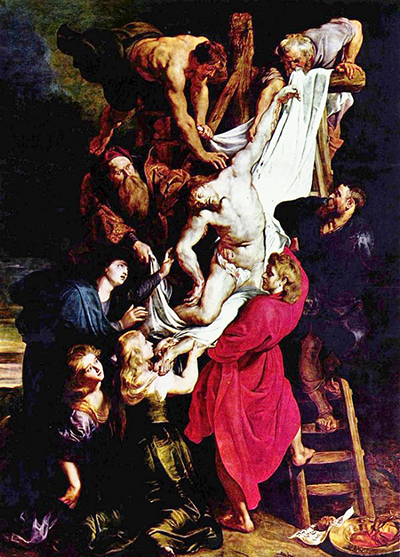
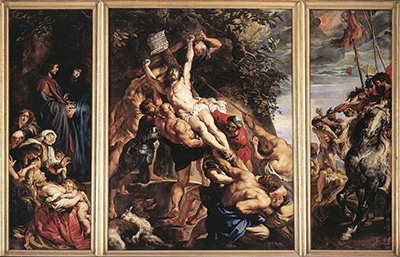
The Elevation of the Cross
1609–10Saint James the Greater
1610–12The Descent from the Cross
1611–14The Garden of Love
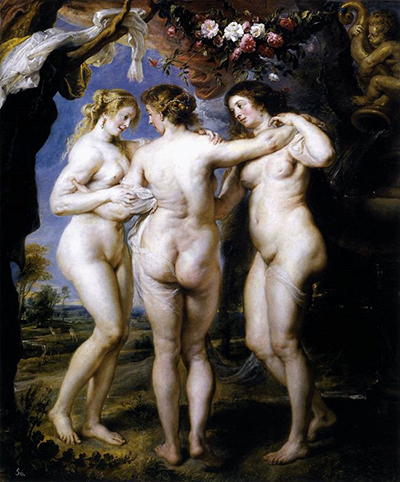
1630–35The Three Graces
1630–35Contents
- Greater James, not James the Less
- One figure in a set
- What happened to the series?
- The force of a simple image
Greater James, not James the Less
The Prado’s English series account[1] identifies this apostle through a pilgrim’s hat and staff, drawn from medieval tradition. The museum’s Spanish essay[2] also draws attention to the book in his hand. Together the objects join two aspects of his public image: an apostle carrying Christian teaching and a pilgrim saint associated with journeys to his shrine. They are signs in religious art; they do not document that a particular man posed in pilgrim dress or that this painting illustrates a recorded walk.
This identification is especially important within the Prado group. Rubens painted James the Less too, and the museum distinguishes him by a different tool linked to his martyrdom. The Greater James is the red-cloaked panel whose direct gaze and staff dominate this image. The two share their status as apostles, but are separately named figures and separately inventoried works.
The pilgrim staff also shapes the picture. It gives James something to hold, directing attention to the gripping hand; its line rises beside the illuminated face and stabilizes a body made broad by the cloak. Rubens does not need a landscape road or a crowd of fellow travellers to evoke pilgrimage. The attribute is compact enough to work within the roughly metre-high format chosen for the series. It lets each apostle remain a powerful single figure rather than turning the set into twelve narrative scenes.
The staff and cloak also clarify the body's turn. James's torso moves to one side, but his face comes back toward the viewer. Hans Vlieghe's catalogue entry[4] for this precise Prado panel, no. 9 in Corpus Rubenianum VIII.1, describes that opposition and links the pilgrim clothing to the late-medieval visual tradition shaped by pilgrimage to Santiago de Compostela. The painting does not show Compostela itself. It translates a centuries-old public association with James into a figure who can be recognised immediately within an apostle series.
One figure in a set
The Prado[1] identifies twelve surviving apostle panels in this group, with inventory numbers P001646–P001657. Its account says the original apostolate also included a Saviour of the World. That statement describes the earlier series, beyond the twelve apostle panels now in the Prado. The museum’s group name connects the set with the Duke of Lerma, though the catalogue account does not establish the precise terms of its commission.
The panels have a common approach: large half-length or three-quarter figures against dark settings, with individual poses and recognisable attributes. The Prado’s essay[1] relates their forceful forms and focused light to Rubens’s experience of Italian art, including Michelangelo. The comparison is a museum interpretation of style, not evidence that a particular figure was copied directly from a specific Michelangelo sculpture. James’s set-wide similarity makes the series coherent, while his red cloak, frontal address and pilgrim equipment give him a character of his own.
The Spanish Prado interpretation[2] stresses the variety among the apostles: some look inward toward books, some face viewers, others lift their eyes or bear signs of martyrdom. Seen together, they offer different ways of responding to Christian witness and suffering. James belongs among the most directly confronting figures. His look outward interrupts a purely private meditation. It lets the viewer become part of the exchange, even though the painting contains no narrative action.
The same essay places the increased production of apostle sets in the religious culture after the Council of Trent and sees sacrifice as a shared theme. That context helps explain why attributes of martyrdom appear across the group. It should not be flattened into a claim that James’s staff alone is a weapon or that every object in every panel means exactly the same thing. His own signs speak most plainly of apostolic identity and pilgrimage. The force of his gaze and the weight of his body keep those symbols from seeming like labels pasted onto an anonymous model.
Vlieghe's study sharpens another distinction. Later printmakers produced versions of the apostles with articles of the Apostles' Creed attached to them, but he argues that Rubens's original painted set should not itself be called a Creed series. In those prints, the labels of some apostles shift, and each print series includes a figure not derived from Rubens's invention in order to complete its own sequence. The Prado's James the Greater is less vulnerable to confusion because his pilgrim equipment is so distinctive. Still, the history of those prints warns against using an engraved caption as if it were a label written on Rubens's panel.
The set also belongs to a longer northern tradition of grouped apostle images. Vlieghe discusses earlier Netherlandish prints and painted bust series as closer precedents than a simple claim that Rubens borrowed the concept from El Greco. This is a discussion of series design, not a claim that James's particular face is copied from one earlier model. The repeating format allows a viewer to compare twelve ways of making a human figure stand for a religious office, while each panel turns attention to an attribute or gesture that differentiates its subject.
The absent Christ as Saviour of the World helps define what survives. Vlieghe says Rubens's original apostolate once included that figure alongside the twelve apostles, and that the Christ panel had already disappeared by the time Isabella Farnese's collection was documented. Copies allow scholars to discuss its design, but a copy cannot supply the original panel's lost paint surface or prove where it went. The twelve Prado apostles therefore form a coherent surviving group without being the whole original ensemble. Seeing James as one member of that twelve is accurate; calling the present museum holding a complete thirteen-picture set would be inaccurate.
This also separates two kinds of completeness. A later engraver could create a complete Creed sequence by changing names or adding a figure. A modern museum can display all twelve surviving apostle originals together. Neither fact brings back the missing original Christ, and neither proves the exact arrangement in the duke's rooms. The paintings, copies and prints answer different historical questions: what Rubens made, what others saw, and how later viewers reorganised the series.
What happened to the series?
Rubens himself supplied a remarkable early point in the history. In an April 1618 letter to the English diplomat Dudley Carleton, discussed and cited by Vlieghe[4], he offered a set of twelve apostles and Christ made by his pupils after his own originals held by the Duke of Lerma, which he would retouch. The letter is strong evidence that Rubens associated the duke with an original set by that date. Vlieghe judges it very likely that the present Prado panels are those originals, while acknowledging that the precise path by which the duke obtained them is unknown. The copy set offered to Carleton is not this Prado panel: the offer concerns works made after the originals.
The Prado places the group by 1746 in the collection of Queen Isabella Farnese at La Granja. For this James panel, the museum’s provenance field[1] then traces later royal rooms at La Granja and Aranjuez, followed by the Royal Museum in Madrid. Vlieghe says we cannot tell exactly how the paintings passed from Lerma's possession to the royal collection, or whether his descendants kept them throughout. The 1618 letter narrows the early uncertainty; it does not close the long gap before 1746.
That gap matters when discussing the Duke of Lerma label. The name is more than a later convention because Rubens's letter mentions originals in the duke's hands, but it does not preserve a commission contract or a shipment record for this panel. Vlieghe places the making of the paintings around 1610–12, after Rubens's return from Italy, and thinks they were probably sent from Antwerp to Spain soon afterward. “Probably” is the right word for that movement. The twelve works were recorded together again in the Spanish royal collection and eventually reached the Prado, where their shared format can be viewed in relation.
Vlieghe explicitly rejects an older idea that Rubens gave this apostolate to Lerma during his 1603 Spanish visit. The weighty figures, close-filled panels and strong dark-light contrasts point instead to the years after Rubens returned to Antwerp in 1608. That stylistic argument does not date a particular shipping event, but it prevents the duke's documented later ownership from pulling the paintings back into Rubens's earlier Spanish trip. The Prado's 1610–12 dating and the 1618 letter fit this later sequence without supplying every step between them.
The series had a life through copies even while the originals' whereabouts were incompletely documented. Vlieghe lists a painted copy of James in the Pallavicini collection in Rome, another copy whose later whereabouts were unknown, a drawing by Nicolaas Ryckmans in the ALBERTINA, and engravings by Ryckmans and Peter Isselburg. These are separate derivatives, not additional Prado originals. The distinction also explains why similar James images can appear in different collections at different sizes. The Prado panel's object number, medium and measurements remain the reliable identifiers for the painting discussed here.
The panel’s later life has changed its audience. A work once made as one element of a religious and collectible set now appears in a national museum. The Prado[1] locates it in Room 028 in its catalogue. Its pose can be compared with the other apostles; a single reproduction makes that relationship less immediately clear. The series context keeps the painting’s size, title and attributes connected to its original group.
The force of a simple image
Rubens gives James few narrative props. The dark background does not tell us where he stands; the cloak and staff could be understood quickly even from some distance. This economy is purposeful within a series whose members had to be distinguishable yet visually related. The strong illuminated face is at once individual and exemplary. We see a man with particular features, but the panel does not name a historical sitter apart from the sacred figure represented.
The book, staff and pilgrim hat also make the picture legible through different traditions of James’s veneration. That does not require assigning a fixed allegorical meaning to each fold of red cloth. The panel succeeds through the relation of body and attribute: James holds the sign of journey while seeming momentarily still. Rubens makes the viewer meet the apostle before following the implied path away from the picture.
Rubens artworks directory
Frequently Asked Questions
The Prado identifies him as Saint James the Greater. Rubens painted a separate James the Less for the same apostolate.
The staff and hat are traditional pilgrim attributes. They identify James visually; they do not depict a specific documented journey.
Yes. The Prado holds twelve apostle panels numbered P001646–P001657. Its account says an earlier form of the set also included a Saviour of the World. Rubens's 1618 letter refers to originals with the Duke of Lerma and a separate copy set offered to Carleton.
The Prado dates the oil-on-panel painting to 1610–12 and gives its size as 108 × 83 centimetres.
It is in the Museo Nacional del Prado, Madrid, inventory P001648.
Discussion
Look closely at James's gaze, cloak, book and staff.
Share an observation grounded in the painting or its sources.
Reader Insights
How do his attributes distinguish him from James the Less?
What changes when this panel is considered with the other apostles?
What can the Prado's provenance record establish?
Join the Conversation
Add your reading below, keeping observations specific and evidence clear.
References
- Museo Nacional del Prado, Rubens, Saint James the Greater , P001648, English object record. View source
- Museo Nacional del Prado, Santiago el Mayor , Spanish object essay. View source
- Museo Nacional del Prado, 2010 Rubens exhibition list including the apostolate. View source
- Hans Vlieghe, Saints , Corpus Rubenianum Ludwig Burchard VIII.1 (1972), “Apostolado Lerma,” pp. 34–38, and Saint James the Greater , catalogue no. 9, p. 41; City of Antwerp digitisation. View source