 by Tom Gurney
Tom Gurney BSc (Hons) is an art history expert with over 20 years experience
Published on June 19, 2020 / Updated on October 14, 2026
Email: tomgurney1@gmail.com / Phone: +44 7429 011000
A lost battle and a surviving sheet
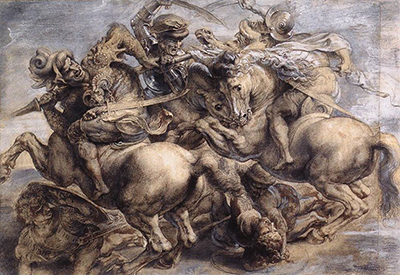
Horses rear into a tight knot of bodies. Riders pull and strike above them, struggling for a standard whose pole cuts through the confusion. Below, a fallen man is almost lost under the animals' hooves. There is little room for a horizon or a calm background: heads, legs, arms and weapons press against one another. This drawing is one of the most vivid surviving ways to imagine the central fight in Leonardo da Vinci's lost Battle of Anghiari. It is not a surviving painting by Leonardo.
The object here is Louvre INV 20271 recto[1], a large sheet called The Fight for the Standard from The Battle of Anghiari. Its authorship has layers. The Louvre's online artist field lists Peter Paul Rubens. In the same record, the museum notes Anne-Marie Logan's proposal that the underlying sheet is an anonymous Italian copy of the sixteenth century. The Louvre's 2019 exhibition catalogue[2] uses the fuller credit: anonymous Italian artist, sixteenth century, reworked by Rubens. That is the most informative way to describe what the viewer sees.
The distinction matters because Leonardo, the anonymous copyist and Rubens did different things at different times. Leonardo invented a battle design for a Florentine wall. A later Italian artist copied part of that design onto paper. Rubens eventually acquired the sheet, strengthened it and enlarged it. The drawing's power depends on that chain, while its present appearance cannot be credited to Leonardo's hand alone. A bare label saying only “Rubens's Battle of Anghiari” would obscure the earlier copy on which he worked.
At a Glance
- Original designLeonardo da Vinci [1][2]
- Underlying copyAnonymous Italian artist, 16th century [1][2]
- Later reworkingPeter Paul Rubens [1][2]
- Date16th–17th centuries; exact stages undated [1][2]
- MediumBlack chalk, inks, wash and heightening on paper [1]
- Dimensions45.3 × 63.6 cm overall [1]
- CollectionMusée du Louvre, INV 20271 recto [1]
Contents
- What did Leonardo plan in Florence?
- Where is the standard in the fight?
- How did the drawing acquire several makers?
- What are the paper and dimensions?
- How did it reach the Louvre?
- Why does the sheet matter?
What did Leonardo plan in Florence?
The Metropolitan Museum of Art[3] dates the commission for Leonardo's monumental battle image to 1503, for the Great Council Hall in Florence's Palazzo della Signoria. The Louvre catalogue[1] places the original wall project around 1504–05 and calls it lost. These dates are compatible when commission, design and attempted execution are separated. They do not mean the Louvre drawing was made in 1503 by Leonardo.
A huge preparatory cartoon, or full-scale design, formed a crucial part of the project. The Louvre's 2019 catalogue[2] describes it as roughly 18 metres wide and 7 metres high, planned at the scale of the mural. Those dimensions belong to Leonardo's vast design, not to the much smaller Louvre sheet. The central clash of horsemen became its most memorable episode. The drawing shown here preserves a version of that episode after the original wall painting and cartoon disappeared.
Leonardo's surviving studies and the later copies are different kinds of evidence. The Met notes a red-chalk study for the head of a shouting soldier among sheets connected with the lost project. That drawing can reveal how Leonardo tested a face and an expression. The Louvre sheet, by contrast, gathers a whole central combat into one crowded arrangement, but does so through copying and reworking. Neither source gives an untouched photograph of the planned wall image. Together they let historians reconstruct parts of an invention whose final appearance is no longer available to inspect.
The loss of the mural is a reason for precision rather than a license to invent. The central fight survives in mediated images; the complete wall painting cannot be walked up to and compared with them. The Louvre says the earlier Battle image it discusses was destroyed around 1560. Rubens travelled in Italy 1600–08, long after that loss. He could study Leonardo drawings, the Louvre says, but he could not stand before the vanished mural and copy it directly.
Where is the standard in the fight?
The title identifies the immediate contest: a standard, a military banner or its pole, is being fought over. The pole rises amid mounted men. One horse pushes towards the centre while another twists away; their heads seem to meet in a violent compression. Riders' bodies bend against the same pressure. At the bottom, a fallen figure shows what happens when the struggle above collapses to the ground. The local reproduction allows these main movements to be followed even though its small size cannot resolve every mark.
The composition makes the battle feel difficult to control. A viewer cannot isolate a single triumphant rider and follow him safely through open space. Limbs and harness overlap, and the horses occupy as much attention as the men. That confusion is organised: the central pole gives the eye a point to return to, while the animal bodies force it around the page. The sheet conveys movement through crowded relationships rather than by placing one figure against an empty background.
The Louvre exhibition text[2] connects Leonardo's battle studies with his interest in the confusion of horsemen and foot soldiers amid dust. It is useful context for this scene, but not every line in the later sheet can be mapped back to a particular thought by Leonardo. The anonymous copy, any intervening changes and Rubens's strong pen work all stand between the viewer and Leonardo's lost design. The frenzy may preserve a major compositional idea while changing its surfaces and emphases.
Even the title names only the central episode, not the whole projected battle. This sheet is rectangular and substantial, but Leonardo's planned wall was far larger. The visible fight has no need to show every unit, commander or stage of a historical campaign. It concentrates on a small violent knot. Readers should treat it as evidence for one portion of the lost composition, not as a scaled-down map of everything Leonardo intended to put on the wall.
How did the drawing acquire several makers?
The Louvre collection commentary[1] summarises Logan's reconstruction. The underlying black-chalk and brown-ink sheet is thought to be a sixteenth-century Italian copy after a lost preparatory prototype related to Leonardo's cartoon. It may then have been handled by one or more people in the early seventeenth century before Rubens's extensive intervention. The exact identity of each intermediary is not settled. The phrase “after Leonardo” describes a relationship to his design, not an autograph Leonardo sheet.
Rubens, according to the Louvre's catalogue, acquired that earlier drawing. He strengthened it heavily with pen and watercolour and enlarged it. The museum's 2019 exhibition label likewise gives him the later reworking rather than the first copy. This makes the sheet a real example of artistic study and adaptation: Rubens was not simply looking at an admired predecessor from a distance. He worked on an existing object, adding to what another hand had preserved.
The two-layer summary is helpful but should not be made artificially exact. The Louvre lists several media—black chalk, pen and brown ink, brush and brown or grey ink, grey wash, white and blue-grey heightening. It does not assign every individual stroke to a named maker in the public record. The drawing's present tones and contours can be described, and the curatorial account of major stages can be reported. A precise diagram of which finger or horse hair belongs to which hand would exceed the available evidence.
This is also why a strong Rubens attribution in the Louvre's top-line field is not simply “wrong.” His intervention was extensive, and the sheet belonged to him. Yet the detailed record and later exhibition catalogue make the earlier Italian copy equally important to its identity. The apparent conflict between catalogue fields is resolved by explaining roles: original design by Leonardo, underlying copy by an anonymous artist, later enlargement and reworking by Rubens.
What are the paper and dimensions?
The Louvre records the overall sheet as 45.3 × 63.6 centimetres. It gives the original central sheet as 42.8 × 57.7 centimetres and says four strips were added around it. These measurements reveal how the present object expanded. The added width and height are modest beside Leonardo's proposed wall, but they matter to the drawing's edges and to the way the horsemen fill the page.
The support is paper carrying several kinds of drawing and wash, not oil paint on a canvas. The surviving image can resemble a densely coloured painting in a reproduction, particularly where the dark and pale washes model horses and bodies. The Louvre's material list prevents that visual impression from becoming an incorrect medium label. Its white and blue-grey heightening also remind us that the dramatic lights are made with applied marks, not merely by leaving paper untouched.
The sheet's size is exceptional for a drawing, as the Louvre notes, but it is still a small fragment of Leonardo's monumental undertaking. It can be handled, collected and studied in ways a wall cannot. Its enlargement by strips belongs to that material history. The object now in the Louvre is therefore both an image of a battle and a physical record of how artists and collectors kept an important design alive after its original form vanished.
How did it reach the Louvre?
The Louvre provenance field[1] begins with Rubens, then names Everhard Jabach, Nicodemus Tessin, Carl Gustav Tessin and Nils Barck before the museum acquired the drawing in 1852. The list establishes a sequence of ownership or association, not a fully dated transaction history. It is enough to show that this unusual sheet survived beyond Rubens's studio through notable collections and eventually entered a public prints-and-drawings department.
The museum currently places it in the reserve for very large formats and says it can be viewed by appointment in the department's study room. That is different from being permanently visible on a gallery wall. Visitor access can change, so anyone hoping to inspect it should consult the Louvre's current arrangements. The distinction is particularly relevant for this work: close examination of the actual paper and added strips would answer questions that a 400-pixel reproduction cannot.
The drawing's later collection history does not fill the gap left by Leonardo's missing mural. What it does offer is a traceable life for one surviving object. The Louvre's inventory number, medium and dimensions identify the paper before us, while its commentary explains why so many historical names attach to it. Provenance and attribution are related but separate questions: knowing Rubens owned the drawing does not by itself prove he made the earlier black-chalk copy.
Why does the sheet matter?
For Leonardo's art, it is a major witness to the central fight of a lost wall project. The Met's 2003 exhibition called the large Louvre drawing one of the best records of the original central section, while explicitly saying it had been reworked by Rubens. For Rubens, it demonstrates an unusually direct engagement with an earlier master's invention. He encountered a transmitted composition and made it more forceful in his own graphic language. Both histories are necessary to understand why the sheet is famous.
It also demonstrates a broader problem in art history: images can survive while their originals do not, and the surviving version may itself have changed. The chain from lost cartoon to anonymous copy to Rubens's additions is partly reconstructed by specialists rather than recorded in a complete workshop diary. A careful label keeps those degrees of certainty visible. The dramatic horses can still be enjoyed immediately, but the object's layered authorship is part of what makes them worth a longer look.
Rubens artworks directory
Frequently Asked Questions
No. Leonardo's wall project was made for Florence in the early sixteenth century and is lost. Rubens later reworked a drawing that preserved part of its design.
The Louvre's 2019 catalogue calls the underlying sheet an anonymous sixteenth-century Italian copy after Leonardo, later enlarged and reworked by Rubens. It is not catalogued there as Leonardo's own drawing.
The central fight for the standard, with mounted men and horses locked together. It is not a full image of the enormous planned mural.
A drawing on an enlarged sheet with black chalk, inks, wash and heightening. The Louvre gives the overall size as 45.3 × 63.6 cm.
In the Musée du Louvre, Department of Prints and Drawings, INV 20271 recto. The department lists study-room access by appointment rather than permanent gallery display.
Discussion
Trace the horses and riders around the contested standard.
Share a close observation or a reliable source about the Louvre sheet.
Reader Insights
Why does the layered maker credit matter here?
What can this sheet show about Leonardo's lost design?
How do the four added strips change the physical object?
Join the Conversation
Add your reading below, keeping evidence and conjecture distinct.
References
- Musée du Louvre, The Fight for the Standard from The Battle of Anghiari , INV 20271 recto, collection record. View source
- Musée du Louvre, Leonardo da Vinci , 2019 exhibition catalogue, entry 141. View source
- Metropolitan Museum of Art, Leonardo da Vinci, Master Draftsman , 2003 exhibition overview. View source