 by Tom Gurney
Tom Gurney BSc (Hons) is an art history expert with over 20 years experience
Published on June 19, 2020 / Updated on October 14, 2026
Email: tomgurney1@gmail.com / Phone: +44 7429 011000
The twins beside the Tiber
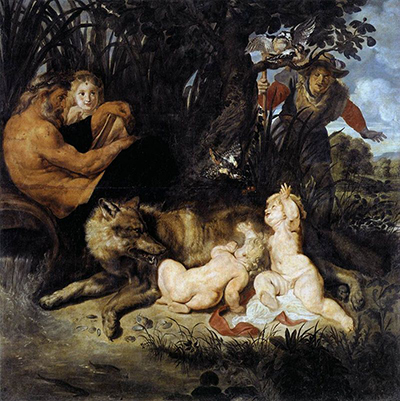
Two babies sit on the ground beside a she-wolf. One bends towards the animal, while the other turns upward. A large fig tree rises behind them, pushing much of the middle of the painting into shade. Around this small, vulnerable pair, Rubens adds a reclining river god, a woman and a shepherd hurrying into view. The scene is not simply an animal nursing two children. It is the finding of Romulus and Remus, the twins of Rome's foundation legend.
The Musei Capitolini in Rome[1] catalogues Peter Paul Rubens's Romulus and Remus as a 1612 oil painting on canvas, 213 × 212 centimetres, inventory PC 67, from the Pio collection. Its restoration account[2] calls the subject The Finding of Romulus and Remus and identifies the figures around the twins: the shepherd Faustulus at right, the personified River Tiber and Rhea Silvia at left, and the Ficus Ruminalis fig tree above.
The painting is nearly square and more than two metres across. A small website reproduction compresses its scale, but the compositional relationships remain clear: the children and wolf occupy the luminous foreground, the tree creates a deep shadow behind them, and the other figures explain why this moment matters for the future city. The museum's precise identification helps us see a story rather than a generic scene of animals and infants.
At a Glance
- ArtistPeter Paul Rubens [1]
- SubjectFinding of Romulus and Remus [1]
- Date1612; around 1612 in museum prose [1]
- MediumOil on canvas [1]
- Dimensions213 × 212 cm [1]
- CollectionMusei Capitolini, Pinacoteca Capitolina, PC 67 [1]
- Earlier collectionPio collection [1]
Where this work sits in Rubens's career
The Elevation of the Cross
1609–10The Descent from the Cross
1611–14The Garden of Love
1630–35The Three Graces
1630–35Contents
- What is happening in the legend?
- Where should the eye go first?
- Why does the fig tree matter?
- What does the painting say about Rubens's Roman interests?
- How does light carry the story?
- Who first owned the painting?
- Is the date certain?
- What should remain in view?
What is happening in the legend?
Romulus and Remus are the twin boys who, in Roman legend, survive abandonment near the Tiber and are fed by a she-wolf. Their rescue and upbringing lead eventually to the founding story of Rome. Rubens does not show the later dispute between the brothers or the city already built. He chooses the earlier moment when the infants are found alive.
The museum identifies the moving figure at right as Faustulus, the shepherd who rushes towards the scene. His arrival gives the picture a human witness. Without him, a viewer might read the wolf and children as a miraculous isolated encounter. Faustulus introduces the next step in the story: someone from the human world has come upon them and can carry their survival forward.
At left, the muscular reclining man represents the Tiber River. Personifications of rivers often have human bodies in classical art; here the form gives the setting a mythic presence. The museum identifies the woman near him as Rhea Silvia, mother of the twins. She is not shown as a modern mother stooping to tend her infants. She belongs to the story's symbolic and genealogical setting, helping make the scene a foundation image rather than merely a woodland discovery.
The wolf performs the most immediate action. She lies beside the boys, her body almost horizontal across the lower centre. Her head turns towards the left as the infants press close. The picture's tenderness depends partly on this surprising stillness in a powerful wild animal. The children are vulnerable, but the animal's presence is protective in the legend at this instant.
Where should the eye go first?
The babies are the brightest, palest forms near the bottom centre. Their bodies contrast with the she-wolf's dark fur and with the shadowed earth. One child's raised torso and the other's bending body make two different silhouettes. Rubens avoids turning them into a perfectly repeated pair. Their gestures help a viewer distinguish the twins even though the subject does not require identifying which baby is Romulus and which is Remus in the image.
From the twins, the eye follows the wolf's long back into the dark undergrowth. The animal connects the foreground children to the deep middle of the scene. The tree trunk rises just behind, dividing the picture while also creating shelter. Dark leaves above make a canopy; thin branches and rushes at the left and right edges keep the site close and overgrown.
The other figures are placed around this centre. The Tiber personification at left is broad and still, his warm body emerging from a dark bank. Rhea Silvia appears close behind him. Faustulus is smaller at upper right, partly screened by foliage, leaning towards what he has found. His elevated position and motion make him a newcomer to a scene that the river and tree seem already to know.
This layout gives the picture two times at once. The wolf and children are in the middle of an ongoing act of care; the shepherd's sudden arrival is a new event. The reclining river god makes the place feel enduring, as if the Tiber itself witnesses Rome's beginnings. These are readings of the composition, anchored by the museum's identification of the figures, rather than proof of exactly what Rubens intended each gesture to symbolize.
Why does the fig tree matter?
The Musei Capitolini calls the large central tree the Ficus Ruminalis, a named fig tree associated with the twins' story. It is not merely background greenery. Its thick trunk and dense canopy make an identifiable place for the legendary finding, while its branches control much of the picture's light and shade.
The tree forms a dark vertical mass behind the wolf. Against it, the babies' pale skin is easier to read. It also breaks the nearly square canvas into areas: the river figures at left, the nursing group below, and Faustulus emerging at right. Rubens uses a feature of the legend as a structural device. The setting helps us locate the protagonists without an architectural frame or a painted city.
The branches reach across the upper edge, making the open areas of sky feel limited. In a small reproduction, some leaves merge into one dark shape. At the painting's original scale, that canopy would help hold the separate figures together. The dense foliage makes the discovery feel private and sheltered even though the story ultimately concerns the founding of a public city.
The named tree also distinguishes Rubens's painting from the familiar bronze Capitoline Wolf. Both involve the she-wolf and twins, but this oil painting includes a larger cast, a river setting and a particular moment of arrival. The bronze is a separate object in the same museum complex; its fame should not replace attention to what this canvas actually shows.
What does the painting say about Rubens's Roman interests?
The museum's restoration account dates the painting around 1612, made in Antwerp, after Rubens's years studying and working in Italy and Spain. It describes the work as a tribute to the history of Rome, where Rubens had lived during two periods earlier in the century. The museum also notes his study of classical art and Venetian colour. These statements provide context for why a Flemish painter might give the foundation legend such an ambitious painted treatment.
The date matters. This is not a work painted in ancient Rome or in Rubens's first months of Italian travel. By 1612, he had returned to Antwerp and was becoming a major painter. The Roman subject could be reconsidered from that position, with earlier knowledge of classical images and Italian painting now available for a large canvas.
The picture combines modes that might otherwise be separated. The powerful river god belongs to a tradition of classical personification. The naturalistic she-wolf and babies bring the legend close to bodily life. The shepherd adds movement and surprise. Thick foliage makes the setting vivid rather than abstract. Rubens does not present a simple emblem of a wolf with two identical infants; he makes a crowded encounter in a specific landscape.
The museum mentions Rubens's assistants as part of his wider career, but it credits this painting to Peter Paul Rubens in its object record. The general fact that he led a workshop is not, by itself, evidence for assigning particular passages of this canvas to assistants. The page follows the holding collection's attribution rather than inventing a division of hands.
How does light carry the story?
Light brings the twins forward. Their skin is pale against earth, fur and foliage, so their survival becomes the visual centre even before the viewer knows the names of the surrounding adults. Rhea Silvia's face and the Tiber's body catch enough light to be read at left. Faustulus at right is smaller and partly shadowed, but his brighter face and arm interrupt the darkness around him.
The wolf has a more complicated role in the tonal design. Her body is neither as pale as the children nor as dark as the tree. It bridges the two, making the animal and infants one group. Rubens can therefore keep the babies visually prominent without separating them from the creature feeding them. Their closeness is compositional as well as narrative.
At the bottom, plants and the uneven bank create a shallow foreground. The children are not placed on a neutral stage. Mud, leaves and roots make the rescue feel embedded in a river environment. The picture asks the viewer to look from that earth up through the children, animal, observers and tree canopy. The legendary event seems to rise out of a particular natural place.
These observations depend on the retained image and the museum's figure identifications. They should not be extended into a claim about an exact hour of day or a specific river bend. Rubens uses light to make the action legible; the museum does not identify a documented landscape view.
Who first owned the painting?
The Musei Capitolini says the canvas belonged to Cardinal Giovanni Francesco Guidi di Bagno, Apostolic Nuncio in Flanders during 1621–27. It then passed to Rome with the Pio family and was sold to the Capitoline collection in 1750 with other works from that collection. The object listing records “Pio Collection” as its origin and PC 67 as its present inventory number.
This sequence tells us something important about the painting's journey. A work made in Antwerp on a Roman foundation subject later entered a Roman collection. The account does not say that Guidi di Bagno commissioned it in 1612. His later ownership should not be converted into a patronage claim. The gap between making and documented possession is a boundary of the record, not an invitation to fill in a convenient story.
The 1750 sale is an event in the painting's later history. It also helps explain why the work is now encountered in the Pinacoteca Capitolina rather than in a church or palace where Rubens first sent it. A reader can appreciate that the modern museum location is historically meaningful without assuming the picture was originally designed for that room.
The museum's restoration account describes a publicly visible conservation project scheduled to end in January 2013. That is evidence of the collection's care for the canvas and of a modern stage in its history. It is not a reason to describe the 1612 painting as newly painted or to infer changes in individual passages without a published technical report. The present page records the museum's account but keeps the visual discussion tied to the image available to readers.
Is the date certain?
The direct Capitoline object listing gives 1612. The museum's restoration text says around 1612. Those formulations are compatible: the listing supplies a conventional catalogue year, while the prose retains an appropriate degree of approximation. The manuscript uses the museum's dating and does not replace it with the later dates sometimes found in general web summaries.
The year should also be kept distinct from the ownership dates. Guidi di Bagno's service in Flanders from 1621 to 1627 comes after the museum's proposed making of the painting. The Pio family and the Capitoline purchase came later still. A simple timeline—painting in Antwerp around 1612, later cardinal ownership, transfer through the Pio collection, sale in 1750—makes the record clear without suggesting an unsupported continuous chain of documents between every step.
At 213 × 212 centimetres, the canvas is a large, near-square work. Its size is a firmer object fact than any attempt to guess how long Rubens spent on it. The painting's scale helps explain why the figures occupy such different zones: the viewer could move close to the nursing group and still see the mythic witnesses arranged around it.
What should remain in view?
The heart of the scene is the surprising survival of two exposed children. Rubens sets them beside a she-wolf under the Ficus Ruminalis and surrounds them with figures who make the story Roman: Faustulus as finder, the Tiber as place, and Rhea Silvia as mother. The museum's restoration account supplies those names; the painting supplies the relationships of movement, shade and attention.
The best way to read the canvas is to alternate between the legend and the image. Find the children first. Follow the wolf's body into the dark centre. Look left to the river god and mother, then right to the arriving shepherd. Finally, trace the fig tree above them all. The route through the picture turns a familiar emblem of Rome into a staged moment of discovery.
Its object identity is equally specific: Rubens's 1612 oil on canvas, PC 67, in the Musei Capitolini. The reproduced image corresponds to that painting, which is distinct from the bronze Capitoline Wolf or later copies of the story. The history of its ownership connects Antwerp and Rome, but the painting's immediate force comes from the contrast between endangered infancy and the large world gathering around it.
Rubens artworks directory
Frequently Asked Questions
It is in the Pinacoteca Capitolina at the Musei Capitolini, Rome, inventory PC 67.
The museum's object page gives 1612; its restoration account says around 1612 and places execution in Antwerp.
The museum identifies Faustulus at right, and Rhea Silvia with the personified River Tiber at left.
It is the Ficus Ruminalis, the fig tree associated with the twins' finding in Roman legend.
No. This is a separate oil painting on canvas, 213 × 212 centimetres, depicting the twins, she-wolf, landscape and several human or personified figures.
Discussion
Find the twins and follow the she-wolf into the shaded centre.
Share a close observation or a reliable source about Capitoline PC 67.
Reader Insights
How do Faustulus, Rhea Silvia and the Tiber expand the story?
What does the Ficus Ruminalis add to the composition?
How does the painting connect its Antwerp making and Roman subject?
Join the Conversation
Add your reading below, keeping this canvas separate from the bronze wolf.
References
- Musei Capitolini, Romulus and Remus , PC 67. View source
- Musei Capitolini, restoration account for The Finding of Romulus and Remus. View source