by Tom Gurney
Tom Gurney BSc (Hons) is an art history expert with over 20 years experience
Published on June 19, 2020 / Updated on October 14, 2026
Email: tomgurney1@gmail.com / Phone: +44 7429 011000
A battle carried by a bridge
A horse rears at the right edge, riders and fighters collide above a stone arch, and bodies tumble toward dark water. The bridge is the key to reading Peter Paul Rubens's Battle of the Amazons. It turns a crowded melee into a passage from attack to defeat. Greeks push in from the left; the opposing forces meet at the arch's crest; the routed Amazons fall down the right side. The river beneath catches the violence that the bridge can no longer contain.
The Bayerische Staatsgemäldesammlungen catalogues the painting[1] as Rubens's The Battle of the Amazons, about 1618, on wood, with an image measurement of 120.3 × 165.3 centimetres. It is inventory 324 in the Alte Pinakothek, Munich. Those identifiers matter because Rubens returned to the Amazon subject more than once. This page concerns the Munich picture with the great stone bridge, rather than every work that shares its mythological title.
The museum calls attention to two levels of battle created by the bridge. That is more than a convenient way to divide the surface. The top gives us a compressed line of horses and fighters pressing together. Below it, the river and bank show the human result. The eye alternates between the struggle for the crossing and the people already losing it. Rubens makes the structure of a landscape feature tell the sequence of an action.
At a Glance
- ArtistPeter Paul Rubens [1]
- DateAbout 1618 [1]
- SupportWood [1]
- Image size120.3 × 165.3 cm [1]
- CollectionAlte Pinakothek, Munich, 324 [1]
- SubjectGreeks and Amazons fighting across a bridge [1]
Where this work sits in Rubens's career
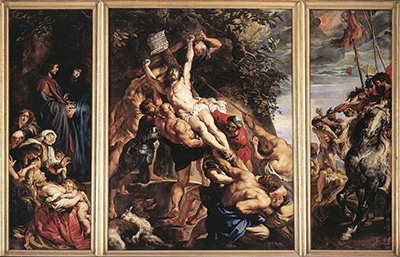
The Elevation of the Cross
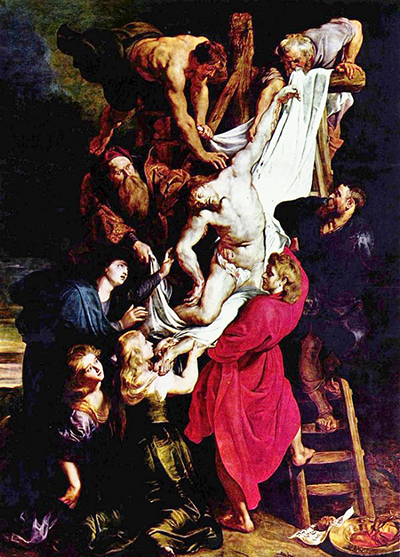
1609–10The Descent from the Cross
1611–14The Battle of the Amazons
c. 1618The Garden of Love
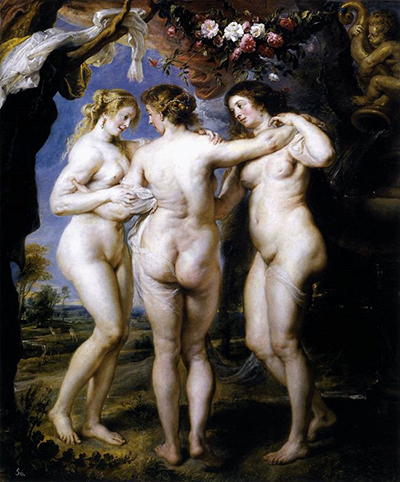
1630–35The Three Graces
1630–35Contents
- Following the movement from left to right
- What the Amazon story supplies
- Water, horses and brushwork
- An earlier drawing is related, not identical
- The battle in print
- From Düsseldorf to the Alte Pinakothek
- Looking again at the arch
Following the movement from left to right
Begin on the left, where mounted and walking figures crowd the approach. Their limbs, weapons and horses overlap, so an orderly advance is difficult to separate from the surrounding struggle. Yet the museum's account gives the large direction: more Greeks advance from the left. Their pressure leads the eye toward the highest part of the arch, where the two sides meet. The bridge is narrow enough to intensify the collision, though wide enough for Rubens to pack it with several simultaneous acts.
At the centre, riders lift weapons while horses turn their heads and bodies in different directions. The painting offers no quiet focal figure who explains everything at once. The crest of the bridge functions instead as a knot of opposed forces. One can read the action by returning to that point and then following the arcs of bodies away from it. The arrangement gives the scene a sense of movement without requiring that every weapon or arm be assigned to a named hero.
The right side changes the direction of travel. The Pinakothek's description[1] says the defeated Amazons plunge down in a whirling movement. A rearing dark horse raises the energy at the edge, while bodies beneath the bridge pull the viewer downward toward the water. The composition is neither a simple procession across the bridge nor a single frozen duel. It sets advancing fighters against falling ones.
Look below the arch after following the upper battle. The water reflects and interrupts the action overhead. People and horses occupy the bank and river at different depths. This lower region is essential to the painting's force: falling out of the fight is not an abstract result, but a physical descent. Rubens gives defeat weight, gravity and contact with water. The stone arch remains solid while the living forms around it become unstable.
What the Amazon story supplies
The Amazons were the legendary women warriors of Greek and Roman myth. The Getty's iconography authority[5] groups battles against them as Amazonomachies. Such stories could involve different heroes and episodes. The broad subject tells a viewer why a battle between men and women appears here, but it does not, on its own, name each participant in the Munich painting.
The painting is most legible as a collective battle. We can recognize the opposing sides and the outcome from the museum's account without claiming that a particular fallen woman must be Hippolyta, or that one horseman must be Theseus. The Pinakothek's object record[1] does not make such figure-by-figure identifications. Its emphasis is on the bridge, the clash and the defeated Amazons. That evidential boundary protects the power of the image: the painting communicates struggle even where personal names remain unsettled.
Ancient art made the Amazon an enduring image of a formidable opponent. A Roman marble Wounded Amazon at the Metropolitan Museum[6], for example, reflects the Greek tradition of depicting these warriors after battle. It is a different object, made many centuries earlier, and cannot explain Rubens's exact cast of figures. It does show why a seventeenth-century painter could expect the subject to carry a history of courage, combat and injury. In Munich, the emphasis falls on the terrifying momentum of a group defeat.
That defeat is visually uneasy. The museum predicts that the Greeks advancing from the left will win, but Rubens lets us see the cost rather than treating victory as a clean emblem. The fallen bodies and horses continue to claim attention after the eye has identified the winners. The scene's excitement and suffering are both part of its design. A viewer can admire the painting's formal energy while still noticing what that energy depicts.
Water, horses and brushwork
The Pinakothek relates the picture's tense subject to its swift, fluid handling. It names three effects in particular: splashes from the river, flying horses' manes and the force of fighters preparing to strike. These are useful places to look. The water breaks into quick accents, while hair and limbs produce short, changing directions around larger masses of horse and stone. Rubens uses painted motion to make an already active subject feel less fixed.
That museum reading does not tell us precisely how many hours the artist spent on the panel, or which passage he finished first. “Swift” describes the visible effect of the brushwork. It should not become a story about a documented single sitting. The work's impact comes from how controlled the whole remains despite those energetic marks. The bridge keeps the many local gestures in a coherent structure, and the river receives the motion they release.
Horses do much of the compositional work. One is not just a vehicle for a rider; its head, mane and body help determine a direction through the crowd. The large horse at right raises the silhouette near the picture's edge, countering the bodies that fall beneath it. At the centre, horses compress the meeting point on the arch. Their shifting weight makes the battle appear dangerous for people and animals alike. The theme gives Rubens a way to show anatomy under pressure, but the scene remains a battle rather than a collection of isolated animal studies.
Light and dark contribute to the reading. Brighter bodies and horses emerge against a smoky sky, while the underside of the bridge and riverbank form a darker interval. The upper crowd seems to surge across that interval. The eye can move from a lit figure to a dark overlap and back again; it continually reconstructs the fight. The painting therefore rewards slow looking even though its first impression is speed.
An earlier drawing is related, not identical
The British Museum holds a Rubens drawing[2] of Greeks and Amazons fighting, dated about 1600–03. It is pen and brown ink over graphite on paper, and its record explicitly connects it with the later Munich painting. But the museum also says that the drawing differs in many details. It suggests Rubens may have returned to selected ideas from this early study while developing the more powerful composition of about 1618.
That distinction changes how we describe preparation. The drawing is evidence of Rubens's long interest in the subject and in the problem of arranging a dense melee. It is not a one-to-one blueprint for Munich no. 324. The British Museum points to minor recurring details, including an Amazon raising a severed head, a stumbling horse and a figure with a lion skin. Those motifs can connect works across years without proving that every line of the early drawing directly generated the later painting.
The British Museum's catalogue discussion[2] relates the drawing to classical battle imagery and debates possible links with Leonardo's Battle of Anghiari. It notes that scholars differ over a particular Leonardo comparison. The safe conclusion is narrower: Rubens was developing ways to organize horses and bodies in combat, and the early drawing provides one documented stage of that exploration. It should not be used to assign a single, certain borrowed pose to every figure in the Munich panel.
The same museum record also warns against treating all Rubens Amazon pictures as one work. It says he appears to have painted the subject at least three times and mentions an earlier painting of about 1603–05. The Munich picture is the best known of these, with its own date, size and inventory number. A title-only search can blur those versions. The bridge and the Pinakothek number identify the particular image discussed here.
The battle in print
Rubens's composition also circulated through engraving. The National Gallery of Art catalogues an upper section[3] of Lucas Vorsterman's Battle of the Amazons, dated 1623, as an engraving after Rubens. Its two-part format and print attribution identify another object and another maker. It can show how the painting's design reached viewers beyond Munich, but its date and medium should not be mistaken for those of the wooden panel.
The relation between painting and print makes the composition's architecture especially striking. An engraver had to translate Rubens's flowing paint, crowded forms and changing light into lines. The bridge still provides a way to hold the melee together across media. The print is a witness to the design's circulation, not evidence that the Munich painting itself was cut in two or made in 1623.
A Getty Research Institute record for a much later print[4] also says that it reproduces the Munich painting. That record dates the print's publication to 1700 and names Cornelis Danckerts. Its value here is limited but clear: the Amazon battle continued to be reproduced long after Rubens and Vorsterman. Later copies and engravings may vary in scale, medium and graphic detail, so their catalogues should be read as the histories of those prints, not silently folded into the painting's object record.
From Düsseldorf to the Alte Pinakothek
The Pinakothek records the acquisition[1] as 1806 from the Düsseldorf Gallery, where the painting had an inventory number, 989. That is a firm point in its later collection history. It does not name an original patron in about 1618. Nor does a nineteenth-century transfer reveal what Rubens intended for the panel's first setting. The object record gives enough to identify the work and a documented route into the Bavarian collection; earlier ownership needs separate evidence.
The museum lists a Joseph Effner frame dating from the eighteenth century. Frame and panel therefore have different histories. A visitor may experience them together, but the frame's date should not be presented as the painting's date. The current collection location is the Alte Pinakothek in Munich; room display can change, so the live museum record is the best place to check where it can be seen.
The catalogue gives the support as wood and marks 120.3 × 165.3 centimetres as the image measurement. Calling the support oak without another object-specific source would add a detail not established by this record. Treating these dimensions as framed size would also misstate what the museum measured. Precise labels help prevent small errors from accumulating around a widely reproduced picture.
Looking again at the arch
Return to the bridge after following the figures. Its arch opens a dark space beneath a luminous and crowded crossing. Fighters press toward the crest, then the movement breaks and pours down the right. Water, horses, stone and bodies each have a different kind of weight. The painting's brilliance lies in making them interact without dissolving into an unreadable mass.
The earlier British Museum drawing and later Vorsterman engraving extend the story of the composition, but neither replaces the Munich panel. The drawing shows a problem Rubens had explored years earlier; the engraving shows one route by which his solution travelled. The painting itself remains the point of reference: about 1618, on wood, inventory 324, with the battle balanced precariously over a river. Following its bridge lets a viewer see both the momentum of the victors and the peril of those who fall.
Rubens artworks directory
Frequently Asked Questions
The painting discussed here is inventory 324 at the Alte Pinakothek, Munich, part of the Bayerische Staatsgemäldesammlungen. Check the museum's live object record for current display details.
The Pinakothek dates the wooden panel about 1618. That date belongs to the Munich painting, not the earlier British Museum drawing or the 1623 Vorsterman engraving.
According to the museum, Greeks advance from the left, the sides clash on the crest of a bridge, and defeated Amazons fall toward the river at the right. The bridge gives the battle two levels.
It is a related, much earlier Rubens drawing of an Amazon battle, dated about 1600–03. The British Museum notes several shared motifs but also many differences. It should not be treated as an exact cartoon for the Munich panel.
The Pinakothek records wood as the support and 120.3 × 165.3 centimetres as the image measurement. Its online entry does not identify the wood species.
The National Gallery of Art catalogues a 1623 engraving by Lucas Vorsterman after Rubens. It is a separate printed work based on the composition.
Discussion
Follow the fighters from the left approach across the arch and down toward the water.
Share an observation about the painting or a reliable source that adds to its history.
Reader Insights
How does the bridge help you understand two levels of action?
What can the earlier British Museum drawing tell us without making it an exact plan?
Which effects in the water and horses make the battle seem to move?
Join the Conversation
Add your reading below, keeping observations specific and evidence clear.
References
- Bayerische Staatsgemäldesammlungen, The Battle of the Amazons , Alte Pinakothek 324. View source
- British Museum, Rubens drawing of a battle of Greeks and Amazons, 1895,0915.1045. View source
- National Gallery of Art, Lucas Vorsterman, The Battle of the Amazons , 1975.68.6. View source
- Getty Research Institute, later Danckerts print after the Munich painting. View source
- Getty Research Institute, Amazonomachies iconography record. View source
- The Metropolitan Museum of Art, Marble statue of a wounded Amazon. View source