 by Tom Gurney
Tom Gurney BSc (Hons) is an art history expert with over 20 years experience
Published on June 19, 2020 / Updated on October 14, 2026
Email: tomgurney1@gmail.com / Phone: +44 7429 011000
Venus and Cupid feel the cold
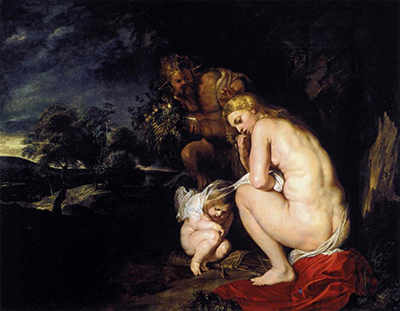
Venus crouches close to the ground, turning much of her back toward us. Beside her, Cupid huddles over a quiver of unused arrows. A grinning satyr approaches with grain, grapes and fruit. The two figures associated with desire look chilled and inactive; food and wine are on their way. Peter Paul Rubens gives a proverb about love a physical, almost comic scene.
The Royal Museum of Fine Arts Antwerp[1] identifies Venus Frigida as a Rubens work dated 1614, oil on panel, inventory 709. Its present dimensions are 143 × 184 × 3.8 centimetres. Those measurements describe the object as it now exists, not the size of every part Rubens painted. The museum says an original, nearly square core of about 121 × 95 centimetres was later surrounded by additional planks and landscape painted by someone else.
That material history changes the first act of looking. In today's broad image, Venus and Cupid sit within a generous dark landscape. Rubens's original design was tighter and nearly square. The cold bodies, approaching satyr and offerings remain central, but the later surroundings extend the space and alter the balance. Understanding the picture means reading both the 1614 Rubens core and the posthumous enlargement.
At a Glance
- Original artistPeter Paul Rubens [1]
- Original coreSigned and dated 1614; about 121 × 95 cm [1]
- Later additionsLandscape added after Rubens's death by unknown painter [1]
- MediumOil on panel [1]
- Current size143 × 184 × 3.8 cm [1]
- CollectionRoyal Museum of Fine Arts Antwerp, 709 [1]
Where this work sits in Rubens's career
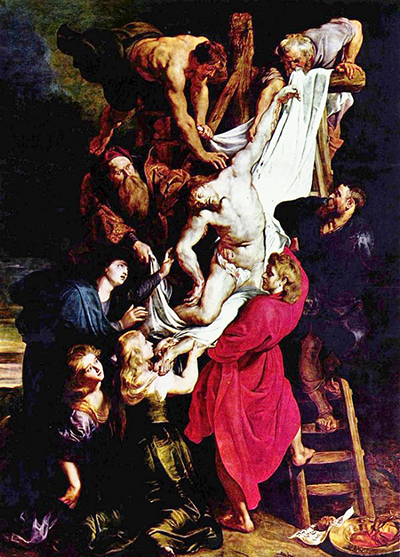
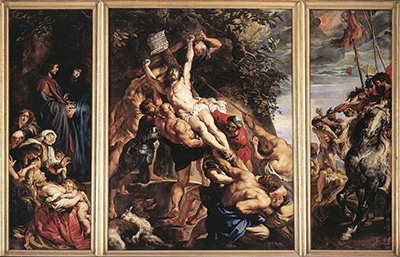
The Elevation of the Cross
1609–10The Descent from the Cross
1611–14Venus Frigida
1614 coreThe Garden of Love
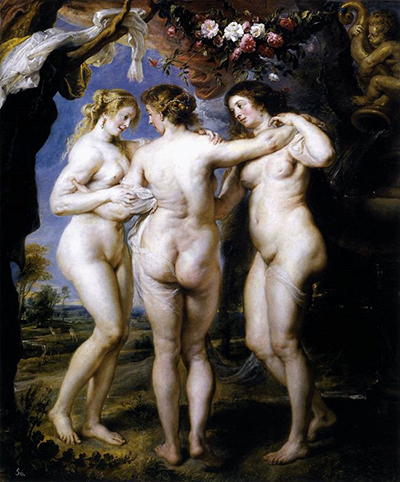
1630–35The Three Graces
1630–35Contents
- A proverb made into people and objects
- The three figures in the 1614 core
- An antique Venus reimagined
- From a near square to a wide landscape
- What the wood can tell us
- A signed picture among Rubens's classical subjects
- How an eighteenth-century title went wrong
- Looking again at the present panel
A proverb made into people and objects
The museum connects the scene to a saying from the Roman playwright Terence: Sine Cerere et Baccho friget Venus. In the KMSKA's plain translation, love becomes chilly without food and drink. Ceres stands for the nourishment of grain; Bacchus evokes wine. Venus, goddess of love, grows cold when those supports are absent. Rubens turns the verbal link between need and desire into bodies that seem genuinely uncomfortable.
The satyr is a follower of Bacchus, not the wine god himself. His horn of plenty carries ears of corn, grapes and other fruit. These are not random gifts. Grain and grapes let the viewer see the proverb's absent Ceres and Bacchus without requiring those deities to appear as separate full-length figures. The satyr's grin adds a worldly, amused response to Venus's exposed coldness.
Cupid sits on a quiver of unused arrows. The detail is small but pointed: his weaponry is ready, yet he is too cold to act. An archer's arrows normally send desire toward others; here they become a seat for the shivering child. Rubens makes the inactivity of love visible through a familiar attribute temporarily put to another use.
The title Venus Frigida means “cold Venus.” It does not ask us to identify a particular winter day, a medical condition or a documented scene from a mythological narrative. The cold is a condition that expresses the proverb. Its force comes from the mismatch between Venus's usual association with warmth and attraction and the vulnerable posture Rubens gives her here.
The three figures in the 1614 core
Venus occupies much of the foreground. Her bent legs and lowered head fold the body inward. She covers herself with her arms, while drapery gathers near her feet. A viewer sees the turn of her back before the face. This is a form of emotional description: the pose makes cold feel like something experienced across skin, limbs and shoulders.
Cupid's smaller body repeats her discomfort. His wings mark him as love's attendant, but he offers no flight or arrow. The museum calls him shivering, and the painting's close grouping makes his response hard to miss. Putting child and goddess together keeps the proverb from resting on Venus alone. Desire itself appears stalled.
The satyr approaches from behind with a different energy. He has the food and drink symbols the saying names, and his expression seems to promise a change in the mood. The painting holds the moment before Venus and Cupid are revived. Nothing in the KMSKA account requires us to claim a later scene showing them warm or amorous; the viewer can infer the proverb's promise from what the satyr brings.
Their relationship is organized through direction. Venus folds inward; Cupid crouches close; the satyr leans toward them. Fruit and corn move toward the cold pair. Rubens makes the proverb readable through body language even to someone who does not know the Latin. The title and museum explanation then supply the classical source that sharpens the visual joke.
An antique Venus reimagined
The KMSKA compares Venus's pose[1] with a first-century Roman sculpture Rubens had seen in the Farnese collection in Rome, now at the National Archaeological Museum in Naples, inventory 6297. The crouching position, with the back turned three-quarters toward the viewer, is the key relationship. The sculptural source offered Rubens a celebrated model for arranging a nude body in space.
Using an antique pose did not bind Rubens to the sculpture's original meaning. In this painting, the crouch expresses cold within a proverb. The body is classical in its visual ancestry and immediate in its physical response. A viewer can recognize the carefully studied turn of the back without mistaking the canvas for a painted photograph of the ancient statue.
Rubens's encounter with the Farnese collection belongs to his Italian experience. The Antwerp museum identifies the sculpture as a model; it does not claim that every line in the painted figure can be traced to a specific view or drawing of it. Treating this as a strong visual comparison rather than a mechanical copying process leaves room for what Rubens altered: surrounding figures, chilly emotion, drapery and the satyr's offering.
The antique reference also fits the painting's literary premise. A classical sculpture supplies form, and a saying attributed to a Roman comedy supplies the thought. Rubens combines them into a work that could appeal to a viewer familiar with both ancient art and Latin literature while remaining readable as a lively scene of cold, hunger and approaching plenty.
From a near square to a wide landscape
The object's dimensions are not a minor technical footnote. The museum explains that Rubens's original core measured about 121 × 95 cm. A seventeenth-century copy at West Wycombe Park in Buckinghamshire documents its almost square composition. The present painting is substantially wider. What looks like a single designed landscape in a reproduction includes a later enlargement of the support and painted surroundings.
According to the KMSKA, two planks on the left added about 69 cm of width. Two more planks, one at the top and one on the right, were each about 20 cm wide. The current overall measurement is 143 × 184 × 3.8 cm. These figures explain the change in shape without inviting us to calculate a falsely exact seam from a small image. The museum's dimensions describe a complex physical object with joins and treatments, not a simple digital rectangle.
The added left-hand landscape is especially consequential because it changes where the main group sits within the frame. Rubens's core makes Venus, Cupid and satyr closely interdependent. The broad view now gives them more surrounding ground, vegetation and darkness. That extension can make the work feel more like a landscape with figures, even though the original composition was a focused emblematic scene.
This is why a caption should distinguish the date of Rubens's core from the date and authorship of the enlargement. “Rubens, 1614, 143 × 184 cm” without explanation could imply he planned and painted the whole present format. The museum's technical account shows that the current shape was made later. The original work survives within it, but the outer image has another, unidentified hand.
What the wood can tell us
The museum reports dendrochronological analysis of the added wood. Tree-ring evidence indicates that the tree used for the additions was felled no earlier than 1640. A board cannot be painted before the tree from which it came is cut, so the result gives an earliest possible date for the enlargement. It is a lower boundary, not a precise year in which the planks were attached.
Rubens died in 1640. The KMSKA concludes that the landscape enlargement occurred after his death and was carried out by a painter not yet identified. The evidence does not justify calling the added areas Rubens's workshop, his pupil or a named later artist. It also does not tell us why an owner wanted the format changed. Perhaps the wide composition suited a setting or taste, but that would be speculation without a record.
The technical result is powerful because it limits attribution using the object's own materials. A visual resemblance in the extended landscape is not enough to override the wood's date and the museum's conclusion. Conversely, recognizing later additions does not make the original figures less Rubens's. The painting is a layered object: an autograph core preserved within an altered panel.
The signed and dated 1614 belongs to Rubens's central painting. The current 143 × 184 cm belongs to the composite object in Antwerp. Keeping these facts together avoids forcing one date or one hand onto every square centimetre. That is the practical lesson of the conservation research for a reader encountering only a small reproduction.
A signed picture among Rubens's classical subjects
The Antwerp museum places Venus Frigida in a small group of classicising works that Rubens unusually signed and dated in 1613 and 1614. It names subjects ranging from Jupiter and Callisto and Susanna and the Elders to Cupid Cutting His Bow. The point is not that all these pictures look alike. It is that Rubens, in this period, repeatedly explored classical or learned themes while giving some works unusually explicit marks of authorship and time.
The signature and date help anchor the central image. They do not date the later planks. This difference is a useful reminder that an artwork can carry a reliable original date and still have a more complicated later physical history. The museum's account of Venus Frigida depends on looking at both evidence types: inscription or dating for the core, material analysis for the added support.
The classical saying also invites comparison with other Renaissance and Baroque images of Venus, Ceres and Bacchus, but this page does not need to pretend every related painting is part of one documented commission. The subject circulated widely because it offered artists an appealing way to join appetite, wine and love. Rubens's particular solution is a cold, crouching goddess with a shivering Cupid and an amused satyr bringing relief.
The painting's tone is neither solemn moralising nor a straightforward celebration of pleasure. The cold is uncomfortable, the satyr is playful, and the offerings are abundant. The human experience of needing warmth and nourishment gives a learned proverb ordinary force. Rubens's antique model makes the body beautiful, while the pose makes it vulnerable.
How an eighteenth-century title went wrong
The KMSKA says that in the eighteenth century the scene was mistakenly described as Jupiter disguised as a satyr approaching Antiope, daughter of the king of Thebes. The error shows how a mythological image can be relabelled when its original proverb is no longer recognized or when a satyr is taken for another character.
That historical label is not a second valid identification of the current subject. It cannot explain Cupid's unused arrows, the horn of plenty with grain and grapes, and Venus's cold pose as well as the Terence saying does. The museum records the misidentification as part of the work's reception, while retaining Venus Frigida as the title.
The later extension may also have changed how readily viewers saw a compact proverbial composition. A wider landscape can make the three figures feel more like a mythological encounter in a setting. That is a possible reading of the format's effect, not a documented reason for the eighteenth-century error. The actual evidence for the misidentification is the museum's historical account.
As with the unknown painter of the additions, the best response is precision rather than a guessed story. We can say what the old label was, why it differs from the current one, and how the surviving objects and source text support the current interpretation. We cannot name the person who made the mistaken identification or assign a motive not in the record.
Looking again at the present panel
Begin with Venus's back and folded limbs. Find Cupid shivering beside the unused quiver, then follow the satyr's offering of corn, grapes and fruit. Read the group as an image of love deprived of food and drink. Now take in the broader landscape and remember that its present reach was added after Rubens's death. The same reproduction contains two phases of work.
The current KMSKA record[1] fixes the essentials: Rubens's signed and dated 1614 core, oil on panel, inventory 709, and a 143 × 184 × 3.8 cm overall object. It also explains that tree-ring study places the added wood after the original painting, with the enlargement by an unknown later painter. A page that names both phases gives readers a more accurate view than a caption treating the whole wide scene as a single 1614 invention.
Venus Frigida is memorable because its idea is so clear. Desire has become cold; a satyr brings the ingredients that might warm it. Its history is equally revealing. Rubens's tight classical composition became a much broader picture, and the new landscape changed how generations could see it. Looking closely now means appreciating the proverb and the material life of the panel together.
Rubens artworks directory
Frequently Asked Questions
It means “cold Venus.” The image illustrates the saying attributed to Terence that love grows cold without food and drink.
A satyr, a follower of Bacchus, brings a horn of plenty containing ears of corn, grapes and other fruit. He is not identified by the museum as Bacchus himself.
The shivering Cupid sits on his unused arrows. The detail makes love's inactivity visible while Venus remains cold.
No. The KMSKA says Rubens's 1614 core was almost square. Planks and landscape were added after his death by an unidentified painter.
The museum gives the original core as approximately 121 × 95 cm. The current enlarged panel measures 143 × 184 × 3.8 cm overall.
It belongs to the Royal Museum of Fine Arts Antwerp (KMSKA), inventory 709. Check the museum's current display information before visiting.
Discussion
Begin with Venus and Cupid, then look at the satyr's offering.
Share an observation about the panel or a reliable source that adds to its history.
Reader Insights
How do the quiver, corn and grapes turn a saying into a scene?
What changes when the original near-square composition becomes a wide landscape?
How does the wood analysis limit who could have painted the added areas?
Join the Conversation
Add your reading below, keeping observations specific and evidence clear.
References
- Royal Museum of Fine Arts Antwerp, Venus Frigida , inventory 709. View source
- The Flemish Art Collection, Venus Frigida , collection record 709. View source