 by Tom Gurney
Tom Gurney BSc (Hons) is an art history expert with over 20 years experience
Published on June 19, 2020 / Updated on October 14, 2026
Email: tomgurney1@gmail.com / Phone: +44 7429 011000
A risen Christ between two praying donors
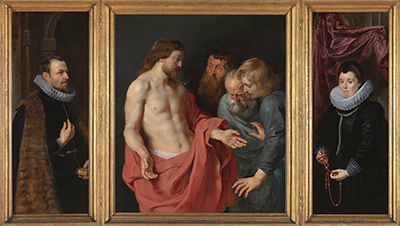
Christ stands in the centre of an open triptych, his upper body bare and a red cloth gathered around him. Three men lean toward the wounds he displays. On the left wing, Nicolaas Rockox kneels in dark clothes. Opposite him, his wife Adriana Perez prays with rosary beads in her hand. The whole painting was made for the couple's grave in Antwerp, so the scene at the centre and the two portraits belong to one memorial design.
The Royal Museum of Fine Arts Antwerp[1], or KMSKA, currently titles it Epitaph of Nicolaas Rockox and His Wife Adriana Perez. It dates the oil-on-panel triptych 1613–15, gives the full open work as 146 × 233 centimetres, and assigns inventory numbers 307–311 to its parts. Those details matter here because the familiar title, The Incredulity of St Thomas, refers only to a traditional interpretation of the centre scene. The illustration shows the entire open object.
The painting is more than an illustration of an episode from a gospel. It places two living patrons, shown in prayer, beside an appearance of the risen Christ. They do not stand among the apostles. Their own wings keep them apart from the biblical action, while the triptych's frames bring the three groups into one field of view. The viewer is invited to consider what Rockox and Perez believe even though they cannot see what the apostles see.
At a Glance
- ArtistPeter Paul Rubens [1]
- Date1613–15 [1]
- MediumOil on panel [1]
- Full open size146 × 233 cm [1]
- FunctionEpitaph for Rockox and Perez [1]
- CollectionKMSKA, Antwerp, 307–311 [1]
Where this work sits in Rubens's career
The Elevation of the Cross
1609–10The Descent from the Cross
1611–14The Incredulity of St Thomas
1613–15The Garden of Love
1630–35The Three Graces
1630–35Contents
- Why the Thomas title is uncertain
- Christ and the three witnesses
- Nicolaas Rockox on the left wing
- Adriana Perez on the right wing
- An epitaph about resurrection
- The changed date and Rubens's hand
- Looking across all three panels
Why the Thomas title is uncertain
The centre panel was long known as The Incredulity of Thomas. The name connects it with the Gospel of John's account of an apostle who doubted the Resurrection until he encountered Christ's wounds. The Flemish Art Collection entry for the centre panel[2] still uses that traditional title. A familiar title can therefore remain visible in collection databases even when a museum's fuller interpretation has changed.
KMSKA's essay asks us to look at the action closely. Christ shows his stigmata, the marks of crucifixion, to three astonished apostles. No figure puts a finger into the wound in his side. Because this crucial gesture of the Thomas story is absent, the museum says Rubens probably depicted Christ's first appearance to the apostles, represented here by Peter, John and James. The museum's word “probably” is important: the painting does not name each man in an inscription that settles the question completely.
This does not make the Thomas title meaningless. The centre is still about seeing the risen Christ and responding to his wounds. KMSKA notes that belief without seeing, central to the Thomas episode, shapes the triptych as a whole. The apostles gaze at Christ, while Rockox and Perez pray on the wings without witnessing the event directly. The old name points toward a theme that remains present even if the precise biblical moment is read differently.
The familiar wording survives in the painting's traditional title. The museum's current whole-object title and the dispute belong together in its description. It would be misleading to present Thomas as certainly the man touching Christ, because no such action appears in the painting. It would be equally overconfident to announce that Thomas is certainly excluded. The holding museum offers a reasoned, qualified alternative.
Christ and the three witnesses
At the centre, Christ turns his torso toward the older men at the right. His exposed skin is the brightest large area of the panel. The red cloth sweeps across the lower body and then toward the apostles, drawing their space into his. His hands and side make the wounds visible, but the painting gives the figures a pause of looking rather than a forceful test by touch.
The apostle closest to him bends forward, his head near Christ's outstretched hand. Another presses in from behind, while a third looks over the group. Their differing ages and positions make the small panel feel crowded without losing its focal point. All three respond to the body before them. Their gaze gives the viewer a way into the scene: we see Christ partly through their act of seeing.
KMSKA's account identifies the central figures as Christ and three apostles. It interprets the likely group as Peter, John and James. The image itself does not label each face, so the article should not claim a perfect one-to-one portrait key beyond that institutional reading. The painting's larger point is the encounter. Christ's body has the tangible marks of the Crucifixion, and the witnesses must decide what that body means.
The museum describes the flesh tones and changes of light and shade as particularly striking after the painting's 2017 restoration. In the retained image, Christ's pale body stands against a dark ground while the red cloth gives it warmth. The light allows the scars and gestures to become legible. KMSKA also calls the body idealised and compares its muscular form to classical sculpture. This is the museum's account of Rubens's artistic treatment, not a claim that a named ancient statue served as a documented model.
Nicolaas Rockox on the left wing
Nicolaas Rockox kneels on the left, dressed for his own social world rather than the apostles' scene. A white ruff frames his face; a patterned garment falls across his shoulder. He turns toward the centre panel while holding a book. KMSKA identifies the book as a Bible, one of the signs of the couple's piety.
Rockox was a prominent Antwerp citizen. The museum describes him as a burgomaster, dean of the Harquebusier's Guild, humanist scholar and important patron of Rubens. Those roles explain why his portrait belongs in an ambitious painted memorial. He was not simply a spectator invented to fill one wing. He was one of the people for whom the epitaph was made.
KMSKA describes the relationship between Rockox and Rubens as more than professional. The painter called Rockox a friend and patron, and named his second son Nicolaas after him. The triptych's careful execution can be read in that personal context, though it should not be reduced to a sentimental document of friendship. It served a public religious and memorial purpose in a church.
The left wing helps make the central question of sight more complex. Rockox faces Christ in the joined composition, but he remains in a separate pictorial compartment and a different time. He prays with faith in an event he did not physically attend. The Bible marks a relation to the story through text and devotion rather than eyewitness experience. This is the museum's own interpretive direction, and the painted arrangement gives it visual force.
Adriana Perez on the right wing
Adriana Perez faces inward from the right, balancing Rockox's kneeling figure. She wears dark clothing with a light ruff and holds rosary beads. KMSKA names the beads as the sign of her piety. Like her husband, she is carefully placed near the risen Christ without crossing into the biblical encounter.
Her presence changes the work from a donor portrait of one powerful Antwerp man into a joint memorial. The whole-object title names both spouses. The painting marked their grave in the Church of the Friars Minor in Antwerp. Reading only the centre panel as a Thomas story would lose that function and make Perez's wing seem like a detachable portrait. It is a necessary part of the original three-panel scheme.
The two donors do not mirror one another exactly. Their faces, clothes and devotional objects differ. Their inward attention, however, makes the triptych coherent. The panels lead the viewer from one praying person, through Christ and the astonished apostles, to another praying person. The visual sequence holds the biblical promise of Resurrection close to a particular couple's mortality.
KMSKA gives Perez's dates as 1568–1619 and Rockox's as 1560–1640. The museum notes that the triptych was ordered well before their deaths. It is therefore misleading to imagine Rubens starting the work only after one spouse died. The epitaph was a planned memorial, made with the donors' future burial in mind.
An epitaph about resurrection
The museum says the triptych stood at the Rockox–Perez grave in Antwerp's Church of the Friars Minor. Its central appearance of the risen Christ suited that funerary setting. KMSKA explains that Christ's Resurrection could be read as a promise of the dead rising at the end of days. The chosen subject therefore speaks directly to the memorial function.
An epitaph is not simply a portrait with a religious painting nearby. Here the arrangement binds the donors' identities to a hope of resurrection. The two wings portray the people to be remembered; the centre provides the event that gives their prayer its future direction. When the triptych is displayed in a museum, this original church and grave context may no longer be immediately visible. The title and provenance restore it to the reading.
The outer faces of the wings carry the coats of arms of the two families, according to KMSKA. They are not visible in this view of the open triptych. Their existence matters because a hinged work has a closed state as well as an open one. A caption should not pretend that the image shows every painted surface. The museum's inventory range, 307–311, reflects the several components of the whole object.
The Flemish Art Collection's centre-panel record[2] gives that one panel as 143 × 123 cm, object 307. KMSKA's 146 × 233 cm applies to the triptych as a whole. These numbers should not be swapped. The inherited splash shows all three panels open, so the full-work measurement belongs in the main caption; the centre size is useful only when discussing that individual component.
The changed date and Rubens's hand
KMSKA dates the complete work 1613–15. It says a date on the outer left wing was altered from 1613 to 1615. The museum proposes that Rubens may have begun in 1613 and finished in 1615. That is a plausible explanation for the changed numerals, not a complete diary of the painting's production.
The museum also says experts believe Rubens painted the triptych entirely himself, although much of his larger output involved assistants. This attribution should be reported as the institution's assessment rather than extended into unsupported claims about every brushstroke. It helps explain the museum's emphasis on the work's quality and the painter's relationship with Rockox.
The changed date and the earlier order are useful together. A memorial could be commissioned ahead of the donors' deaths, and a complex triptych might take more than one year to complete. Neither point requires a story about a sudden bereavement during its making. The evidence is a dated object, a museum interpretation and the documented deaths of Rockox and Perez later on.
In 2017, restoration made subtleties of colour more visible, according to KMSKA. That work also reminds us that what viewers see today is a cared-for material object. The inherited web image cannot capture all the colour or the reverse faces. Its value here is to show the open arrangement accurately, not to replace close study of the panels or museum documentation.
Looking across all three panels
Begin with Rockox at the left: his Bible and inward pose establish an act of prayer. Move to the centre, where Christ shows the marks of death and the apostles respond with astonishment. Then look to Perez, her rosary and her matching orientation toward the same central event. The frame separates the scenes, but the figures' attention binds them.
The tension between seeing and believing runs across the work. The centre witnesses see Christ. The donors, painted outside their time, believe without that sight. This is why the traditional Thomas title persisted and why KMSKA can question the exact episode while still finding the Thomas theme relevant. A good reading can preserve both parts of the evidence.
The painting shown here is Rubens's Rockox–Perez epitaph triptych, 1613–15, oil on panel, KMSKA 307–311. The full open work measures 146 × 233 cm. Its centre was long called The Incredulity of Thomas, while the museum probably sees Christ's first appearance to Peter, John and James because no apostle touches the side wound. The two donor wings are indispensable to understanding the object: this is a memorial for Rockox and Perez, made to set their prayer beside the promise of Resurrection.
Rubens artworks directory
Frequently Asked Questions
No. The centre panel has long carried that title, but KMSKA says Rubens probably showed Christ's first appearance to apostles represented as Peter, John and James. No one puts a finger into Christ's side wound.
It shows the entire open triptych: Christ and three apostles in the centre, Nicolaas Rockox on the left wing and Adriana Perez on the right. The outer coats of arms are not visible in this view.
They were an Antwerp couple whose grave the triptych once marked in the Church of the Friars Minor. Rockox was a prominent civic figure and patron of Rubens. Both appear praying on the wings.
It belongs to the Royal Museum of Fine Arts Antwerp, or KMSKA, with inventory numbers 307–311 for the whole work.
KMSKA gives 146 × 233 centimetres for the triptych. The Flemish Art Collection records 143 × 123 centimetres for the centre panel alone, object 307.
KMSKA says a date on the outer left wing was changed from 1613 to 1615, perhaps reflecting the start and completion of the work. Its catalogue date is 1613–15.
KMSKA says experts believe the triptych was painted entirely by Rubens. The article reports that institutional assessment without assigning undocumented passages to other hands.
Discussion
Look from Rockox across the risen Christ to Perez in the open triptych.
Share an observation about the panels or a reliable source that adds to their history.
Reader Insights
What does the absence of a finger touching Christ's side change about the title?
How do the praying donors relate to the central apostles' direct sight?
Why does the former grave setting matter to the central Resurrection scene?
Join the Conversation
Add your reading below, keeping observations specific and evidence clear.
References
- Royal Museum of Fine Arts Antwerp, Epitaph of Nicolaas Rockox and His Wife Adriana Perez , inventories 307–311. View source
- The Flemish Art Collection, centre panel 307, traditionally titled The Incredulity of Thomas. View source