by Tom Gurney
Tom Gurney BSc (Hons) is an art history expert with over 20 years experience
Published on June 19, 2020 / Updated on October 14, 2026
Email: tomgurney1@gmail.com / Phone: +44 7429 011000
A basket held towards the viewer
A horned satyr stands behind a basket overflowing with fruit. A young woman comes close at his left, looking towards him and the grapes. The basket fills the lower foreground, where pale and dark bunches spill over its woven rim. The two figures and the fruit are brought so near that little room is left for a landscape or a longer story. Rubens makes the act of holding and looking at an abundant harvest the painting's immediate event.
The current Liechtenstein Collections object record[1] uses the English title Satyr and Maid with Fruit Basket. It credits Peter Paul Rubens, dates the canvas about 1615, and gives oil on canvas, 113 × 71 centimetres, inventory G 6. The older route name Satyr and Girl remains for continuity, but the public heading should name the fruit basket because it occupies so much of the composition.
The ownership line requires care. The lender is a private collection; the work has been on permanent loan to LIECHTENSTEIN. The Princely Collections since 2003. The catalogue currently lists it in the Garden Palace permanent presentation and gives Antwerp as the place of making. “In the Liechtenstein Collections” describes its present catalogue and display context, but it does not mean the princely institution is the legal owner.
At a Glance
- ArtistPeter Paul Rubens [1]
- SubjectSatyr, maid and fruit still life [1]
- DateAbout 1615 [1]
- MediumOil on canvas [1]
- Dimensions113 × 71 cm [1]
- OwnerPrivate collection [1]
- On loan toLIECHTENSTEIN. The Princely Collections, G 6 [1]
Where this work sits in Rubens's career
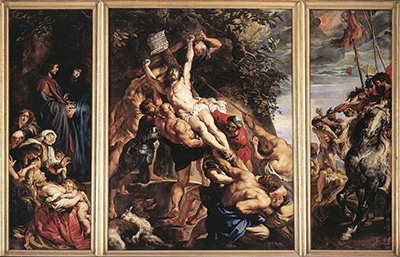
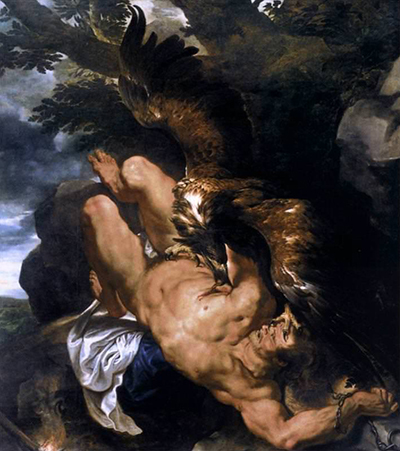
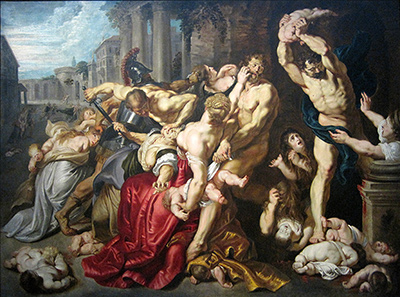
The Elevation of the Cross
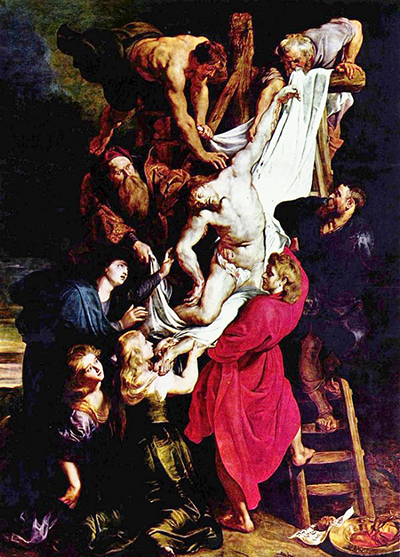
1609–10The Descent from the Cross
1611–14The Garden of Love
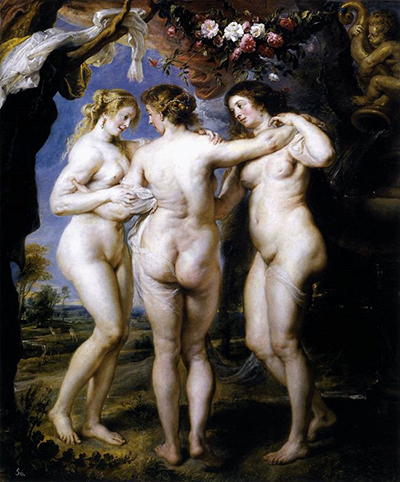
1630–35The Three Graces
1630–35Contents
- Who is the horned figure?
- What is the maid doing?
- What is in the basket?
- How does Rubens use light and dark?
- Is this a named myth or an allegory?
- Where did the painting come from?
- Why does the title matter?
- What should a reader notice first?
Who is the horned figure?
The holding collection identifies him as a satyr. His small horns, dark hair and broad bare shoulders distinguish him from an ordinary portrait sitter. The figure looks down with a mischievous expression, while the woman beside him watches. Their proximity creates a sense of shared attention, but the short object record does not name the maid or identify a specific mythological episode.
In Greco-Roman art, satyrs are woodland beings associated with Bacchus, wine and unruly celebration. A Metropolitan Museum of Art object essay on a satyr and satyress[2] explains this general tradition. Grapes are also a familiar attribute of Bacchus, as the Met's essay on food and drink in European painting[3] notes. Those sources help explain why a horned figure and grapes can feel Bacchic. They do not prove that this particular image depicts a named feast, a quotation from a classical text or an exact moral allegory.
The satyr's body is large and direct. His pale chest catches light against a dark background. One arm supports the basket, and the other side of his body disappears into shadow. The head is turned down towards the fruit and the woman, so the figure seems engaged with what is in front of him rather than posing as a formal portrait. Rubens gives the creature a human face and physical weight while preserving the horns that mark his mythic identity.
His expression is open to more than one reading. The lowered eyes and slight grin can seem inviting, teasing or possessive. The painting does not document what he “intends” towards the young woman. A careful page can describe the visible gestures and the established satyr type without inventing dialogue or a precise emotional transaction between the figures.
What is the maid doing?
She is placed partly behind the satyr and fruit at left. Her face is bright against the dark background, while red clothing introduces a strong colour beside the basket. Her eyes turn towards the man and the grapes; one hand reaches into the crowded space above the fruit. She is close enough to feel part of the same action, but her body is not given the same broad, central display as the satyr's.
The collection's English title calls her a maid. That is a catalogue description, not a documented personal name. It does not say that she was a specific Rubens family member, a named nymph from a myth or a real servant in the artist's household. A viewer may sense playfulness or a social exchange, but the record's secure identification is more limited: a satyr, a young female figure and a basket of fruit.
Her placement creates a visual conversation. The satyr's head inclines, the woman's gaze turns inward, and the basket occupies the shared space below them. The two faces have different expressions and different degrees of prominence. Rubens uses their glance across the fruit to make a still life part of an encounter, rather than an isolated arrangement of produce.
The woman's red garment also works structurally. Without it, the pale fruit and satyr's body might dominate the whole surface. The warm cloth on the left balances the dark grapes and shadow on the right. It draws attention to the maid's presence without requiring an elaborate costume description or a defined setting.
What is in the basket?
The lower half of the painting is crowded with grapes and other fruit in a woven basket. Pale bunches spread across the left; dark grapes gather near the centre and right. Round yellow and red fruit add variety of shape and colour. Leaves and stems project above the pile. The basket's striped weave is visible beneath the fruit, making the heavy load seem physically supported.
The Liechtenstein record tags the subject as both satyr and fruit still life. That pairing is useful. The fruit is not an incidental prop added after the figures; its variety, ripeness and placement command close attention. It provides a material reason for the figures to lean together, and it gives the viewer a spectacle of surface: translucent grape skins, matte rind, pointed leaves and woven fibres.
The Met's survey of food imagery notes that fruit in European painting can serve both as an exercise in observation and as a carrier of associations. Grapes can evoke Bacchus, while abundance can suggest pleasure or plenty. For this particular canvas, however, the collection entry does not supply a complete allegorical key. It would be too certain to say that every grape stands for a single moral idea or that the basket illustrates a named proverb. The fruit's visible role is secure even while its symbolic range remains open.
Rubens sets the basket very close to the lower edge. It seems to push into the viewer's space, held out by hands that emerge from behind it. The arrangement makes the viewer a third participant in the act of looking. The satyr and maid see or handle the fruit; we are invited to examine it as well. This near presentation is one reason the painting's compact portrait format feels vivid.
How does Rubens use light and dark?
The background is predominantly dark, with little architectural or landscape detail. Against it, the satyr's chest and the maid's face are sharply legible. The fruit catches smaller, varied highlights. Rubens can move the eye between large pale forms—the bodies—and many small bright marks on grapes and leaves. That alternation keeps the picture lively without opening it into a wide scene.
The satyr's head is darker than his torso, so his horns and hair partly merge with the space behind him. The face comes forward through selected light on forehead, nose and beard. The maid's face is smaller but comparatively clear, framed by hair and red cloth. The contrast in scale and illumination helps the two figures feel different without separating them physically.
The lower right falls into shadow where fruit and basket meet a dark surrounding area. The pale grapes at lower left push forward, while dark bunches recede. This is not merely decorative colour. It gives the crowded basket depth and weight. The viewer can follow the fruit from the outer clusters towards the dark centre and back to the figures' hands.
At 113 × 71 centimetres, the canvas is taller than it is wide. The vertical shape suits a composition stacked from fruit at the bottom to faces near the top. A small web reproduction may make it look like a casual genre picture, but its original size is substantial enough to give the bodies and basket a strong presence in a room.
Is this a named myth or an allegory?
The catalogue gives an iconographic subject of satyr and fruit still life. It does not identify a particular classical narrative, assign the woman a mythological name, or publish a fixed allegorical interpretation in the short record. The satyr's connection with Bacchus and the grapes makes a Bacchic atmosphere plausible; that is a contextual reading, not a title supplied by the holding collection.
It is useful to distinguish the figure type from a narrative event. A satyr is a recognisable mythic being even without a particular story being enacted. Rubens can put such a figure into a close encounter with a young woman and a fruit basket to explore expression, bodies and abundance. The scene's appeal need not depend on identifying a verse of Ovid or a moral lesson that the available record does not document.
Nor should the woman be renamed a “nymph” as a catalogue fact. Some secondary discussions of similar subjects use that vocabulary, and a viewer may see a mythic companion in her. The present collection entry's English title says “maid,” and that is the firm wording for this object. The page can explain general satyr imagery while staying close to the actual museum record.
The painting's abundance is evident without declaring that it depicts one season. Grapes and other ripe fruit can suggest harvest, but the collection does not label the scene Autumn or The Four Seasons. A precise title helps readers avoid transferring interpretations from Rubens's other paintings of Bacchus, Ceres or seasonal allegories onto this canvas.
Where did the painting come from?
The Liechtenstein record says the painting was first mentioned in Joseph von Hormayr's 1830 description of the Count Schönborn painting collection. It then lists a private collection and the permanent loan to Liechtenstein since 2003. This is a useful outline, but it is not a complete chain of named owners for every year between the nineteenth century and today.
The phrasing “first mentioned” does not mean the painting was made in 1830; the museum dates it about 1615. It means that the cited written description is the earliest point the current catalogue highlights in its provenance. The gap between the painting's creation in Antwerp and that documentary reference should not be filled with an invented journey.
The present loan arrangement is similarly specific. The painting is recorded in the Liechtenstein online collection and currently listed for display at the Garden Palace, but its lender remains a private collection. The inventory number G 6 helps identify it within the display and catalogue system. It is not, by itself, proof that ownership was transferred to the princely family.
The object record lists many exhibition and catalogue references, including a recent scholarly Corpus Rubenianum volume. That bibliography shows the painting has been studied and exhibited, but the references are not all available in full through the object page. The public manuscript therefore uses the record's explicit claims and visible image rather than attributing a specialist's detailed argument that has not been read.
Why does the title matter?
The inherited path Satyr and Girl preserves an older, shorter label. The current collection title, Satyr and Maid with Fruit Basket, names the painting's three central elements. It also prevents the still life from disappearing behind the two figures. In a work where the basket covers so much of the foreground, that fuller wording is more informative.
The original German title, Satyr und Mädchen mit Früchtekorb, similarly includes the fruit basket. The English catalogue's “maid” is a translation of Mädchen in this context, and the site can acknowledge the inherited “girl” wording without treating it as a separate painting. The image, dimensions, date and inventory match the loaned work in the Liechtenstein record.
A good caption should also state ownership accurately: private collection, permanent loan to LIECHTENSTEIN. The Princely Collections. The displayed image belongs to a real object with a documented catalogue location, not just to a generic Rubens subject. The approved legacy reproduction is retained; the collection's low-resolution download is governed by terms for non-commercial use, so it is not silently substituted here.
What should a reader notice first?
Find the horns and the satyr's downward glance. Then move to the maid's face and her hand near the fruit. Finally, slow down over the basket: pale grapes, dark grapes, round fruit, leaves and woven rim compete for attention. Rubens makes a compact encounter out of bodily presence and still-life detail.
The painting's secure facts are clear: Rubens, about 1615, oil on canvas, 113 × 71 centimetres, made in Antwerp, now on a private collection's permanent loan in the Liechtenstein catalogue. The satyr and fruit still life are catalogued subjects. Those anchors leave room to discuss light, expression and possible Bacchic associations while marking the point where interpretation begins.
The work is lively precisely because it does not settle into one documented narrative. A horned figure, a maid and an overflowing basket occupy the picture almost completely. Their proximity and the fruit's abundance are enough to hold attention. The viewer can see pleasure, play or invitation in the scene, provided those words remain readings of the visible painting rather than unsupported claims about named characters or a hidden story.
Rubens artworks directory
Frequently Asked Questions
The Liechtenstein Collections catalogue calls it Satyr and Maid with Fruit Basket. The inherited route uses the shorter phrase Satyr and Girl.
The lender is a private collection. The painting has been on permanent loan to LIECHTENSTEIN. The Princely Collections since 2003.
The collection dates it about 1615 and lists Antwerp as the place of origin.
It is oil on canvas, 113 × 71 centimetres, catalogue inventory G 6.
The catalogue identifies a satyr and a fruit still life but does not specify a particular narrative or name the maid as a mythological character.
Discussion
Look from the satyr's horns and face down into the basket.
Share a close observation or a reliable source about loan G 6.
Reader Insights
How does the fruit still life shape the encounter between the figures?
Which Bacchic associations can be supported without inventing a story?
Why does the lender line matter for an accurate caption?
Join the Conversation
Add your reading below, distinguishing catalogue facts from interpretation.
References
- LIECHTENSTEIN. The Princely Collections, Satyr and Maid with Fruit Basket , G 6. View source
- The Metropolitan Museum of Art, Satyress with Vase. View source
- The Metropolitan Museum of Art, “Food and Drink in European Painting, 1400–1800”. View source