by Tom Gurney
Tom Gurney BSc (Hons) is an art history expert with over 20 years experience
Published on June 19, 2020 / Updated on October 14, 2026
Email: tomgurney1@gmail.com / Phone: +44 7429 011000
A painter presents himself as a gentleman
Rubens turns towards us beneath a broad black hat. Light catches his face, beard and white collar while most of his cloak merges with the dark background. His hands are outside the frame. There is no palette, brush or easel to announce his profession. The painting asks us to meet a courtly, self-possessed man, and only then to remember that he made this image of himself.
The National Gallery of Australia[1] identifies the portrait in Canberra as Self-portrait, painted in 1623 and purchased for the national collection in 1983. An Art Gallery of New South Wales exhibition label[2] describes it as an autograph oil painting on canvas. That support helps identify the work: Rubens painted a remarkably similar 1623 self-portrait on panel for Charles, Prince of Wales, now in the Royal Collection. The two images must not be treated as one object merely because they share a pose.
Canberra's portrait was associated with Rubens's friend Nicolas-Claude Fabri de Peiresc, a scholar and lawyer who wanted the artist's likeness for his collection. The NGA's essay explains why a painter might belong among Peiresc's portraits of eminent thinkers. Rubens was known not only for making pictures but also for antiquarian learning and diplomatic work. This self-portrait presents those overlapping identities without putting a scholarly book or diplomatic paper in his hands.
At a Glance
- ArtistPeter Paul Rubens [1]
- SubjectThe artist's own likeness [1]
- Painted1623 [1]
- MediumOil on canvas (AGNSW exhibition label) [1]
- Early recipientNicolas-Claude Fabri de Peiresc [1]
- CollectionNational Gallery of Australia, Canberra [1]
Where this work sits in Rubens's career
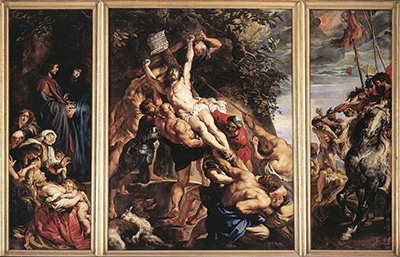
The Elevation of the Cross
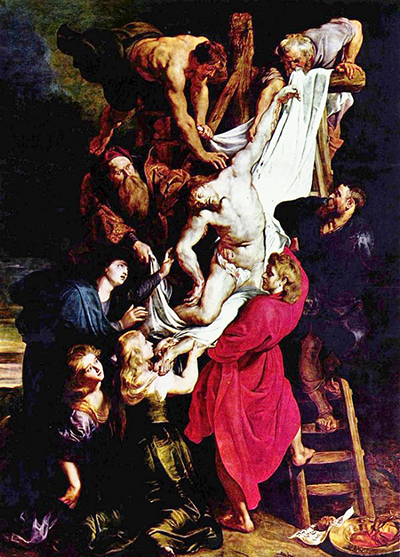
1609–10The Descent from the Cross
1611–14Rubens Portrait
1623The Garden of Love
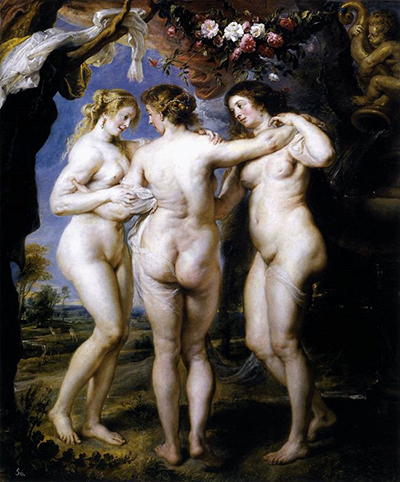
1630–35The Three Graces
1630–35Contents
- What do the hat, cloak and chain say?
- Why was the portrait made for Peiresc?
- Were there two portraits in 1623?
- When did Peiresc receive the canvas?
- How does Rubens use light and paint?
- Why did the image circulate beyond Peiresc?
- What should a viewer take away?
What do the hat, cloak and chain say?
The hat occupies much of the upper left of the picture. Its sweeping dark brim frames the face and makes the lit forehead and eyes more vivid. Rubens wears a fashionable black cloak, its bulk filling the lower half of the canvas. Against it, the narrow white collar and touches of gold near his throat become small but deliberate accents. The effect is dignified rather than showy.
The NGA reads this dress as a claim to gentlemanly status. Rubens had served as court painter to the rulers of the Spanish Netherlands since 1609. The museum identifies the gold chain visible below his throat as a sign of his court position. It is easy to miss at first glance because black clothing dominates the image. The chain works as a quiet marker of recognition rather than a display covering the whole chest.
His face carries more movement than his clothes. The lively eyes, moustache and beard receive precise attention. Soft transitions around the cheeks sit beside firmer dark edges at the hat and cloak. Rubens's head turns slightly, so the encounter is neither a strict frontal stare nor a profile. A viewer senses the artist's awareness of being watched, expressed through the direction of his gaze and the angle of his body.
The absence of painting tools is meaningful. Self-portraits can show an artist at work, but this one does not. The Art Gallery of New South Wales notes that Rubens conceals his hands as part of an image suited to a gentleman. That interpretation should be kept with the visible fact: the hands are not shown. The composition turns attention from manual labour to the sitter's face, clothing and social presence.
Why was the portrait made for Peiresc?
The NGA's 1988 exhibition essay says Rubens probably committed to the painting during a Paris visit in February 1622. Peiresc had helped with negotiations surrounding Rubens's commission to paint the life of Marie de Médicis for the Luxembourg Palace. The two men shared an interest in ancient objects, particularly engraved gems, and corresponded about a proposed illustrated study of them. Their connection supplied a personal setting for the portrait.
Peiresc wanted the likeness in his study at Aix-en-Provence, above his bookcases. According to the NGA, he gathered a group of portraits of distinguished people from scholarship, religion and literature. Rubens was the only painter in that group. The inclusion was therefore an honour, but it did not depend on presenting him with brushes. Peiresc valued him as an artist whose learning and courtly relationships made him a participant in a wider intellectual world.
The proposed book on antique gems did not appear, the NGA explains, although Rubens made drawings and ordered engravings for it. This unfinished collaboration still tells us something about the friendship. The men were exchanging more than compliments. They had a shared project with material to study and publish, and the portrait would stand within Peiresc's room as the likeness of one of his active correspondents.
The portrait's destination helps explain its self-presentation. A painting hung among learned figures needed to read clearly as a distinguished individual, even to a visitor who had never met Rubens. The hat, cloak, chain and attentive face do that work. This does not prove that Peiresc specified the pose or clothing; no such instruction is established by the cited museum account. It explains why the image was well suited to the collection described there.
Were there two portraits in 1623?
Yes. The NGA explicitly distinguishes the Canberra canvas for Peiresc from the panel sent to Charles, Prince of Wales. The Royal Collection Trust[3] catalogues the latter as RCIN 400156, signed and dated 1623, oil on panel, measuring 85.7 × 62.2 cm. Those measurements and that inventory number belong to the royal panel, not to the Canberra canvas.
The prince's painting arose in a different relationship. Royal Collection Trust explains that Rubens had supplied a lion hunt through Henry Danvers, but it disappointed because it had not been worked throughout by Rubens himself. Danvers then sought an original self-portrait made by the artist's own hand as a suitable gift for Charles. The royal version thus carried a pointed claim about authorship and courtly favour. Peiresc's canvas belongs to a friendship and a collection of learned men.
The two portraits look closely related because Rubens reused an effective way of showing himself. A broad hat, black dress and turned face can be recognised in both. Still, shared likeness is not shared physical identity. One work is in the Australian collection on canvas; the other is in the Royal Collection on panel. They had different early recipients and later collection paths. Any caption that gives the prince's panel dimensions to Canberra's canvas would erase this distinction.
The Royal Collection records the panel's Latin inscription giving Rubens's name, his own image, the year 1623 and his age. The Canberra picture does not need that inscription to be identified, because its museum record and Peiresc history establish its separate course. Comparison is useful when it reveals how Rubens adapted one persona for different audiences, not when it collapses the paintings into a single version.
When did Peiresc receive the canvas?
The picture is dated 1623, but its delivery to Peiresc is a separate event. The Art Gallery of New South Wales's exhibition label says Rubens kept this canvas until 1628 and then sent it as a gift. Other scholarship on the correspondence places the transfer later, noting delays in dispatch around 1629–30. The sources do not support a simple statement that Peiresc had the finished painting in his study immediately in 1623.
What is secure for this page is the object's broad sequence: Rubens painted his likeness in 1623; it was intended for or eventually sent to Peiresc; and it was purchased for the National Gallery of Australia in 1983. The exact shipping date needs more careful reconciliation of letters and later catalogues. A difference of a few years would affect the portrait's early journey, but it would not turn the Canberra canvas into the royal panel.
It is also worth separating the NGA's wording about the portrait's intended setting from a claim that every planned display detail was realised in precisely that form. The museum describes Peiresc's wish to hang it above books among other portraits. That intention explains the image's social role. It should not be transformed into a fully documented room arrangement for every year of the painting's history.
The purchase year 1983 is a modern collection event. It does not tell us how the work passed from Peiresc's circle through all subsequent owners. The NGA exhibition essay gives the friendship and the present collection as anchors; a complete provenance would require dedicated records for the centuries between. Stating the limits keeps the portrait's known history clear.
How does Rubens use light and paint?
The face emerges from a field of dark cloth and shadow. A pale forehead, glistening eyes and warm cheeks become the visual centre. The hat brim both shades and frames the head. In the lower canvas, Rubens lets broad black shapes carry the figure, so the detailed facial passage does not have to compete with richly painted accessories. His control of what stays quiet is as important as the liveliness around the eyes.
The NGA points to the swirling beard and moustache as examples of the painter's touch. These passages animate a formal pose. The slight motion in the hair and the softness of the skin help the figure feel present rather than fixed like a carved emblem. Rubens does not need an energetic full-body gesture to suggest intelligence and alertness. The eyes and mouth provide enough human movement.
At the left edge, a glimpse of landscape and sky opens the dark setting. It gives depth without becoming the subject. Most of the composition remains occupied by the man and the surrounding shadow. This balance lets the viewer read both his worldly dress and the painter's handling of atmosphere. The image is controlled but not flat: the head turns within space, and the background does not close around it as a single blank wall.
Close looking can distinguish observation from interpretation. We can observe the black hat, dark cloak, white collar, chain and absent hands. We can then ask what their combination suggests about social rank and artistic identity. The NGA's courtier reading has strong support from those details, but Rubens left no painted label saying exactly how every viewer should respond. The picture's force rests partly in that open encounter with a living face.
Why did the image circulate beyond Peiresc?
The NGA says the Canberra likeness served as a model for a 1630 engraving by Paulus Pontius. A print could take Rubens's chosen appearance beyond Peiresc's study and the artist's own network of correspondents. Its format allowed his face to circulate as an image of an eminent person. The NGA relates the engraving to recognition of Rubens's diplomatic success as well as his artistic reputation.
That afterlife reinforces the portrait's unusual emphasis. The image is easily read as a celebrated gentleman, with no visible studio setting to limit it to one craft. Printed portraits of writers, rulers and scholars commonly worked this way: the face and signs of status carried the identity. Rubens's painted self-presentation could function in the same social world. The print's use does not mean the canvas was originally made as a print design; it shows how a compelling likeness acquired another purpose.
The painting itself also travelled through exhibitions. The NGA's 1988 focused exhibition placed it within the artist's career, and the gallery listed it among works lent around Australia in 2003. These later events are part of its public life as a national collection picture. They differ from the private setting Peiresc had envisaged: today's viewers meet it in a gallery or reproduction, often without the surrounding portraits that once gave it context.
The portrait's success as an image may be why its two 1623 versions are frequently confused. Both show the same famous painter in similar dress. Careful attention to the canvas and panel records restores their separate histories. In Canberra, we look at a painting connected to Peiresc's learned circle; in the Royal Collection, we see a related work involved in gift exchange with the future Charles I.
What should a viewer take away?
Begin with the bright face under the sweeping hat, then notice how little else is allowed to distract from it. The dark cloak, hidden hands, white collar and modest glint of a chain produce a deliberate public image. Rubens presents himself as someone who could move among scholars and princes, not merely as a man who knew how to hold a brush.
The 1623 date is important, but so is the portrait's particular object identity. The Canberra work is an autograph canvas, associated with Peiresc and now in the National Gallery of Australia. Its close relative is a panel for Charles, Prince of Wales, Royal Collection RCIN 400156. This difference lets us understand why Rubens might use one successful likeness for two very different relationships.
Finally, the painting is personal without being casual. It shows the artist's face directly, while making clothing, pose and light serve a considered social role. The NGA's account of Peiresc's collection explains where that role came from. Viewed today, the canvas lets us see how Rubens balanced painterly skill with the image of a learned courtier, and how a self-portrait could move between friendship, reputation and public display.
Rubens artworks directory
Frequently Asked Questions
Yes. Rubens painted his own likeness. The National Gallery of Australia identifies the Canberra canvas as his Self-portrait of 1623.
Rubens made the canvas for his friend Nicolas-Claude Fabri de Peiresc, who wanted a portrait of the artist among the learned figures in his study.
No. Charles, then Prince of Wales, received a related 1623 panel, now Royal Collection RCIN 400156. The Canberra picture is on canvas.
The canvas was painted in 1623. An exhibition label says Rubens sent it in 1628, while later scholarship reports dispatch delays around 1629–30. The delivery date needs further reconciliation.
It is in the National Gallery of Australia, Canberra, which purchased it in 1983.
Discussion
Begin with Rubens's gaze beneath the broad black hat.
Share a close observation or a reliable source for the Canberra canvas.
Reader Insights
How do the hidden hands and gold chain shape the portrait?
What distinguishes Peiresc's canvas from the prince's panel?
Why should the 1623 painting date be kept apart from its dispatch?
Join the Conversation
Add your reading below, keeping the two 1623 portraits distinct.
References
- National Gallery of Australia, Rubens's Self-Portrait in Focus , 1988 exhibition essay. View source
- Art Gallery of New South Wales, Self Portrait: Renaissance to Contemporary , extended label for the Canberra canvas. View source
- Royal Collection Trust, Rubens's separate 1623 panel for the Prince of Wales, RCIN 400156. View source
- National Gallery of Australia, Out and About 2003 loan listing. View source
- Scholarly article, Itinerant Matters: Rubens and the Itineraries of Painting , on delayed Peiresc dispatch. View source