 by Tom Gurney
Tom Gurney BSc (Hons) is an art history expert with over 20 years experience
Published on June 19, 2020 / Updated on October 14, 2026
Email: tomgurney1@gmail.com / Phone: +44 7429 011000
The moment a forbidden basket opens
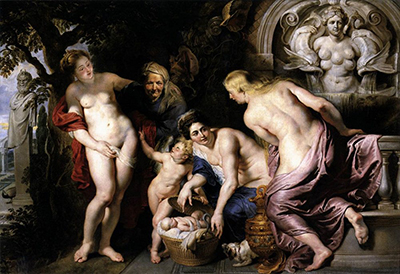
The child is small, but the entire painting turns on him. One of three young women bends toward a basket; another leans in, and a third stands at the left. Between them an older attendant looks down at the infant. Their overlapping gestures draw the eye toward the opening in the basket, while the women's large figures and brightly coloured draperies make the discovery a lavish spectacle. A fountain crowned by a sculpted female figure closes the space at the right.
Peter Paul Rubens painted this The Discovery of the Infant Erichthonius around 1616, according to LIECHTENSTEIN. The Princely Collections[1]. The museum records it as oil on canvas, 218 × 317 centimetres, inventory GE 111. The page route uses the established wording “Discovery of the Child Erichthonius”; the collection's current English title uses “Infant.” Both point to this large finished canvas. The approximate date and the inventory number matter because Rubens returned to the same myth in other works.
The subject may be unfamiliar, but the action is simple: three sisters were told to guard a closed basket and not look inside. They opened it. The living secret within was Erichthonius, a child tied to the founding myths of Athens and, in many accounts, to serpents. Rubens shows the instant when concealment becomes revelation. Instead of leaving the story at a small narrative group, he expands it into a composition with bodies, fabrics, architecture, an attendant and a fertility image at the fountain.
At a Glance
- ArtistPeter Paul Rubens [1]
- DateAbout 1616 [1]
- MediumOil on canvas [1]
- Dimensions218 × 317 cm [1]
- CollectionLIECHTENSTEIN. The Princely Collections, GE 111 [1]
Where this work sits in Rubens's career
The Elevation of the Cross
1609–10The Descent from the Cross
1611–14The Garden of Love
1630–35The Three Graces
1630–35Contents
- Why was Erichthonius hidden?
- What does the painting actually show?
- A garden made of nature and art
- The Courtauld sketch and another Rubens painting
- Patron, collection and setting
Why was Erichthonius hidden?
The Liechtenstein collection's essay[1] tells the myth of the god Vulcan, or Hephaestus, pursuing Minerva, or Athena. His seed fell on Gaia, the earth, and Erichthonius was born from that unusual conception. Ancient versions differ over whether he was himself partly serpentine or was accompanied by snakes. The collection observes that artists sometimes gave him legs ending in snakes, as Rubens does here. Minerva placed the infant in a closed basket and entrusted it to Herse, Aglauros and Pandrosos, daughters of Cecrops, the king of Athens, with orders not to open it.
One ancient telling can be read directly in Ovid's Metamorphoses, Book 2[2]. Ovid's account is framed as a report by a bird that witnessed the sisters' disobedience. In that version, Aglauros breaks the command while Herse and Pandrosos had initially obeyed; the opened container reveals an infant and a serpent. The bird reports the secret to the goddess. Ovid later returns to Aglauros's punishment in the story of Mercury and Herse. That sequence gives the basket incident a consequence, but it does not require the sisters to die at the moment of discovery.
Other ancient accounts have a more violent outcome. The Liechtenstein essay says that in many versions the sisters react to what they see by killing themselves. It proposes that Rubens's treatment is closer to Ovid, in which they survive. That is the collection's interpretation of his chosen emphasis, not proof that he illustrated one ancient passage word for word. Ovid, for example, does not instruct a painter to put the sisters beside a monumental fountain or to make all three women into an elaborate study of flesh and fabric.
What does the painting actually show?
The reproduction on this page makes the great width of the painting's arrangement clear. The standing woman at left balances the figure bending in from the right. Between them, the basket is low in the foreground and the infant draws attention at the centre. Red and violet cloth frame the pale bodies. Behind the group, darker figures and architecture deepen the stage. Rubens arranges a large canvas so that a tiny child remains the focus without being made physically large.
The fountain sculpture at the right is not a generic female ornament. The Liechtenstein collection identifies it as Diana of Ephesus, a figure marked by multiple breasts and often associated with fertility. Its presence broadens the subject beyond a simple story of curiosity. The infant's unusual birth, the women gathered around him and the fertility figure occupy the same visual field. The museum argues that Rubens used the story to create an opulent display of three differently posed female bodies, comparable in function to the Three Graces or the goddesses in a Judgement of Paris. That is a reading of the painter's choices, not something explicitly required by Ovid's narrative.
An older woman stands between the daughters at the left of the basket. Her covered body and darker clothing make her visibly distinct from the younger women. The Liechtenstein essay says her role remains puzzling despite attempts to explain it. It describes her as attending to Herse, but does not securely name her as a particular person or personification. It would be tempting to call her a nurse, a warning figure or an allegory of age; the available evidence does not settle any of those identities. In this page she remains an older attendant whose presence changes the visual and social texture of the discovery.
The contrast between the little child and the adults is important. Erichthonius's body is the source of the surprise, but Rubens places the work of looking on the women's faces and bodies. They bend, turn and pause at different distances from the basket. In the reproduction, the infant's precise serpentine anatomy is hard to inspect at the image's small size. The holding collection's account provides the stronger basis for stating that Rubens shows snake-ended legs. The image itself securely supports the open basket, the infant, the gathered women, the attendant, the fountain and their overall positions.
A garden made of nature and art
The fountain rewards a slower look. Art historian Katrina Mandabach, writing in the Journal of Historians of Netherlandish Art[4], describes the setting as an ornate garden containing shells, a branch of coral, a sculpted Pan and a vase with a Medusa head. She points out gridded planting beds in the landscape of the finished canvas. These details make the garden more than a neutral stage: living plants, collected natural specimens and objects made by human hands occupy the same space. The opened basket presents another, much stranger kind of encounter between life and matter.
Mandabach reads the Ephesian Diana as an image of Nature, an association made in sixteenth-century emblems. On that reading, the figure also recalls Gaia, Erichthonius's mother. Water runs from the fountain's breasts and from carved dolphins at its sides; below the statue, it falls into a basin. The contrast between a grey stone body and flowing water gives Mandabach a way to read the sculpture as both an ancient object and a source of life. This is a modern art-historical interpretation of Rubens's imagery, rather than a label written by the painter or an identity explicitly stated in Ovid.
The connection also helps explain the painting's unusual balance of scales. The child announces the myth, but the great fountain occupies a conspicuous part of the canvas. A viewer who starts with the basket can move outward to the statue, the water and the cultivated garden, then back to the child's serpentine form. Mandabach proposes a visual relation between the grey colouring of his snake-like lower body and the grey sculpture. Her reading asks what happens when Rubens makes stone appear animated and paint make a mythical birth visible. The Liechtenstein collection offers a related but narrower point: the Diana figure signals fertility, while the women's poses let Rubens display different kinds of bodily beauty. Both accounts are useful so long as neither is mistaken for a proven account of the unknown patron's intentions.
The Courtauld sketch and another Rubens painting
The Liechtenstein collection[1] identifies a preliminary oil sketch in the Courtauld Gallery, London, and calls it lively. That sketch belongs to the design history of this final canvas. It is a distinct painting and should not be used as the image for this route. The collection also cautions that the differences between sketch and final version do not solve the puzzle of the old woman. Mandabach's published study identifies the Courtauld work as an oil sketch on panel, about 1615, 50 × 41 centimetres, accession P.1978.PG.364. She observes that the Ephesian fountain occupies a larger share of that sketch's surviving surface, whereas the broad finished canvas extends the setting and adds further figures and garden detail. The different formats and dimensions make it especially important to keep the small design study separate from the finished work.
The painting also had an afterlife in print. The Princely Collections catalogue an engraving by Pieter van Sompel after Rubens's composition[5], inventory GR 763. Its recorded inscriptions distinguish the roles: Rubens painted the model; Van Sompel engraved it; the plate also names publishers. This is a reproductive print, not another painted version of GE 111. It shows that the design circulated beyond the full-size canvas, although the collection record does not by itself establish how widely or precisely when each impression was made. Like the Courtauld sketch, it is valuable evidence for a composition with several material forms, but it cannot replace the holding collection's record for the canvas.
There is a second source of confusion: Rubens made a later painting of the finding of Erichthonius, now represented by a fragment in the Allen Memorial Art Museum at Oberlin[3]. Oberlin dates its object 1632–33 and explains that the complete composition was cut down and overpainted in its later history. Its catalogue tells the remarkable story of the infant being hidden under painted flowers before the subject was recognised again in the twentieth century. Those events concern the Oberlin painting, not the large Liechtenstein canvas of about 1616. The Richelieu ownership and 1944 Oberlin acquisition likewise cannot be transferred to the object discussed here.
The two paintings show why a title alone is not enough for object identification. A reader may find images labelled The Finding of Erichthonius, The Discovery of the Infant Erichthonius or The Daughters of Cecrops Discovering Erichthonius. Some belong to a sketch or later version. For the present page, the definitive anchors are the Liechtenstein collection's GE 111, its 218 × 317 centimetre canvas and the image showing the broad arrangement with three women, attendant, basket and fountain.
Patron, collection and setting
The original patron has not been identified in the Liechtenstein essay. The museum describes the picture as made for an unknown patron and interprets its visual richness accordingly. Its public record does not document a commission contract or an exact date of completion. “About 1616” is the responsible dating; attaching the picture to a specific court or private room would be speculation without further evidence.
The first secure acquisition point supplied by the collection is 1701. Prince Johann Adam Andreas I von Liechtenstein[1] bought the canvas from the Vienna dealer Marcus Forchondt. The museum's current record locates the work in the Princely Collections and lists it in the Garden Palace permanent presentation. The acquisition tells us how the painting entered that collection. It does not by itself tell us every place the canvas hung during the roughly eighty-five years after Rubens made it.
The collection's catalogue also records remnants of a 1733 guardianship seal at the lower right and another seal on the reverse. Those marks belong to the object's later history, after its acquisition by the princely family. They are more precise physical evidence of collection life than a guess about its first display. The catalogue's literature list begins with an eighteenth-century gallery description by Vincenzio Fanti, published in 1767, and includes later nineteenth-century descriptions. Such records trace the painting's long scholarly and collecting history; they do not close the earlier gap between Rubens's studio and the documented 1701 purchase.
The huge dimensions give a sense of what the subject offered its early viewer. The picture is over three metres wide. What begins as a small forbidden object becomes an expansive display of human reactions, surfaces and mythological clues. Rubens's choice of scale is as striking as his choice of story: an episode that Ovid can recount briefly becomes a crowded, sensuous history painting.
Rubens artworks directory
Frequently Asked Questions
It belongs to LIECHTENSTEIN. The Princely Collections, inventory GE 111.
The holding collection dates it about 1616.
It is an oil canvas measuring 218 × 317 centimetres.
In Ovid's telling Aglauros breaks Minerva's instruction. The painting presents the daughters together; exact assignment of every painted pose should be made carefully from a high-resolution image or specialist catalogue.
No. The Courtauld work is a separate preparatory sketch. The completed canvas discussed here is the much larger Liechtenstein work.
No. Oberlin catalogues a later Rubens painting of the same myth, dated 1632–33, which was subsequently cut down.
Discussion
Look closely at the opened basket, the sisters and the older attendant.
Share an observation about the painting or a reliable source that adds to its history.
Reader Insights
How does the tiny infant become the centre of a large canvas?
Which elements does Rubens add beyond Ovid's brief account?
What distinguishes this painting from the later Oberlin fragment?
Join the Conversation
Add your reading below, keeping observations specific and evidence clear.
References
- LIECHTENSTEIN. The Princely Collections, The Discovery of the Infant Erichthonius , GE 111. View source
- Ovid, Metamorphoses , Book 2, via the Perseus Digital Library. View source
- Allen Memorial Art Museum, Rubens's separate later Finding of Erichthonius fragment. View source
- Katrina Mandabach, “Matter as an Artist: Rubens’s Myths of Spontaneous Generation,” Journal of Historians of Netherlandish Art. View source
- LIECHTENSTEIN. The Princely Collections, Pieter van Sompel engraving after Rubens, GR 763. View source