by Tom Gurney
Tom Gurney BSc (Hons) is an art history expert with over 20 years experience
Published on June 19, 2020 / Updated on October 14, 2026
Email: tomgurney1@gmail.com / Phone: +44 7429 011000
A road through the countryside
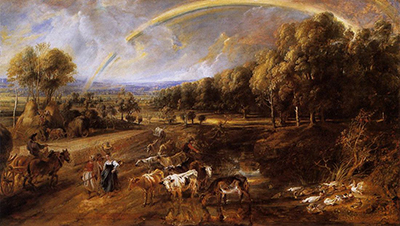
A broad road carries people and animals towards a bright distance. A cart loaded with produce fills the lower foreground; farther away, smaller groups follow the road between trees and buildings. Dark trunks rise at the left, and the light opens across the centre and right. The painting is full of little incidents, yet the journey gives them a common direction. The destination named in its title is the market, not a battle, a saint's shrine or a mythic meeting.
A Royal Collection Trust publication[1] identifies the work as Peter Paul Rubens's Summer: Peasants Going to Market, about 1618, oil on canvas, Royal Collection inventory 401416. The Städel Museum's catalogue of a later related painting[3] identifies the Rubens original by the same inventory number and gives its dimensions as 143.4 × 222.9 centimetres. The retained image corresponds to that wide composition, including the foreground cart, the deeply shaded trees and the road receding into a lighter landscape.
The Royal Collection's title joins a season to an activity. “Summer” suggests the time of growth and produce, while “Peasants Going to Market” describes people taking goods through the countryside. The scene does not document a named town or a particular market day. Its figures are small enough to let the land command attention, but active enough that the road feels used. Rubens makes rural labour and exchange part of the landscape's subject.
At a Glance
- ArtistPeter Paul Rubens, with possible assistant work [1][4]
- DateAbout 1618 [1]
- MediumOil on canvas [1]
- Dimensions143.4 × 222.9 cm [3]
- CollectionRoyal Collection, RCIN 401416 [1][3]
Where this work sits in Rubens's career
The Elevation of the Cross
1609–10The Descent from the Cross
1611–14The Garden of Love
1630–35The Three Graces
1630–35Contents
- How does the painting guide the eye?
- Why call it Summer ?
- Was the whole canvas painted by Rubens?
- How did the design travel?
- Where does it sit among Rubens's landscapes?
How does the painting guide the eye?
The high viewpoint permits a long look over the valley. From the cart at the bottom, a viewer can follow the road through groups of travellers, past buildings and towards the horizon. The change in scale makes distance intelligible: large figures and animals occupy the foreground, while those farther along the route become small marks in the open country. This is a landscape that invites the eye to travel much farther than any one person in it could see at a glance.
The dark mass of trees on the left is a counterweight to the bright opening at centre right. A vertical trunk catches some light, while the road bends away from the dense foreground. The contrast gives the painting both shelter and movement. It does not make the countryside a flat backdrop for the cart. A viewer repeatedly moves between the people nearest the picture's edge and the much larger space that surrounds them.
The weather and illumination are as active as the road. Dense cloud crosses the upper part of the image, but a lighter band illuminates the distance. It is possible to read this as the changing light of a summer morning, though the small legacy reproduction cannot fix an exact hour. A Christie's scholarly catalogue[5] compares the painting's high view and light-dark division with another Rubens landscape, and describes the Royal Collection picture as suggesting early morning. That is an interpretive comparison, not a clock recorded in the painting.
Small people move in several directions across the foreground and middle distance. Some are near the cart, others walk or ride farther along the road. Because they are embedded in the same terrain, attention can shift from a single exchange to the route that connects many activities. The broad view preserves both scales: individual bodies and a countryside in which travel, farming and trade take place. The title gives the road a purpose without forcing each small figure into a fixed story.
Why call it Summer ?
The Royal Collection publication places the picture in a northern tradition of landscapes crowded with human incident. Its discussion of the art writer Karel van Mander observes that landscape could include peasants doing something rather than remain empty scenery. It does not say Rubens painted this canvas as an illustration of one particular passage by Van Mander. The connection is a way to understand why a seasonal landscape can be so full of work, movement and small encounters.
The produce cart and market-bound travellers make the season legible through activity. A painter could signify summer with a single emblem or an inscription; here people, animals, road and light carry much of the idea. The rural economy is visible in motion. Goods do not simply appear at the market: somebody must load them, move them and accompany the animals through a varied landscape. That practical sequence gives a large view its human rhythm.
“Summer” is still a title, not proof that the painting records one observed place during one particular summer. The road, fields, buildings and sky can be read as a crafted landscape scene. The high view combines details that a walker on the road would encounter one after another into a single panorama. Its appeal lies partly in this double perspective: the figures live inside the route, while the viewer can survey nearly all of it at once.
The foreground is busy enough to resist a simple division between landscape and genre painting. Figures and animals are not incidental decorations that could vanish without consequence. They explain why the road matters and why the season is more than a colour of light. At the same time, their small scale keeps attention on the valley and the passage from shadow to brightness. The human scene and the terrain are composed together.
Was the whole canvas painted by Rubens?
The visible painting did not remain a single, untouched rectangle. A Sotheby's catalogue discussion[4], citing Royal Collection specialist Christopher White, describes a central canvas with strips added at both sides and along the bottom. White's published assessment, as reported there, regards the central area as largely or entirely Rubens's work, while the additions and the large foreground figures overlapping the earlier rectangle are more likely to be largely by an assistant. This is a qualified scholarly account of authorship, not a neat line that a viewer can trace across every brushstroke.
The distinction changes how the composition is read. Expanding a canvas can make a landscape broader and give people or animals more room near the picture's edge. Here the larger foreground figures press the market activity closer to the viewer. If the central landscape was already coherent, the additions did more than repair a shortage of space: they changed the balance between a distant panorama and people entering it. The current image is the resulting object, not a photograph of an earlier central painting.
Neither the Royal Collection's attribution to Rubens nor the specialist qualification should be flattened into a claim that every part was painted by one hand. The painting belongs to Rubens's artistic project, while the reported account allows for studio work in particular areas. The source does not establish the name of the assistant, a precise day of enlargement or a complete map of who painted each figure. Naming Lucas van Uden as the author of the added strips would go beyond the evidence used here.
The fact of a composite canvas also helps explain why dimensions should be tied to the object as it now exists. The 143.4 × 222.9 centimetre measurement is for the Royal Collection work identified by the Städel, not for a hypothetical original central section. It must not be borrowed for a later copy or taken as proof of the first design's width. The support is part of the work's history, even though it is easy to overlook when seeing only a digital image.
How did the design travel?
The Städel Museum[3] owns a related landscape by Lucas van Uden, dated about 1629–30, oil on oak panel, inventory SG 544. Its catalogue identifies the Royal Collection Rubens as the model and lists other painted copies and variants. The Städel panel is a separate object with its own size, support, maker and collection history. Seeing a familiar cart or road in it does not turn it into the canvas now numbered RCIN 401416.
The museum's list is unusually useful because it does more than say “after Rubens.” It distinguishes copies from altered versions and records changes in some compositions, such as a reduced group of figures, a missing building or a different subject inserted into the landscape. Such variations show that later artists used the design as material for their own paintings. A copy could preserve the overall scene, while a variant could adjust the route, its travellers or its meaning. The Royal Collection painting's identity therefore depends on its specific support and inventory, not on a common title alone.
The Städel also lists two drawings connected with parts of the composition: a study of trees in the Louvre, attributed to Rubens or van Uden, and a drawing of the middle distance in the Hermitage under Rubens's name. Those are related sheets, not established full-scale plans for every figure in the Royal Collection canvas. The Louvre attribution itself is unresolved in the Städel entry. Drawings may help trace how landscape elements circulated, but the record does not let us present either sheet as a definitive first draft of Summer.
Van Uden's later version is evidence that Rubens's landscape was worth revisiting. It is not evidence that van Uden painted the original canvas's centre or its extensions. The two questions—who helped make Rubens's picture, and who subsequently copied or adapted it—require different kinds of proof. The Städel gives strong evidence for the latter relationship; the White assessment reported by Sotheby's addresses the former with explicit caution.
Where does it sit among Rubens's landscapes?
Rubens returned to roads, trees, fields and workers across his career, but paintings with similar rural subjects are not interchangeable. His Return from the Fields in Florence presents people moving from agricultural labour, whereas the Royal Collection Summer names a journey towards market. Different titles describe different actions, and the paintings have different supports and collection histories. The comparison helps keep this specific canvas from being absorbed into a generic “Rubens landscape.”
A Christie's catalogue[5] compares Summer with a later Wooded Landscape at Sunset, noting a similar use of light along trees and across the ground. That comparison describes a pictorial problem Rubens revisited; it does not prove the two pictures were painted as a pair or at the same time. The Royal Collection publication dates Summer around 1618, well before many of the late landscapes for which Rubens is also celebrated.
An older illustrated catalogue of the royal paintings[6] explains that Summer acquired its seasonal name partly through being displayed with a Winter farm scene. The author expressly cautioned that this later pairing did not establish an original connection between the two works. Its further proposals about an assistant and an early collector are historical opinions, not current documented facts adopted here. The painting can be appreciated as a seasonal landscape without inventing a commission for a matched set.
What remains especially distinctive is the meeting of the enormous view with mundane travel. From a cart close to the frame to a road that shrinks into light, the picture carries the viewer across several distances at once. Its later copies, altered canvas and cautious authorship discussion make it a complex material object, but the activity named in its title remains direct: people move through a productive summer landscape towards a market.
Rubens artworks directory
Frequently Asked Questions
It is in the Royal Collection, inventory RCIN 401416. The painting's display location can change; check the collection before planning a visit.
A Royal Collection publication dates it about 1618. That is an approximate catalogue date, not a dated inscription described in the sources used here.
The Royal Collection identifies oil on canvas. The later Städel painting by Lucas van Uden is oil on oak panel and must be kept separate.
Christopher White's qualified assessment, reported by Sotheby's, gives the central area largely or wholly to Rubens and considers the added strips and overlapping foreground figures more likely to include substantial assistant work. The assistant is not securely named there.
No. It is a later work by Lucas van Uden, catalogued by the Städel as related to the Royal Collection Rubens. It has a different inventory, support, date and dimensions.
Discussion
Follow the road from the foreground cart toward the horizon.
Share a close observation or a reliable source about this landscape.
Reader Insights
How do the travellers change the meaning of a seasonal view?
What does the enlarged canvas suggest about changes to the design?
How does the Städel version differ from the Royal Collection work?
Join the Conversation
Add your reading below, keeping evidence and interpretation distinct.
References
- Royal Collection Trust, Dutch Landscapes , caption and context for Summer: Peasants Going to Market , RCIN 401416. View source
- Royal Collection Trust, collection path for RCIN 401416. View source
- Städel Museum, Lucas van Uden, River Landscape with Peasants Going to Market , SG 544, related works and the Rubens model. View source
- Sotheby's, A Wooded Landscape at Sunset , 2010 catalogue note citing Christopher White on the Royal Collection canvas. View source
- Christie's, A Wooded Landscape at Sunset , comparative discussion of Summer. View source
- Lionel Cust, The Royal Collection of Paintings at Buckingham Palace and Windsor Castle , historical discussion of Summer and Winter. View source