by Tom Gurney
Tom Gurney BSc (Hons) is an art history expert with over 20 years experience
Published on June 19, 2020 / Updated on October 14, 2026
Email: tomgurney1@gmail.com / Phone: +44 7429 011000
After the cross, before the burial
Christ’s body rests across an ornamented stone sarcophagus. His head drops toward his shoulder and one arm hangs down. A woman in dark clothing supports him from behind and looks toward the light that breaks through the clouds. Other mourners gather close, their faces and hands registering different kinds of grief. The body is already off the cross, but it has not yet been placed in a tomb. Rubens holds the narrative in the interval between those two events.
This is the painting that the Galleria Borghese[1] now calls Lamentation over the Dead Christ. It catalogues the work as by Peter Paul Rubens, 1601–02, oil on canvas, 180 × 136 centimetres, inventory 411. The page address, /deposition/, preserves a historic way of referring to the subject, but the current museum title is more exact for the action Rubens depicts. No one is shown lowering Christ from the cross. The figures mourn and support a body that has already been removed.
That distinction is useful when looking at other works with similar titles. “Deposition” can mean the removal from the cross and has also been used broadly for a scene in the sequence of Christ’s death and burial. The Borghese picture belongs to a group of Passion images that overlap in subject but differ in the moment they show: the Descent from the Cross shows the removal; a Lamentation centres on mourning over the body; an Entombment takes it toward burial. Rubens makes the sarcophagus present, so the tomb is anticipated, yet the mourners’ encounter with Christ is still the scene’s emotional centre.
At a Glance
- ArtistPeter Paul Rubens [1]
- Date1601–02 [1]
- MediumOil on canvas [1]
- Dimensions180 × 136 cm, after enlargement [1]
- CollectionGalleria Borghese, Rome, 411 [1]
Where this work sits in Rubens's career
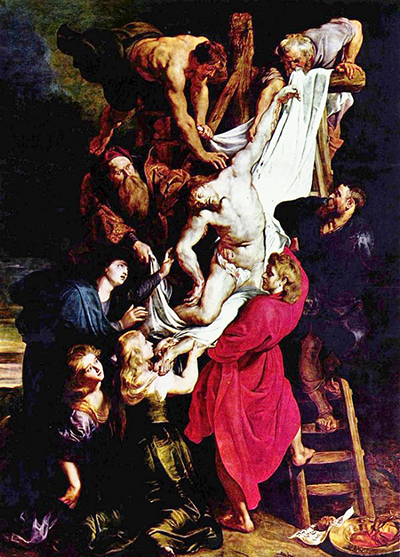
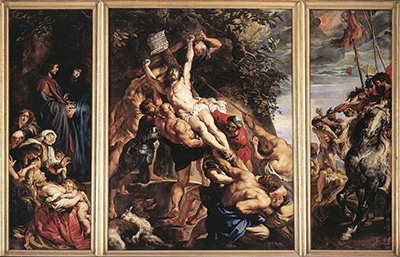
The Elevation of the Cross
1609–10The Descent from the Cross
1611–14The Garden of Love
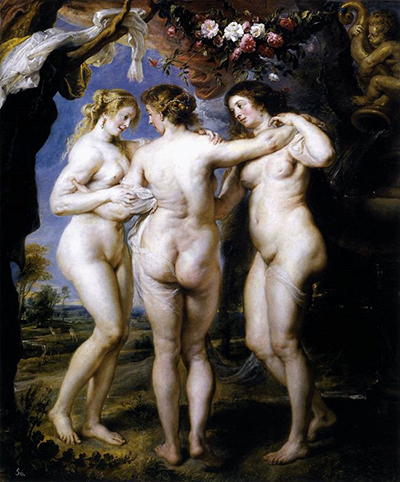
1630–35The Three Graces
1630–35Contents
- Who gathers around Christ?
- Why put the body on a carved sarcophagus?
- An early Rubens in Rome
- Why was the painting once given to Van Dyck?
- How did it enter the Borghese collection?
Who gathers around Christ?
The young man in red supports Christ near the shoulder while the dark-clothed woman behind him looks upward. An older bearded man leans in from the left. A woman at the right wipes or shields her face. A smaller figure is partly hidden behind the principal mourners. The painting therefore moves from bodily contact with the dead Christ to several responses to his death. The tight vertical grouping keeps their grief near the body rather than spreading it into a broad landscape.
A museum-linked account by Sofia Barchiesi[4] identifies the woman supporting Christ as the Virgin Mary, the young man as John the Evangelist, the older man as Joseph of Arimathea, and the woman at the far right as Mary Magdalene. It describes another pious woman as partly concealed. These traditional identifications help make the scene legible. They are readings of painted figures rather than names written into the image itself. The smaller reproduction supports the positions, gestures and relationships more securely than every facial detail.
Mary’s action is especially important. The Borghese catalogue essay by Pier Ludovico Puddu[1] observes that she supports her son’s back instead of holding him across her lap. That choice keeps Christ upright enough for the mourners, and for the viewer, to see him. It also distinguishes the composition from a conventional Pietà, in which the Virgin commonly bears his body on her knees. The youth in red takes some of the weight. Christ’s unsupported head and hanging arm still make his death unmistakable.
The Gospels provide the sequence of death, removal and burial rather than a painted inventory of the people in this particular group. John 19:38–42[5], for example, tells of Joseph of Arimathea and Nicodemus taking Jesus’s body and laying it in a nearby tomb. Rubens places a pause of communal mourning into that sequence. The picture should not be treated as a literal illustration of a single verse that names every person he included.
Why put the body on a carved sarcophagus?
The stone tomb fills much of the foreground. It is not a neutral ledge. Its carved reliefs bring ancient funerary art into a Christian scene, making the viewer look at Christ’s death against a material reminder of other deaths. Christ’s body, pale against the dark surroundings, crosses its heavy surface diagonally. The cloth drops over its edge and almost into the viewer’s space. The sarcophagus anchors the figures physically while pointing forward to burial.
The Borghese essay says the presence of a sarcophagus draws on a northern European pictorial tradition. It also offers a theological interpretation: the stone support can allude to the altar and the Eucharist, where Christ’s sacrificed body is central to Christian worship. Puddu discusses particular reliefs, including a small figure tending a fire and a ram, as possible references to the soul’s survival and remission of sins. These are the catalogue’s iconographic proposals, not labels directly supplied by Rubens. The small reproduction here does not resolve every carving, so these details are best understood through the museum’s scholarly reading.
The antique form of the sarcophagus belongs to the painting’s Roman character too. Rubens had arrived in Italy in 1600 and encountered ancient sculpture as well as Italian painting. The carved stone is a plausible place for him to bring classical form into a Christian subject. Yet a classical object in a religious picture does not cancel the mourners’ devotion. It sharpens the contrast between a permanent, hard monument and a body still being touched, held and mourned.
An early Rubens in Rome
The Borghese collection dates this painting 1601–02, during Rubens’s first stay in Rome. Its essay explains that Rudolf Oldenbourg, who first argued for Rubens’s authorship in 1916, placed it closer to 1605, during a later Roman visit. Subsequent scholars favoured the earlier date partly by comparing the proportions of its figures and the Virgin’s face with Rubens’s work for the Saint Helena Chapel in the Basilica of Santa Croce in Gerusalemme. This is a comparative dating argument, not a dated commission document. The collection’s current date should be used while the history of the disagreement remains visible.
The same catalogue sets the painting between traditions. The northern motif of Christ laid against a sarcophagus is combined with arrangements associated with Italian artists. Puddu points to Correggio for the relationship of Christ and the Virgin, and discusses possible connections with works by Giuseppe Porta, Tintoretto, Raphael and Titian. He notes an ancient relief of the Death of Meleager as a possible model for the hanging arm. These are comparisons within an art-historical argument. They help explain what Rubens may have learned in Italy; they do not prove that every named picture was in front of him when he painted this canvas.
Caravaggio is part of that Roman conversation, but the objects should be kept separate. A Galleria Borghese exhibition text[3] describes Rubens’s interest in Caravaggio’s Deposition, painted for the Vittrice Chapel at the Chiesa Nuova and now in the Vatican Museums. The exhibition showed a Rubens drawing after Caravaggio’s painting, lent from the Rijksmuseum. That drawing is not the Borghese Lamentation. The museum describes Rubens’s own canvas as an energetic early work. The two painters addressed related Passion subjects in Rome, but their canvases are distinct works made for different contexts.
In the reproduction here, light from the upper left reaches Mary’s face, Christ’s torso and parts of the mourners while the background stays dark. The red garment gives the supporting young man a strong place beside the pale body. Rubens gives emotional force to physical support: the weight of the dead man is shown through the living figures’ hands and shoulders. The light, colour and close grouping work together, so the painting is neither a detached study of anatomy nor merely a set of symbolic clues.
Why was the painting once given to Van Dyck?
The present attribution has its own history. The 1833 Borghese inventory described the picture as a Deposition by “Vendich.” An inscription on the back, apparently added in the eighteenth or nineteenth century, likewise named “Vandich.” Those spellings refer to Anthony van Dyck, Rubens’s younger Flemish contemporary. The Borghese catalogue[1] explains that several earlier writers accepted the Van Dyck attribution before Oldenbourg argued for Rubens in 1916. The museum states that Rubens’s authorship is now generally accepted.
An old label can be evidence for how a collection understood an object without being evidence that the named artist made it. The back inscription is not a signature by Van Dyck, and the inventory was written more than two centuries after the painting’s likely execution. Conversely, the modern attribution is not based simply on replacing one famous name with another: the catalogue relates the picture’s forms to Rubens’s early Roman work. Naming the old attribution is valuable because it explains why historical documents use a different artist and a different title for what is now inventory 411.
The canvas itself has also changed. The museum reports that it was enlarged at an unknown date, perhaps after leaving its original setting. Its current 180 × 136 centimetre dimensions describe the object as catalogued now, not necessarily the exact proportions Rubens first painted. The catalogue mentions a possible relationship between those original proportions and a contemporary drawing after a Descent from the Cross at the Hermitage, but a pendant painting has not been established. The original destination of the Borghese work likewise remains unknown; a proposed church setting rests partly on the view from below that the composition seems to invite.
The museum separately dates the picture’s present frame to the nineteenth century. Its large acanthus-and-acorn frieze belongs to the later display history of the canvas, so it cannot be used as evidence for the setting Rubens designed. The collection also lists several twentieth-century conservation campaigns, including work in 1914, 1936, 1947 and 1987–88. Those dates document care of the object over time; they do not establish when or why the canvas was enlarged. Distinguishing the painted composition, the later additions to its support and its later frame matters when imagining the work as an early Roman painting. We can study the object that survives without claiming that its present edges and presentation reproduce the artist’s first arrangement.
How did it enter the Borghese collection?
The museum’s 2022 catalogue entry[1] records Camillo Borghese’s acquisition after 1818, with the painting securely listed in the 1833 inventory. It rejects an older suggestion that Cardinal Scipione Borghese had received the work as a seventeenth-century gift. A possible original commission by Cardinal Peretti Montalto, who was connected with Rubens in Rome, remains a hypothesis. So does a proposed identification with a picture owned by the dealer James Durno in the 1690s. The museum’s public account does not provide an uninterrupted ownership chain back to Rubens.
Research published after that museum entry offers a more precise, but still scholarly, reconstruction. In the abstract of a 2025 peer-reviewed study[2], Flavia De Nicola reports newly examined archival documents and proposes that the painting passed from Palazzo Altieri al Gesù through Giovanni Gherardo De Rossi and Pietro Camuccini to Prince Camillo II Borghese on 1 April 1826. De Nicola presents a possible Altieri family connection as a question for patronage research, not a proved original commission. Her proposed path refines the museum’s broader post-1818 acquisition window.
The collection record says the Italian state acquired the Borghese collection in 1902. The picture is now in the Galleria Borghese, Rome, under inventory 411. Its route from early-seventeenth-century Rome to the modern museum can be described with more confidence after the nineteenth-century records than before them. Preserving that uneven evidence is part of telling the painting’s history accurately.
Rubens artworks directory
Frequently Asked Questions
No. Christ has already been taken down. The picture shows mourners gathered around his body before burial, which is why the Galleria Borghese calls it a Lamentation. The page address retains the older “deposition” wording.
The holding collection dates it 1601–02, during Rubens’s first Roman period. An earlier scholarly proposal placed it around 1605.
The current museum record gives oil on canvas, 180 × 136 centimetres. The canvas was enlarged at an unknown time, so those are its catalogued present dimensions.
The painting was historically attributed to Van Dyck, including in the 1833 inventory. The Galleria Borghese now catalogues it as Rubens, an attribution it says is generally accepted.
No original commission has been securely identified. Cardinal Peretti Montalto and an Altieri family connection have been proposed in different research contexts, but neither is documented as a settled patron for this canvas.
It is in the Galleria Borghese, Rome, inventory 411.
Discussion
Look closely at how the mourners support Christ's weight.
Share an observation about the painting or a reliable source that adds to its history.
Reader Insights
How does the sarcophagus connect burial to the scene of mourning?
Which details suggest an early Roman setting for Rubens's work?
How should the older Van Dyck attribution and newer provenance proposal be read?
Join the Conversation
Add your reading below, keeping observations specific and evidence clear.
References
- Galleria Borghese, Lamentation over the Dead Christ , inventory 411, object fields and catalogue essay by Pier Ludovico Puddu. View source
- Flavia De Nicola, “Tracing the Provenance of the Lamentation over the Dead Christ by Peter Paul Rubens at the Galleria Borghese,” transfer 4 (2025), abstract and article record. View source
- Galleria Borghese, Rubens and Caravaggio exhibition text. View source
- Sofia Barchiesi, “Lamentation of Christ,” Museum With No Frontiers, on the Borghese object and traditional figure identifications. View source
- John 19:38–42, New Revised Standard Version Updated Edition. View source