by Tom Gurney
Tom Gurney BSc (Hons) is an art history expert with over 20 years experience
Published on June 19, 2020 / Updated on October 14, 2026
Email: tomgurney1@gmail.com / Phone: +44 7429 011000
The side seen when the triptych closed
Two saints stand beneath an angel in a very tall, narrow painting. Amandus, robed as a bishop, looks down to a book. Walburga, an abbess, stands beside him with her staff. Their painting belongs to the outside of one wing of Peter Paul Rubens’s great Elevation of the Cross in Antwerp Cathedral. When the triptych was shut, Amandus and Walburga appeared with Eligius and Catherine of Alexandria on the opposite exterior wing. A visitor who sees only the central image of Christ being raised on the Cross can miss this other face of the work.
The cathedral[1] dates the altarpiece to 1609–10 and identifies its medium as oil on panel. Each completed wing measures 460 × 150 centimetres; the centre is 460 × 340 centimetres. This page concerns one finished exterior surface, not an independent small portrait panel. Its vertical format helps explain the way Rubens placed the figures: the ample bishop’s vestment, Walburga’s upward body and the angel above make a strong column that would be legible high at an altar.
The RKD’s scholarly Dulwich catalogue[3] calls the exterior saints the altarpiece’s everyday side. That phrase matters. The triptych could be opened for a feast and closed at other times. On an ordinary day, worshippers saw local protectors and exemplars instead of the dramatic Passion image inside. The outer panels were thus an active part of the commission, not a decorative cover to be ignored whenever the central picture was discussed.
At a Glance
- ArtistPeter Paul Rubens [1]
- Date1609–10 [1]
- MediumOil on panel [1]
- DimensionsWing 460 × 150 cm [1]
- CollectionCathedral of Our Lady, Antwerp [1]
- Image scopeFinished exterior wing [1]
Where this work sits in Rubens's career
Saints Amandus and Walburga
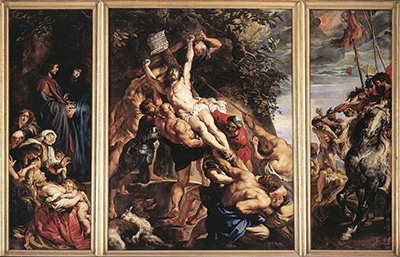
1609–10The Elevation of the Cross
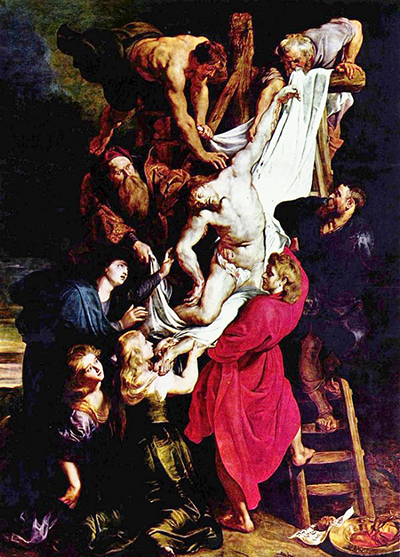
1609–10The Descent from the Cross
1611–14The Garden of Love
1630–35The Three Graces
1630–35Contents
- Who are the two saints?
- What did Rubens change while planning the wing?
- Why place local saints on a Passion altarpiece?
- A timeline for the altar and its wings
- How the saint names were checked
- The London sketch's separate collection history
Who are the two saints?
According to Dulwich Picture Gallery[2], Amandus was a seventh-century bishop who preached in Flanders; Walburga was an eighth-century abbess and missionary. The RKD catalogue adds that Amandus was styled an Apostle of Flanders. It also records an Antwerp tradition, developed centuries after Walburga’s life, that associated her with the church’s crypt. Their appearance on an Antwerp altarpiece joined widely venerated saints to the identity and history of the particular church that had commissioned it.
Rubens marks Amandus’s episcopal status through his voluminous vestment and staff. The decorated fabric dominates the lower half of the narrow field, while his bent head draws us toward the open book. Walburga stands taller and more upright at the side; her dark gown and pale face hold their place beside the bishop’s rich clothing. The angel occupies the upper zone. The figures are monumental but not isolated, because their gestures and glances make the pair readable together.
The image does not record an event from either saint’s life. Amandus is not shown preaching to a crowd, and Walburga is not shown in a particular miracle. Their attributes and bearing make them present as patrons. This is an important difference from the narrative interior, where figures strain to lift Christ’s Cross. The exterior asks viewers to recognise a lasting religious community; the interior turns to the concentrated violence and suffering of the Crucifixion.
The church formerly stood at the place known as the Burcht or Borcht. The RKD catalogue[3] identifies St Walburga’s church as the original setting and names these saints as the finished wings’ subjects. The current location is Antwerp’s Cathedral of Our Lady. The painting’s meaning is clearer when both places are named: it was conceived for one altar and later moved to another building, where it is now encountered with Rubens’s Descent from the Cross.
The original building also explains the unusually large scale. The Antwerp church heritage account[4] says St Walburga’s choir stood high above the nave floor and at a considerable distance from the congregation. The completed triptych was therefore about 4.6 metres tall and 6.4 metres wide when open. The heritage account says Rubens worked on the monumental painting in the spacious choir because his earlier workshop could not accommodate it. Amandus’s broad robes and Walburga’s upright silhouette were designed to be understood at that architectural scale, not merely at the size of a book illustration.
The former altar had still more components. Antwerp’s 2004 heritage account[5] describes a crowning structure with God the Father, angels and a pelican, and three small scenes beneath the triptych. One lower scene showed Walburga’s miracle at sea. The RKD[3] identifies a related surviving panel in Leipzig. These were parts of the old altar arrangement, not painted details in the tall exterior wing shown on this page. The altar was remade in the eighteenth century, so the cathedral installation no longer reproduces everything a seventeenth-century visitor saw.
What did Rubens change while planning the wing?
A small oil sketch of this pair survives in Dulwich Picture Gallery[2], inventory DPG040a. It is also on panel, but measures only 66.6 × 25 centimetres. Its narrow proportions anticipate the finished wing; its scale and purpose are entirely different. The Dulwich painting allowed Rubens and a patron to see an arrangement before it was made at an architectural size. The reproduction here shows the finished cathedral wing, not the London sketch.
The finished design changes the relationship between the angel and saints. Dulwich[2] says the preparatory sketches show angels bringing haloes to the female saints, whereas in the Antwerp work the angels concentrate on the male bishops’ mitres. The RKD catalogue also notes a changed face for Amandus and a different arrangement of the angel. The shift is visible as a compositional decision, but its exact cause is not documented. Dulwich suggests a patron may have wanted the alteration. That possibility should remain a possibility, rather than become a story of a recorded instruction to Rubens.
The RKD[3] lists a further drawing of Amandus and Walburga at the Courtauld in London, made after the small modello and before the finished panel in its reconstruction. Its attribution to Rubens is marked as qualified in the catalogue’s related-work list. In that drawing Amandus is bare-headed, closer to his appearance in the altarpiece. This is useful evidence for a developing design, not grounds to assume that every surviving line is certainly Rubens’s hand or that the drawing fixes an exact day when the angel changed.
The Dulwich pair have their own later history. The RKD records that its two narrow oil sketches were once joined and separated around the mid-twentieth century. This explains why they are discussed together in the gallery’s catalogue. That history belongs to the sketches, not to the cathedral wings. The latter remain two exterior faces of the large triptych. The difference between drawings, small oil modelli and the monumental commission is central to the page: each survives, but each tells us something different about the finished result.
Why place local saints on a Passion altarpiece?
Four saints could bind the universal story of Christ’s death to a city and church. Amandus and Eligius were associated with bringing Christianity to the region; Walburga was the church’s namesake; Catherine had a related local tradition. The RKD study[3] suggests that the finished emphasis on the male missionary bishops may have better served the patrons’ Counter-Reformation priorities. That is an art historian’s proposal about the change from the sketches, not a written programme supplied by the commissioners.
The exterior also made the viewer move between two kinds of time. A saint at full height, book or staff in hand, offers an example of durable religious identity. The opened panels draw the eye to one terrible moment in the Passion. Such a change of view was built into a hinged altarpiece’s use. The saints were not an afterthought added to a famous central scene; their presence gave the closed work a purposeful image for repeated everyday viewing.
The Antwerp church heritage account[4] traces the work’s original setting at St Walburga’s and its move to the cathedral in 1816, as the former church faced demolition. Today the open central scene is usually the image reproduced in books and online. The completed Amandus–Walburga wing deserves attention as another face of the same object, distinct from the small London preparation.
A timeline for the altar and its wings
The RKD's scholarly catalogue gives a useful sequence beneath the broad 1609–10 date. A contract for the St Walburga altar was signed in June 1610. The interior scene was installed that year while the exterior wings still had to be finished. The catalogue suggests completion in the winter of 1610 and records a final payment in 1613. These are stages of one commission, not alternative dates for four different works. The finished Amandus–Walburga panel must be read with the production of the whole hinged altar in mind.
The RKD says Rubens's bill was 2,600 guilders, apparently paid largely by Cornelis van der Geest, an Antwerp merchant and collector connected to the church. The financial reconstruction is more specific than the familiar phrase “painted for St Walburga's,” but it has limits. A possible payer is not automatically the person who chose every attribute or directed the change from halo to mitre. Dulwich says a patron may have suggested the alteration; it does not cite an instruction that would identify who did so. The strongest documented difference remains visible between the small sketch and the cathedral painting.
The original high altar changed after the seventeenth century. The RKD records a new altar in 1733 and the dispersal of components from the old setting, including the lower paintings and figures above the triptych. The surviving Ship Miracle of St Walburga predella is now in Leipzig, separate from the cathedral wing. It narrates the saint's protection of seafarers rather than duplicating her standing figure. That distinction shows how the first altar could repeat a saint across formats for different purposes: a monumental presence on the closed wing and a specific miracle beneath. The Dulwich sketches were not themselves predella panels, and the Leipzig painting was not cut out of this tall wing.
How the saint names were checked
The RKD catalogue history records several older, conflicting identifications of the four figures. Some nineteenth-century Dulwich catalogues called them Ambrose, Gregory, Catherine and Theresa. Other scholars recognised some saints but exchanged Amandus and Eligius between the two wings. The catalogue says Burchard correctly named the two pairs in 1947. Thus the current identification is the result of comparing attributes, local history and related altar scenes, rather than simply perpetuating an unbroken label from Rubens's lifetime.
For this wing, Amandus's bishop's dress, staff and open book agree with the image of a missionary prelate. Walburga's abbess's dress and staff suit the female saint for whom the church was named. The RKD recounts a fifteenth-century Antwerp legend in which Walburga stayed for a time in the church's crypt while travelling to Germany. That is a local tradition recorded centuries after her life, not a modern historical proof of the visit. Its value here is to show why a community might regard her as closely connected to this specific site.
The saint names also gain force from the lower altar subjects. A Walburga sea miracle appeared below the wing on her side, while a Catherine scene corresponded to the other pair. Once the altar was dispersed, later viewers had less immediate context for distinguishing the saints, making catalogue errors easier to understand. The present cathedral setting preserves the exterior figures but not the whole first arrangement. Naming Amandus and Walburga correctly restores part of the original relationship among painting, church and local devotion.
The London sketch's separate collection history
The Dulwich panel DPG040a is currently displayed with its companion sketch DPG040b. Dulwich lists both under the Bourgeois Bequest of 1811. The RKD notes that the two narrow paintings were once joined and separated around 1947. Their joined state in a collection and their paired function as models for two exterior wings are related facts, but they do not mean Rubens painted one continuous cathedral-sized sheet and cut it later. The cathedral wings and the Dulwich modelli were different objects from the start.
This distinction helps interpret the Courtauld Amandus–Walburga drawing listed by the RKD. The catalogue places it in a proposed sequence between the Dulwich sketch and the completed wing, while marking its attribution as uncertain. It can illuminate a possible design change without providing a fixed day-by-day studio diary. That is a stronger use of the drawing than treating a qualified line study as unquestioned proof of Rubens's exact final intention. The surviving preparation, finished panel and later collection records each answer a different question.
Rubens artworks directory
Frequently Asked Questions
Yes. They occupy one exterior wing of Rubens’s Antwerp triptych. Their companions Eligius and Catherine appear on the other exterior wing when the work is closed.
No. Dulwich holds a small preparatory oil sketch, DPG040a. The image on this page shows the monumental finished cathedral wing.
Rubens revised their action: the finished angels focus on the bishops’ mitres rather than the female saints’ haloes. The records reviewed do not document who requested the change.
It is part of The Elevation of the Cross in the Cathedral of Our Lady, Antwerp. Each completed wing is 460 × 150 centimetres.
Discussion
Look closely at the two saints on this exterior wing.
Share an observation grounded in the painting or its sources.
Reader Insights
How did closing the triptych change what visitors saw?
Which details differ between the Dulwich sketch and finished wing?
How does this wing relate to the opposite pair of saints?
Join the Conversation
Add your reading below, keeping observations specific and evidence clear.
References
- Antwerp Cathedral, Rubens, The Elevation of the Cross. View source
- Dulwich Picture Gallery, Rubens, Saints Amandus and Walburga , DPG040a. View source
- RKD Studies, Dulwich catalogue of the paired sketches and Antwerp exterior wings. View source
- Antwerp church heritage, history of Rubens’s Elevation of the Cross. View source
- Antwerp 2004 heritage account of the original St Walburga altar and predella. View source