by Tom Gurney
Tom Gurney BSc (Hons) is an art history expert with over 20 years experience
Published on June 19, 2020 / Updated on October 14, 2026
Email: tomgurney1@gmail.com / Phone: +44 7429 011000
A vast scene around one act
Jesus stands in the water with his head bowed. John the Baptist leans toward him from the bank, raising an arm for the baptism. Around the two men, other figures gather, undress, watch and turn toward the event. A tree divides the broad canvas, and light opens above the central encounter. The picture is crowded and physically active, yet the movement leads back to the quiet meeting of Jesus and John.
This is Peter Paul Rubens's The Baptism of Christ in the Royal Museum of Fine Arts Antwerp[1], known as the KMSKA. The museum dates it 1604–05, catalogues it as oil on canvas, and gives its dimensions as 411 × 675 centimetres, inventory 707. The exceptional width is part of the painting's identity. A reproduction on a screen can make it look like a conventional landscape image; in person, the canvas extends more than six and a half metres across. Its scale becomes easier to understand when its original setting is restored in thought.
Rubens painted it for a chapel in Mantua, not for the Antwerp museum where it is now kept. The Flemish Art Collection's chronology[3] records that Duke Vincenzo I Gonzaga commissioned three large canvases for the main chapel of the Jesuit church of Santissima Trinità in 1604–05. The Baptism occupied a choir sidewall. The commission came during Rubens's years in Italy, when he worked in Gonzaga service and studied works in Rome and elsewhere. It was an early opportunity to organise a religious subject at monumental size for an architectural space.
At a Glance
- ArtistPeter Paul Rubens [1]
- Date1604–05 [1]
- MediumOil on canvas [1]
- Dimensions411 × 675 cm [1]
- CollectionRoyal Museum of Fine Arts Antwerp, inventory 707 [1]
Where this work sits in Rubens's career
The Baptism of Christ
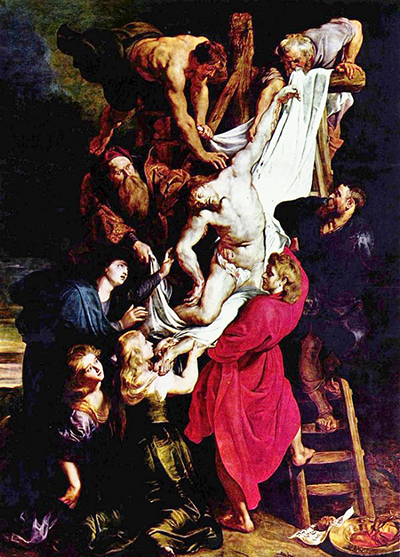
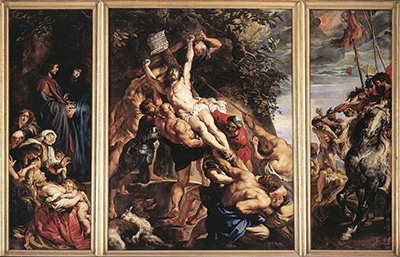
1604–05The Elevation of the Cross
1609–10The Descent from the Cross
1611–14The Garden of Love
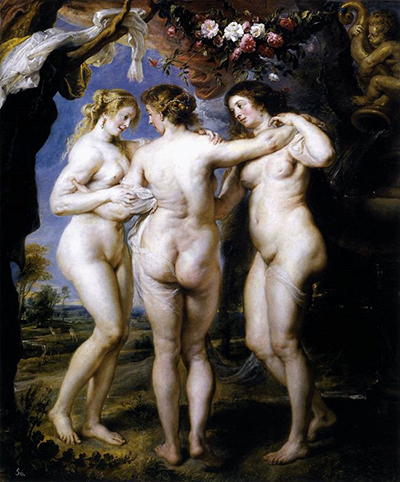
1630–35The Three Graces
1630–35Contents
- What happens in the biblical scene?
- How does Rubens use the crowd?
- A drawing that helps explain the design
- What were the other Mantua paintings?
- How did the Baptism reach Antwerp?
What happens in the biblical scene?
In Matthew 3:13–17[7], Jesus comes to the Jordan to be baptised by John. John initially objects, but Jesus asks him to proceed. After the baptism, the heavens open, God's Spirit descends like a dove, and a voice from heaven identifies Jesus as the beloved Son. Rubens's canvas takes this event as its centre. The biblical narrative supplies Jesus, John, the water and the descent from above; the many surrounding bodies are part of the painter's larger visual invention.
The event has a natural place in a church dedicated to the Holy Trinity. The Son is present bodily in the river, the Gospel tells of the Spirit's descent, and the Father's voice comes from heaven. Art historian Larry Silver, reviewing Fiona Healy's Corpus Rubenianum study of the Mantua paintings[5], notes that The Baptism and the companion Transfiguration were two Gospel scenes that made the Trinity manifest beside the central Gonzaga canvas. This relationship is more precise than calling the three paintings a generic set of altarpieces. They were made to speak to one another across a chapel.
In the reproduction on this page, the meeting of John and Jesus lies left of the tree, with a great deal of human activity continuing to the right. The tree and the water help the eye hold the event in place without freezing the rest of the picture. Standing in the original chapel, viewers would have seen the painting from an angle rather than head-on from the centre of a modern museum wall. Healy's research, as described in Silver's review, argues that Rubens took account of the oblique view from the chapel's left side. The unusual breadth and the distribution of groups are therefore worth considering in relation to the building for which the canvas was designed.
How does Rubens use the crowd?
The people around Jesus and John do more than fill spare space. Figures on the right turn, bend and overlap. On the left, other onlookers frame the river. These bodies give the small act of pouring water a public setting and a physical scale. Their poses also let Rubens show the human figure from several angles across the enormous surface. The picture is not a single front-facing devotional icon; it is an event that seems to extend past the two central participants.
The contrast between motion and stillness is especially strong in the black-and-white reproduction here. The gestures of the surrounding figures are legible, but the reduced reproduction cannot communicate the painting's full colour or paint surface. It is better to describe what this image supports: bowed head, extended baptising arm, water, tree, clouds and a broad assembly. Exact identities for the peripheral figures should not be guessed from the small file. The KMSKA's concise English record supplies no complete list of who they are.
Rubens's Italian experience provides context for that interest in bodies and movement. The Flemish Art Collection notes his study of Michelangelo, Raphael, Titian, Tintoretto and Caravaggio during his time in Italy. Those names describe a broad artistic education, not a source assignment for every figure here. Silver's account of Healy's specialist study makes narrower proposals: the painting's nudes recall Michelangelo and antique sculpture, while some disrobing figures have been related to Raphael's treatment of the Baptism in the Vatican Loggia. Such comparisons help identify the visual problems Rubens was solving. They are scholarly arguments about models, not proof that a particular model was copied in front of the canvas.
The scene's size also changes how small gestures work. In a painting more than four metres high, the turn of John's body must read from a distance; Jesus's bent head must remain distinct from the crowd; the tree must divide a huge field without splitting it into unrelated pictures. The relatively intimate narrative act is embedded in a display of figures sized for a chapel wall. That tension between one sacramental action and many expressive bodies is one reason the Mantua canvas should be read within its architecture.
A drawing that helps explain the design
The Louvre[4] holds a large drawing of the same subject, INV 20187, recto, which its catalogue explicitly calls a study for the Baptism formerly in the Mantua choir and now in Antwerp. The drawing measures 47.7 × 76.6 centimetres and is made with black chalk and stump on grey-beige paper. It is squared in black chalk: a grid was applied to help carry the design into a larger format. The Louvre's identification ties this particular sheet to the KMSKA canvas; it is a separate preparatory object, not a reduced version of the finished painting to be substituted for its image.
Silver's review of Healy's Corpus Rubenianum account describes the Louvre sheet as a very large, detailed modello and reports technical evidence of changes made when Rubens executed the painting. Healy's dating argument, as conveyed in the review, suggests that the commission may have begun before Rubens's 1603–04 Spanish journey, with revisions after his return. That is a research proposal about the sequence of design and execution. It does not replace the KMSKA's 1604–05 date for the completed canvas or prove the precise day on which Rubens began his first sketch.
The drawing is useful because it shows that a huge composition did not simply emerge by enlarging a casual note. Rubens worked out relationships on paper large enough to map figures across the width, then adapted them in paint. Squaring provides concrete evidence of a transfer process. Changes during execution show that transfer was not mechanical: a measured design could still be revised on the monumental canvas.
The Louvre's record[4] also points to a separate study of Christ alone at the École nationale supérieure des Beaux-Arts in Paris. That reference suggests more than one stage or scale of thinking about the subject: the figure of Jesus could be worked out individually, while the Louvre's large sheet arranged the wider event. The Louvre entry does not give the Paris study's measurements or full history, so those should not be supplied from guesswork. Nor should the existence of another study be taken to mean that every figure on the finished canvas had its own surviving sheet. What is documented is a linked design drawing for the overall composition and a further related study of its central figure.
The Louvre sheet has its own later history. Its catalogue traces it through the collector Everhard Jabach and says it entered the French royal drawing collection in 1671. The old Jabach inventory attributed it to Van Dyck; the Louvre now catalogues it as Rubens. That history belongs to the drawing, not to the Antwerp painting. It is a reminder to keep preparatory sheets, finished canvases and later collection labels separate even when they concern the same composition.
Its old mount preserves unusually tangible evidence for that drawing's early collecting history. The Louvre lists Jabach's gold-bordered mount, an inventory number written on the back and a later 1690 checking mark as signs that connect today's sheet to the royal acquisition. Those marks are valuable because the present attribution is not merely a modern name substituted for an old one: the physical paper and mount can be followed through historical cataloguing. The corrected Rubens attribution tells us about a preparatory drawing's authorship; the mounted object's seventeenth-century French history remains separate from the six-metre canvas that was still part of the Mantua commission.
What were the other Mantua paintings?
The central work for Santissima Trinità showed the Gonzaga family adoring the Holy Trinity. The other sidewall painting was The Transfiguration, now in the Musée des Beaux-Arts de Nancy[6]. These works formed one chapel programme under Gonzaga patronage. A person seeing only the Antwerp Baptism today encounters a survivor from that larger setting, not the complete decorative scheme.
The three works have different later histories. Silver's review explains that the central Gonzaga painting was cut apart and is known through fragments and reconstruction, while the two great side canvases were dispersed to different cities. The Nancy museum identifies its Transfiguration as a youthful Rubens of 1604–05. These facts give scale to what happened to the original ensemble; they do not mean that the central work was once part of the Antwerp canvas or that the Nancy painting can be used to fill missing pieces of it.
The theological connection is as important as the practical one. In the Baptism, a voice and the Spirit's descent accompany the Son at the Jordan. In the Transfiguration, the Gospel subject likewise sets Jesus within a revelation from above. At the chapel's centre, the Gonzagas were shown in prayer before the Trinity. The paintings therefore joined sacred narrative to dynastic devotion. The exact visual effect of their original installation requires architectural and historical reconstruction; a present museum arrangement cannot recreate it automatically.
How did the Baptism reach Antwerp?
The KMSKA's Dutch acquisition history[2] says the painting was sold by Italian dealers after the French capture of Mantua in 1797. Its subsequent trail passes through sales and private collections in London, Paris, Ghent and Lille. The museum records that it was shown at the Louvre in 1858, where Eugène Delacroix saw it on 14 September. It later entered the Antwerp collection of Joseph de Bom, who bequeathed it to the museum in 1877. These entries make the journey from a Mantuan chapel to a Belgian public museum traceable rather than suggesting that the canvas remained in its original church until the KMSKA acquired it.
The record does not make every intermediate name equally certain: one dealer is listed with a question mark. A concise account should retain that caution and not turn uncertain ownership into a firm chain. What is secure in the museum's account is the painting's original Mantua context, its later market and collection history, and its eventual bequest to Antwerp.
The current museum title and number are practical anchors for identifying the work. The vast oil canvas is KMSKA inventory 707. A viewer searching for “Rubens Baptism of Christ” may also find the Louvre drawing, later prints or paintings of the same Gospel event. None of those objects takes the Antwerp canvas's dimensions or its place in the Gonzaga chapel.
Rubens artworks directory
Frequently Asked Questions
The KMSKA dates the completed canvas 1604–05, during Rubens's Italian years.
It measures 411 × 675 centimetres. The width is 675 centimetres, making it a very broad choir-wall painting.
The Flemish Art Collection records Vincenzo I Gonzaga as commissioner of the three paintings for Santissima Trinità in Mantua.
No. The Louvre holds a separate chalk study connected to the canvas now in Antwerp. Its grid helped Rubens carry the design toward a larger work.
It is in the Royal Museum of Fine Arts Antwerp, inventory 707.
Discussion
Look closely at the meeting of Jesus and John within the broad crowd.
Share an observation about the painting or a reliable source that adds to its history.
Reader Insights
How does the tree hold the wide composition together?
What does the Louvre's gridded drawing reveal about preparation?
How might a sidewall view in the Mantua chapel change the scene?
Join the Conversation
Add your reading below, keeping observations specific and evidence clear.
References
- Royal Museum of Fine Arts Antwerp, The Baptism of Christ , object fields. View source
- KMSKA, Dutch object page with acquisition and provenance history. View source
- Flemish Art Collection, Peter Paul Rubens chronology, 1604–05 Mantua commission. View source
- Louvre, Rubens, Baptême du Christ , preparatory drawing INV 20187. View source
- Larry Silver's review of Fiona Healy, Corpus Rubenianum Ludwig Burchard , IV/1, on the Mantua programme and Louvre modello. View source
- Musée des Beaux-Arts de Nancy, the separate Transfiguration. View source
- Matthew 3:13–17, New Revised Standard Version Updated Edition. View source