


 by Tom Gurney
Tom Gurney BSc (Hons) is an art history expert with over 20 years experience
Published on June 19, 2020 / Updated on August 9, 2026
Email: tomgurney1@gmail.com / Phone: +44 7429 011000
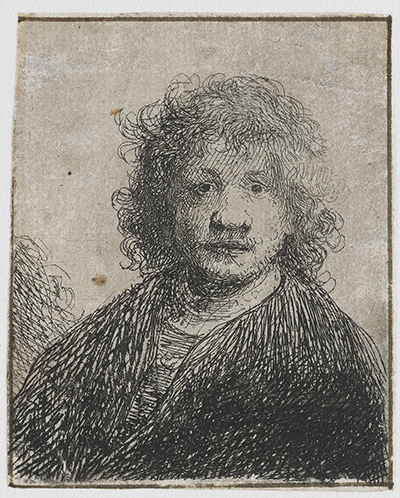
Self Portrait with a Broad Nose dates from around 1628 and during this period Rembrandt was producing a good number of self portrait etchings. This particular one was directly face on with the viewer, revealing the full features of the artist's face.
This piece would have been completed when the artist was in his early twenties and still searching for a style to call his own. Technically, he could already work to an impressive level, though. His local town had accepted his brilliance and already promoted his work outside these boundaries, though his work still varied in quality and some of his earlier paintings were actually a little crude and more aimed at what would sell in local markets. Etching provided an alternative tool which immediately grabbed his attention. Over time he would incorporate different techniques into his etchings and take this medium much further than it had previously been - typically artists had seen etchings as a way of reproducing existing paintings, but he saw it as a separate option which should be treated as such.
Strokes can be seen so clearly within etchings, see how he creates his clothes with very strong, parallel lines which together provide planes of colour which produce the collar, arms and main part of his jacket. Light comes in from our right hand side, creating a shadow across the left side of his face, which he implements with more intense, closer lines. His hair is curly and loose, with Rembrandt typically leaving the outer part of his hair to be much freer. He was not someone who always took too much care for his appearance, which is strange considering how often he appears within self portrait paintings and etchings - with around 90 produced across the full length of his career.
The etching can be found at the Rijksmuseum, Amsterdam, Netherlands, which is probably the best place to see this artist's original work. His masterpiece, Night Watch, is a part of their impressive collection, but you can also enjoy a large number of other artists here as well. They have, over time, built up a diverse collection of Dutch art as well as tackling all of the different mediums in which Rembrandt himself was involved, with many paintings and drawings also out on display all year round. Amsterdam remains one of the finest art cities in the world, and has plenty to pack a full week's holiday for those looking to visit.
Object Notes and Research Context
Rijksmuseum records Self-portrait with a Broad Nose as a c.1628 etching printed with plate tone and a pen border. It belongs to the early group in which Rembrandt uses his face not as polished likeness but as a flexible testing surface for light, shadow and character.
The broad nose and heavy shadow make the head almost anti-ideal. That is the point: Rembrandt learned to make ordinary or even awkward features visually compelling, a skill that later underpinned his tronies, apostles, old men and late portraits. The print connects to Rembrandt's self-portraits and to Bust of a Young Jew as a later tronie comparison.
The title sounds blunt, but it records exactly the kind of observation Rembrandt was testing. The enlarged nose, shadowed cheek and reduced setting make the face less ideal and more memorable. That anti-classical quality later became part of Rembrandt's appeal: he could make ordinary features carry presence without smoothing them into academic beauty.
This print should also be connected to the idea of the mirror as a studio tool. Rembrandt did not need a commissioned sitter to practise facial structure, lighting or expression; his own face was always available. The page can therefore link to the broader self-portrait hub without claiming that every early etched head was intended as a finished statement of identity.
Further Rembrandt Context
This shorter legacy page remains part of the Rembrandt archive. For fuller context, use the refreshed Rembrandt pages below, which explain the artist's biography, media, technique, attribution issues and major works in greater depth.
For secure object data, attribution and collection history, compare Self-Portrait with a Broad Nose with the relevant museum or catalogue record before treating older page text as final.
 Rembrandt.jpg)
Discussion
What feels most useful when looking at Self-Portrait with a Broad Nose: the subject, the handling of light, the medium, the attribution history, or its place within Rembrandt's wider etching or print output?
Reader Insights
Set this page beside the refreshed Rembrandt hubs before relying on older summaries alone.
Rembrandt pages often need museum records, catalogue history and attribution caution, especially where older sources use broader labels.
Which detail would you most want clarified next: date, medium, collection, attribution, subject, condition or comparison with another Rembrandt work?
Join the Conversation
Have a thought or observation about Self-Portrait with a Broad Nose? Share it below. Thoughtful responses may be added as the Rembrandt archive continues to be reviewed.