


 by Tom Gurney
Tom Gurney BSc (Hons) is an art history expert with over 20 years experience
Published on June 19, 2020 / Updated on August 9, 2026
Email: tomgurney1@gmail.com / Phone: +44 7429 011000
Christ Presented to the People: Introduction
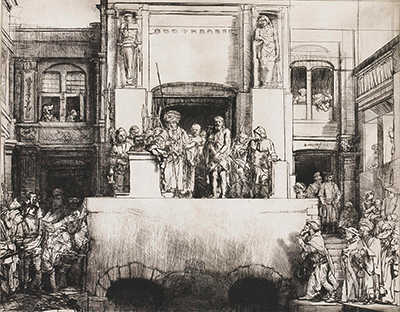
Christ Presented to the People is one of Rembrandt's most powerful works in drypoint. It shows the Ecce Homo subject: Christ brought before the people by Roman authority, exposed to a crowd whose looking becomes part of the drama. The scene is biblical, but Rembrandt makes it feel like a civic event, a judgement staged in architecture, bodies, balconies, steps and open space.
The work was made in 1655 and belongs to Rembrandt's mature printmaking. It is not a painting, and it should not be treated as a single fixed object. It is a print made from a copper plate and known through surviving impressions. Those impressions belong to different states, or stages in the plate's development. A second-state impression, a third-state impression and an eighth-state impression are related to one plate history, but they are not the same visual object.
This matters from the first facts. The Metropolitan Museum of Art records one impression as drypoint on Japanese paper, second state of eight, with a plate size of 38.4 x 44.9 cm. The Rijksmuseum records another impression as drypoint with plate tone, printed on Japanese paper, 387 x 454 mm, and identifies it as a third state of eight through Bartsch, Hollstein and New Hollstein references. The Met also records an eighth-state impression. Together these records show a work that has to be read through subject, technique and change.
What remains constant is the force of the scene. Christ stands before the people, but Rembrandt is just as interested in the people before Christ. The crowd judges, watches, gathers, hesitates and disperses. The architecture turns the episode into a stage, yet the emotional pressure is not theatrical in a simple sense. The print asks what happens when innocence, authority and collective judgement occupy the same space.
Contents
- Introduction
- The Ecce Homo Subject
- A Large Drypoint
- Plate, State and Impression
- The Stage of Judgement
- Christ and the Crowd
- Architecture, Empty Space and Revision
- Japanese Paper and Plate Tone
- Among Rembrandt's Prints
- How to Look at Christ Presented to the People
Annotated Details from Christ Presented to the People
These annotated details examine the print's public theatre: Christ before the crowd, architectural staging, spectatorship and the drypoint drama of light and shadow.
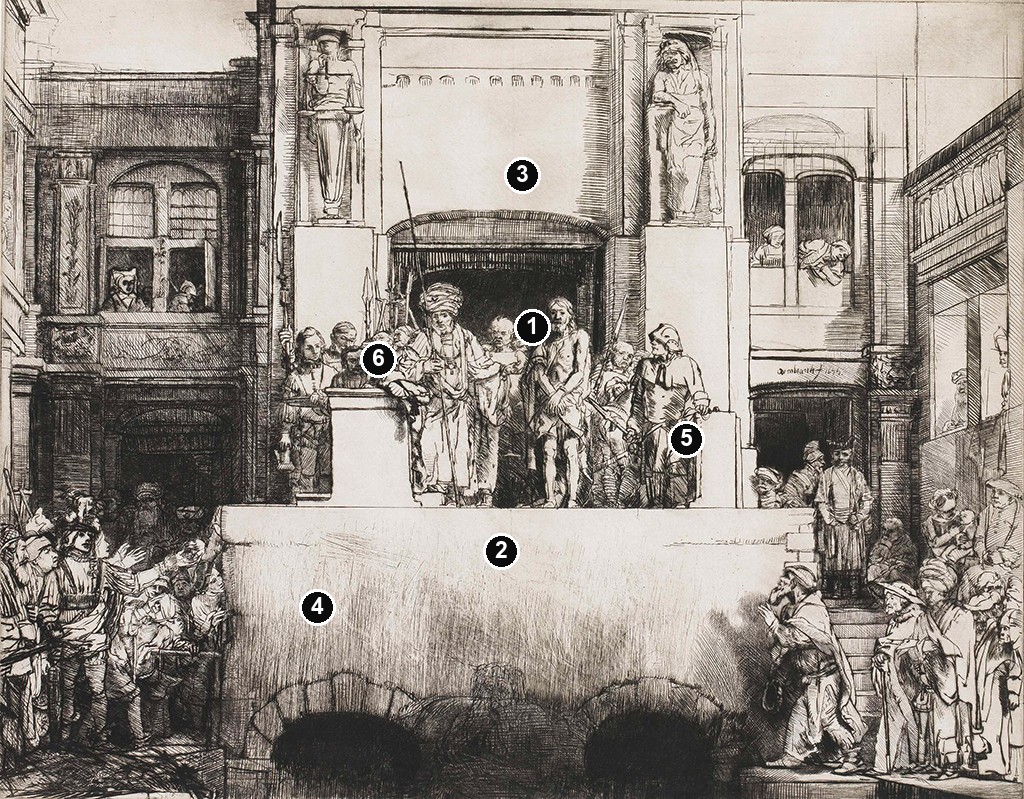
Details from CHRIST PRESENTED TO THE PEOPLE
Close looking shows how Rembrandt turns the Ecce Homo subject into an image of judgement, public pressure and printmaking force.
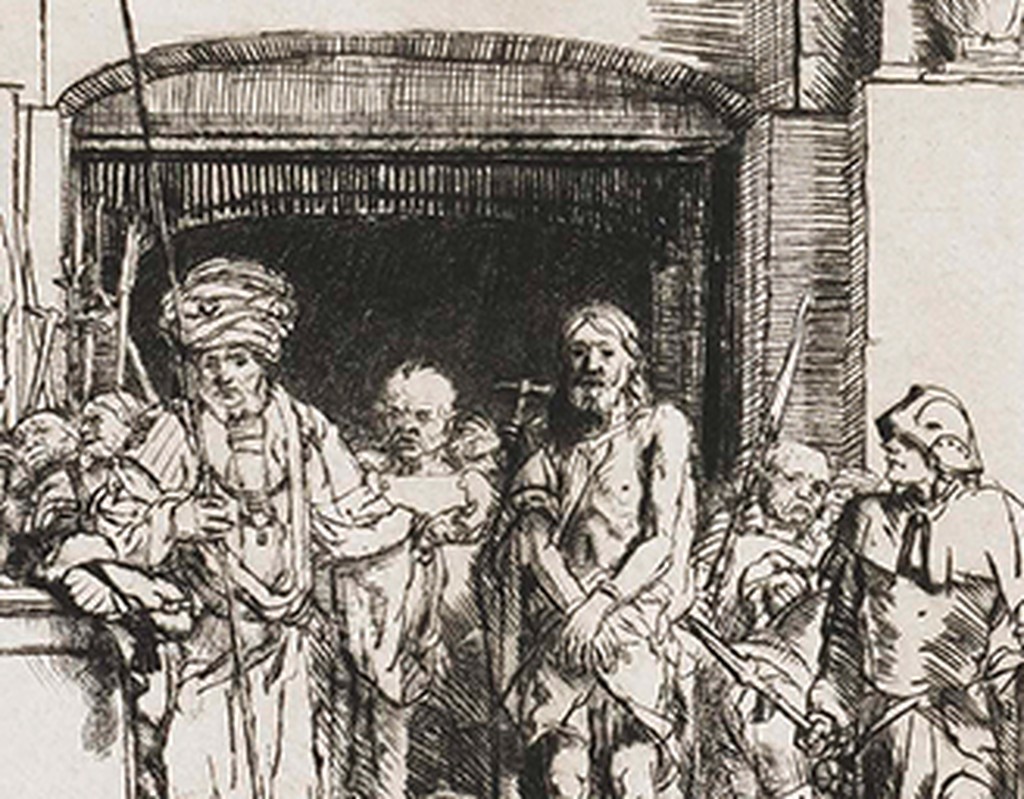
Christ and Pilate
The central presentation concentrates the subject's moral pressure. Christ is shown before a public that must decide how to see him.
The crowd below
The crowd changes the scene from private suffering into public judgement. Individual responses become a collective force.
Architecture as stage
The architecture creates a raised theatre for the event. It gives the print scale and public authority.
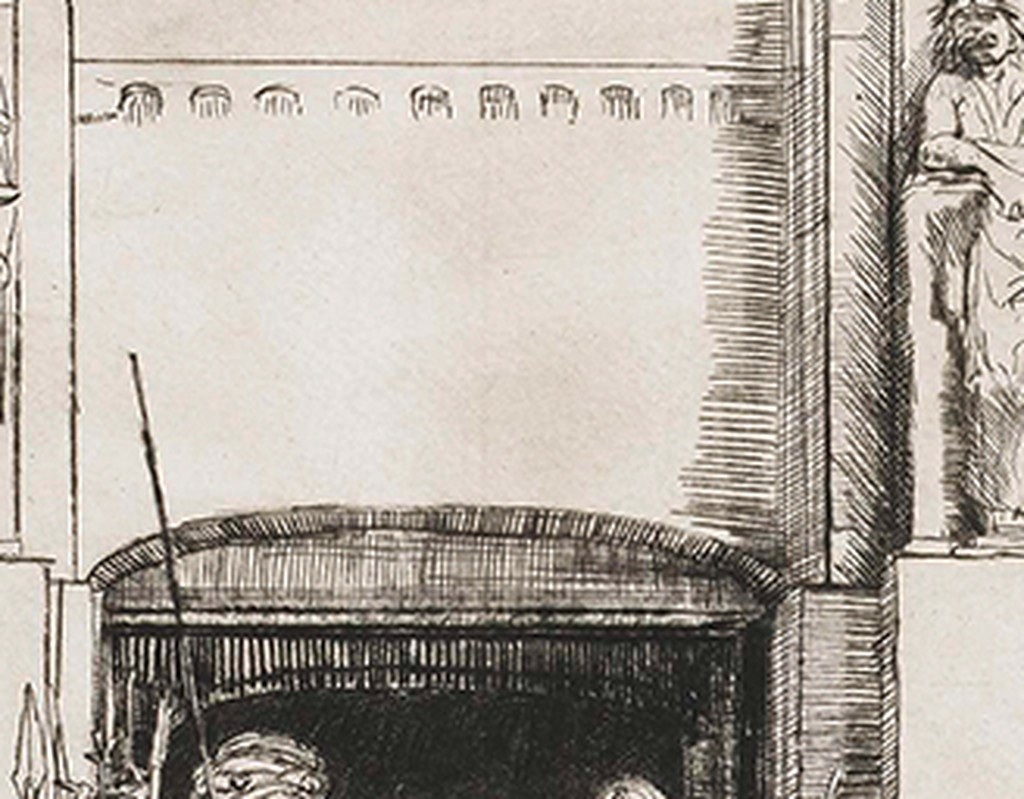
Shadowed foreground
Dark foreground passages hold the viewer back from the central platform. Rembrandt uses shadow to make viewing morally uneasy.
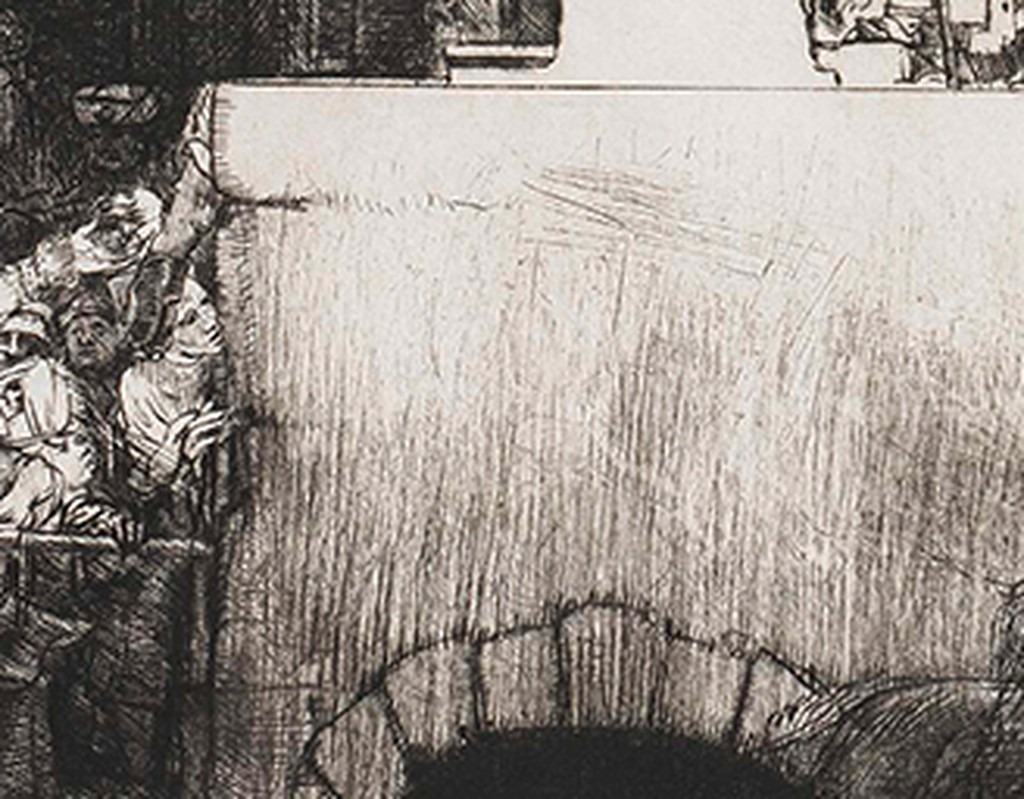
Drypoint emphasis
Dense line and drypoint burr can make some impressions feel especially rich. The print's material state affects how the scene is read.
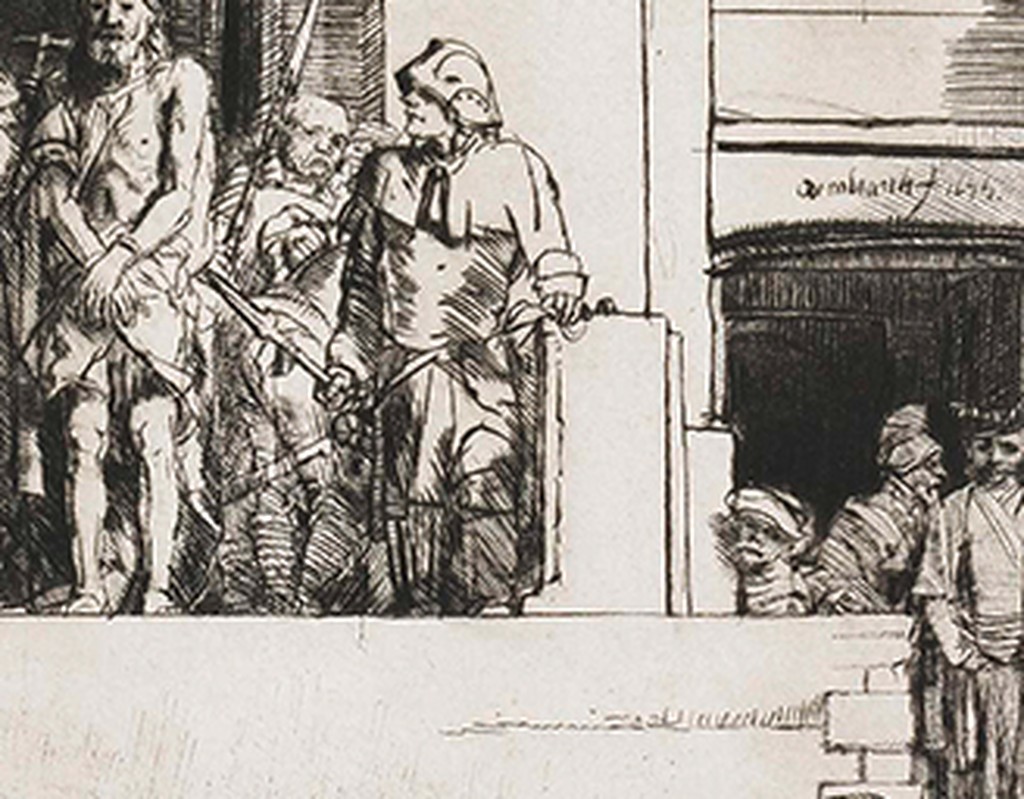
Open space and pressure
The open central space separates rulers, crowd and victim. It gives the scene room while increasing its emotional distance.
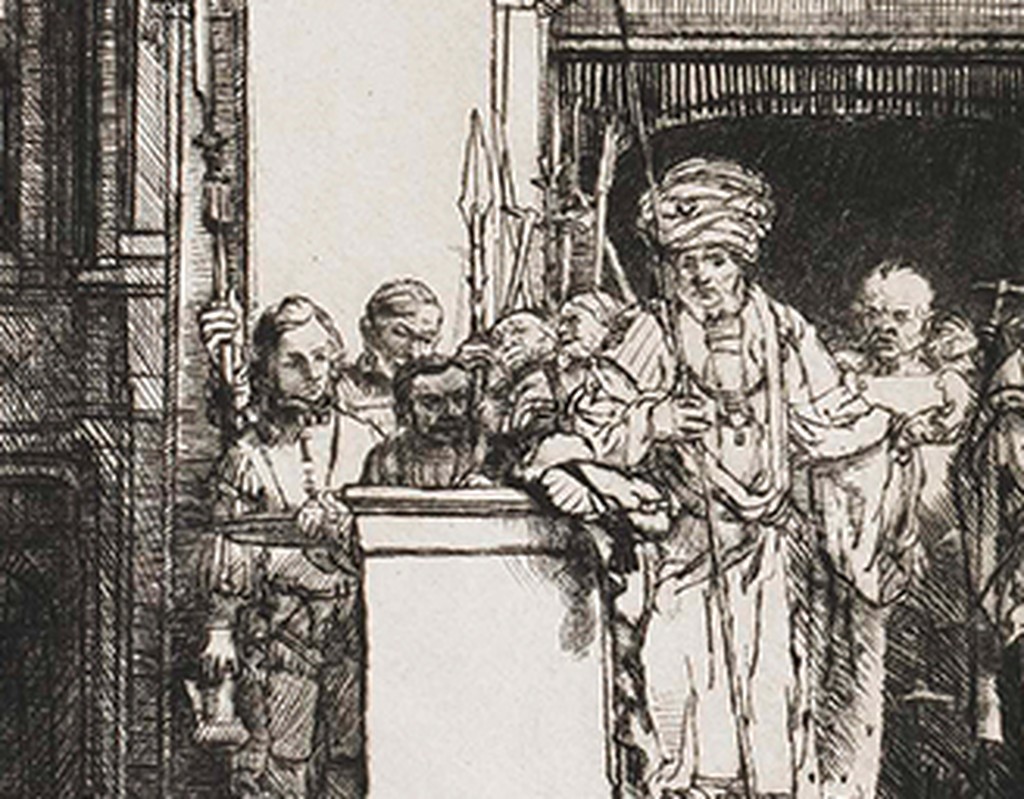
The Ecce Homo Subject
Ecce Homo means "Behold the man." In Christian tradition, the phrase refers to Pilate presenting Christ to the people before the Crucifixion. It is a subject about exposure: Christ is made visible to a crowd, and the crowd is invited to respond. The scene carries accusation, pressure, spectacle and moral failure.
Rembrandt did not invent the subject, but he found a distinctive way to make it work in print. Many earlier Ecce Homo images concentrate on the figure of Christ, Pilate and the hostile crowd. Rembrandt keeps those elements, but expands the social space around them. He makes the event a public judgement carried by architecture and spectatorship.
The viewer looks across a broad setting. The main figures stand on an elevated platform. Around them are gathered observers, guards, dignitaries and onlookers. Below and around the platform, groups gather in different densities. Some figures are close to the action; others seem held back by space, steps or shadow. The composition gives the crowd a physical body.
That crowd is not only an audience. It is part of the subject. The people are being shown Christ, but they also reveal themselves by how they look. Some press near. Some turn aside. Some appear absorbed by the event; others seem caught in the social machinery of the moment. Rembrandt's print is therefore not only about Christ's suffering. It is about human response under pressure.
The title Christ Presented to the People is helpful because it names the action plainly. Ecce Homo is helpful because it carries the theological phrase. Used together, the titles show the double nature of the work: a biblical episode and a meditation on seeing, judging and exposing.
A Large Drypoint
The scale of Christ Presented to the People is striking for a drypoint. The Met gives its second-state plate size as 38.4 x 44.9 cm, while the Rijksmuseum gives its impression as 387 x 454 mm. For a medium often associated with intimate line and fragile burr, this is a large, ambitious scene.
Drypoint is made by scratching directly into the copper plate with a hard point. The tool raises a slight ridge of metal along the line, called burr. When the plate is inked and wiped, ink can catch in that burr and print as a rich, soft, dark line. The effect can be beautiful, but it is also fragile. Burr wears down as impressions are printed, which is one reason state and impression details matter so much in Rembrandt's printmaking.
The Rijksmuseum emphasizes that Rembrandt created this large scene entirely in drypoint by scratching directly into the copperplate. That fact helps explain the work's visual intensity. The line is not simply neat description. It has pressure, drag and material life. Architecture, figures and shadows are all held by marks cut into metal by hand.
Drypoint also suits the subject. Ecce Homo is a scene of exposure and pressure. The crowd is not calmly described from a distance; it feels scratched into being. The platform, the steps and the surrounding architecture stabilize the scene, but the drypoint line keeps the surface alive. The work feels both monumental and restless.
Because the line depends on the plate and its condition, no impression should be treated as a neutral duplicate. A sheet with fresh burr can feel richer and darker than one printed after wear. A later state may include changes to the plate that alter the spatial and emotional structure. In this print, technique and meaning cannot be separated.
Plate, State and Impression
The most important words for this page are plate, state and impression.
The plate is the copper surface Rembrandt worked. The state is a stage in the development of that plate. If the plate was changed in visible ways, impressions printed after those changes belong to a different state. An impression is an individual sheet printed from the plate.
Christ Presented to the People is especially useful because major museum records identify different states. The Met's object 41.1.34 is a second state of eight. The Rijksmuseum's RP-P-1975-1 is recorded through catalogue references as a third state of eight. The Met's object 41.1.36 is an eighth state of eight. These are not three separate inventions, but neither are they interchangeable views of one unchanged thing.
This distinction protects the viewer from a common mistake. A museum record may name Japanese paper, plate tone, dimensions, state and object number. Those facts belong to that record's sheet. They should not be automatically applied to every other impression of the print.
The state history also affects interpretation. Earlier and later states can change how the architecture, figures and open space behave. A later state can make the scene feel more compressed, more severe or differently balanced. A viewer comparing impressions is not just comparing image quality. The viewer is reading a plate's life.
For Rembrandt, that life is part of the art. He did not use printmaking merely to repeat a design. He could return to a plate, alter passages, strengthen or remove details, and change how the final sheet worked. Christ Presented to the People makes that process visible on a grand scale.
The Stage of Judgement
The scene is built like a stage, but not like a simple theatre set. Architecture gives the event public force. A raised platform holds the central figures. Windows, walls, steps and open spaces organize who can see and who is seen. The print turns judgement into a spatial problem.
Christ is presented before the people, yet the eye does not remain fixed only on him. Rembrandt draws attention outward, into the social arrangement around the event. The architecture asks the viewer to notice distance: the distance between ruler and crowd, between elevated authority and ordinary onlookers, between the exposed body of Christ and the larger civic structure that surrounds him.
The platform is crucial. It raises the central action, making it visible across the composition. It also creates separation. Christ and the officials do not stand among the crowd as equals. They are displayed above it. The staging gives the scene its violence without needing exaggerated motion. Exposure itself becomes the action.
The crowd below and around the platform changes the emotional temperature. It is not a single roaring mass. It is broken into groups, pauses and pockets of attention. Some figures gather close; others stand apart. The open spaces are as important as the groups, because they make the event feel suspended. The viewer senses a decision forming across the whole scene.
This is one reason the print feels so modern in its psychology. Rembrandt does not need to show every face clearly. He makes the structure of collective judgement visible. The crowd becomes a body with many eyes, many distances and no single conscience.
Christ and the Crowd
Christ is the focus of the subject, but Rembrandt does not isolate him from the human world around him. The meaning depends on relation. Christ is shown to the people; the people are shown to the viewer.
In many religious images, the sacred figure is set apart by light, halo or compositional dominance. Rembrandt's print is more unsettled. Christ is central to the event, but the surrounding architecture and crowd share the burden of meaning. The eye has to move between spiritual innocence and social response.
That movement matters. The subject is not only "What happens to Christ?" It is also "What do people do when Christ is placed before them?" The crowd's watching becomes a moral action. Looking is not neutral. To look and judge, to look and remain passive, to look and join the pressure of the crowd: these are all part of the print's drama.
Rembrandt's broader religious art often works this way. The Hundred Guilder Print gathers the sick, the poor, children, questioners and the wealthy around Christ. Christ Presented to the People gathers another kind of crowd: not a crowd seeking mercy, but a crowd drawn into judgement. The two prints belong near each other because both make Christ's presence visible through human response.
There is also a difference. The Hundred Guilder Print is full of approach. People come toward Christ with need, argument or hope. Christ Presented to the People is full of exposure. Christ is placed before the people, and the people must reveal what kind of crowd they are. One print is organized around healing and teaching; the other around accusation and spectacle.
That contrast gives Christ Presented to the People its severity. It is not only a devotional image. It is a study of how public authority and collective will can make suffering visible while refusing to understand it.
Architecture, Empty Space and Revision
The architecture in Christ Presented to the People does more than provide a setting. It controls the moral geometry of the scene.
Walls and openings frame the figures. The platform creates a visible hierarchy. Steps and open ground direct movement. The broad horizontal format lets Rembrandt spread the event across a civic space rather than crowding everything into a narrow devotional scene. The result is a print that feels architectural before it feels anecdotal.
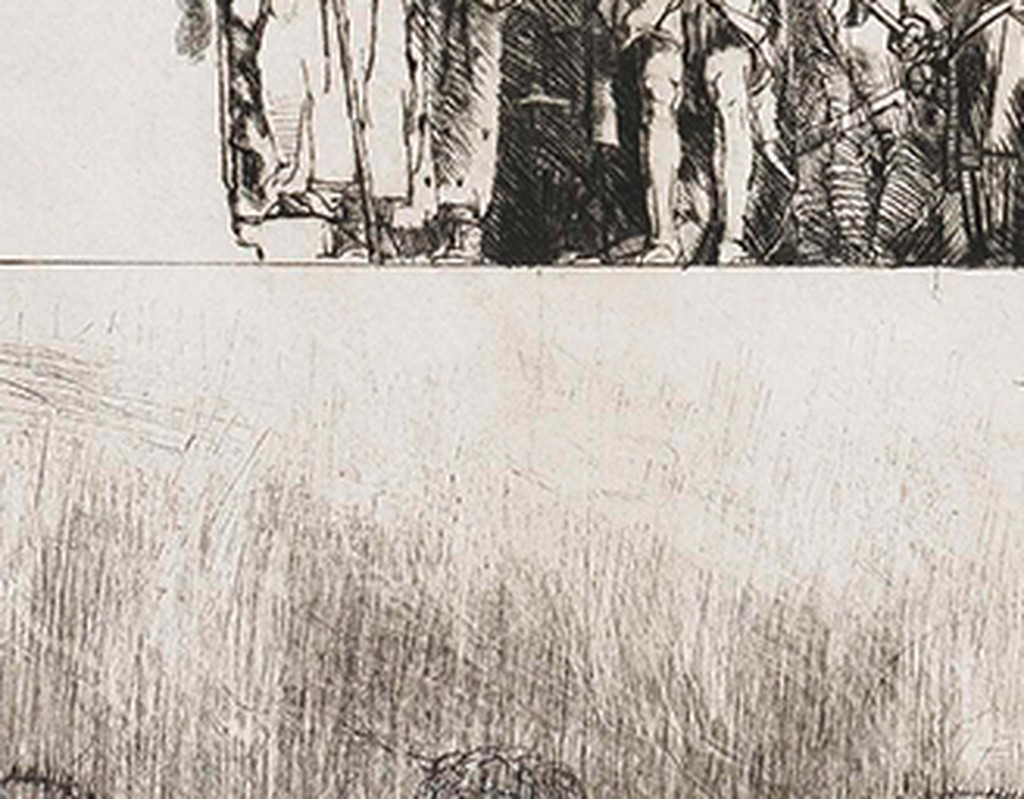
Empty space is especially important. In a crowded subject, emptiness can carry pressure. Open ground below the platform prevents the lower part of the composition from becoming mere decorative filling. It creates distance, silence and delay. The crowd does not simply surge forward. The scene holds its breath.
Because the plate changed across states, these spatial relations are part of the print's history. A later state can alter the weight of the foreground, the density of figures or the balance between architecture and crowd. This is why a state comparison would not be a technical footnote. It would change how the subject is read.
Rembrandt's willingness to revise is central to his printmaking. He could use a copper plate almost as a field of thought, returning to it as the image demanded. In painting, revision may hide beneath the final surface unless technical study reveals it. In printmaking, states can preserve stages of change more publicly. They let viewers see that an image had a history of decisions.
Christ Presented to the People is therefore a work about judgement and a record of judgement. Rembrandt judged the plate, altered it, tested the distribution of line and space, and allowed the image to change. The subject is a crowd evaluating Christ; the object is an artist evaluating how that crowd should be made visible.
Japanese Paper and Plate Tone
Both the Met second-state record and the Rijksmuseum record identify Japanese paper. The Rijksmuseum also records plate tone. These details are not decorative collecting facts. They affect how a viewer encounters the print.
Japanese paper can bring warmth, softness and absorbency to an impression. It can make line and tone feel different from the effect on a cooler or more familiar European laid paper. That does not mean every impression of Christ Presented to the People has the same paper character. It means that these particular museum records give us important examples of how Rembrandt's print could live on a chosen support.
Plate tone is ink left on the surface of the plate after wiping. Instead of appearing only in the incised lines, ink can remain as a thin film that gives the sheet atmosphere, warmth or shadow. In a scene like Ecce Homo, plate tone can change the emotional weight of the space. It can make architecture feel less bare, shadows more continuous and the crowd more enveloped in the event.
These material choices connect Christ Presented to the People with Rembrandt's wider print practice. The Hundred Guilder Print is also known through important impressions on Japanese paper. The Three Trees depends strongly on tone, paper and the handling of weather through printed marks. Rembrandt's prints ask viewers to look not only at subject, but at how a sheet has been made.
For an ordinary reader, the lesson is simple: read the object record before making a claim. If the record says second state, Japanese paper and a particular plate size, that is information about the sheet being described. Another impression may share the same title and subject while differing in state, paper, tone, dimensions or condition.
This precision makes the work more vivid. It gives the viewer permission to compare. One impression may seem warmer, another starker, another more worked or more severe. The differences are not distractions from Rembrandt. They are part of the way Rembrandt's printmaking survives.
Among Rembrandt's Prints
Christ Presented to the People belongs with Rembrandt's greatest prints. It is not as tender as The Hundred Guilder Print and not as atmospheric in the landscape sense as The Three Trees, but it is equally important for understanding how ambitious Rembrandt could be on a copper plate.
The Hundred Guilder Print shows Christ among people who seek healing, teaching and blessing. It uses etching, drypoint and engraving or burin work to gather many Gospel episodes around a luminous centre. Christ Presented to the People is more severe. It uses drypoint on a large scale to stage a crowd in judgement. Together the two prints show how Rembrandt could think about Christ not as an isolated holy figure, but as a presence revealed by human response.
The Three Trees offers a different comparison. It is a landscape print, but it helps explain Rembrandt's command of tone, pressure and open paper. In that work, weather becomes visible through line and plate tone. In Christ Presented to the People, the atmosphere is social and moral rather than meteorological. The same printmaker's intelligence is at work: how much can be done with marks, tone, blankness and pressure?
The work also belongs near Rembrandt's style-and-technique story. It shows drypoint pushed beyond small-scale intimacy into a large scene. It shows state practice as an artistic tool. It shows that paper and plate tone can affect interpretation. And it shows why Rembrandt's printed works should never be reduced to black-and-white versions of paintings.
Printmaking gave Rembrandt a special kind of freedom. A plate could be changed. Impressions could circulate. Different papers could create different effects. Collectors could compare states and sheets. Christ Presented to the People uses that freedom to make a biblical judgement scene that is itself open to judgement by later viewers.
How to Look at Christ Presented to the People
Begin with the title. Christ is being presented, but to whom? The people are not a passive label. They are a presence across the image. Let your eye move between the central platform and the surrounding crowd.
Then notice the architecture. The raised stage, walls, windows, steps and open ground organize the event. Ask who is elevated, who is below, who is near and who is kept at a distance. Rembrandt uses space to make authority visible.
Look at Christ without rushing past the crowd. His exposure is the subject, but the crowd's response gives the exposure meaning. The people gathered around the scene create the pressure under which the event happens.
Next, read the print as a print. Which impression are you seeing? Which state? Does the record mention Japanese paper, plate tone, dimensions or object number? If another museum record describes a different state, compare carefully. The difference may alter how the whole scene feels.
Finally, look for what drypoint does. The line has a scratched, worked energy because it comes from direct pressure on copper. Richer passages, darker accents and softer darks belong to the material life of the plate. The print's moral force is inseparable from that physical pressure.
Frequently Asked Questions About Christ Presented to the People
No. It is a print made from a copper plate and known through surviving impressions. Major museum records describe different states and impressions, so the work should not be treated as one fixed painting-like object.
Ecce Homo means "Behold the man." It refers to Pilate presenting Christ to the people. In Rembrandt's print, the phrase becomes a scene about looking, authority and collective judgement.
The work is a drypoint. In drypoint, the artist scratches directly into the copper plate. The Rijksmuseum records its impression as drypoint with plate tone, printed on Japanese paper.
The museum records used for this page identify the work through an eight-state history. The Met records a second-state impression and an eighth-state impression, while the Rijksmuseum identifies its impression as a third state of eight.
States are stages in the plate's development. Because the plate changed, impressions from different states can alter the appearance and force of the composition. A statement about one state should not be applied automatically to another.
Japanese paper is named in both the Met second-state record and the Rijksmuseum record. It can affect warmth, softness and surface character, making the material sheet part of how the print is experienced.
Discussion
What feels most important in Christ Presented to the People: Rembrandt's light, the figure's expression, the material surface, the historical source, or the way the work sits beside his other paintings and prints?
Reader Insights
Begin with one detail in Christ Presented to the People, then move outward to light, gesture, surface and the surrounding space.
Connect the work to Rembrandt's biography, workshop, medium and the museum record rather than reading it as an isolated image.
Which detail changes the interpretation most once you know the date, subject, attribution history or present collection?
Join the Conversation
Have a thought or observation about Christ Presented to the People? Share it below. Thoughtful responses may be added to this section as the Rembrandt pages develop.
References
- Rijksmuseum, Christ Presented to the People (Ecce Homo), object RP-P-1975-1: https://www.rijksmuseum.nl/en/collection/object/Christ-Presented-to-the-People-Ecce-Homo--cb3a54189cf597446fe26248d57bb9d2
- The Metropolitan Museum of Art, Christ Presented to the People, second state, object 41.1.34: https://www.metmuseum.org/art/collection/search/343142
- The Metropolitan Museum of Art, Christ Presented to the People, eighth state, object 41.1.36: https://www.metmuseum.org/art/collection/search/356476
- The Metropolitan Museum of Art, Christ Presented to the People, fourth state: https://www.metmuseum.org/art/collection/search/360048
- Museum Rembrandthuis, collection overview: https://www.rembrandthuis.nl/en/find-out-more/collection/
- Museum Rembrandthuis, science portal: https://www.rembrandthuis.nl/en/find-out-more/science-portal/
- Museum Boijmans Van Beuningen, Rembrandt etchings from the museum's collection: https://www.boijmans.nl/en/collection/research/rembrandt-etchings-from-the-museum-s-collection
- CODART, The Watermark Identification in Rembrandt's Etchings (WIRE) Project: https://www.codart.nl/feature/curators-project/the-watermark-identification-in-rembrandts-etchings-wire-project/
 Rembrandt.jpg)