


 by Tom Gurney
Tom Gurney BSc (Hons) is an art history expert with over 20 years experience
Published on June 19, 2020 / Updated on August 9, 2026
Email: tomgurney1@gmail.com / Phone: +44 7429 011000
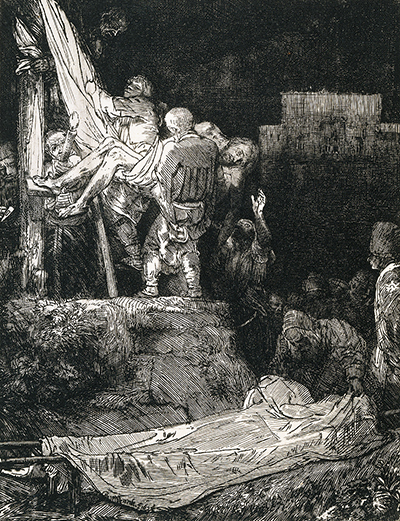
Rembrandt produced many depictions of Descent from the Cross during his career, with this piece being a combination of etching and drypoint from 1652.
In this version we find most content placed around the left hand side, with lighting carefully used in order to lead one's eyes towards the key elements. Down below are a number of other figures, mainly disguised by darkness and just serving more of a supportive role to the overall artwork. A makeshift stretcher can be found beneath Christ, made from just a couple of narrow poles and some bedsheets. Considerable care is being taken to comfort and support Christ after his arduous ordeal. Several people are directly involved in taking him down from the cross, eager to protect this important individual who would become such an icon within religion and also European art as well. Etching is a medium which does not use great varieties of colour, but rather just reflects the areas in which a stroke has been left. This means an etcher must be precise and innovative in how they create form within each artwork.
We can compare the painting by Rembrandt of the same name, which was completed in 1634, nearly two decades earlier. In that piece we find a good variety of tones, albeit within a restricted palette. This brings everything to life, and provides a greater feeling of drama. The Descent from the Cross, the painting, remains one of Rembrandt's most famous and respected artworks, though there is also much to appreciate from this etched version. Additionally, the two together help to remind us of Rembrandt's versatility across different mediums, somehow being able to achieve great success with different specialist tools. There was a good number of prints produced from this etching, with the latter ones being on Japanese paper, as Rembrandt started to work with new materials for the first time. In the centuries that followed, Japan would establish itself as perhaps the leader in printmaking, gifting us the likes of Hiroshige and Hokusai.
The torchlight refered to in the title of this artwork is held up by a figure behind Christ, with the light peering through. This very obvious addition signals to the viewer where this abundance of light has arrived from, and also tells us more about the situation in which this rescue is being carried out. Several commentators have also suggested that a view of the city can be seen behind these figures but it is hard to tell from the images that we have. In terms of the tale itself, it would have been perfectly understandable and unsurprising to find this addition within the background, but most images indicate only a area of detail in the dark sky which cannot be conclusively identified without perhaps seeing some of these prints in person. Currently, they are spread around some of the most famous galleries and museums in the world, so at least many will be able to study them in person. Rembrandt also produced an etched version in the triangular format titled Descent from the Cross (Second Plate).
Object Notes and Research Context
Rijksmuseum records date The Descent from the Cross by Torchlight to 1654 and describe it as etching and drypoint, with light surface tone on Japanese paper in one key impression. The torch is the only light source in the scene, so the subject becomes a technical demonstration of how Rembrandt could make darkness active rather than empty.
The small late print contrasts with the much larger 1633 Descent from the Cross, Second Plate. Instead of public scale and princely reproduction, the torchlight version is quiet, compressed and nocturnal. It belongs with late religious prints where the drama comes from a small pool of light and the disappearance of surrounding detail.
Further Rembrandt Context
This shorter legacy page remains part of the Rembrandt archive. For fuller context, use the refreshed Rembrandt pages below, which explain the artist's biography, media, technique, attribution issues and major works in greater depth.
For secure object data, attribution and collection history, compare Descent from the Cross by Torchlight with the relevant museum or catalogue record before treating older page text as final.
 Rembrandt.jpg)
Discussion
What feels most useful when looking at Descent from the Cross by Torchlight: the subject, the handling of light, the medium, the attribution history, or its place within Rembrandt's wider etching or print output?
Reader Insights
Set this page beside the refreshed Rembrandt hubs before relying on older summaries alone.
Rembrandt pages often need museum records, catalogue history and attribution caution, especially where older sources use broader labels.
Which detail would you most want clarified next: date, medium, collection, attribution, subject, condition or comparison with another Rembrandt work?
Join the Conversation
Have a thought or observation about Descent from the Cross by Torchlight? Share it below. Thoughtful responses may be added as the Rembrandt archive continues to be reviewed.