


 by Tom Gurney
Tom Gurney BSc (Hons) is an art history expert with over 20 years experience
Published on June 19, 2020 / Updated on August 9, 2026
Email: tomgurney1@gmail.com / Phone: +44 7429 011000
The Descent from the Cross by Rembrandt: Introduction
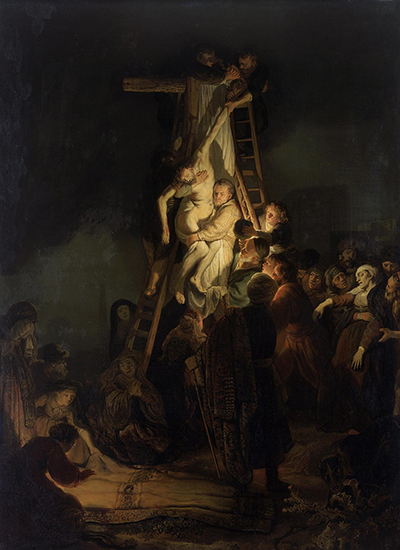
Rembrandt's The Descent from the Cross is a small painting with the emotional pressure of a much larger scene. It shows the moment after the Crucifixion when Christ's body is lowered from the cross and received by those who must carry the dead weight of grief as well as the body itself.
The work discussed here is the 1632/33 painting in the Bayerische Staatsgemaeldesammlungen, Alte Pinakothek, Munich. The museum's English collection route gives the title as The Deposition, while the German title is Kreuzabnahme Christi. Both titles point to the same Passion subject: Christ is no longer dying on the cross, but being taken down from it.
That object boundary matters. Rembrandt and artists around him returned to the Descent subject in prints, variants, copies and workshop-related works. There is a large 1633 print connected with the Munich painting, a later 1654 etching called Descent from the Cross by Torchlight, and other paintings associated with Rembrandt's workshop or with later copying. This article keeps its focus on the Munich painting and treats those related works only as context.
Contents
- Introduction
- Object Facts
- The Passion Subject
- Light, Body and Grief
- A Young Rembrandt and a Courtly Commission
- Rubens and the Problem of Comparison
- The 1633 Print After the Painting
- The 1654 Torchlight Etching
- Versions, Workshop Works and Copies
- How to Look at the Painting
Object Facts
The Alte Pinakothek painting is by Rembrandt Harmensz. van Rijn and is dated 1632/33. The Pinakothek record identifies the support as Cedrela odorata wood and gives the dimensions as 89.4 x 65.2 cm. Its inventory number is 395, and the acquisition line records that it entered the collection in 1806 from the Duesseldorf Gallery.
The painting belongs to the so-called Passion Cycle made for Frederik Hendrik of Orange, stadholder of the United Provinces. The Pinakothek explains that the six paintings do not form a complete, closed narrative cycle. Important events are missing, and the works were not created in Gospel sequence. Rembrandt completed the Descent in 1633, while the Adoration of the Shepherds was not finished until 1646.
Those facts are useful because they prevent two easy mistakes. The painting is not simply an isolated devotional image, even though it can be read devotionally. It was part of a prestigious courtly commission. At the same time, the Passion Cycle should not be imagined as a perfectly planned set that calmly moved from one biblical scene to the next. It grew over time, unevenly, through commission, delay and changing circumstances.
The Passion Subject
The Descent from the Cross comes after the Crucifixion and before the Entombment. In narrative terms, it is a practical act: the dead body must be removed, held, wrapped and carried. In emotional terms, it is one of the most difficult moments in the Passion because grief has to become action.
Rembrandt was drawn to precisely that kind of moment. He often avoids the instant that is easiest to summarize. Instead of showing only public spectacle, he looks for the human burden inside the event. Here the sacred subject depends on hands, cloth, balance and bodies leaning into one another.
The cross rises above the group, but the eye is pulled down toward Christ's body and the people who support it. The scene is not an abstract symbol of sorrow. It is a problem of weight. A dead body does not arrange itself gracefully. It slips, hangs, bends and has to be held. The shroud is not only a sign of burial; it is a tool. The ladder is not only a compositional device; it is part of the labor of taking Christ down.
That practical seriousness is one reason the painting feels so intense. Rembrandt makes the viewer sense that holy grief has entered the hands and backs of ordinary people. Mourning is not only an expression on a face. It is a task performed in darkness.
Light, Body and Grief
The painting's drama depends on light. Rembrandt does not spread illumination evenly across the scene. He concentrates attention where the body, shroud and helpers meet. The darkness around them is not empty. It presses against the action, making the illuminated forms feel vulnerable.
Christ's body is the central pale form. Its exposure is stark, but not theatrical in the simple sense. Rembrandt is less interested in heroic anatomy than in lowered weight and human dependence. The body that was raised on the cross is now being received by other bodies. The physical change from elevation to descent becomes the emotional center of the painting.
The surrounding figures matter because they show different forms of grief and responsibility. Some are close enough to touch. Others watch from the edge of shadow. The Virgin, mourners and assisting men do not all perform the same emotion. Rembrandt's strength lies in the variety: one figure may act, another may support, another may recoil inward, another may look on in stunned silence.
The darkness also changes the temperature of the scene. It removes ordinary daylight and leaves a concentrated zone of action. In that darkness, the body and the shroud become almost painfully visible. The painting asks the viewer to look at grief as something material: cloth pulled taut, limbs lowered, hands reaching, knees bent, faces half-seen.
A Young Rembrandt and a Courtly Commission
The commission for Frederik Hendrik was a major opportunity for the young Rembrandt. In the early 1630s he was moving from Leiden into the larger Amsterdam world of portraiture, history painting and ambitious patrons. A Passion series for the stadholder placed him in a courtly context and tested his ability to handle a subject with high artistic expectations.
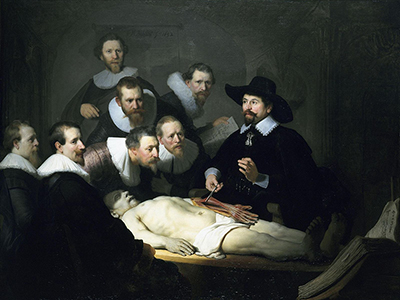
The Descent from the Cross therefore belongs near The Anatomy Lesson of Dr Nicolaes Tulp in Rembrandt's early Amsterdam story. Both works show a young artist working at a higher level of public ambition. The Anatomy Lesson transforms a professional group portrait into a drama of looking and knowledge. The Descent turns a sacred subject into a drama of weight, darkness and human feeling.
The Passion paintings also connect to Rembrandt's rare surviving words. In a letter of 12 January 1639 to Constantijn Huygens, Rembrandt explained delays in Passion paintings by referring to his search for the greatest and most natural movement or emotion in the figures. That letter was written about later works in the commission, not specifically about the Munich Descent. Even so, it helps name a concern visible across the series: Rembrandt wanted bodies to carry feeling naturally, not merely to illustrate a story.
In the Descent, that concern appears through physical action. The figures do not only show grief; they move under it. The scene becomes moving because the body has to be handled with care. Rembrandt's religious drama is grounded in human labor.
Rubens and the Problem of Comparison
Any Descent from the Cross by a seventeenth-century northern artist invites comparison with Peter Paul Rubens, whose great Antwerp altarpiece was one of the most powerful treatments of the subject. The comparison should be used carefully. Rubens and Rembrandt are not doing the same thing at different sizes, and Rembrandt's painting should not be reduced to a Dutch reply to a Flemish model.
The National Gallery of Art's catalogue discussion of a later Descent from the Cross associated with the Rembrandt workshop notes the importance of Rubens for Rembrandt's earlier Descent compositions. It states that Rembrandt's 1633 Passion-series painting was based on Lucas Vorsterman's reproductive engraving after Rubens's Antwerp altarpiece. That source makes the comparison legitimate, but it also makes the route clear: Rembrandt was working through print culture as well as through the larger prestige of Rubens's composition.
The differences are just as important as the connection. Rubens builds a grand altarpiece drama around sweeping bodies, muscular energy and a crowded orchestration of movement. Rembrandt's Munich painting is smaller, darker and more compressed. Its force comes less from outward magnificence than from concentrated grief. Rubens makes the descent grand. Rembrandt makes it heavy.
That contrast helps explain why the Munich painting matters. Rembrandt did not avoid a famous model because it was intimidating. He absorbed the subject into his own language of light, body and inward feeling.
The 1633 Print After the Painting
The Princeton University Art Museum holds a large 1633 print titled Descent from the Cross. Its record is especially useful because it states that the print reproduces Rembrandt's dramatic Descent from the Cross in the Alte Pinakothek, Munich. It also identifies the print as etching and engraving, made with the help of Jan van Vliet, with the plate and sheet trimmed to plate measuring 52.7 x 41 cm.
This print is related to the Munich painting, but it is not the same kind of object. It translated the composition into a printed image that could circulate more widely than the painting. It also belongs to Rembrandt's early reputation as a printmaker and to the broader seventeenth-century practice of reproducing, adapting and distributing painted inventions through prints.
The Princeton record notes that viewers familiar with Rembrandt's self-portraits would have recognized his likeness in the scowling figure on the ladder who helps lower Christ's body. That observation is valuable, but it should be kept in proportion. The public article on the painting does not need to turn the whole interpretation into a self-portrait claim. The more important point is that the Passion scene became a place where artistic identity, devotion and physical action could meet.
The print also clarifies why version discipline matters. A printed Descent may preserve or adapt details from the painting, but it has its own medium, scale, inscription, collector history and catalogue references. A responsible reading keeps print facts and painting facts separate.
The 1654 Torchlight Etching
Rembrandt returned to the Descent subject more than two decades later in Descent from the Cross by Torchlight. The Metropolitan Museum of Art records its impression as a 1654 etching and drypoint, first of four states. The Met explains that the work belongs to a series of Passion scenes Rembrandt created around 1654 and that it focuses on the quiet activity of taking down and burying Christ's body.
That later etching is a beautiful comparison because it shows how Rembrandt could rethink the subject rather than repeat it. In the Met's description, only the bottom portion of the cross is visible, Christ's head is partly shadowed, and figures carrying him are brought into bright light. The subject has moved toward silence and nocturnal concentration.
But again, it is not the Munich painting. The 1654 work is a print, made through etching and drypoint, and it belongs to a later moment in Rembrandt's career. Its first state, later states and print-specific qualities should be discussed on print or etching pages, not treated as object facts for the Alte Pinakothek panel.
Seen beside the Munich painting, the torchlight etching shows continuity and change. Rembrandt remained interested in the descent as an act of care after violence. Yet the later print reduces the scene, darkens the surrounding world and makes the handling of the body feel even more hushed.
Versions, Workshop Works and Copies
The Descent from the Cross is one of those Rembrandt subjects where a title alone can mislead. Several related objects carry similar titles, and they do not all have the same attribution or function.
The National Gallery of Art in Washington has a painting titled The Descent from the Cross, dated 1650/1652, attributed to the Rembrandt workshop, probably Constantijn van Renesse. The NGA catalogue treats it as a free variant of Rembrandt's earlier Descent representations, including the 1633 painting for the Passion series and a large-scale related version in the Hermitage. That Washington work is important for the afterlife of the composition, but it is not the Munich panel and should not be presented as a straightforward Rembrandt painting.
The Pinakothek collection also records a nineteenth-century copy after Rembrandt under a related Descent title. That is another reminder that famous Rembrandt compositions generated copies and derivative objects. A copy can be historically interesting, but it cannot provide the primary object facts for the Munich painting.
This kind of caution is not pedantry. It protects the reader from a common problem in famous old-master subjects: the same title can point to a painting, a print, a workshop variant, a later copy or a reproductive image. The safest approach is to begin with the owning institution, inventory number, date, medium and attribution.
For the target URL, that means the Munich painting: Rembrandt, 1632/33, Cedrela odorata wood, 89.4 x 65.2 cm, inventory 395, Alte Pinakothek.
How to Look at the Painting
Begin with the descent itself. Follow the movement from the raised cross down into the group. Notice how the body has to be negotiated through the shroud, ladders and hands. The subject is not only that Christ has died. It is that those who love or follow him must now handle death physically.
Then look at the light. Ask where Rembrandt wants the eye to stop. The illuminated body and cloth do not float in space. They are surrounded by people whose faces and gestures appear at different levels of visibility. The darkness creates both mystery and pressure.
Look for the difference between action and witness. Some figures carry weight. Others receive it. Some seem absorbed by the task. Others register grief. Rembrandt does not make the scene a single emotional shout. He builds it from many degrees of attention.
Finally, remember the scale and commission. This is not a monumental altarpiece, but a small courtly Passion painting. Its power lies in compression. Rembrandt takes a subject associated with grand religious drama and finds its center in the care required to lower a body.
Why The Descent from the Cross Matters
The Descent from the Cross matters because it shows Rembrandt discovering how to make sacred history human without making it ordinary. The event is biblical, but its emotional force depends on recognizable acts: holding, lowering, watching, receiving, mourning.
It also matters because it sits at a crossing point in his early career. The painting belongs to a prestigious commission for Frederik Hendrik, connects to Huygens and the Passion paintings, and stands near Rembrandt's rise as an ambitious painter of history and portraiture. It shows him thinking at once about courtly expectation, famous models, print circulation and the bodily truth of feeling.
The related print history deepens that importance. The 1633 print after the Munich painting spread the composition beyond the panel. The later torchlight etching shows Rembrandt revisiting the subject in another medium and another mood. Workshop and copy material show how the composition continued to generate new objects and attribution questions.
At the center, though, remains the Munich painting. Its darkness, lowered body and gathered mourners make the Passion feel immediate. Rembrandt does not ask the viewer only to admire a sacred scene. He asks the viewer to feel the difficult moment when grief becomes a shared human task.
Frequently Asked Questions About Rembrandt's Descent from the Cross
The target work is a painting on Cedrela odorata wood. Rembrandt also made, or was connected with, printed versions and related Descent subjects, including the 1633 etching and engraving after the Munich painting and the 1654 Descent from the Cross by Torchlight.
Yes. It belonged to the so-called Passion Cycle painted for Frederik Hendrik of Orange. The Pinakothek notes that the six paintings do not form a complete closed cycle and were not made in Gospel narrative order.
The relationship is more precise than simple copying. The NGA catalogue discussion of related Descent material states that Rembrandt's 1633 Passion-series painting was based on Lucas Vorsterman's reproductive engraving after Rubens's Antwerp altarpiece. Rembrandt transformed that source into a smaller, darker and more compressed image.
No. Descent from the Cross by Torchlight is a later 1654 etching and drypoint recorded by the Metropolitan Museum of Art. It is a related Passion subject, not the 1632/33 Munich painting.
Discussion
What feels most important in The Descent from the Cross: Rembrandt's light, the figure's expression, the material surface, the historical source, or the way the work sits beside his other paintings and prints?
Reader Insights
Begin with one detail in The Descent from the Cross, then move outward to light, gesture, surface and the surrounding space.
Connect the work to Rembrandt's biography, workshop, medium and the museum record rather than reading it as an isolated image.
Which detail changes the interpretation most once you know the date, subject, attribution history or present collection?
Join the Conversation
Have a thought or observation about The Descent from the Cross? Share it below. Thoughtful responses may be added to this section as the Rembrandt pages develop.
References
- Bayerische Staatsgemaeldesammlungen / Sammlung Pinakothek, Kreuzabnahme Christi / The Deposition, inventory 395: https://www.sammlung.pinakothek.de/en/artwork/JzG6oQD4WO
- Princeton University Art Museum, Rembrandt van Rijn, Descent from the Cross, 1633, object x1937-267 bis: https://artmuseum.princeton.edu/art/collections/objects/48987
- The Metropolitan Museum of Art, Rembrandt, Descent from the Cross by Torchlight, 1654, object 17.14: https://www.metmuseum.org/art/collection/search/370684
- National Gallery of Art, Washington, Dutch Paintings of the Seventeenth Century, The Descent from the Cross, 1650/1652: https://www.nga.gov/research/publications/online-editions/dutch-paintings-seventeenth-century-descent-cross-16501652
- Rijksmuseum, Studies of the Mourning Magdalen and the Virgin, Rembrandt, c. 1635-c. 1636: https://www.rijksmuseum.nl/en/collection/object/Studies%2Bof%2Bthe%2BMourning%2BMagdalen%2Band%2Bthe%2BVirgin--141195258233dd786d830ab705e97e70
- DBNL / J. A. Worp edition, Constantijn Huygens, Briefwisseling. Deel 2: 1634-1639, Rembrandt letter dated 12 January 1639: https://www.dbnl.org/tekst/huyg001jawo04_01/huyg001jawo04_01_1062.php
 Rembrandt.jpg)