


 by Tom Gurney
Tom Gurney BSc (Hons) is an art history expert with over 20 years experience
Published on June 19, 2020 / Updated on August 9, 2026
Email: tomgurney1@gmail.com / Phone: +44 7429 011000
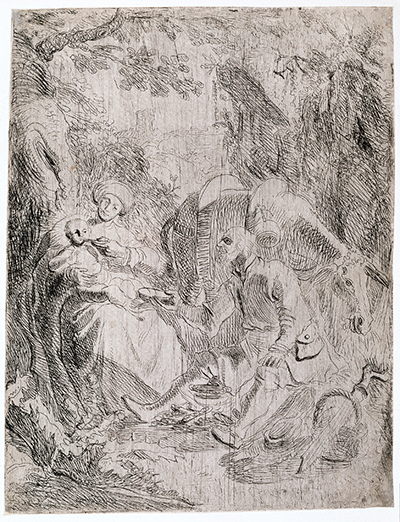
This print of a Rembrandt etching is believed to have been produced in 1626, with one of the copies now residing in the collection of The British Museum, London, UK.
That institution has managed to acquire a good number of original prints from this artist's career and many come from this same period of the mid to late 1620s, which was when Rembrandt was spending considerable time in perfecting his understanding of this artistic discipline. The process of turning a drawing or other artwork into a form suitable for printing was very foreign to him initially, but he soon grasped the basics with help from specialist advice. Before too long he was inserting his own creative ideas upon the process and forging a system which was very much his own. Interestingly, he started to avoid giving away information about his etching process once he became more confident and wanted to avoid others making use of his own discoveries.
This composition features a view through dense woods, with the Holy Family feeding Christ. They are centered around a prominent tree with a tower reaching up into the background. The surrounding trees help to frame the figures centrally. Some of the detail is hard to pick out because the prints are not as clear as perhaps they once were, but also the artist was still perfecting his methods at this time. We do know that Mary is holding the baby in her arms, with its legs leaning on her lap. She holds out a spoon of food for him, whilst Joseph looks on whilst preparing the fire for dinner. There are additional elements around them which provide clues as to his own occupation as a carpenter, and an animal sits behind with whom they would use for transporting their possessions.
The print displayed here is around 20cm in height and 16cm wide, which is entirely what one would expect for a single paper artwork. Rembrandt developed his techniques over time and would also produce different sets of prints from the same design, often tweaking it here and there to perfect the final look. He would then label each set depending on the iteration so that one can understand the changes that he made by comparing the different versions. Etchings would become the main way in which this artist achieved fame during his own lifetime and helped massively in promoting his career across wider boundaries than would be possible with his more traditional oil paintings.
Object Notes and Research Context
Rijksmuseum records show that Rembrandt returned to the Rest on the Flight into Egypt several times. One early c.1626 etching is described as his second print, still grappling with volume and depth. A later 1645 lightly etched version looks almost like a silverpoint drawing because the plate was bitten so delicately.
This page can use that contrast to become more useful: the subject was not in the biblical text itself but became a popular devotional pause during the Holy Family's escape. Rembrandt used it to test very different print languages, from dense early shadow to pale, tender outline. Link the page to the etchings hub and to nocturne/light glossary terms when available.
The Rest on the Flight into Egypt was a flexible devotional subject because it imagines a pause between biblical events. That allowed artists to combine landscape, family intimacy and travel without needing a dramatic miracle. Rembrandt's repeated return to the theme shows how useful it was for testing mood as much as narrative.
The contrast between the early and later etched versions should be explicit. The early sheet is valuable because it is close to the beginning of Rembrandt's print career; the later light-touch version shows how spareness could become expressive. The comparison also helps readers understand technique terms such as etching, drypoint, plate tone and state.
Further Rembrandt Context
This shorter legacy page remains part of the Rembrandt archive. For fuller context, use the refreshed Rembrandt pages below, which explain the artist's biography, media, technique, attribution issues and major works in greater depth.
For secure object data, attribution and collection history, compare The Rest on the Flight into Egypt with the relevant museum or catalogue record before treating older page text as final.
 Rembrandt.jpg)
Discussion
What feels most useful when looking at The Rest on the Flight into Egypt: the subject, the handling of light, the medium, the attribution history, or its place within Rembrandt's wider etching or print output?
Reader Insights
Set this page beside the refreshed Rembrandt hubs before relying on older summaries alone.
Rembrandt pages often need museum records, catalogue history and attribution caution, especially where older sources use broader labels.
Which detail would you most want clarified next: date, medium, collection, attribution, subject, condition or comparison with another Rembrandt work?
Join the Conversation
Have a thought or observation about The Rest on the Flight into Egypt? Share it below. Thoughtful responses may be added as the Rembrandt archive continues to be reviewed.