


 by Tom Gurney
Tom Gurney BSc (Hons) is an art history expert with over 20 years experience
Published on June 19, 2020 / Updated on August 9, 2026
Email: tomgurney1@gmail.com / Phone: +44 7429 011000
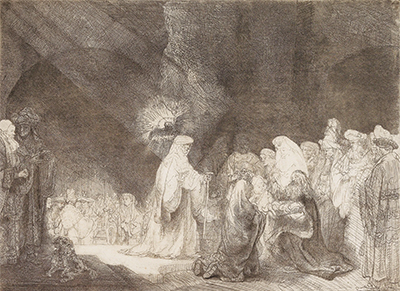
The Presentation in the Temple (Simeon's Hymn of Praise) was a complex etching completed by Rembrandt van Rijn in around 1640, by which time the artist had been using this medium for well over a decade.
This is an entirely accomplished piece with considerable detail in every corner of the artwork. Rembrandt may well have adapted the piece over time, regularly releasing prints of it as a means to make money but also to test the existing status of the design. He would be able to browse every last detail and then make tweaks to the etching itself which would then carry across into all future series of prints. He grew to love this art medium and it was critical to him achieving success within his own lifetime, even though today most still consider him to be a painter, first and foremost. In truth, his natural abilities were correctly applied to a good number of alternative mediums, and he was able to retain his enthusiasm by taking on different challenges across his career.
The larger photograph below offers great detail on this impressive artwork and several prints of it have recently come up for auction. Always be careful to check upon the authenticity of these items when bidding online, as some sellers are more trustworthy than others. You will often find many other prints from his etchings for sale from time to time and these can be picked up normally for around just a few thousand dollars, which will interest many who have more limited budgets than the major art collectors out there. This piece is particularly impressive, with a huge number of figures to be found in the foreground, with a further arched interior placed behind.
The prints of this artwork that we have found in various collections tend to be around 30cm wide by 20cm tall, which is entirely consistent with most publishers of this period. Rembrandt took advice from many local printmakers when he first started working with this medium and understood that different challenges would come his way than when working with paintings. He was already a highly accomplished draughtsman and so those talents were suitable to laying out his designs for the purpose of adding acid to the etching and then releasing series of prints from that. The process is arduous but many still like to work in this way today. Rembrandt has inspired many in that regard, but there were also other famous names involved in printmaking, such as Nuremburg's Albrecht Durer.
 Rembrandt Etching.jpg)
Object Notes and Research Context
Nationalmuseum records a c.1654 Rembrandt etching of the Presentation in the Temple, also known as Simeon in the Temple or The Presentation in the Temple in the dark manner. Its Swedish record describes four related etchings of similar size from the life of Christ, where darkness and light carry symbolic weight.
That is the best route for this page. Joseph and Mary bring the child to the temple; Simeon recognises the Messiah and holds him in a moment of quiet revelation. Rembrandt leaves a thin film of ink on the plate in printing, so the figures emerge from a deep, mysterious interior rather than from clear architectural space. Link this page to the 1669 Simeon painting and the etchings hub.
The dark manner is the phrase to explain here. Rembrandt often left tone on the plate or used dense work to make figures emerge from a charged interior rather than from clean outlines. In the Simeon subject, that darkness is theological as well as visual: recognition arrives as light within a dim temple space.
The print also benefits from comparison with the late Nationalmuseum painting. Across both works, Simeon is not a public hero but an old man meeting the fulfilment of a promise. The page can use that continuity to connect etching, late painting and Rembrandt's repeated interest in aged figures encountering revelation.
Further Rembrandt Context
This shorter legacy page remains part of the Rembrandt archive. For fuller context, use the refreshed Rembrandt pages below, which explain the artist's biography, media, technique, attribution issues and major works in greater depth.
For secure object data, attribution and collection history, compare Simeon's Hymn of Praise with the relevant museum or catalogue record before treating older page text as final.
 Rembrandt.jpg)
Discussion
What feels most useful when looking at Simeon's Hymn of Praise: the subject, the handling of light, the medium, the attribution history, or its place within Rembrandt's wider etching or print output?
Reader Insights
Set this page beside the refreshed Rembrandt hubs before relying on older summaries alone.
Rembrandt pages often need museum records, catalogue history and attribution caution, especially where older sources use broader labels.
Which detail would you most want clarified next: date, medium, collection, attribution, subject, condition or comparison with another Rembrandt work?
Join the Conversation
Have a thought or observation about Simeon's Hymn of Praise? Share it below. Thoughtful responses may be added as the Rembrandt archive continues to be reviewed.