


 by Tom Gurney
Tom Gurney BSc (Hons) is an art history expert with over 20 years experience
Published on June 19, 2020 / Updated on August 9, 2026
Email: tomgurney1@gmail.com / Phone: +44 7429 011000
The Three Trees by Rembrandt: Introduction
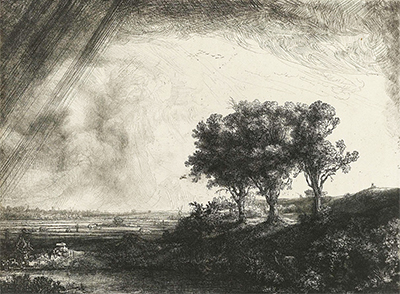
Rembrandt's The Three Trees is one of the great landscape prints of the seventeenth century. It is not a painting, and it should not be approached as a small black-and-white substitute for one. It is an etched landscape from 1643, made through copper, line, ink, paper and pressure. Its drama comes from weather, light and printmaking itself.
The scene is simple at first glance. Three dark trees stand on a raised bank near water. A wide low landscape opens to the left. Clouds sweep across the sky. Rain seems to fall in diagonal strokes, while light breaks from the right and begins to push the storm away. Small human activities continue below and around the trees: people fish, work, travel, sketch and seek shelter. Nature changes, but life goes on inside it.
The Rijksmuseum records The Three Trees as a print by Rembrandt van Rijn, dated 1643, object RP-P-OB-444. Its dimensions are 213 x 279 mm, and the museum describes the technique as etching, drypoint and burin, printed with light plate tone. The Met records its own impression as etching, engraving and drypoint, with a plate size of 21.3 x 27.8 cm and a sheet size of 21.3 x 28.3 cm. The National Gallery of Art records another impression as etching with drypoint and burin on laid paper, with a Strasbourg lily watermark. The Art Institute of Chicago records its impression as etching and drypoint on ivory laid paper.
Those details matter because The Three Trees is a print, not a single painted object. A museum owns an impression: one sheet printed from the plate, with its own paper, dimensions, condition, tone and collecting history. The broader image is famous, but each sheet carries material evidence. That is part of the fascination.
Contents
- Introduction
- First Look at the Scene
- Weather as the Subject
- A Landscape Made by Printmaking
- Plate Tone and Light
- State, Impression and Paper
- The Human Details
- Location and Invention
- The Three Trees and The Mill
- Place Among Rembrandt's Etchings
Annotated Details from The Three Trees
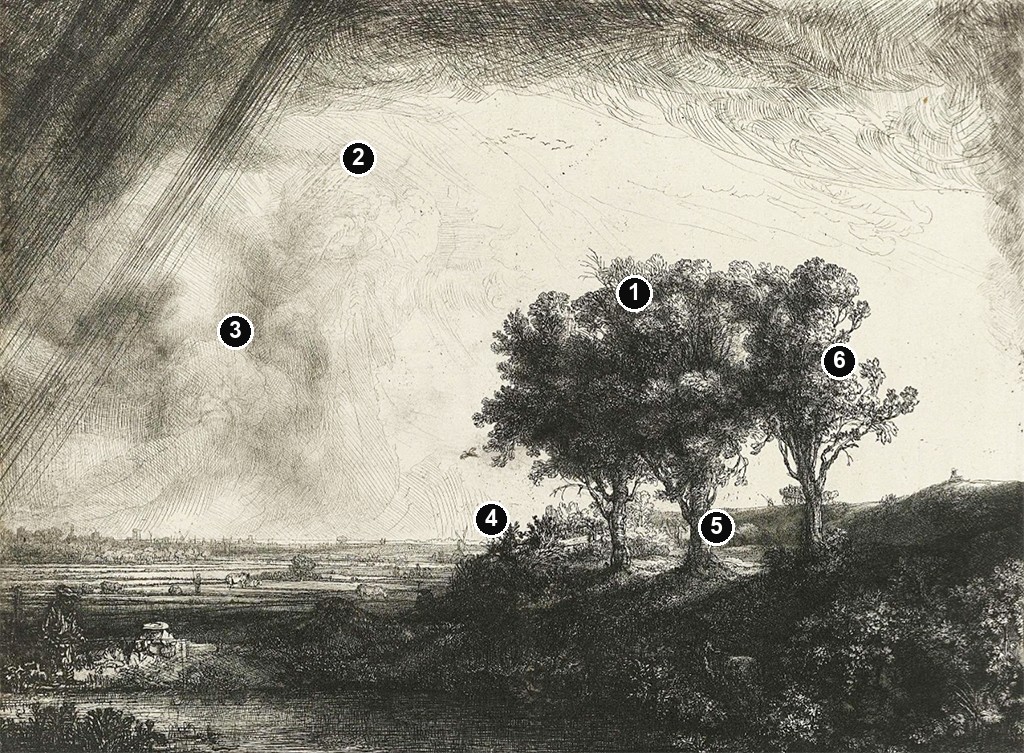
These annotated details follow the print's weather, trees, fields and small incidents, showing how Rembrandt made landscape from etched line and atmosphere.
Details from THE THREE TREES
Close looking shows how the print combines dramatic weather with tiny human and topographical details.
The three trees
The trees give the print its title and main vertical accent. They stand against weather rather than calm space.
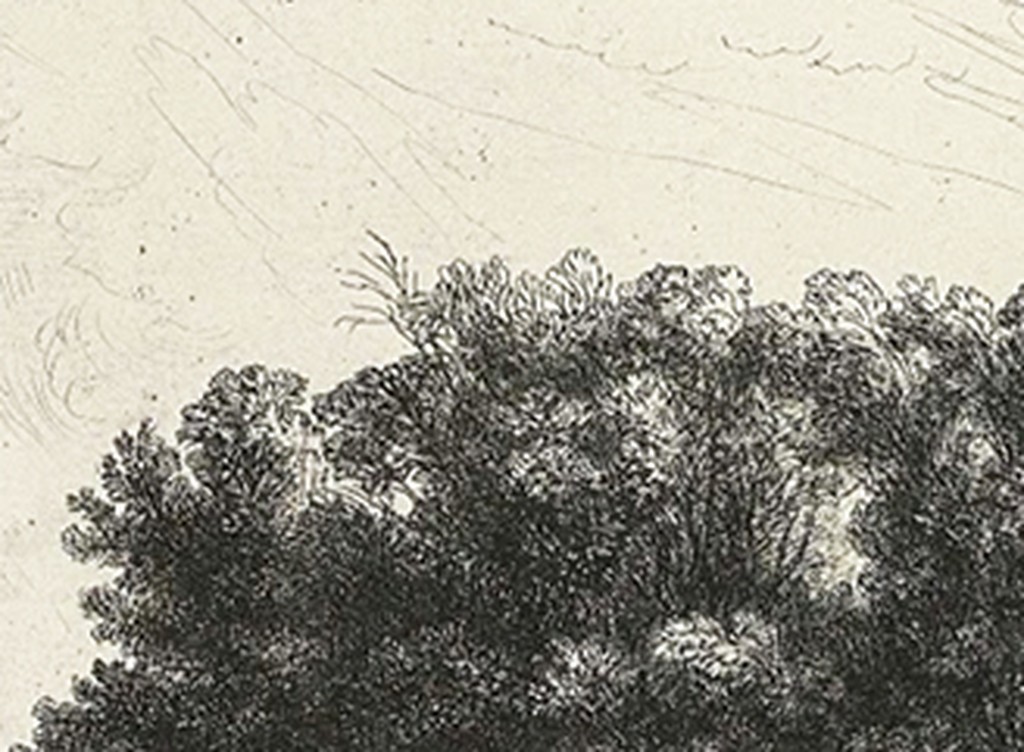
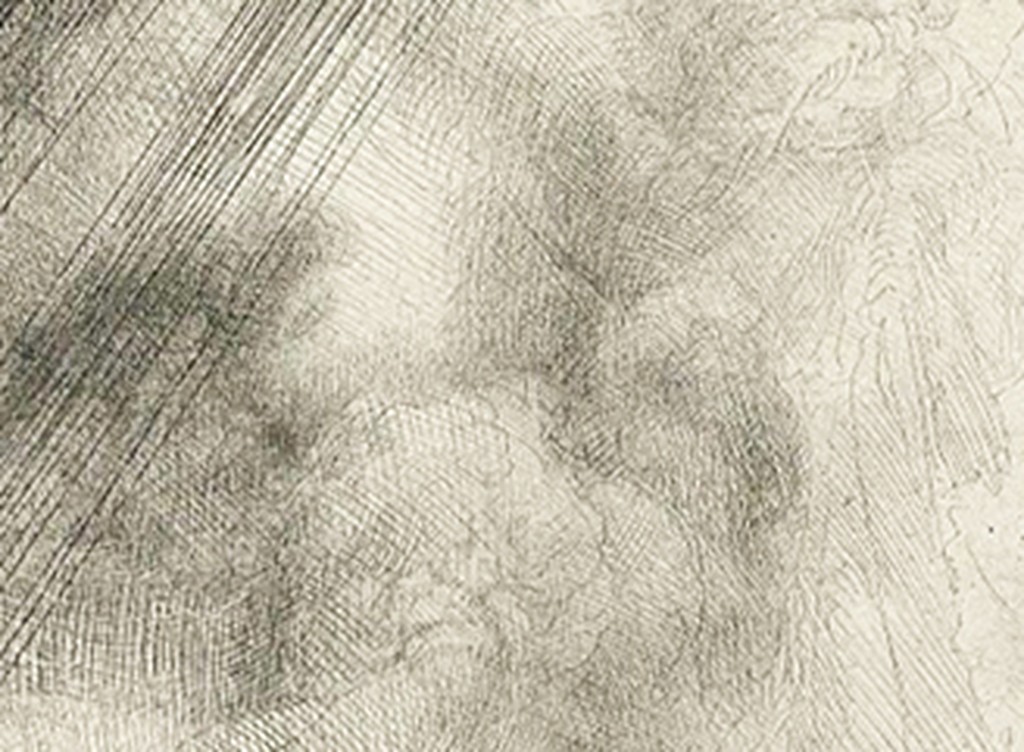
Storm cloud and sky
The sky carries the print's drama. Dark hatching makes weather feel like an active force.
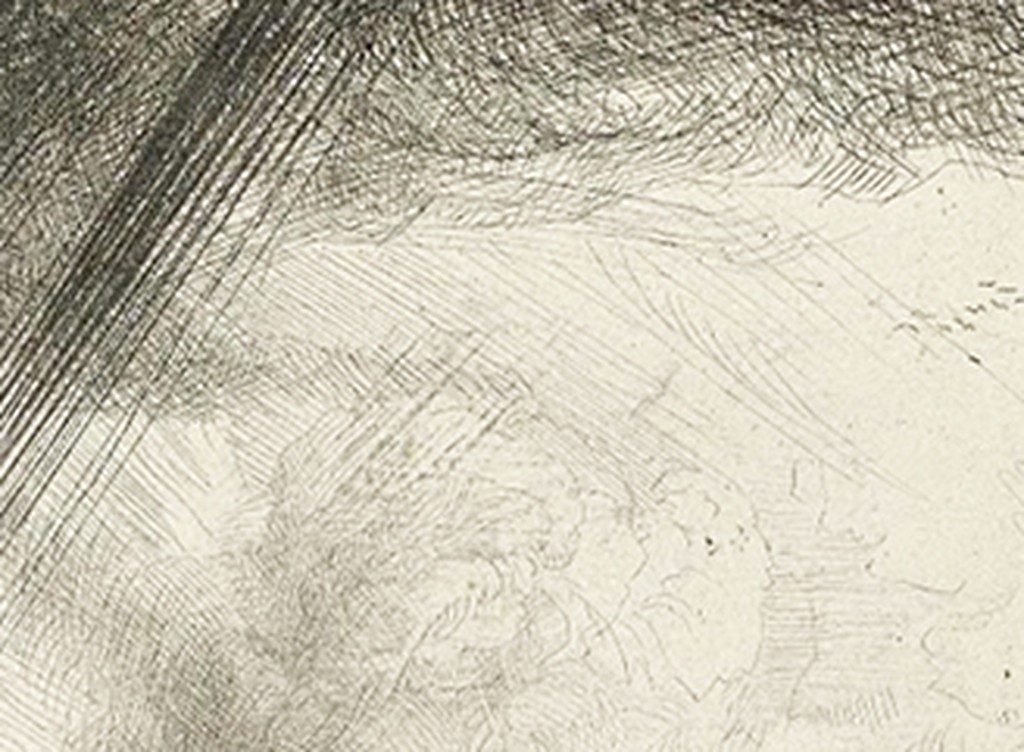
Rain and distant land
Distant rain and low land stretch the view outward. The landscape feels large despite the print's small scale.
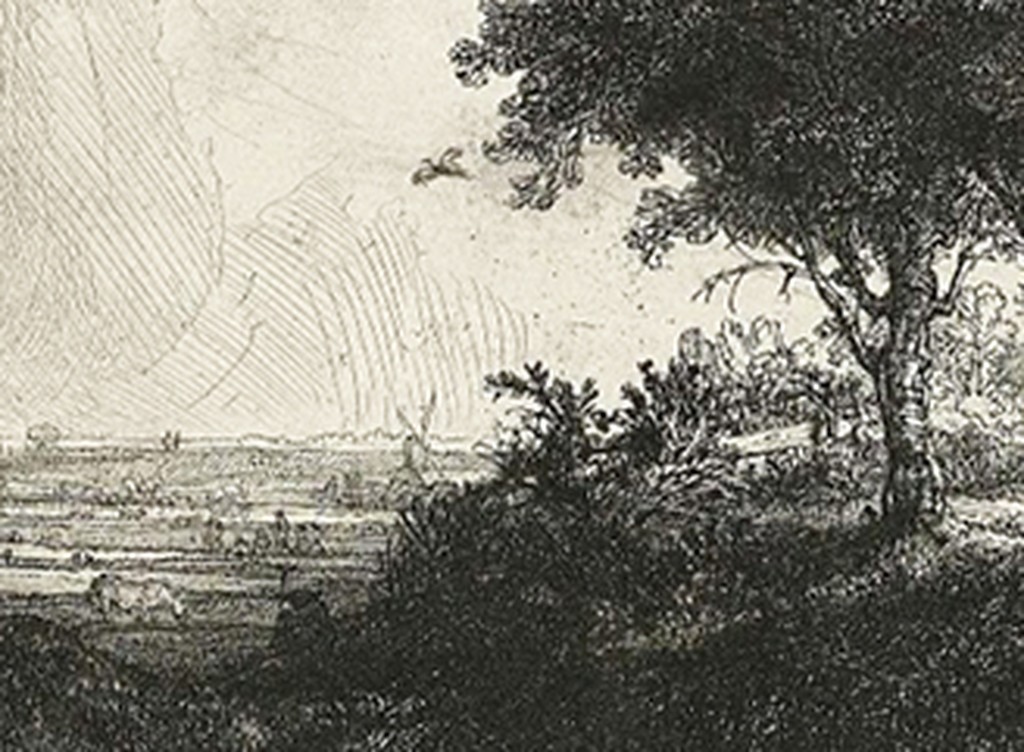
Fields and paths
Fields and paths structure the lower half. Rembrandt balances broad atmosphere with mapped detail.
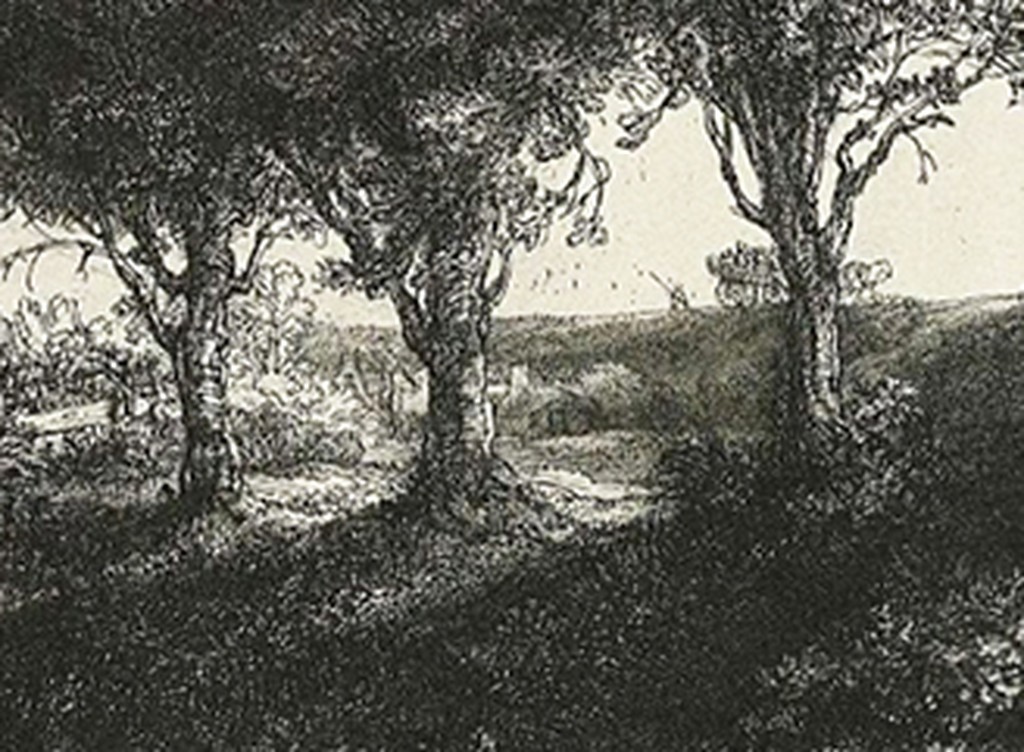
Tiny figures
Small figures give the landscape scale and lived presence. They reward slow looking.
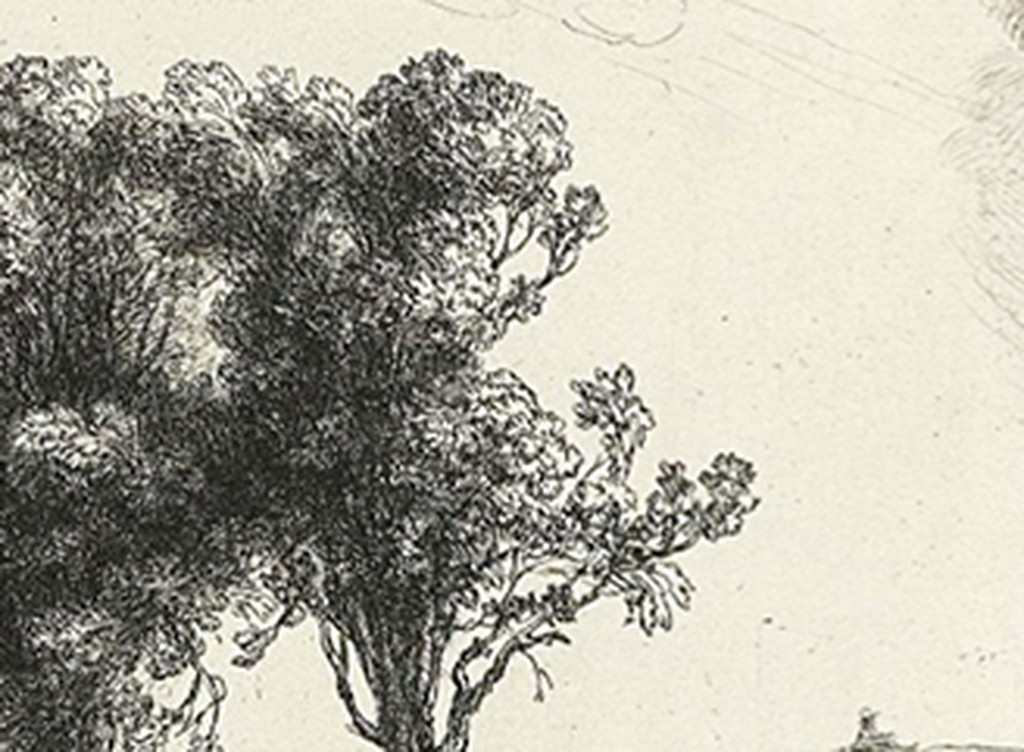
Etched line and tone
Line, hatching and tone create texture without colour. The print's surface carries much of its atmospheric power.
First Look at the Scene
The three trees dominate the print, but they do not fill it. They stand high on the right, grouped like a dark landmark against the open sky. Their forms are dense, almost black in places, and their rooted mass gives the landscape a center of gravity.
To the left, the land opens into distance. The horizon is low. Fields, water and far buildings are reduced to small signs, but the space feels broad. Rembrandt does not need elaborate description to make distance breathe. A few lines can suggest a bank, a field, a building or a shift in ground.
The sky carries much of the emotional force. Dark cloud enters from the left, rain cuts across the upper corner, and the storm seems to be passing rather than settling permanently over the land. Light from the right changes everything. It catches the open spaces and makes the trees appear even stronger by contrast.
The print rewards slow looking because the landscape is filled with small lives. A fisherman and companion appear at the lower left. Distant figures and cattle animate the fields. A tiny sketching artist sits on a rise at the right. A couple is hidden in the dark foreground bushes. These details do not turn the print into anecdote. They make the land inhabited, observed and alive.
Weather as the Subject
The Three Trees is often praised because it makes weather visible. That sounds simple, but it is one of the print's great achievements. Rembrandt does not merely draw clouds over a landscape. He makes the whole sheet feel subject to changing air.
Rain, darkness and clearing light are all present at once. The storm has not vanished; it still bears down from the left. Yet the right side of the image opens toward brightness. The viewer feels a moment between conditions, when the land has not yet settled after rain and the sky is still moving.
This is why the print feels larger than its size. The drama is not a battle, a miracle or a famous episode. It is a change in the weather. Rembrandt makes that change feel monumental by giving it structure: dark trees, low land, driving cloud, open light and small human actions that continue beneath the sky.
The weather also gives the image its rhythm. The left side pulls downward with rain and darkness. The right side lifts through light and high ground. The trees hold the two movements together. They are not symbols with one fixed meaning, but they behave like witnesses to the passing storm.
A Landscape Made by Printmaking
The word "painterly" is often used for The Three Trees, and the Rijksmuseum calls it Rembrandt's largest and most painterly etched landscape. The word is useful if it points to atmosphere, mass and light. It becomes misleading if it makes the print sound like a painting reduced to line.
The Three Trees is powerful precisely because it is a print. Rembrandt uses etched line to build distance and movement. He uses drypoint and burin or engraving to deepen and strengthen passages. He uses plate tone to leave a film of ink that can work like atmosphere. He also uses untouched paper, allowing brightness to appear where no mark has been added.
Etching begins with a metal plate covered by an acid-resistant ground. The artist draws through that ground, and acid bites the exposed lines into the copper. Drypoint works more directly: a hard point scratches into the plate and can raise burr, a fragile ridge of metal that catches ink and prints as a rich dark line. A burin cuts into the plate more cleanly. In Rembrandt's hands, these methods could work together rather than remain separate categories.
The Met describes its impression of The Three Trees through drypoint, engraving, varied depths of etched line and speckled tone. That description helps explain why the print is so varied. Some passages are sharp and open. Others are dark, soft or dense. The sky has motion; the land has firmness; the trees have weight. The technique does not sit behind the image. It is the way the image exists.
Plate Tone and Light
Plate tone is one of the most important ideas for this print. It is the ink left on the surface of the plate after wiping, rather than ink held only in the etched or cut lines. If the plate is wiped very clean, the paper can appear bright wherever there are no lines. If a thin film of ink remains, it can make the sheet feel warmer, darker or more atmospheric.
The Rijksmuseum specifically records its impression of The Three Trees as printed with light plate tone. That phrase matters because the print is about weather and light. Tone can help the storm feel like air, not just like a collection of lines. It can bind the sky, land and shadow together.
Rembrandt's printed light is also made by restraint. He leaves parts of the sheet open. The paper itself becomes sky, distance and illumination. In a painting, light might be produced by pigment. In this print, light often comes from absence, from the areas Rembrandt chooses not to darken.
This is one reason The Three Trees remains so fresh to modern eyes. It does not need color to create atmosphere. Black ink and paper can suggest wet air, open fields, distant buildings, heavy trees and a clearing sky. The print turns economy into grandeur.
State, Impression and Paper
The language of printmaking can sound technical, but it protects the viewer from a common mistake. The Three Trees is an image known through impressions. A particular museum sheet has a particular paper, size, tone and history.
The National Gallery of Art records its impression as etching with drypoint and burin on laid paper. It gives the image size as 21.3 x 28.1 cm and the sheet size as 21.5 x 28.3 cm. It also records White and Boon 1969, number 212, as "state only," and notes a Strasbourg lily watermark. That watermark is not a decorative curiosity. Watermarks can help print scholars compare sheets, understand paper batches and think about when an impression was made.
The Art Institute of Chicago records its impression as etching and drypoint on ivory laid paper, with the sheet trimmed within the platemark to 20.9 x 28.1 cm. The Met gives a plate and sheet measurement for its own impression. The Rijksmuseum gives a height and width of 213 x 279 mm for its object.
These small differences do not mean the museums are contradicting one another. They are describing different physical sheets. A viewer does not need to become a cataloguer to enjoy the print, but knowing this much changes the experience. It reminds us that a Rembrandt print is both an image and a surviving object.
The Human Details
The human figures in The Three Trees are tiny, yet they are essential. Without them, the print might become only a heroic landscape. With them, it becomes a world.
At the lower left, a fisherman and companion occupy the water's edge. In the distance, people and cattle appear in the flat land. On the hill at the right, a small artist sketches. In the dark foreground at the lower right, a couple is hidden in the bushes. Rembrandt places these details so lightly that they can be missed, but once seen they change the whole image.
The sketching figure is especially interesting because it quietly reflects the act of looking. The print contains a landscape and also a person attending to landscape. The viewer, the small artist in the scene and Rembrandt himself are all connected through observation.
The hidden couple adds another note. They are sheltered beneath the dark growth, apart from the larger weather drama. Their presence makes the foreground less empty and more private. The storm is a shared condition, but each figure has a different relation to it: work, travel, shelter, looking, desire, waiting.
These details prevent the print from becoming abstract. The land is not only a stage for light. It is a lived place, full of small actions that continue even as the sky changes.
Location and Invention
The Three Trees looks deeply Dutch, but it should not be treated as a simple topographical view. The Rijksmuseum notes that the location is unclear and that Rembrandt may have partly invented the scene, while also suggesting that the trees likely stood along a dike near the Zuiderzee.
That balance is important. The print feels rooted in the Dutch landscape: low horizon, water, fields, dike-like ground, distant settlement and an enormous sky. Yet it is arranged with the intensity of invention. Rembrandt is not merely recording a place. He is making a landscape that gathers observation, memory and imagination.
Dutch landscape art in the seventeenth century often paid close attention to ordinary terrain: roads, rivers, dunes, trees, mills, farms and skies. The Three Trees belongs to that world, but Rembrandt gives it unusual concentration. The grouped trees are strong enough to organize the whole sheet. The weather is strong enough to become the drama.
This is one reason the print is so often treated as a major landscape. It does not depend on a famous landmark. It makes a dike, trees, fields and weather feel sufficient.
The Three Trees and The Mill
The comparison with The Mill helps place The Three Trees inside Rembrandt's landscape imagination. The Mill is an oil painting, now in the National Gallery of Art, Washington. The Three Trees is an etching. They are different kinds of objects, but they share several concerns.
Both works make weather central. Both set small human activity inside a larger atmosphere. Both use a few strong forms to give the landscape emotional structure. In The Mill, the windmill rises like a dark presence against a changing sky. In The Three Trees, the three trees stand against storm and light.
The comparison should not blur the media. The Mill works through paint, canvas, color, surface and later restoration history. The Three Trees works through etched line, drypoint, burin or engraving, plate tone and paper. But they show the same artist thinking about land as more than scenery.
They also help correct a narrow idea of Rembrandt. He was not only a painter of faces, biblical interiors and dramatic bodies. He could make landscape carry feeling without turning it into a backdrop. In both works, ordinary land becomes charged because light and weather transform it.
Place Among Rembrandt's Etchings
Rembrandt's etchings cover portraits, self-portraits, biblical scenes, beggars, studies, landscapes and experiments in light. The Three Trees belongs among the most ambitious of them because it uses the medium to solve a large problem: how to make open land and moving weather convincing in black ink.
It also stands beside The Hundred Guilder Print and Christ Presented to the People as a reminder that Rembrandt's printed art cannot be reduced to copied images. These are original works in print. They depend on plates, states, impressions, papers and decisions about inking and wiping.
The Three Trees is different from those biblical prints because it has no central sacred episode. Its drama is environmental and observational. Yet it is no less serious. Rembrandt gives landscape the same density of attention that he gives a face or a crowd.
The print also connects to his drawings. Rembrandt's landscape drawings often depend on quick notation, open paper and close attention to ordinary views. The Three Trees brings that observational habit into a more worked and repeatable medium. It has the freshness of looking, but also the density of a carefully developed plate.
Why the Print Still Matters
The Three Trees matters because it changes what a landscape print can do. It turns a modest sheet into a world of weather, distance, work, shelter and light. It also teaches viewers how much printmaking can carry without color or scale.
The image is not dramatic in the obvious sense. No armies clash. No saint performs a miracle. No patron looks out from a portrait. Instead, Rembrandt asks viewers to attend to a storm clearing over low land. That subject could have been small. In his hands it becomes profound.
The print's greatness lies partly in its restraint. The trees are strong, but not overloaded with meaning. The figures are tiny, but not irrelevant. The weather is powerful, but not apocalyptic. The land is ordinary, but not empty. Everything is held in a moment of change.
It also remains useful because it slows looking down. The first impression may be of trees and storm. Then the viewer notices the fishermen, the cattle, the sketching artist, the hidden couple, the distant buildings, the direction of the rain, the openness of the paper and the varied kinds of line. The print becomes richer the longer it is studied.
That is why The Three Trees deserves its own page rather than only a mention in a guide to Rembrandt's etchings. It is a landscape, a printmaking lesson and a meditation on weather all at once.
Frequently Asked Questions About The Three Trees
Important impressions are held by major collections including the Rijksmuseum, the Metropolitan Museum of Art, the National Gallery of Art, the Art Institute of Chicago and the Stadel Museum. Availability for viewing depends on each collection's display or study-room policies.
The subject is a Dutch landscape under changing weather. Three trees stand on a raised bank while storm, rain, clearing light, water, distant fields and small human figures create the scene's drama.
Different museums record different impressions. One sheet may be trimmed differently, measured by plate, image or sheet, or printed on different paper. Those measurements describe individual objects, not separate paintings.
Plate tone is ink left on the surface of the plate after wiping. In The Three Trees, light plate tone helps create atmosphere and makes the printed weather feel more continuous.
Both works show Rembrandt using landscape, weather and strong forms to carry emotion. The Mill is a rare landscape painting, while The Three Trees is an etching, so the comparison is about shared concerns rather than identical media.
Discussion
What feels most important in The Three Trees: Rembrandt's light, the figure's expression, the material surface, the historical source, or the way the work sits beside his other paintings and prints?
Reader Insights
Begin with one detail in The Three Trees, then move outward to light, gesture, surface and the surrounding space.
Connect the work to Rembrandt's biography, workshop, medium and the museum record rather than reading it as an isolated image.
Which detail changes the interpretation most once you know the date, subject, attribution history or present collection?
Join the Conversation
Have a thought or observation about The Three Trees? Share it below. Thoughtful responses may be added to this section as the Rembrandt pages develop.
References
- Rijksmuseum, The Three Trees, object RP-P-OB-444: https://www.rijksmuseum.nl/en/collection/object/De%2Bdrie%2Bbomen--4c0c780d82c4055bfd186ad2c117239e
- The Metropolitan Museum of Art, The Three Trees, object 29.107.31: https://www.metmuseum.org/art/collection/search/354633
- National Gallery of Art, The Three Trees, accession 1955.6.10: https://www.nga.gov/artworks/43418-three-trees
- Art Institute of Chicago, The Three Trees, reference no. 1938.1811: https://www.artic.edu/artworks/29271/the-three-trees
- Stadel Museum, The Three Trees, inventory 5950 / object 5950 D: https://sammlung.staedelmuseum.de/en/work/the-three-trees
- Museum Boijmans Van Beuningen, Rembrandt etchings from the museum's collection: https://www.boijmans.nl/en/collection/research/rembrandt-etchings-from-the-museum-s-collection
- Museum Rembrandthuis, collection overview: https://www.rembrandthuis.nl/en/find-out-more/collection/
- Museum Rembrandthuis, science portal: https://www.rembrandthuis.nl/en/find-out-more/science-portal/
 Rembrandt.jpg)