by Tom Gurney
Tom Gurney BSc (Hons) is an art history expert with over 20 years experience
Published on June 19, 2020 / Updated on October 2, 2026
Email: tomgurney1@gmail.com / Phone: +44 7429 011000
A closer look
A man stands above an open tomb and raises the crown of thorns and the nails of the Crucifixion. Below him, the mourners press so closely around Christ that their bodies almost become one structure. The Virgin has fainted; Saint John catches her while Christ's body lies across her knees. Mary Magdalene clasps his feet at the lower edge. Botticelli makes the instruments of his death visible overhead while the human response to that death fills nearly every space beneath them.[1]
This vertical painting is The Dead Christ Mourned, also called the Lamentation over the Dead Christ, in the Museo Poldi Pezzoli in Milan. The museum dates it to 1495–1500 and identifies it as tempera on a panel measuring 106 × 71 cm. It is a different work from Botticelli's wider Lamentation in Munich, with a different recorded Florentine setting. The inherited page name “Lamentation over the Dead Christ II” is useful only if that distinction is kept clear.[1][2]
At a glance
- ArtistSandro Botticelli
- TitleThe Dead Christ Mourned (Compianto sul Cristo morto)
- Date1495–1500
- Mediumtempera on panel
- Dimensions106 × 71 cm
- CollectionMuseo Poldi Pezzoli, Milan
- Inventory1558
- Present displayGolden Room, according to the museum's current record
The museum's title describes mourning, while the older word Pietà sometimes appears in discussions of the picture's proposed Florentine altar. Neither title gives a contemporary commission document or an eyewitness account of the event depicted. The painting gathers familiar figures, signs of the Passion and a rock-cut tomb into a devotional image meant to hold the viewer's attention.[1][2]
This work in Botticelli’s career
Fortitude
1470The Dead Christ Mourned
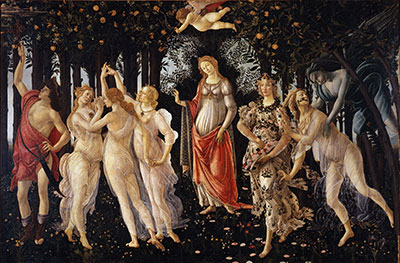
1495–1500Primavera
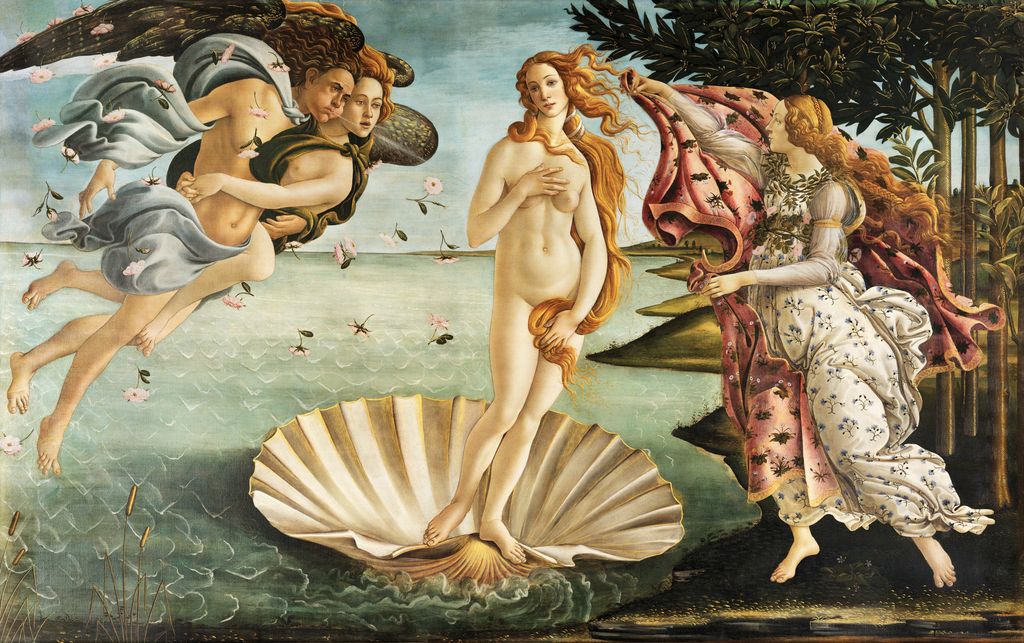
c. 1480Birth of Venus
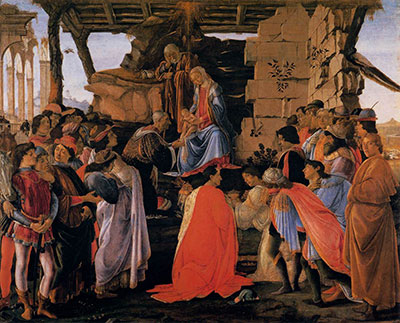
c. 1485Mystic Nativity
1500Contents
- At a Glance
- A Vertical Chain of Grief
- How Botticelli Built the Scene
- A Small Altar in Florence?
- The Later Botticelli and the Munich Painting
- Looking Again
A Vertical Chain of Grief
At the centre, the Virgin's head falls back against John. His red sleeve descends beside her body, drawing the eye toward Christ's outstretched arm. Another woman cups Christ's head and brings a white cloth close to his face. On the left, a mourner pulls a dark mantle over her face. At the bottom, Magdalene touches and embraces his feet. The group's hands and arms form an interlocking chain: each person seems to support, shelter or reach for someone else.[1][2]
Christ is not arranged on a separate stone slab. His upper body rises within the mourners' hold, while the lower part of his body lies across Mary's knees and the cloth beneath him. The unusual angle makes the closeness of the figures physically legible. John supports the fainting mother, the women support her son, and Magdalene makes contact at the lowest point. Looking from top to bottom, we pass from the objects that caused the suffering to the body and then to the people who cannot release it.[1]
The tomb's squared stone opening is a dark frame behind the standing figure. It gives the scene a place near burial without letting landscape or architecture spread outward. Botticelli instead compresses the mourners against that opening. The gold, red and blue garments strike against one another; dark drapery fills the lower right. The museum notes that many of the mourners' eyes are shut or hidden. Their inability to meet the sight of the dead Christ becomes part of how the painting represents grief, even as the viewer is invited to look steadily at him.[1]
The man at the top is named Joseph of Arimathea by the Poldi Pezzoli Museum. A technical study notes that this figure has also been read as Nicodemus. The visual role is clear whichever name is used: he holds up the crown and nails, wrapped or held with pale cloth, above the mourners. These are not simply background props. Their elevated position recalls the Crucifixion while the body below shows its consequence. Identifying the man as Joseph follows the museum; the alternative should prevent a certainty greater than the sources allow.[1][3]
How Botticelli Built the Scene
Conservation research lets us see that the tightly connected composition was not fixed at the first drawing. Infrared reflectography carried out in connection with a 2004 treatment revealed an earlier angle for John's head. In the underlying brush drawing he leaned closer toward Mary's shoulder; the painted version lifts his head and opens his face more fully to view. The study also found that the woman hiding her face on the left originally extended her blue-clothed arm farther forward, across part of John's red sleeve. In the final painting Botticelli moved her back and set her on a more oblique plane.[3]
The researchers found an earlier position for Christ's arm too, nearer his sternum than in the painted version. These are specific, visible changes in the making of the panel. They do not reveal a single dramatic moment of inspiration or the artist's private feeling. They show him adjusting the relation between heads, sleeves and hands while preserving the painting's crowded design. The final arrangement connects John to the figure above and lets the mourner on the left withdraw into her covered face.[3]
The same technical study describes the support as two vertical poplar planks. In a restoration during the 1950s, three oak crossbars were inserted into channels cut across the already thin panel. Later examination found that this treatment had contributed to deformation. Before the 2004 exhibition loan, conservators prioritised the support and removed surface deposits; they postponed the larger removal of discoloured retouching. The painting seen today has therefore passed through interventions as well as Botticelli's own revisions. Close reading of colour and line should acknowledge that material history.[3]
This evidence makes the image more, rather than less, deliberate. Mary's collapse, John's grasp and Magdalene's touch can appear like a single overwhelming response to death. Imaging shows that Botticelli tested the positions that make those responses read together. The solemn encounter offered to a viewer is an achieved arrangement on a vulnerable wooden panel.[3]
A Small Altar in Florence?
The Poldi Pezzoli Museum identifies this panel with the altarpiece of a small funerary altar set against a pillar in Santa Maria Maggiore, Florence. The Italian national catalogue explains how that identification was made. Giorgio Vasari described a small Pietà near the Panciatichi chapel there; the scholar Jacques Mesnil distinguished that reference from Botticelli's other Lamentation, which came from San Paolino and is now in Munich. On that reading, the Milan picture is the Santa Maria Maggiore work.[1][2]
The proposed setting helps explain the painting's intimate scale and close focus. A person approaching a small funerary altar could attend to the body, the mourners and the instruments of the Passion without scanning a broad narrative scene. But the identification rests on matching later descriptions and histories to the surviving panel. No known contract in these sources names Botticelli, a commissioner and this exact painting together. The picture's first placement should therefore be presented as a strong historical identification, not as a surviving signed order.[1][2]
The altar itself has a history older than the painting. The national catalogue records its foundation by Antonio Cioni in 1441 and says that patronage passed to his son Donato d'Antonio. Donato has consequently been suggested as Botticelli's commissioner. The same account reports Mesnil's objection: a 1495 financial declaration indicated that Donato had sold land and was not wealthy, making an expensive altarpiece commission doubtful. An altar founder and a later patron of the altar are documented in the historical reconstruction; the purchaser of this particular painting remains uncertain.[2]
According to the catalogue, the altar structure was dismantled in 1629 and the painting was moved. The historian Giuseppe Richa still described it in the church's sacristy in 1755. After that, its documentary trail becomes difficult to follow until it entered the Poldi Pezzoli collection in the nineteenth century. The museum gives 12 March 1879 as Gian Giacomo Poldi Pezzoli's purchase date; the national catalogue cautions that the exact date of acquisition is unknown, although a late purchase is likely. The secure point shared by the collection's account and a later exhibition history is its association with Poldi Pezzoli in 1879.[1][2][4]
The Later Botticelli and the Munich Painting
The museum places The Dead Christ Mourned late in Botticelli's career, between 1495 and 1500. It relates the sharper gestures and intense religious mood of his later work to Florence's response to the Dominican preacher Girolamo Savonarola and to the political and cultural changes after Lorenzo de' Medici's death. That is an interpretation of artistic and civic context. The picture alone cannot establish what Botticelli personally believed, or that one sermon or event caused a particular painted gesture.[1]
The national catalogue considers the Milan panel somewhat later than the Munich Lamentation. Both works bring figures close around the dead Christ, but their formats create different experiences. Munich extends its mourners across a broad horizontal field; Milan stacks them beneath a single standing figure and a dark tomb opening. The comparison is useful for seeing Botticelli revisit a subject and reshape it for a different panel and probable setting. The relative order is scholarly dating, not a dated sequence in a workshop record.[2][5]
There have also been debates over whose hand made the Milan painting. The national catalogue records older proposals to assign it to Botticelli's workshop or followers, even while describing the quality and design that support the master's authorship. The Poldi Pezzoli Museum currently catalogues it as Botticelli. This history is a reminder that attribution and the identity of a proposed patron are separate questions: the current museum attribution can be stated plainly without treating every aspect of the first commission as solved.[1][2]
Looking Again
Return to the raised crown and nails, then follow the descending arms to Mary's limp body and Christ's exposed torso. At the edges, one woman closes herself behind her mantle while Magdalene presses close to his feet. Between those actions, Botticelli gives grief several bodily forms: support, collapse, concealment and touch. The tomb waits behind them, but the people and the instruments of the Passion occupy the picture's foreground. Technical study shows how carefully the artist revised their positions; the likely small-altar history suggests the concentrated attention the panel could demand. In Milan, this is a distinct, vertical Lamentation, whose force lies in the connections Botticelli made among the mourners.[1][2][3]
Botticelli and related artworks
Discussion
Which detail changes how you read The Dead Christ Mourned?
Reader Insights
How are the mourners gathered around Christ?
Which details distinguish the Milan panel from the Munich Lamentation?
What does the museum record establish about the date?
Join the Conversation
Share a source-led observation or question below.
References
- Museo Poldi Pezzoli, “The Dead Christ Mourned,” collection record, inventory 1558, accessed 29 September 2026 View source.
- Italian Ministry of Culture / Regione Lombardia, “Compianto su Cristo morto,” national catalogue record RL480-00030_R03, compiled 2014, accessed 29 September 2026 View source.
- Ezio Buzzegoli and Ciro Castelli, “Botticelli's Lamentation over the Dead Christ from the Poldi Pezzoli Museum in Milan: Notes on a Minimal Intervention and Non-invasive Imaging Analysis,” English translation in Structural Conservation of Panel Paintings at the OPD in Florence, pp. 27–40; originally published with Andrea Di Lorenzo in OPD Restauro 16 (2004), pp. 15–30 View source.
- Gallerie d'Italia / Intesa Sanpaolo, “Botticelli: Lamentation over the Dead Christ,” exhibition account of the Poldi Pezzoli loan and 1879 acquisition, accessed 29 September 2026 View source.
- Bayerische Staatsgemäldesammlungen, “The Lamentation,” Alte Pinakothek, inventory 1075, collection record updated 20 May 2026; accessed 29 September 2026 View source.