by Tom Gurney
Tom Gurney BSc (Hons) is an art history expert with over 20 years experience
Published on June 19, 2020 / Updated on October 2, 2026
Email: tomgurney1@gmail.com / Phone: +44 7429 011000
A closer look
A headless body lies across a bed at the foot of a crowded tent. Around it, men recoil, raise their hands and press forward for a closer look. Above them, a dark canopy is drawn back like a theatre curtain. A white horse waits in the light beyond the opening. The murder has already happened, but Botticelli makes its discovery feel immediate: the still body holds the foreground while the shock travels from face to face.[1][2]
The Discovery of the Body of Holofernes is the smaller, darker counterpart to Botticelli's Return of Judith to Bethulia. Both belong to the Uffizi in Florence, which dates them to about 1470–75 and describes them as tempera on wood. The Italian national catalogue gives this particular panel inventory 1890 no. 1487. Its subject is not the moment Judith kills the Assyrian general. It is the moment his followers learn that she has escaped and their command has collapsed.[1][2][3]
At a glance
- ArtistSandro Botticelli
- TitleThe Discovery of the Body of Holofernes
- Datec. 1470–75
- Mediumtempera on wood
- Dimensions31 × 24 cm (Uffizi record)
- Current collectionUffizi Galleries, Florence
- Inventory1890 no. 1487
The Uffizi lists a size of 31 × 24 cm for the paired works. An older national-catalogue entry gives 31 × 25 cm for this individual panel. A centimetre's difference in recorded width is worth noting because the panel is so small; the current gallery value is used in the fact box. Both records agree on the subject, support, artist and collection.[1][2]
This work in Botticelli’s career
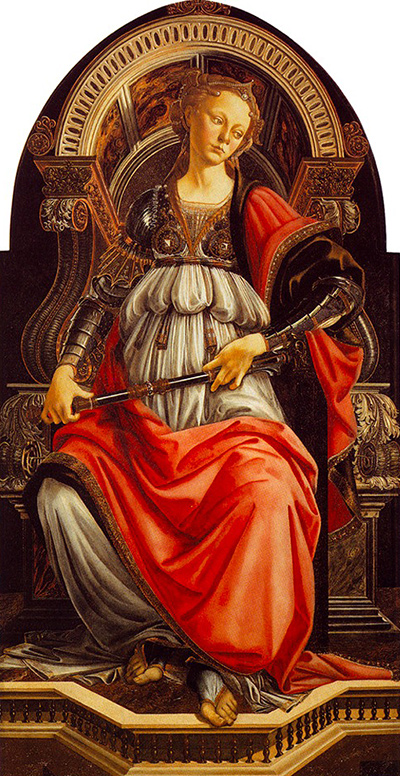
Fortitude
1470Discovery of Holofernes
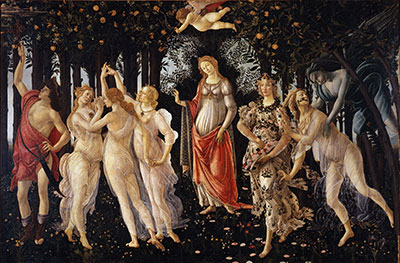
about 1470–75Primavera
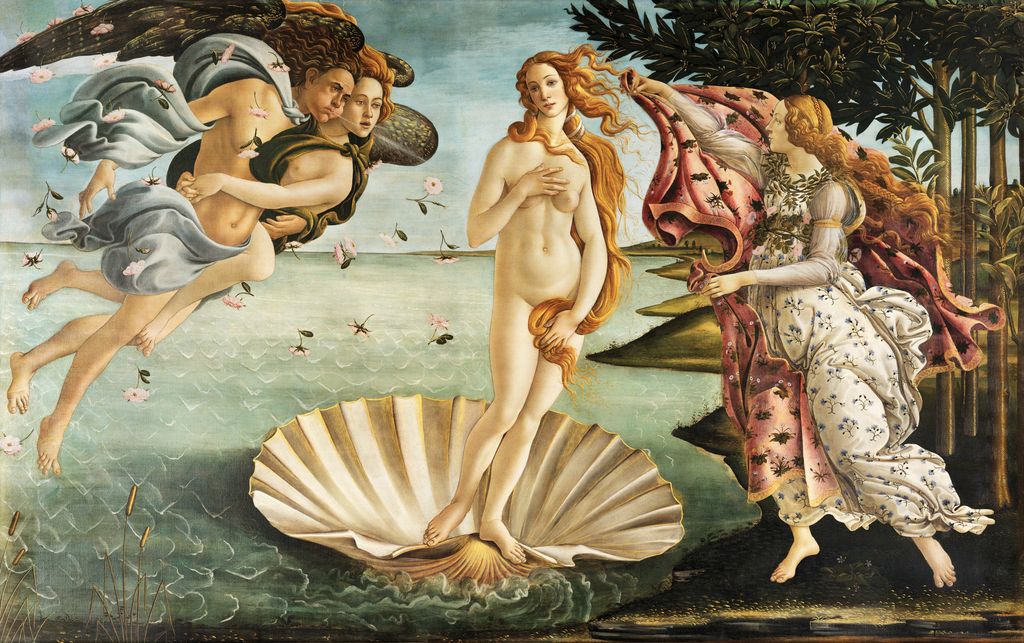
c. 1480Birth of Venus
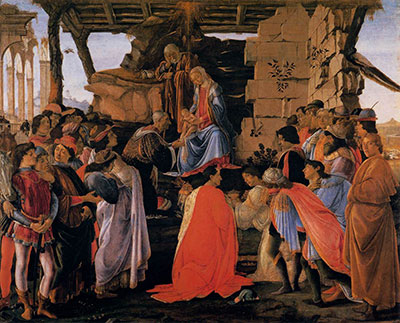
c. 1485Mystic Nativity
1500Contents
- At a Glance
- The Moment in the Tent
- Curtains, Bodies and an Open View
- A Companion Scene, a Different Point of View
- Seeing the Reversal
The Moment in the Tent
The Book of Judith gives the sequence behind the scene. Judith entered the camp of Holofernes, killed him with his own sword and left with her maid, who carried the head. At Bethulia, the head was shown to the people and hung on the city wall. When the Assyrian commanders came to Holofernes' tent to summon him against the apparent Israelite attack, his servant Bagoas went inside. He found the general dead and without a head, then cried out and told the troops. Their fear spread through the camp.[3][4]
Botticelli compresses that chain of recognition into an encounter around the bed. Several men have already reached the body. One near the middle holds his hands up, while another bends towards the corpse. Their armour and layered clothing fill much of the little surface. The bodies overlap so closely that the viewer cannot count the moments between the first person entering and the others gathering. The painting gives us a single image of communal alarm.[2][3]
The biblical account places Holofernes on the floor when Bagoas finds him. Botticelli paints the body sprawled on a bed. That difference need not be treated as an error to correct by imagination. The bed makes the dead man immediately visible across the lower half of the panel, with the men above and behind him. It places the viewers of the painting almost among those who have entered the tent. The painter arranges the episode for visual force rather than copying every physical detail of the written account.[3]
Judith is absent, yet everything here depends on her act. Holofernes' neck shows what has been taken away, and the sword visible among the furnishings recalls the weapon named in the story. The body is exposed, while the person who caused the crisis has already moved beyond the scene. This absence also distinguishes the painting from images that place Judith and the severed head directly before us. The discovery panel is about what the camp sees too late.[2][3][4]
Curtains, Bodies and an Open View
The broad blue canopy curves across the top of the panel, its golden edge tracing the opening. Its deep folds darken the enclosed space. Beneath it, the faces of the men form a cluster of varied responses: attention, disbelief and fear. The canopy directs the eye downward to the corpse, then outward to the lighter country behind the tent. Botticelli uses drapery to control the tiny picture as a stage, but the soldiers' gestures keep it from becoming still.[2]
The horse outside is a sharp counterpoint to the body. Its pale head emerges against the bright distance, close enough to seem connected to the armed men but separate from their crowding. It suggests the army's world just beyond the enclosure. The general's death will not remain private knowledge in his tent; it will move through those waiting outside. In the text, Bagoas rushes out and announces the loss to the troops. The opening behind the horse gives that movement a place in the image.[2][3]
Holofernes takes up the lower foreground without controlling the action any longer. The bed and bedding support his inert body; a red cloth at the right brings a strong colour close to the men who bend over him. Their raised arms and turned heads create energy around someone who cannot answer them. The contrast between that physical stillness and their urgent reaction is the central drama. Botticelli does not need to paint a battle to show an army coming apart.[2][3]
The scale is also part of the experience. At roughly the height of a handspan, the work asks for close viewing. Details that a large reproduction can isolate—the edge of the canopy, the horse's muzzle, a soldier's open palm—would have been gathered in one compact field for an early viewer. The exact first display is unknown, but the panel's smallness makes the attentive act of looking integral to its design.[1][2]
A Companion Scene, a Different Point of View
The Uffizi catalogues this painting with The Return of Judith to Bethulia, inventory 1890 no. 1484. That companion shows Judith and her maid carrying the sword and the hidden head away from the camp. Here the camera, as it were, turns back. The women have gone; the men confront what is left behind. The two pictures therefore divide one aftermath into two points of view. A viewer who sees both understands the cause of the alarm without either panel having to stage the killing.[1][2]
The national catalogue calls the two works a diptych and traces them through later collections. That historical label confirms that they have long been regarded together. It does not, by itself, recover a contemporary hinged frame or a written order from Botticelli's first patron. The Uffizi's current record identifies their later owner as Bianca Cappello. The national catalogue gives an earlier owner, Rodolfo Sirigatti, and says they passed from Bianca to don Antonio de' Medici before entering the Uffizi in 1633. These are collection-history points after the works were painted, not evidence naming the person who commissioned them around 1470.[1][2]
The earlier ownership is recorded in more detail by Raffaello Borghini in his 1584 Il Riposo. He identifies two small Botticelli pictures together, describing this one as Holofernes headless on a bed with his astonished men around him. He says Ridolfo Sirigatti had recently owned the pair and gave them to Grand Duchess Bianca Cappello, understanding that she wished to furnish a scrittoio with paintings and antique statues. That is a contemporary account of Sirigatti's gift and intended destination, not proof that the two panels were actually installed in the study. The national catalogue adds that don Antonio later displayed the pair in the gallery of his Casino on Via Larga before their entry into the Uffizi in 1633.[2][6]
The Uffizi's object database lists the pair in storage, while its June 2026 announcement of the newly arranged Botticelli rooms says the Stories of Judith were placed in new display cases between the rooms devoted to Primavera and The Birth of Venus. The dated installation report is more informative about recent viewing than the older location field. It also shows the pair being presented together today, a modern curatorial choice that should not be confused with proof of their exact fifteenth-century display.[1][5]
The Uffizi discusses Judith as a figure of fidelity and resistance to tyranny in Florentine civic culture. Those meanings suit the narrative of a besieged people saved through her action. They can inform the way we read the frightened soldiers here, but they do not provide a documented political programme for this particular small panel. The museum also notes the installation of Donatello's bronze Judith in the Piazza della Signoria in 1494. That public placement occurred well after Botticelli painted the Uffizi pair, so it belongs to the later life of Judith's image rather than the cause of this work.[1]
The national catalogue records broad agreement on Botticelli's authorship but a narrower debate over the pair's precise place in his early career. It reports Gamba's comparison with the Pollaiolo as support for a date around 1470, while Bettini proposed as early as 1467–68 in view of a perceived Mantegna influence. Those are stylistic arguments, not dates written on the panels. The Uffizi's broader c. 1470–75 remains the practical date for this page while acknowledging that scholars have read the young artist's visual sources differently.[1][2]
Seeing the Reversal
The biblical story ends this phase with the Assyrians overcome by panic. Botticelli begins that reversal inside the commander's tent. The men are armed and numerous, yet all their attention is fixed on one helpless body. Outside, the horse and open landscape hint at the army that must soon hear the news. The picture makes the loss of authority visible before any retreat takes place.[2][3]
Read beside the return panel, The Discovery of the Body of Holofernes turns the same event inside out. Judith moves towards her city carrying proof of deliverance. Holofernes' followers stand over proof of defeat. In this little space, Botticelli makes their gestures, the parted canopy and the motionless general do the narrative work. We see not the strike of a sword but the moment everyone understands its consequence.[1][2][3]
Botticelli and related artworks
Discussion
Which detail changes how you read Discovery of Holofernes?
Reader Insights
How do the men’s gestures register discovery?
What differs between the biblical account and this painted bed?
How does Judith’s companion panel complete the story?
Join the Conversation
Share a source-led observation or question below.
References
- Uffizi Galleries, “The Stories of Judith: the Return of Judith to Bethulia; the Discovery of the Body of Holofernes,” current paired object record, accessed 29 September 2026 View source.
- Italian Ministry of Culture, “Scoperta del cadavere di Oloferne,” national catalogue 0900188556, Uffizi inventory 1890 no. 1487, accessed 29 September 2026 View source.
- U.S. Conference of Catholic Bishops, “Judith, Chapter 14,” New American Bible, Revised Edition, accessed 29 September 2026 View source.
- U.S. Conference of Catholic Bishops, “Judith, Chapter 13,” New American Bible, Revised Edition, accessed 29 September 2026 View source.
- Uffizi Galleries, “The new permanent installation of the Botticelli Rooms,” announcement, 16 June 2026, accessed 29 September 2026 View source.
- Raffaello Borghini, Il Riposo, Florence: Giorgio Marescotti, 1584, book III, pp. 351–52, original edition consulted in Internet Archive scan, accessed 1 October 2026 View source.