 by Tom Gurney
Tom Gurney BSc (Hons) is an art history expert with over 20 years experience
Published on June 19, 2020 / Updated on October 2, 2026
Email: tomgurney1@gmail.com / Phone: +44 7429 011000
A closer look
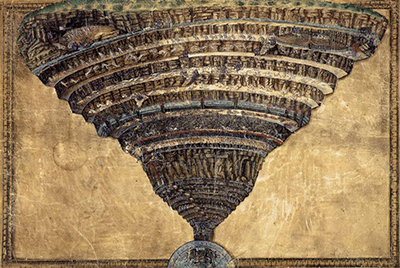
The image opens like a cut through the earth. A broad, inhabited rim contracts through tier after tier until it meets the darkest point below. The small figures do more than fill a diagram: Dante and Virgil's journey can be followed down the same funnel. The work often called Botticelli's Abyss of Hell is the coloured chart of Dante's entire Inferno on folio 101r of a manuscript now in the Vatican Library. It is a visual synopsis of many canti, not the illustration of one isolated episode.[1][2][3]
The manuscript belongs to the celebrated Dante project associated with Sandro Botticelli. The Vatican's catalogue names him among its makers, but its own project essay flags a debate over who executed this particular chart. That distinction matters: the chart can be studied within Botticelli's illustrated Commedia without asserting that every line and painted passage on this leaf is securely by his hand.[1][3]
At a glance
- Current subjectCratere dell'Inferno or chart of Hell, summarising Dante's Inferno
- ArtistAssociated with Botticelli's illustrated Dante manuscript; the execution of this chart is debated
- DateLate fifteenth century for the manuscript; the Vatican essay discusses c. 1485–1500 for the wider project
- MaterialDrawn and coloured parchment leaf within an illustrated manuscript
- Current collectionBiblioteca Apostolica Vaticana
- Shelfmark and leafReg. lat. 1896 pt. A, folio 101r
- ReverseFolio 101v illustrates Inferno I, a different image
The source shelfmark is more precise than the popular title. Folio 101r is the recto, or front, of a surviving manuscript leaf. The Vatican catalogues the reverse as an illustration to Inferno I. A single leaf thus carries two different visual tasks: the comprehensive map on one side and a canto scene on the other. Treating the map as a free-standing panel loses that book relationship.[1][2]
This work in Botticelli’s career
Fortitude
1470The Abyss of Hell
late 15th centuryPrimavera
c. 1480Birth of Venus
c. 1485Mystic Nativity
1500Contents
- At a Glance
- A Map That Is Also a Journey
- Boundaries Within the Funnel
- Ice at the Centre, and the Way Out
- One Exceptional Leaf in a Larger Manuscript
A Map That Is Also a Journey
The picture has the clarity of a cross-section: a wide entrance narrows towards the earth's centre. Yet it is also a narrative. Dante's poem makes its travelers enter, descend, stop, meet figures, cross boundaries and finally turn outward. The Vatican's folio annotations identify many of these stages across the chart. They explain why the image cannot be read merely as nine empty bands marked with the names of sins. Its compressed figures and structures register encounters as well as locations.[4][5]
The Vatican describes Acheron as the first infernal river at the entrance and the first circle as Limbo. Deeper levels become narrower as the punishments become more severe in Dante's moral geography. Even where the old small reproduction makes an individual figure difficult to identify, the stepped contraction is evident. The architecture establishes the direction of travel before any tiny scene is decoded.[4]
Follow the upper bands with the idea of repeated action in mind. Dante and Virgil appear at successive points, so a reader is not meant to imagine that several identical pairs exist at once. Their recurrence turns one static surface into an itinerary. The Vatican's scene annotations move from early crossings and guardians through the inner circles, providing a guide to a visual sequence that is too dense to exhaust at a glance.[4][5]
The design makes an important choice about scale. The whole descent is visible from outside the crater, while the travelers within it are minute. Dante's poem is narrated from the moving poet's position; the chart gives a reader an impossible overview of places he experiences one after another. That change in viewpoint is a strength of the drawing. It allows spatial order and narrative order to be held together on one page, even though they cannot be perceived together by the characters in the poem.[4][5]
Boundaries Within the Funnel
The City of Dis marks a major break. In the Vatican's explanation, its walls divide the upper part of Hell from the lower part. Dante and Virgil pass into the city after an angel opens its gate, then find the fiery open tombs of the heretics. The chart gives that boundary a position in a continuous descent; a single canto drawing could instead enlarge the gate, the angel or the tombs as its main episode.[4][5]
Other guardians and crossings help prevent the circles from becoming an abstract list. The Vatican's annotations identify Minos at the second circle as a judge who assigns destinations, and describe Cerberus in the rain and mud of the third. Such details are text-led identifications in the institutional guide. They do not license a confident label for every tiny mark in the 400-pixel legacy splash. The full manuscript record and annotated viewer are the safer places to test the location of a particular figure.[1][5]
Farther down, the eighth circle is Malebolge. It is not a single plain shelf. Dante divides it into ten ditches or bolge, connected by rocky bridges and separated by banks. The Vatican annotations explain this construction and identify selected scenes, including the fraudulent counselors in flames. In the chart, the geometry of repeated trenches makes the visual space more intricate just as the subject matter becomes more morally differentiated.[5]
The movement into the ninth circle has its own dramatic hinge. At the well of the giants, Dante first mistakes enormous bodies for towers. The Vatican guide names Nimrod, Ephialtes and Antaeus in its reading of this part of the folio; Antaeus carries the travelers to the frozen lake below. This episode is also given room on a separate Berlin Inferno XXXI sheet. There the giants dominate one wide drawing. Here they are one turning point in a map of the entire descent. The difference shows what a synopsis can retain, and what it must reduce.[5][6]
Ice at the Centre, and the Way Out
The point of the cone is Cocytus, the frozen ninth circle. That is a useful correction to the familiar image of Hell as flames from top to bottom. The Vatican's chart commentary places Lucifer in the ice at the deepest point. Its detailed annotations distinguish punishments for several kinds of betrayal around the lake and describe the three-faced figure at the centre.[4][5]
In Inferno XXXIV, Virgil and Dante climb down Lucifer's body. After passing the earth's centre, the direction of movement reverses: what seemed to be a descent becomes an ascent towards the other hemisphere. The Vatican guide and the Princeton Dante Project follow this turn and the travelers' eventual emergence. The chart's narrowing point is therefore not simply a dead end. It is the place where Dante's route changes direction.[5][7]
That ending is easy to miss if one treats the map only as a ranking of sins. The whole sheet offers a route through a story, and stories need exits. A reader can move from the broad inhabited rim down to the tiny central passage, then remember that the poem continues beyond the diagram into Purgatorio. The composition condenses a cantica while pointing to the larger three-part journey.[3][4][5]
One Exceptional Leaf in a Larger Manuscript
The Vatican's project essay reports seven surviving leaves in its collection and 85 in Berlin, now kept loose. It describes the chart as the only completed painted leaf in the group. The wider project is generally linked to Lorenzo di Pierfrancesco de' Medici and dated by scholars, with some variation, around 1485–1500. The essay also cautions that the original format, intended use and degree of completion are still debated.[3][4]
In the Vatican's proposed reconstruction, the scribe Nicola Mangona set the poem in four columns on the front of wide parchment leaves, while canto images generally occupied their reverses. An album opening upwards could have presented picture and corresponding text together. Folio 101 is conspicuous within that pattern: its chart is on the front and its Inferno I illustration on the back. The unusual pairing helps explain the chart's orienting function, but it does not settle exactly how the whole project was first bound or presented.[1][2][3]
Those uncertainties sharpen rather than weaken the object. An elaborately coloured overall chart stands beside numerous linear canto drawings; the comparison suggests different functions within one ambitious enterprise. The chart helps orient a reader across Inferno, while individual sheets linger over a stage of the journey. Botticelli's earlier designs connected with the 1481 printed Commedia form another project and should not be mistaken for impressions of this manuscript leaf.[3]
The survival of the two collections has a history of its own. The Vatican essay traces its leaves through Paris, the collections of Alexandre Petau and Isaac Vossius, and then the library associated with Queen Christina of Sweden. It states that the material was already separated by the seventeenth century. That later path helps explain why a manuscript conceived as a connected sequence must now be understood through holdings in different cities.[3]
The reliable way to read the Abyss of Hell is thus to keep three layers in view. Dante supplied the journey and moral geography. The surviving Vatican leaf presents that geography as a densely populated, coloured descent. Modern catalogue and scholarly work identify many episodes, reconstruct the manuscript context and openly debate the chart's precise hand. The page can honour the power of the image without turning a debated attribution or an uncertain book history into a settled fact.[1][3][4][5]
Botticelli and related artworks
Discussion
Which detail changes how you read The Abyss of Hell?
Reader Insights
How does the narrowing funnel organize the journey?
Where do the small narrative figures change a simple chart?
Why is folio 101r part of a manuscript rather than a separate panel?
Join the Conversation
Share a source-led observation or question below.
References
- Biblioteca Apostolica Vaticana, “Reg. lat. 1896 pt. A,” digitised manuscript record, shelfmark and folio sequence, accessed 29 September 2026 View source.
- Biblioteca Apostolica Vaticana, “Reg. lat. 1896 pt. A,” Viaggiare con Dante thematic catalogue, fols. 101r–v descriptions, accessed 29 September 2026 View source.
- Eva Ponzi, “Una cosa maravigliosa,” Viaggiare con Dante, Biblioteca Apostolica Vaticana, project history, attribution and manuscript discussion, accessed 29 September 2026 View source.
- Biblioteca Apostolica Vaticana, “101r: Cratere dell'Inferno,” annotated folio overview in Viaggiare con Dante, accessed 29 September 2026 View source.
- Biblioteca Apostolica Vaticana, “Reg. lat. 1896 pt. A: Annotazioni,” scene-level notes on folio 101r in Viaggiare con Dante, accessed 29 September 2026 View source.
- Staatliche Museen zu Berlin, “Inferno XXXI: The Giants,” Kupferstichkabinett object record for the related separate Dante sheet, accessed 29 September 2026 View source.
- Princeton Dante Project, “Summary of Inferno XXXIV,” canto synopsis of Cocytus, Lucifer, the turn and exit, accessed 29 September 2026 View source.