by Tom Gurney
Tom Gurney BSc (Hons) is an art history expert with over 20 years experience
Published on June 19, 2020 / Updated on October 2, 2026
Email: tomgurney1@gmail.com / Phone: +44 7429 011000
A closer look
One young man fills this small sheet. Seen mostly from behind, he turns his head to the side and gathers his hands near his waist. Light lines pick out the rounded shoulder, the narrow pleats of his short garment and the long shape of his legs. A second youth is much less complete, emerging behind and to the right. The two form a compact group, yet the drawing does not settle every face and gesture. The 2022 Uffizi/Minneapolis exhibition catalogue calls it Sandro Botticelli's Study of Two Standing Figures, made about 1475, now in the Musée des Beaux-Arts de Lille, inventory 77.[1]
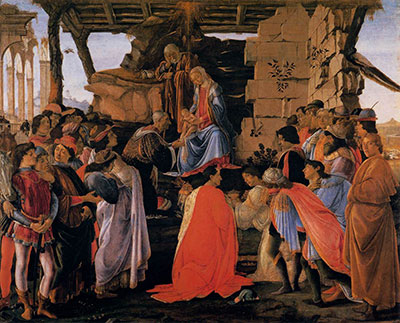
The sheet is connected to two young attendants at the far left of Botticelli's Adoration of the Magi in the Uffizi. That panel was commissioned for the Del Lama chapel in Santa Maria Novella, Florence. The Lille drawing is useful precisely because it is not a miniature finished version of the painting. Its loosely resolved heads, stance and hands show an artist working through how a pair would occupy the foreground of a crowded altarpiece.[1][2][3]
At a glance
- TitleStudy of Two Standing Figures
- AttributionSandro Botticelli in the 2022 Uffizi/Minneapolis catalogue; the Web Gallery of Art raises Filippino Lippi as a possible draughtsman
- DateAbout 1475 in the 2022 catalogue
- TechniqueMetalpoint on tinted paper, heightened with white; WGA calls the surface primed paper
- Dimensions16.5 × 10 cm
- CollectionMusée des Beaux-Arts de Lille, inventory 77, as recorded in the 2022 catalogue
- Related paintingBotticelli's Adoration of the Magi, Uffizi 1890 no. 882, dated 1470–75 by the museum[1][2][3]
This work in Botticelli’s career
Fortitude
1470Study of Two Figures
about 1475Primavera
c. 1480Birth of Venus
c. 1485Mystic Nativity
1500Contents
- At a Glance
- Two Figures on a Narrow Sheet
- How the Pair Appears in the Adoration
- Is One of Them Giuliano de' Medici?
- Botticelli or Filippino Lippi?
Two Figures on a Narrow Sheet
The main youth stands with his weight settled into one leg. His back and right shoulder curve under a short, fitted upper garment. Long pale strokes follow vertical folds, then break into shorter marks at his bent arm and belt. Below, the legs are drawn with a narrower, more economical contour. The body is described well enough to understand its turning pose without the face receiving the detail of a portrait. The rear figure is still fainter: a head and body position are suggested rather than finished to the same degree.[1]
The tinted ground is part of the effect. Metalpoint makes fine, controlled marks on a prepared surface; white heightening brings light to the drapery and edges. On a mid-tone sheet, those bright strokes can describe volume without filling every area with shading. Here, pale lines along the shoulder and clothing bring the nearest figure forward. The softer marks behind him keep the second youth spatially present but subordinate. The uneven finish is visible evidence of a study's working priorities, not damage that needs to be imagined away.[1][3]
At 16.5 by 10 centimetres, this is a small object beside the Uffizi painting's 111 by 137 centimetres. Scale matters to how it was used. A separate sheet could explore a pose or grouping before the painter committed it to an altarpiece crowded with figures. It need not carry the full architectural setting, Magi, Virgin or Child to do that job. The narrow format concentrates on the relationship between the two standing youths and the space they occupy together.[1][2]
How the Pair Appears in the Adoration
In the Uffizi Adoration, a cluster of young men, horses and attendants fills the left foreground. The foremost youthful figure wears a short, colourful garment and stands near a sword. A companion close behind helps form a paired silhouette at the edge of the scene. The Lille sheet studies the posture of two young men for this part of the picture. Cecilia Frosinini, writing about the altarpiece in the 2022 catalogue, calls the drawing preparatory for the foremost figure in a group of pages. Carl Brandon Strehlke's essay in the same book notes how lightly the heads are indicated on the sheet.[1][2]
The relationship is compelling without requiring an exact copy. In the painting the two figures have the colour, costume detail and facial definition needed in a public altarpiece. The drawn pair tests how bodies and hands might fit together before those final decisions. The Web Gallery of Art points out differences in the position of the rear youth's head and hands. Such differences are what one expects from a working drawing: a comparison reveals choices made between sheet and panel, rather than proving that one of the objects is unrelated.[1][3]
The painted scene is much more than a study of costume. The Virgin and Child receive the Magi beneath a ruined structure; crowds surround the act of homage. The Uffizi describes Botticelli's picture as a biblical episode filled with people recognizable as contemporary Florentines. The Lille sheet belongs to the design of that social crowd. It helps explain how the left side of the painting was assembled while keeping the devotional centre on the Holy Family. A viewer need not identify the youths by name to see the painter's interest in their standing, their proximity and the way they lead the eye toward the centre.[1][2]
Is One of Them Giuliano de' Medici?
The left foreground youth in the painting has often been proposed as Giuliano de' Medici. The Uffizi uses qualified language for that identification; Frosinini likewise presents it as a common view amid several debated Medici likenesses in the Adoration. The drawing contains no inscription naming Giuliano. Its heads are only sketchily developed. It can therefore support the connection to a position in the painting, but it cannot independently verify that position's sitter.[1][2]
This is a useful limit. Some people in the Adoration, especially its patron Gaspare del Lama, have stronger historical and pictorial grounds for identification than the young attendants do. Other proposed Medici identities compete with each other. The identity of the youth at far left is part of that scholarly discussion, not an established fact that may be transferred back to every preliminary study of his pose. Calling the Lille sheet “a portrait of Giuliano” would hide the distinction between a compositional drawing and a secure likeness.[1][2]
The limited drawing of the heads may itself show why the figures were studied. Strehlke suggests that their features could have been worked out separately; his point is a reading of the sheet, not proof that particular missing portrait studies once existed. The figure's back, legs and hands needed to fit a group whether or not a later face was meant to resemble anyone in Florence. The sheet still conveys the bodies' social confidence and dressed-up presence, without giving us a dependable name.[1]
Botticelli or Filippino Lippi?
The 2022 Uffizi/Minneapolis catalogue prints this sheet under Sandro Botticelli and supplies Lille inventory 77. The Web Gallery of Art also files it under Botticelli, but its commentary says the draughtsman may have been Botticelli's pupil Filippino Lippi, judging by style. That is not a contradiction to erase by choosing the more familiar name. Designs, copies and execution could circulate among artists in a Renaissance workshop, and resemblance to a Botticelli painting does not by itself prove the master's hand on a related sheet.[1][3]
The records used here do not include a current direct object page from Lille that resolves the attribution. The recent exhibition catalogue is a strong, specifically identified scholarly source; WGA's alternative remains worth telling the reader about. For this page, “catalogued as Botticelli, with a Filippino Lippi possibility noted” is more accurate than an unconditional claim of autograph drawing. The physical identity, dimensions and relation to the Adoration are firmer than the individual hand.[1][3]
The identification of this sheet as a study for the Adoration is not a recent invention. In his 1878 account of Lille's Wicar collection, Louis Gonse listed a group of two standing Florentine youths, old catalogue no. 398. He described one holding a sword, silverpoint with white heightening on lilac prepared paper, and called it a study for the Uffizi Adoration. Gonse judged a small group of neighbouring drawings almost certainly Botticelli's, while considering other sheets nearby possibly Filippino's. His text gives a dated witness to the drawing's appearance and proposed relationship to the painting; it cannot settle today's disagreement over which artist made the marks. The old 398 is a historical catalogue number, not a replacement for the 77 used in the 2022 exhibition book.[1][4]
The reproduction history has a separate limit. The 2022 book credits its photograph to RMN-Grand Palais / Jacques Quecq d'Henripret / Art Resource. The small image circulating through WGA and Wikimedia traces to that older web reproduction, not to a directly licensed Lille file. Neither supplies commercial-use permission for a new large site photograph here. A reader can still examine the study's documented lines in available reproductions, but a publisher needs an image permission decision independent of the object-attribution question.[1][3]
The sheet's main achievement is to make a planning stage visible. A back-turned youth and his less finished companion become, in the altarpiece, part of a lively Florentine crowd around the Magi. The Lille drawing preserves the quieter problem behind that result: how two clothed bodies stand together, where their arms meet and how much definition a painter needs before the larger scene is finished. Its value is in those decisions, with its authorship and the sitters' names stated only as far as the evidence allows.[1][2][3]
Botticelli and related artworks
Discussion
Which detail changes how you read Study of Two Figures?
Reader Insights
How are the two figures arranged on the narrow sheet?
Where do they appear in the Adoration?
Why is the Botticelli or Filippino question unresolved?
Join the Conversation
Share a source-led observation or question below.
References
- Cecilia Frosinini, “Adoration of the Magi,” no. 49, pp. 176–79; fig. 49.1 and caption on p. 179; and Carl Brandon Strehlke, “Botticelli's Faces,” p. 59, in Botticelli and Renaissance Florence: Masterworks from the Uffizi, Minneapolis Institute of Art and Gallerie degli Uffizi, 2022. The caption identifies Lille inventory 77, c. 1475, metalpoint, tinted paper and white highlights; illustration credit on p. 234 View source.
- Gallerie degli Uffizi, Adoration of the Magi by Botticelli, inventory 1890 no. 882, 1470–75 and interpretation of the foreground figures; accessed 1 October 2026 View source.
- Web Gallery of Art, Study of Two Standing Figures, Lille sheet description and Filippino Lippi possibility; accessed 1 October 2026 View source.
- Louis Gonse, Le Musée Wicar (Paris: Gazette des beaux-arts, 1878), p. 45 (digitised PDF p. 55), old no. 398. Original edition directly consulted 1 October 2026. Gonse's attribution is a nineteenth-century opinion, not a current museum determination View source.