by Tom Gurney
Tom Gurney BSc (Hons) is an art history expert with over 20 years experience
Published on June 19, 2020 / Updated on October 2, 2026
Email: tomgurney1@gmail.com / Phone: +44 7429 011000
A closer look
A lean, long-haired man stands almost the full height of a narrow sheet. One arm reaches outward while the other gathers a falling mantle. Brown lines describe his face, hair and body; pale strokes pick out the high folds of the cloth against rose-tinted paper. This is the drawing catalogued as St John the Baptist, Uffizi Gabinetto dei Disegni e delle Stampe 188 E, and attributed to Sandro Botticelli. It is a study of a saintly figure, not a small painting of John alone.[5]
The sheet has often been brought into discussion of Botticelli's San Barnaba Altarpiece, which includes a standing John the Baptist. That relationship helps a viewer understand why a single figure might receive such concentrated attention. It should not turn the drawing into a signed, dated instruction for the finished panel: the records give different date ranges and do not document exactly when or how this sheet served the painting.[1][3][4]
At a glance
- TitleSt John the Baptist (San Giovanni Battista)
- ArtistSandro Botticelli in the Uffizi's 2024 catalogue record
- ObjectDrawing, Uffizi Gabinetto dei Disegni e delle Stampe, 188 E
- TechniquePen and ink, diluted-ink brushwork, lead-white heightening and traces of metalpoint on partly rose-tinted paper
- Size359 × 156 mm in the Uffizi record; other catalogues give slightly different measurements
- DateFifteenth century in the Uffizi record; Zeri's broad c. 1490–1510 range conflicts in part with that dating[1][2][5]
This work in Botticelli’s career
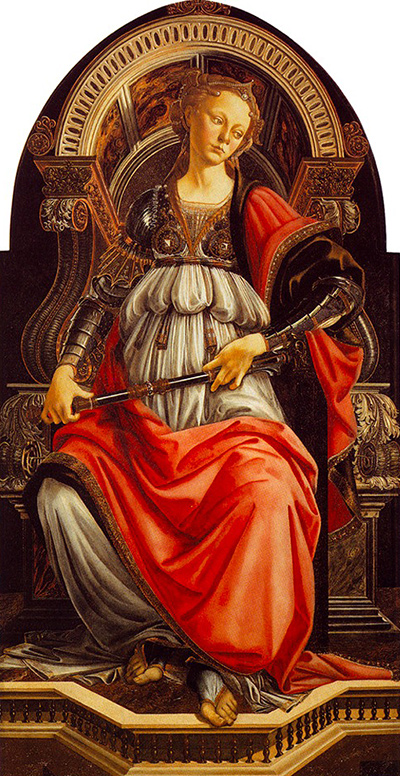
Fortitude
1470Saint John the Baptist
15th century (Uffizi)Primavera
c. 1480Birth of Venus
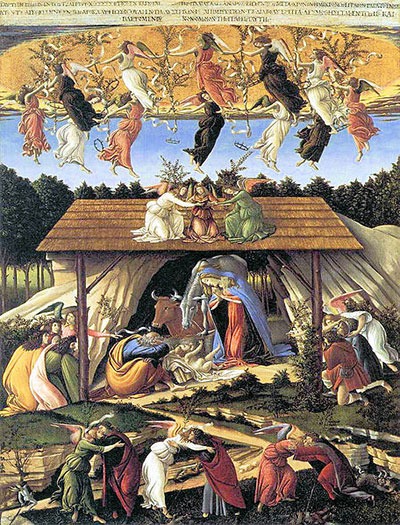
c. 1485Mystic Nativity
1500Contents
Reading the Figure
John's wiry body is revealed beneath and beside the broad cloth. His hair falls in long strands around an intensely worked face. The arm reaching toward the sheet's left edge gives the figure an address beyond the paper, as though he were about to direct attention to someone or something nearby. The other arm brings the drapery across his torso. These unequal gestures keep the tall figure from becoming a stiff, symmetrical saint.[1][2]
The hanging mantle is a second subject of the drawing. Its upper sweep crosses the chest, and a deeper cascade breaks into angular folds over the hip and leg. Dark brown wash settles into the recesses. Light strokes of lead white mark projecting ridges, especially where the cloth turns toward the imagined light. The exhibition listing identifies both the wash and the white heightening; their visible contrast lets us follow the folds before noticing individual line details.[2]
Rose colour appears in the paper rather than in an applied flesh-painting scheme. The exhibition description calls it partly tinted. That qualification matters: the warm ground and the white accents work together without making this a coloured oil or tempera panel. The drawing uses modest materials to suggest volume. A darker mark can define a deep crease, while a few pale touches give the impression of a raised surface.[2]
The head receives a density of marks quite different from the quieter open space beside the figure. Lines accumulate around hair, brow and beard. His legs are more lightly indicated in parts, yet the figure's weight remains legible through the angled stance and the mantle's fall. What looks unfinished in one area may be a deliberate economy: a draughtsman can state the essential turn of a limb with fewer marks than the face or a complicated fold needs. The surviving sheet shows a worked investigation, not a uniformly polished miniature painting.[1][2]
The saint's dress supports the title. A coarse-looking garment beneath the mantle suits John the Baptist's familiar wilderness image; an older Botticelli monograph described it as camel-hair dress, with a scroll and an extended hand. The Uffizi's direct catalogue record reads the surviving scroll as “ECE AGNVS […]”, the beginning of John's declaration in the Gospel, “Behold the Lamb of God.” The missing portion in the catalogue transcription matters: the sheet does not preserve a complete, securely readable sentence just because the biblical wording is familiar.[4][5]
The museum also records traces of metalpoint beneath the ink and a rose-coloured preparation now considerably yellowed. That adds a preliminary marking stage to the pen, wash and white heightening already visible in reproductions. It does not by itself prove that the sheet was pricked, squared or transferred directly to a panel. The current paper colour can also affect how viewers imagine the balance of the original pink ground, brown marks and white accents.[5]
Drawing and Painted Altarpiece
The Uffizi's San Barnaba Altarpiece shows the Virgin and Child enthroned with angels and six saints. John the Baptist stands among them, alongside Ignatius of Antioch and Michael the Archangel on the right side of the composition. The painting was made for the church of San Barnaba and is dated by the Uffizi to about 1487–88. Its large, populated setting is very different from this isolated sheet. The drawing allows the viewer to examine one body, hand and mantle without the altarpiece's architecture or surrounding figures.[3]
Scholars have associated drawing 188 E with the painted John. A historical monograph describes the sheet in relation to the altarpiece, noting the outward gesture and arrangement of drapery. That is a useful visual comparison. The single-figure format can support working through a pose; it does not alone prove a literal transfer from paper to panel, nor does it say whether the sheet is an initial thought, a variant or a later reworking. The Uffizi catalogue observes that no painted Baptist is an exact match and also compares the sheet with the Bardi Altarpiece in Berlin and a Baptist in a Courtauld Trinity with Saints.[4][5]
The same catalogue records a different account of the drawing's function. Carmen Bambach argued in a 1997 exhibition that its careful finish and broadly usable gesture suit a workshop model or exemplum better than a design for one painting. John's free right hand does not hold the scroll, staff or baptismal bowl that would tie the pose to a particular finished scene. That proposal explains how a drawing could guide several later figures without being mechanically copied into any one of them. It remains an interpretation of the sheet's use, not an inventory of every workshop occasion on which it was seen.[5]
The dates demand particular care. The Uffizi dates the finished altarpiece around 1487–88 and places the drawing generally in the fifteenth century, but the Zeri photo-archive entry assigns drawing 188 E a broader c. 1490–1510 range. These are positions attached to different records, not compatible exact years that can be averaged. The drawing's possible relation to several paintings does not settle the sequence. This page therefore describes the sheet and its proposed relationships without putting a definite year in its title.[1][3][5]
The inventories must also stay apart. 188 E names the drawing in the Uffizi prints-and-drawings collection. The altarpiece's painting inventory is 1890 no. 8361, with separate numbers for its predella parts. The altarpiece is tempera on wood and measures 268 × 280 cm. Those are the painting's properties, not the drawing's. A search for John the Baptist in Botticelli can lead to both objects; this page concerns the single figure on paper.[1][3]
There is a second subject distinction within the painted altarpiece itself. Its predella includes Salome with the Head of the Baptist, a narrative of John's death. That small scene is neither the standing Baptist in the main altarpiece nor this preparatory-looking figure study. Keeping these related images distinct makes the drawing's achievement easier to see: it explores John's bodily presence and cloth rather than recounting an episode.[3]
Catalogue Facts and Open Questions
Fondazione Federico Zeri records a Botticelli attribution, pen on paper, 360 × 155 mm, a broad c. 1490–1510 date and Uffizi inventory 188E. A Bologna exhibition listing supplies a more detailed technique and 358 × 155 mm. The Uffizi's updated record gives 359 × 156 mm and adds metalpoint traces. These small differences may reflect measurement or rounding conventions; the sources do not explain them. The owning museum's direct record is the strongest current basis for the object facts, while the older descriptions show why search results do not all agree.[1][2][5]
The Uffizi catalogue also traces the sheet's history as a collected drawing. A name written at the lower left may be an old attribution by Filippo Baldinucci, who organised Cardinal Leopoldo de' Medici's collection; the catalogue treats that identification of the writer as possible, not certain. It considers the sheet likely to have belonged to the group of twenty Botticelli drawings Baldinucci listed in 1687. Giuseppe Pelli Bencivenni's late eighteenth-century inventory then describes a standing Baptist in the relevant volume, using details of pen, wash and white on a reddish ground. Those records support a long-standing Botticelli attribution and a collection history, although the proposed identification with Baldinucci's earlier group remains a reasoned match rather than an uninterrupted ownership chain.[5]
The attribution in those catalogues is Botticelli. They do not, by themselves, show every stage of the sheet's early ownership or establish a documentary link to the San Barnaba commission. The image we can study has the lively variation of a drawing made for looking and testing: thin contour, pooled brown wash and white marks used in different densities. The paper preserves choices a finished painting would conceal. That is the page's central reason to treat 188 E as an artwork in its own right, even when it is studied beside a much larger painted saint.[1][2][3]
Botticelli and related artworks
Discussion
Which detail changes how you read Saint John the Baptist?
Reader Insights
How does the figure occupy the tall sheet?
What identifies the saint on his scroll?
Why might this be a workshop model rather than a design for one painting?
Join the Conversation
Share a source-led observation or question below.
References
- Fondazione Federico Zeri, “Filipepi Alessandro, San Giovanni Battista,” photo archive entry 107965, Uffizi GDSU 188E; artist, medium, measurements, broad dating and bibliography, accessed 1 October 2026 View source.
- Comune di Bologna, 2015 exhibition listing of Uffizi drawings, object line for San Giovanni Battista, GDSU 188 E; technique and 358 × 155 mm dimensions, indexed text checked 1 October 2026 View source.
- Uffizi Galleries, “The San Barnaba Altarpiece,” painted work with John the Baptist among its saints, c. 1487–88; separate object data and predella titles, accessed 1 October 2026 View source.
- Herbert P. Horne, Alessandro Filipepi, commonly called Sandro Botticelli, painter of Florence, historical discussion of the Uffizi sheet numbered 188 and its relationship to the altarpiece; used for attributed comparison, not current cataloguing, accessed 1 October 2026 View source.
- Uffizi Galleries, Progetto Euploos catalogue record for drawing 188 E, updated 9 July 2024, object materials, dimensions, inscriptions, collection history and Cristina Casoli's 2015 critical discussion of alternative painted comparisons and Carmen Bambach's workshop-model proposal; consulted 1 October 2026. The record transcribes older inventories but does not reproduce every original archival document in full View source.