by Tom Gurney
Tom Gurney BSc (Hons) is an art history expert with over 20 years experience
Published on June 19, 2020 / Updated on October 2, 2026
Email: tomgurney1@gmail.com / Phone: +44 7429 011000
A closer look
Mary sits high at the centre of a marble setting, holding the infant Jesus. Four saints stand to either side, and two kneel close to the front edge. Their red and dark garments create a pattern across the broad panel, but each figure has a separate relation to the enthroned pair. Some look inward, one looks out, and the child turns toward a saint beside him. The scene has the order of a formal sacred gathering and the varied attention of people sharing a space.[1]
The painting is often called the Sant'Ambrogio Altarpiece. That name is useful but needs care: it records a later association with the Florentine convent of Sant'Ambrogio, not a proven original commission for it. The Uffizi dates Botticelli's large tempera panel to about 1470 and calls it one of his first altarpieces. Its six saints are Mary Magdalene, John the Baptist, Francis of Assisi, Catherine of Alexandria, Cosmas and Damian.[1]
At a glance
- Uffizi titleVirgin and Child Enthroned with Saints Mary Magdalene, John the Baptist, Francis of Assisi, Catherine of Alexandria, Cosmas and Damian
- Common nameSant'Ambrogio Altarpiece or Madonna and Child with Six Saints
- ArtistSandro Botticelli
- Dateabout 1470, a stylistic dating in the Uffizi record
- Mediumtempera on panel
- Dimensions170 × 194 cm
- CollectionUffizi Galleries, Florence
- Inventory1890 no. 8657
These facts identify the panel behind a title that otherwise sounds generic. The Uffizi's record also states that it was restored in 2019 by the Opificio delle Pietre Dure. That treatment and its accompanying investigations revealed that Botticelli changed important parts of the design while making it.[1][2]
This work in Botticelli’s career
Fortitude
1470Six Saints Altarpiece
about 1470Primavera
c. 1480Birth of Venus
c. 1485Mystic Nativity
1500Contents
- At a Glance
- A Gathering Around the Throne
- Why Call It the Sant'Ambrogio Altarpiece?
- An Early Work Still Being Rethought
- Looking Again at the Six Saints
A Gathering Around the Throne
The central throne lifts Mary above the black-and-white floor. The child rests in her lap, surrounded by her blue mantle and red clothing. Behind her, the architecture rises in orderly panels and curves. Its coloured marble gives the sacred figures a setting that feels monumental, even though the saints stand close enough to Mary to form one group.[1]
Four standing figures frame this centre. John the Baptist and Francis of Assisi are among them, together with Mary Magdalene and Catherine of Alexandria. Their heights and upright poses create two side walls of people rather than a distant crowd. The saints in front break that symmetry: the kneeling Cosmas and Damian occupy the threshold nearest the viewer. Their red garments pull the eye down from Mary's blue mantle to the tiled floor.[1]
The two kneeling saints are identified on the painting by inscriptions reading “S. COSIMUS” and “S. DAMIANUS.” Both were revered as physician saints. Their prominence is why the Uffizi proposes a link to the Florentine Guild of Physicians and Apothecaries or to the Medici family as possible commissioners. The inscriptions identify the figures; they do not name a patron or prove either proposal.[1]
The black-and-white floor leads the eye toward the throne. It also makes the front edge of the picture feel close, where the kneeling saints meet the viewer's space. Botticelli sets the saints at different depths, so the composition is neither a flat row of holy figures nor a naturalistic crowd. The throne and architecture give a stable centre, while their gestures and glances circulate attention around the child.[1]
Why Call It the Sant'Ambrogio Altarpiece?
The Uffizi traces the panel to the Benedictine convent of Sant'Ambrogio in Florence. It entered the collections of the Florentine galleries after the convent was suppressed in 1808, passed through the Galleria dell'Accademia and reached the Uffizi in 1948. That history explains the familiar name. It does not take the record back to a commission in Botticelli's own time.[1]
The museum expressly doubts that the convent was its first destination. No saint linked to the Benedictine order or to the church's dedication appears in the group. Cosmas and Damian instead point toward other possible patrons. The panel may have been intended for a different altar or institution, but the surviving evidence does not allow a specific first setting to be stated as fact.[1]
This uncertainty changes how the arrangement can be read. The two physician saints are not incidental extras added to a conventional list. Their front-row positions, red robes and inscriptions make them important to the painting's public address. We can see their emphasis and understand the museum's hypotheses without turning one hypothesis into a commission document.[1]
The Italian national catalogue records a more specific but disputed alternative: Carlo Gamba proposed that this was the altarpiece which early writers said Botticelli made for the nuns of Santa Elisabetta delle Convertite. The presence of Mary Magdalene, associated with repentant women, and of Cosmas and Damian could fit that house and its connection to the physicians and apothecaries' guild. But the same catalogue stresses that the sixteenth-century references do not describe the Santa Elisabetta painting. It also notes that neither the convent's titular Saint Elizabeth nor Saint Augustine, whose rule its nuns followed, appears here. Those absences cannot disprove the suggestion on their own, but they prevent a firm match between this surviving panel and the documented yet undescribed commission.[3]
The catalogue further records a proposal that a predella with scenes of Mary Magdalene in Philadelphia once formed the altarpiece's base. That would make the prominence of Magdalene more consequential if the join could be established. The record presents it as a scholarly hypothesis, not a surviving physical attachment. Identifying a detached predella, a lost convent commission and a known large panel as one ensemble requires stronger evidence than compatible saints alone. Until then, Sant'Ambrogio remains a later documented location and Santa Elisabetta a possible earlier destination, not two secure names for the same commission.[3][1]
An Early Work Still Being Rethought
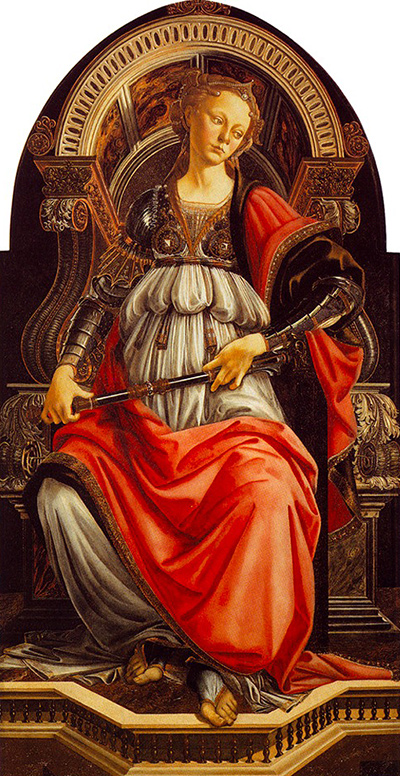
The Uffizi places the altarpiece around 1470 partly because of its stylistic relationship to Botticelli's Fortitude, painted that year. It calls the panel an early monumental commission. The saints' forms recall his teacher Filippo Lippi, while the classical marble setting and carefully observed drapery suggest an interest in the practice associated with Verrocchio's workshop. The Uffizi presents those connections as stylistic readings, not records that identify each hand in the painting.[1]
The 2019 conservation study gives a more surprising picture of how the panel was made. Infrared reflectography, X-radiography and examination of the finished paint revealed many substantial revisions. Botticelli first planned a structured floor, then replaced its central portion with a platform that raised Mary. The child changed position: the investigators found an earlier orientation of his eyes and an altered leg. The carefully balanced final group was reached through decisions made during work, rather than simply transferred intact from an initial drawing.[2]
Cosmas changed too. The study found that his head had first been directed upward toward Mary; in the finished painting it sits lower and turns toward the viewer. His clothing was also shifted, leaving a trace of its former placement visible on close inspection. His present gaze helps connect the sacred scene to the person standing before it. The revision therefore affects how the picture addresses its audience, not merely a minor contour.[2]
At the far right, Catherine's hand preserves signs of late changes to a thumb and the tip of a little finger. Investigators also found a pair of incised eyes beneath the final area of her robe. One proposed explanation is that Botticelli first imagined Catherine kneeling and then made her stand. The marks are real evidence of planning beneath the surface; the proposed earlier pose remains an interpretation. The Uffizi itself notes that a certain answer is not yet available.[2]
Opificio art historian Cecilia Frosinini proposes that this repeated rethinking may reflect Botticelli's training with Filippo Lippi, who also revised compositions as he worked. That is a specialist explanation of the working method, not a documented lesson or proof that Lippi helped paint this panel. Frosinini also says the newly visible design stages may offer grounds to revisit the commission. They have not identified a patron: the guild and Medici suggestions still rest chiefly on the prominent physician saints, not on a newly discovered contract.[1][2]
The panel's appearance has also affected its attribution history. The national record reports extensive sixteenth-century repainting, especially around Mary and the Child, and notes older assignments to Domenico Ghirlandaio, Andrea del Castagno and the school of Botticelli before the Botticelli attribution became accepted. These names belong to the history of cataloguing the altered picture, not to a modern claim that those artists jointly painted it. The record lists a 1991–95 restoration under S. Scarpelli, while the Uffizi's separate account describes the 2019 Opificio investigation. Neither brief public source supplies a full treatment report for every intervention. The conservation history is thus relevant to why earlier viewers disagreed, but the exact scope of removed and surviving repainting still needs a technical publication.[3][2]
The restoration also dealt with problems in the wooden support and areas where paint had lifted. The findings are more than a curiosity about hidden lines. They show Botticelli revising the architecture, the child's movement and the saints' relationship to the viewer over several stages. A work that looks ceremonially settled in its final form was built through a sequence of adjustments.[2]
Looking Again at the Six Saints
Knowing about those changes, begin with the platform beneath Mary. It establishes her height and brings the child into the sightlines of the surrounding saints. Follow the tiled floor forward to Cosmas and Damian, then move up through the standing figures. The repeated reds, blues and dark robes make the broad panel coherent, while the positions of heads and hands prevent the six saints from becoming interchangeable.[1][2]
This is a different altarpiece from Botticelli's later Bardi Altar in Berlin, where Mary is accompanied by the two Johns and a documented Bardi commission. The Uffizi panel has six saints and an uncertain first destination. Its common title comes from a later convent history, while its physician saints and material revisions give us the sharper questions: who may have ordered it, and how did Botticelli arrive at this arrangement?[1][2]
The painting holds those questions in view. The Uffizi can identify its figures, date it approximately and trace its later movement; the first patron remains unknown. Conservation lets us see Botticelli testing the positions that now seem inevitable. Mary and the child still command the centre, but the saints around them reveal a young painter turning a formal gathering into an active composition.[1][2]
Botticelli and related artworks
Discussion
Which detail changes how you read Six Saints Altarpiece?
Reader Insights
How do the kneeling saints draw you towards the throne?
What can the saints’ inscriptions establish?
Why is the first commission still uncertain?
Join the Conversation
Share a source-led observation or question below.
References
- Uffizi Galleries, Daniela Parenti, “Virgin and Child Enthroned with Saints Mary Magdalene, John the Baptist, Francis of Assisi, Catherine of Alexandria, Cosmas and Damian,” inventory 1890 no. 8657, current object record; accessed 29 September 2026 View source.
- Uffizi Galleries, “The Restoration of a Youthful Work by Sandro Botticelli Reveals How the Young Master Worked,” 13 June 2019, report on Opificio delle Pietre Dure examination and treatment of the Sant'Ambrogio Altarpiece; accessed 29 September 2026 View source.
- Italian Ministry of Culture, full national catalogue card for the Madonna and Child Enthroned with Saints, record 0900188565, pp. 3–4 (PDF pp. 3–4), older attributions, Santa Elisabetta and predella hypotheses, repainting and 1991–95 restoration metadata; card compiled 1985 and updated through 2006, consulted 1 October 2026. Its historical proposals are not a record of the original commission or a substitute for the 2019 technical report View source.