 by Tom Gurney
Tom Gurney BSc (Hons) is an art history expert with over 20 years experience
Published on June 19, 2020 / Updated on October 2, 2026
Email: tomgurney1@gmail.com / Phone: +44 7429 011000
A closer look
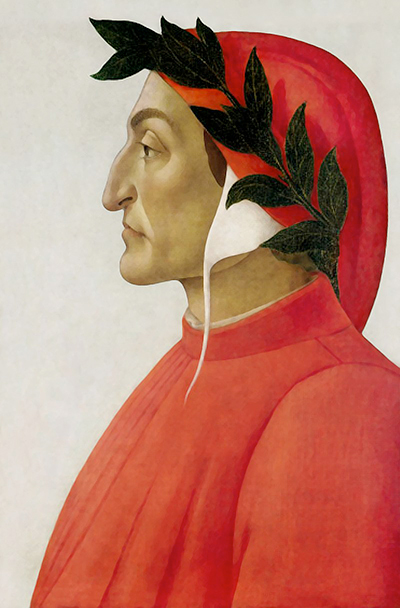
Dante faces left in a strict profile. A long nose, lowered eye and firm mouth give the pale face a sharply drawn outline against an almost empty background. A red hood and robe surround his head and shoulders; a white undercap drops a narrow tie beside his cheek. Dark laurel leaves cross the red cloth. This is the pale-background Portrait of Dante Alighieri linked to Botticelli's circle. The Fondazione Federico Zeri catalogues the painting as workshop of Sandro Botticelli, while recording Botticelli himself as an alternative attribution.[1]
The portrait has often been reproduced simply as “Botticelli's Dante.” That label leaves out two material questions. Who painted the image remains debated, and similar red-capped Dante portraits exist. The light-ground composition on this page matches Zeri's historical photograph and the image used in a 2021 Fondation Martin Bodmer exhibition guide. A dark-ground Dante portrait shown in the Bodmer museum is a different version. Keeping them apart lets the profile be read as a specific object rather than as a generic symbol of Dante.[1][3]
At a glance
- TitlePortrait of Dante Alighieri (Ritratto di Dante Alighieri)
- AttributionBotticelli's workshop in Fondazione Zeri's lead entry; Botticelli alone is listed there as an alternative
- Date1490–1510 in Zeri's broad range; about 1495 in later catalogue and exhibition references
- SupportCanvas; WGA calls the painting tempera, while Sotheby's 2019 comparison note calls it oil
- Dimensions54.7 × 47.5 cm
- Documented locationsZeri records the M. Bodmer collection, Cologny, as its last-known historical location; a 2019 Sotheby's reference says private collection, Geneva. The pale-ground portrait was reproduced for a 2021–22 Bodmer exhibition. Present owner and location are unverified.[1][2][3][4]
This work in Botticelli’s career
Fortitude
1470Portrait of Dante
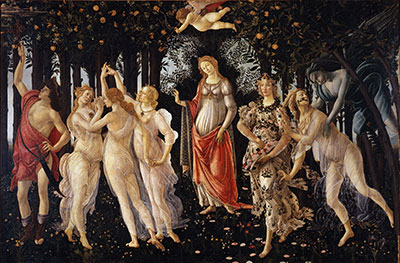
1490–1510 broad rangePrimavera
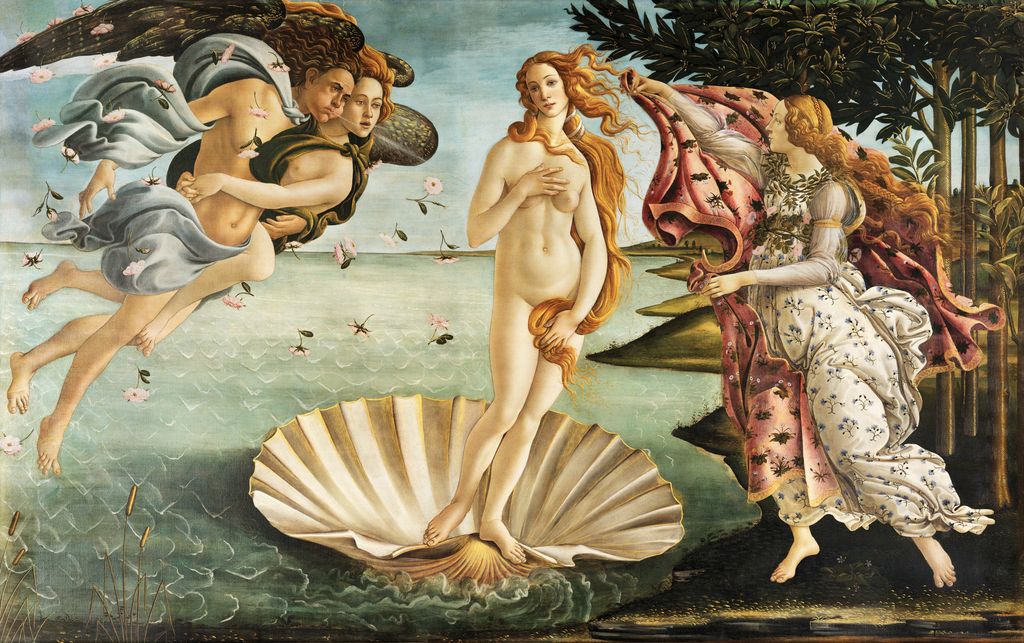
c. 1480Birth of Venus
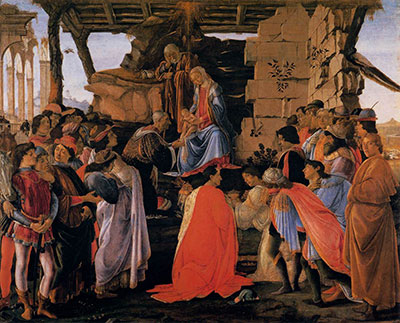
c. 1485Mystic Nativity
1500Contents
- At a Glance
- A Face Made from Familiar Signs
- Where the Visual Type Came From
- Whose Hand Painted This Version?
- The Pale Portrait and the Dark Version
- Location and the Limits of the Record
A Face Made from Familiar Signs
The face is nearly all contour. Its long bridge and hooked tip run from the forehead into the space before the lips, and the jaw descends in a thin line into the neck. Dante does not look toward us. The single visible eye is lowered, so the portrait offers no exchange of glances with a spectator. It gives an immediately recognizable silhouette instead. The plain field behind him removes furniture, books and scenery that could date or explain a particular setting.[1][3]
Colour and costume carry the rest of the identification. The red robe fills the lower half of the canvas; its broad folds are subdued enough that the head remains the centre. The hood's red arch frames the face, while the white cloth beneath it opens a bright wedge at the ear and falls as a thin line. Laurel leaves arc across the forehead and toward the back of the hood. The wreath names the sitter as a celebrated poet in the visual language of portraits. There is no inscription in the pictured composition, yet the combined profile, cap, clothing and laurel were already established signs of Dante by the time this version was made.[1][4][5]
This is therefore a posthumous image, not a likeness painted from life. Dante died in 1321; Zeri's proposed date begins in 1490, more than a century and a half later. The shape of the face may convey a tradition of how Dante was imagined, but it cannot alone document his exact features. A reader can admire its incisive line without mistaking a later Florentine type for a sitter present before the painter.[1][5]
Where the Visual Type Came From
An earlier public example stood in Florence Cathedral. The Opera di Santa Maria del Fiore records that Domenico di Michelino's large image of Dante, Florence and the Divine Comedy was commissioned in 1465, on the bicentenary of the poet's birth. It shows Dante with red clothing, an aquiline nose and laurel, surrounded by Florence and the three realms of the poem. These signs were therefore familiar before the pale-background portrait's late-fifteenth-century date range.[5]
The two works solve different visual problems. Domenico's Dante points the viewer toward a city and an imagined geography of Hell, Purgatory and Paradise. The smaller portrait removes that story and leaves a single recognizable poet. It does not prove that the workshop painter copied Domenico's particular figure: similar traits circulated in other Florentine depictions. The comparison shows why laurel, red dress and a strong profile could identify Dante even without a title written beside him.[1][5]
Botticelli's wider engagement with Dante offers another context, but it is not an object-identity shortcut. The artist and his circle produced an illustrated Divine Comedy in which the traveller Dante appears repeatedly within narrative landscapes. This portrait isolates the poet from those episodes. It is neither one of the parchment canto drawings nor evidence that the same hand painted the portrait and drew every surviving sheet. A viewer meeting Dante here is asked to recognize an author; the canto sheets ask the viewer to follow a journey.[1][5]
Whose Hand Painted This Version?
The Zeri catalogue places this exact portrait in its Botticelli workshop group. Its entry records Botticelli as another published attribution, rather than silently merging the two opinions. The accompanying black-and-white archive photograph matches the legacy pale-ground image: the branching laurel, undercap and garment contours align. Zeri records the support as canvas, the size as 54.7 × 47.5 cm, and a deliberately broad 1490–1510 range. None of those fields supplies a signature or documented commission.[1]
Other sources use firmer names. The Fondation Bodmer's 2021–22 La Fabrique de Dante teaching materials introduce a celebrated original portrait “by Botticelli” and reproduce the same pale-ground composition. A 2019 Sotheby's catalogue, discussing a different Florentine-school portrait of Dante, cites a Botticelli profile from about 1495 and the same measurements. These references establish that the painting has circulated under the master's name. They do not cancel the Zeri archive's workshop assessment. A useful public label is therefore “catalogued as Botticelli workshop; also attributed to Botticelli.”[1][2][3]
Even the paint medium is not settled by the sources consulted. Zeri specifies canvas but no binder. The Web Gallery of Art gives tempera on canvas; Sotheby's 2019 comparative footnote gives oil on canvas for the 54.7 × 47.5 cm Geneva portrait. Rather than choose a technique from the image's appearance, the support can be stated confidently and the tempera/oil disagreement left visible. A digital photograph cannot resolve it.[1][2][4]
The Pale Portrait and the Dark Version
The distinction between versions is particularly important in Geneva. The pale-ground portrait is the one in Zeri's historical photograph and in the 2021 Bodmer exhibition dossier. Another painting displayed by the Fondation Martin Bodmer has a black background, a dark-framed head, and visibly different handling of the face and red garment. The two share Dante's profile, hood and laurel, which makes mistaken identification easy in small reproductions, but they are not the same canvas with the background recoloured.[1][3]
The Bodmer exhibition described its celebrated original portrait as a loan. That statement is compatible with a privately held pale-ground work appearing temporarily alongside a Bodmer-held dark version, but it does not itself provide a complete loan agreement or present-day inventory. The page's picture must not inherit a dark variant's museum number or its photograph. Nor should the dark version's attribution automatically decide the pale portrait's painter. They are separate objects with related iconography and separate evidence trails.[1][3]
Location and the Limits of the Record
Zeri's archive lists an earlier R. Langton Douglas collection in London, then the M. Bodmer collection in Cologny as the last location known to that catalogue. Its photograph was made in the early twentieth century. A later scholarly note in the 2019 Sotheby's catalogue names a private collection in Geneva for the profile of the same dimensions. The 2021 Bodmer teaching material shows the pale portrait in its exhibition context and describes a loan from outside. These statements are dated snapshots, not a continuous chain of ownership to the present.[1][2][3]
The simplest current claim is also the most precise: present owner and physical location are unverified. It is fair to report the historical Bodmer connection, 2019 Geneva private-collection reference and 2021–22 exhibition, each with its date and source. It would be misleading to say without qualification that the pale portrait is permanently in the Bodmer museum, or to infer that its exhibition loan identifies its legal owner.[1][2][3]
Dante's pared-back profile has remained persuasive because it makes a literary figure readable through a few strong signs. The open pale field, taut facial edge and laurel-lined red hood leave almost nothing to compete with his identity as poet. The painting also illustrates how an image can be famous while its maker, exact medium and present address remain less certain than its subject. Those limits belong in the account of this particular portrait, not in a footnote hidden behind the familiar Botticelli name.[1][2][3][4]
Botticelli and related artworks
Discussion
Which detail changes how you read Portrait of Dante?
Reader Insights
Which signs make the sitter recognisable as Dante?
How does this pale version differ from the dark portrait?
Why is a workshop attribution plausible?
Join the Conversation
Share a source-led observation or question below.
References
- Fondazione Federico Zeri, Ritratto di Dante Alighieri, work URL 16478, catalogue entry 14544, workshop lead attribution, canvas, measurements, date range, historic locations and linked photograph; accessed 1 October 2026. Its image licence is CC BY-NC-ND 4.0 View source.
- Sotheby's, Portrait of Dante Alighieri, lot 1, Master Paintings Evening, New York, 31 January 2019, catalogue note and footnote 3. The auctioned c. 1530 panel is a different portrait; the footnote is the source for this profile's c. 1495, oil-on-canvas, 54.7 × 47.5 cm, private Geneva reference View source.
- Fondation Martin Bodmer, 2021–22 education programme for La Fabrique de Dante and exhibition teaching dossier, especially p. 7's pale-ground portrait reproduction and pp. 4, 19 on the exhibit loan and display; accessed 1 October 2026 View source View source.
- Web Gallery of Art, Portrait of Dante, c. 1495, tempera-on-canvas catalogue description; accessed 1 October 2026 View source.
- Opera di Santa Maria del Fiore, Domenico di Michelino, Dante, Florence and the Divine Comedy, commission, date and traditional costume/face; accessed 1 October 2026 View source.