by Tom Gurney
Tom Gurney BSc (Hons) is an art history expert with over 20 years experience
Published on June 19, 2020 / Updated on October 2, 2026
Email: tomgurney1@gmail.com / Phone: +44 7429 011000
A closer look
An angel leans so close to the Christ Child that their faces almost meet. Another appears just behind, while Mary supports the boy across her lap. He raises one hand to his mouth; his other holds a small fruit. The ordinary motion of a child sits inside an unusually crowded sacred group. This is Sandro Botticelli's Virgin and Child with Two Angels in the Musée des Beaux-Arts de Strasbourg, inventory MBA 558.[1][2]
The title is easy to confuse with other Botticelli Madonnas. The Strasbourg panel has two angels at the right, a lily rising above them, a marble structure and vase at the left, and the Child's hand at his mouth. A Naples painting with two angels, a Metropolitan Museum oval, and a close Angers variant are separate objects. Keeping the museum and inventory number in view lets the details of this particular painting come forward.[1][2][3]
At a glance
- WorkVierge à l'Enfant avec deux anges (Virgin and Child with Two Angels)
- ArtistSandro Botticelli in the Strasbourg and French national catalogues; a historical workshop attribution is recorded by Strasbourg
- DateAbout 1467–1468 in Strasbourg's catalogue; 1468–1469 in the national Joconde notice
- MaterialOil on wood, as catalogued by both institutions
- Size107 × 75 cm for the panel; 129.5 × 98 cm overall in the catalogue measurements
- CollectionMusée des Beaux-Arts de Strasbourg, MBA 558
- Original commissioner or settingNot established in the cited records[1][2]
This work in Botticelli’s career
Fortitude
1470Strasbourg Madonna
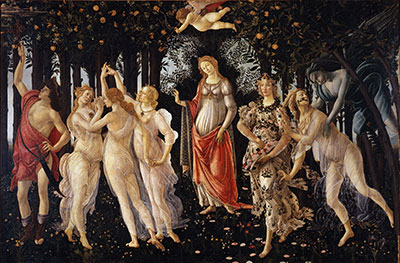
about 1467–69Primavera
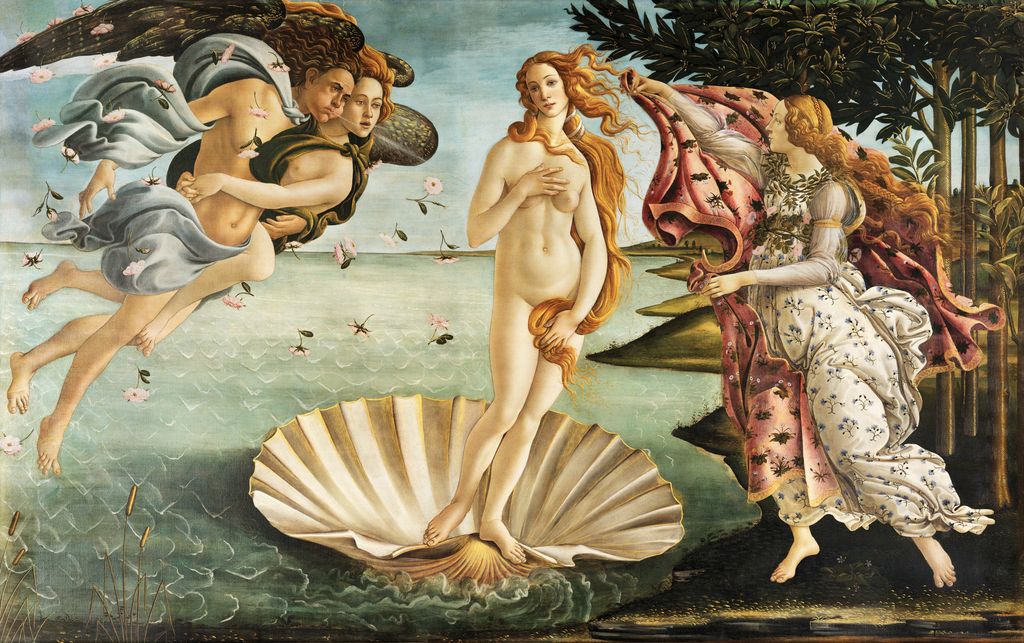
c. 1480Birth of Venus
c. 1485Mystic Nativity
1500Contents
- At a Glance
- A Child at the Centre of Attention
- Marble, Book, Flowers and Trees
- An Early Botticelli and His Florentine Models
- A Close Variant in Angers
- How the Panel Reached Strasbourg
A Child at the Centre of Attention
Mary sits at the left, dressed in red under a dark mantle. Her face is lowered towards the Child, and her hands give his small body a stable seat. He is not held rigidly upright for display: his legs run across her lap, one hand rises to his mouth and the other holds the fruit. The angels close in from the right, turning the usual mother-and-child pair into a compact exchange of looks, hands and overlapping forms.[1][2]
The closest angel bends toward the child's face. The second appears behind, partly enclosed by the first and by the tall lily stem. Their nearness matters more than any invented conversation between them. Together they make the Child the point toward which the group leans, while Mary's larger, calmer figure provides its weight. The composition moves across the panel from her bent head through his small gestures to the angels' attentive faces.[1][2]
The museum's description notes something distinctive about the boy: his body is relatively substantial and his expression less idealised than in many Botticelli Madonnas. This is a useful observation, even if judgements about beauty are inevitably subjective. The Child's fullness makes the physical support of Mary's hands and the angels' closeness more immediate. The sacred figure has a recognisable human body's awkward weight.[1]
The national catalogue identifies the fruit in his left hand as an apple. Its keyword list also includes pomegranate, but the detailed figure description says apple. It is safer to keep the described fruit and the visible small round shape distinct from a certain symbolic reading. In Christian painting, fruit can prompt thoughts about fall and redemption, yet the object record does not prove that a specific theological programme was ordered for this panel.[2]
Marble, Book, Flowers and Trees
The figures are close enough to fill most of the painted surface, but they do not float in an empty field. A marble construction rises beside Mary. A vase sits above it, and the Strasbourg museum singles out the book placed on a low wall, the vase and roses as motifs later repeated in Florentine compositions. These details give the scene a tangible setting: carved stone, a handled book and planted or cut flowers provide different textures around the soft bodies and cloth.[1]
The lily is more conspicuous. It is held by one of the angels and lifts above the crowded heads, creating a slender vertical line through the upper-right part of the scene. The French national notice lists the lily among the panel's identifying subjects. Its familiar association with Mary's purity is a plausible devotional reading, but the picture does not explain how every flower, fruit and vessel was understood by its first viewers. Looking at their positions is a firmer starting point than giving each a fixed dictionary meaning.[1][2]
Behind the figures, three trees stand against the blue sky in the national description. That opening prevents the high marble mass and close group from sealing the whole scene. The stone at the left and the soft distance behind the angels produce two kinds of space: a near place where hands touch and objects can be held, and a farther place where the figures have room to breathe.[2]
The contrast also helps the viewer navigate the painting. The eye can move from the bright child's body to the darker clothing that supports it, then upward by the lily and outward through the trees. The book, vase and carved surface slow that movement and bring it back to the human scale of the foreground. The arrangement makes a densely furnished image readable without reducing it to a list of symbols.[1][2]
An Early Botticelli and His Florentine Models
Strasbourg dates the panel to about 1467–1468; the French national Joconde entry gives 1468–1469. The ranges overlap, and both place it among Botticelli's early Madonna paintings. They should not be blended into one false exact year. These dates are catalogue assessments, not a date painted on the surface or a surviving payment record.[1][2]
The Strasbourg catalogue describes a strong connection to Fra Filippo Lippi, Botticelli's teacher. It also reports that some scholars, especially Roberto Salvini, saw accents of Andrea del Verrocchio in Mary's lips and the angel's carefully rendered dress. These are comparisons of visual language: they help place the panel among Florentine ways of forming faces, cloth and tender sacred groups. They do not prove which master designed a particular feature or how long Botticelli worked on each passage.[1]
The painting's early date makes the interplay between inherited model and local choice interesting. The Child is lively and heavy; Mary is poised; the angels are packed into a narrow right-hand space. The composition allows a young artist to test how four bodies can appear close without losing their separate gestures. Its success is not solely in the prettiness of Mary's face or the fineness of an angel's sleeve. The figures hold one another in a believable sequence of attention.[1][2]
The museum attributes the work to Botticelli, as does the French national catalogue. Strasbourg also records Bernard Berenson's historical view that it was a workshop version. That dissent belongs in the history of the attribution, while the current owner label remains Botticelli. Presenting the difference openly is more accurate than either suppressing it or turning the painting into an anonymous work by default.[1][2]
A Close Variant in Angers
The Musées d'Angers identify an instructive near variant of the Strasbourg composition. Their panel, MNR 252, repeats much of the arrangement but places the young Saint John the Baptist and one angel beside Mary and the Child. The Angers museum calls its own artist attribution unresolved among Botticelli, Francesco Botticini and an anonymous painter. That uncertainty belongs to the Angers object; it should not be silently carried over to Strasbourg's MBA 558.[3]
The comparison shows how a successful Madonna arrangement could be adapted. Keeping mother, child and much of their setting while changing an attendant figure creates a recognisable relationship between paintings without making them the same work. It also warns against identifying a panel from a generic title alone. Virgin and Child with Two Angels can point to several works; the child's hand, the attendants and the collection record are better identifiers.[1][2][3]
Angers reports technical findings on its own MNR 252 and a complex twentieth-century recovery history. Neither is evidence of the Strasbourg panel's underdrawing, later retouching or ownership. For MBA 558, the public collection records used here state oil on wood and give its dimensions, but do not provide a comparable technical report. The close variant is valuable as a compositional comparison, not as a substitute conservation record.[1][2][3]
How the Panel Reached Strasbourg
The first commissioner and original place of use have not been identified in the cited records. A Madonna of this size could invite thoughts about private prayer, but the painting's dimensions alone cannot prove its first room, patron or purpose. The documented later trail begins much closer to the present.[1][2]
The French national notice lists Horatio Granville Murray Stewart and Karl Ignaz Trübner among former owners. Strasbourg's museum explains that Wilhelm Bode acquired this and other early Italian works while helping rebuild a collection damaged by the 1870 war. The panel entered the museum physically in 1908, according to the national entry, and its 1909 acquisition is recorded as Trübner's bequest. “1908 entry” and “1909 acquisition” describe different administrative stages, rather than competing accounts of a Renaissance commission.[1][2]
Today the work is an early Botticelli in a French public collection, but its modern museum history is only one layer of its meaning. The painting itself asks a simpler visual question: how can a small gesture by a child command the attention of three other figures? Mary's support, the angels' leaning bodies and the closely set objects all answer it. The catalogue dates and attribution history help locate the panel; its crowded, attentive group gives a viewer a reason to keep looking.[1][2]
Botticelli and related artworks
Discussion
Which detail changes how you read Strasbourg Madonna?
Reader Insights
How do the angels direct attention to the Child?
What do the book, flowers and marble contribute?
How is Strasbourg’s panel distinct from the Angers variant?
Join the Conversation
Share a source-led observation or question below.
References
- Musées de la Ville de Strasbourg, “Vierge à l'Enfant avec deux anges,” Musée des Beaux-Arts object record MBA 558, accessed 29 September 2026 View source.
- French Ministry of Culture, “Vierge à l'Enfant avec deux anges,” Joconde notice 00190018848, inventory, date, material, dimensions, subject and provenance, accessed 29 September 2026 View source.
- Musées d'Angers, “MNR 252 – La Vierge, saint Jean-Baptiste et un ange adorant l'Enfant Jésus,” related but distinct composition and debated attribution, accessed 29 September 2026 View source.