 by Tom Gurney
Tom Gurney BSc (Hons) is an art history expert with over 20 years experience
Published on June 19, 2020 / Updated on October 2, 2026
Email: tomgurney1@gmail.com / Phone: +44 7429 011000
A closer look
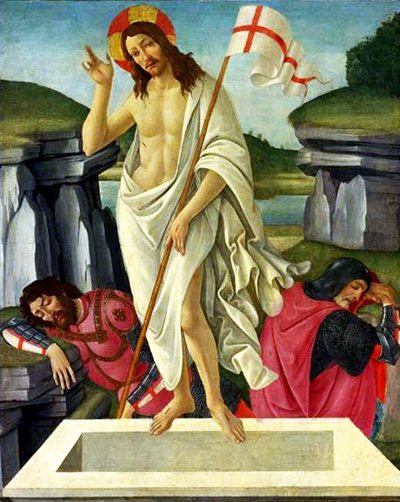
Christ stands on the near rim of an open stone tomb, one bare foot balanced ahead of the other. A white cloth loops over his shoulders and around his body, leaving his chest visible. His right hand rises in blessing; his left holds a tall staff with a white banner marked by a red cross. Below him, one armoured guard slumps against the tomb and another twists away with a hand to his face. The still figure above and the disoriented figures below make the event legible before the viewer has read a title. This Resurrection was catalogued by Sotheby's in 2011 as Sandro Botticelli and Studio, a qualified attribution that has been debated.[1][2]
The painting once belonged to a larger sequence of Christ's Passion. It is a companion to a Flagellation in the Uffizi and a divided Way to Calvary scene, whose Christ-bearing-cross portion was offered immediately before this Resurrection in the same sale. These scenes are linked by subject, scale and historical scholarship. The Resurrection is not a detached fragment of the road painting: it is a separate picture with its own composition and its own conservation history.[1][2][3]
At a glance
- TitleThe Resurrection
- AttributionBotticelli and Studio in Sotheby's 2011 catalogue; studio of Botticelli in several earlier cited assessments
- DateA late Botticelli workshop context is supported by the related Uffizi scenes; the exact date of this separately held panel is unverified
- MediumTempera on wood panel, later transferred to canvas
- Dimensions52 × 41⅞ inches, about 132.1 × 106.4 cm, in the 2011 catalogue
- Documented locationBeaverbrook Art Gallery loan, Fredericton, 1963–2010; offered at Sotheby's in 2011. Present owner and location unverified.[1][2][3]
This work in Botticelli’s career
Fortitude
1470The Resurrection
late workshop periodPrimavera
c. 1480Birth of Venus
c. 1485Mystic Nativity
1500Contents
- At a Glance
- Above an Open Tomb
- Gospel Account and Painted Moment
- A Separate Scene Within a Passion Group
- The Attribution and What Lies Beneath the Paint
- From the Beaverbrook Loan to the 2011 Offering
Above an Open Tomb
The foreground is dominated by the sarcophagus's bright rectangular opening. Its pale rim forms a sharp, almost architectural frame around a dark inner space. Christ's two feet meet that rim near the middle, so that the body rising above seems poised between enclosure and open air. The enclosing stone does not fill the painting's height; the figure and banner do. The visual movement runs from the guarded chamber at the bottom to Christ's lifted hand and the fluttering flag above.[1]
Christ's body is slender and upright. The white drapery falls in broad, angular folds and sweeps toward the right guard. A red-and-yellow halo frames his head, whose face tilts gently toward the viewer. His raised hand is a blessing gesture, whereas the other keeps the staff vertical. The banner's red cross is the boldest graphic mark in the sky. It declares victory in a way the exposed wounds and burial cloth alone would not. Such a cross banner is a familiar Christian visual symbol, but it is part of this painted interpretation rather than a detail named in the Gospel's empty-tomb account.[1][4]
The guards provide contrasting responses. On the left, a man in patterned red armour has fallen heavily beside the tomb, head lowered on his arm. On the right, a second guard turns his back partly toward Christ and leans away; his red cloak and dark helmet make a sharp block of colour against stone and greenery. Both are dwarfed by the central figure and the wide banner. Their poses are not orderly witnesses' postures. They emphasise bewilderment below while Christ stands calmly above them.[1]
The background is spare but carefully divided. Dark rocks rise on both sides, framing a low view through the middle toward water and distant land. The opening supplies depth beyond the stone enclosure. It also lets the figure stand against sky rather than a continuous wall. The rocks repeat the vertical weight of the tomb, while the pale distance gives relief to the concentrated action in front. The painting makes the sacred moment close to the viewer, not a small incident in an extensive landscape.[1]
Gospel Account and Painted Moment
Matthew 28 describes women coming to the tomb after the Sabbath, an angel rolling back the stone, and guards shaken with fear. The angel announces that Jesus has been raised. The Gospel does not describe people watching Christ step out of the tomb at the instant of resurrection. The two guards in this painting draw on Matthew's frightened watchers, but the central upright Christ, his blessing and his cross banner make visible a moment that the text leaves unnarrated.[4]
There are no women or angel in this composition. Their absence narrows the scene to a contrast between the risen Christ and the human watch placed around the tomb. A viewer can read the guards' bodies as proof of a dramatic event, but their precise gestures belong to the painter's arrangement. The red cross on the banner, white cloth and pale tomb also work through colour and repeated shapes. These visual devices help communicate victory and surprise without becoming separate historical claims about who saw what.[1][4]
A Separate Scene Within a Passion Group
Sotheby's 2011 catalogue connected this picture with three other surviving Passion parts. The Uffizi holds a Flagellation (inventory 5876) and Way to Calvary (5877). The latter is the left half of a larger road scene; the matching right half, Christ Carrying the Cross, was Sotheby's lot 103. The rope and the Virgin's dark drapery run across those two road fragments, giving that split a specific physical basis. By contrast, the Resurrection relates to them as a later episode of the same narrative series, not as a cut edge that rejoins the same painting.[1][2][3]
The 2022 Uffizi/Minneapolis catalogue calls the Florentine scenes workshop of Botticelli and dates them to about 1505–10. It mentions the Resurrection as a third canvas in the series. Sotheby's imagined a symmetrical arrangement: a central, originally double-width road scene flanked by the Flagellation and Resurrection. It also suggested a confraternity meeting room as a possible original setting. These proposals explain the pictures' scale and subject matter, but no contract or original display record supplied by these sources proves a patron, room or final arrangement. The 2022 dating of the Uffizi scenes gives a context; it is not an individually documented date on this panel.[1][2][3]
That distinction matters to the experience of the painting. Viewed alone, it presents a complete, tightly framed triumph above the tomb. Viewed with its related Passion scenes, it becomes the final movement in a story of scourging, forced journey and death. Neither mode requires pretending that the surviving pieces can be installed exactly as they were first seen. The modern group is reconstructed from objects that were separated and altered during their later lives.[1][2][3]
The Attribution and What Lies Beneath the Paint
Sotheby's labelled this lot “Botticelli and Studio.” Its own literature list records that Federico Zeri in 1985, a 2001 Uffizi exhibition and Alessandro Cecchi in 2005 had described the picture as studio work. A workshop could follow a master's designs without every painted passage being by his hand. The 2022 exhibition catalogue's workshop classification of the Uffizi companions is consistent with caution about the series, though it does not by itself settle who painted this separately offered Resurrection.[1][2][3]
The 2011 catalogue used infrared findings to argue for more direct involvement by Botticelli. It described a freer underdrawing in the rising Christ than in the road scene, changes to the positions of his arms, and adjustments to a soldier's armour. One arm holding the banner was drawn across preliminary indications of a sleeve; another was painted over a rocky outcrop. Such changes show an active working process rather than mechanical completion of a fixed design. They do not identify every painter who made those changes. The attribution remains a scholarly judgement, not a signature recovered beneath the surface.[2]
The physical support carries another kind of evidence. Sotheby's listed tempera on panel transferred to canvas. An independent condition report published with the 2011 lot said the original panel comprised three wooden sections, with vertical joins passing through the bridge of Christ's nose and through the flag. The later transfer canvas has a horizontal join through the level of his thighs. The same report noted restoration and larger paint losses in the sky between Christ's head and the banner, and on the right below the cliffs. These are observations reported in 2011, not a claim about how the painting looks after any later treatment.[1]
Transfer and retouching mean that the picture seen today is not an untouched panel. Its design remains vivid: the diagonal drapery, unsteady guards and bright banner are all readable. But the painted surface has a history that qualifies close claims about particular damaged passages. The two different supports should not be collapsed into “tempera on canvas,” as if the artist had originally stretched fabric to paint this scene.[1]
From the Beaverbrook Loan to the 2011 Offering
Sotheby's provenance starts in the art trade: Luigi Albrighi had the picture in Florence in 1959, and it passed through London's David Carritt Ltd around 1960. Max Aitken, 1st Lord Beaverbrook, bought it in 1963. His family retained it through the point at which the auction house prepared its 2011 catalogue. Throughout most of that interval, 1963–2010, the panel was lent to the Beaverbrook Art Gallery, Fredericton. The gallery was a long-term exhibition venue in this record; Sotheby's did not name it as the owner.[1]
The picture was offered as lot 104 on 27 January 2011. The public Sotheby's page says the result requires login, so the accessible record does not establish whether it sold or who held it afterward. A 2022 Uffizi/Minneapolis catalogue nevertheless described the Resurrection as “also at Fredericton.” That could refer to a later return or preserve an older location description. Without a direct current holding record, the conflicting statements cannot be resolved responsibly. Its present owner and physical location remain unverified.[1][3]
Christ's balanced foot, open tomb, blessing and banner give the image its confident centre. The slumped guards and dark enclosing rocks make that confidence more forceful. The picture can be read closely on its own while keeping its limits clear: a workshop-era Passion painting with a contested share of Botticelli's hand, a later transferred support, a documented former museum loan and an unconfirmed present address.[1][2][3][4]
Botticelli and related artworks
Discussion
Which detail changes how you read The Resurrection?
Reader Insights
How does Christ stand above the open tomb?
What connects the panel to the other Passion scene?
How do the sale and catalogue records describe its attribution?
Join the Conversation
Share a source-led observation or question below.
References
- Sotheby's, The Resurrection, lot 104, Important Old Master Paintings & Sculpture, New York, 27 January 2011; description, provenance and condition report; accessed 1 October 2026 View source.
- Sotheby's, Christ Carrying the Cross, lot 103, catalogue note on the four-part Passion group and infrared findings for both sale lots; accessed 1 October 2026 View source.
- Annamaria Bernacchioni, “The Flagellation” and “Way to Calvary,” nos. 15–16, pp. 104–05 in Botticelli and Renaissance Florence: Masterworks from the Uffizi, Minneapolis Institute of Art and Gallerie degli Uffizi, 2022 View source.
- United States Conference of Catholic Bishops, Matthew 28:1–10, empty tomb and frightened guards; accessed 1 October 2026 View source.